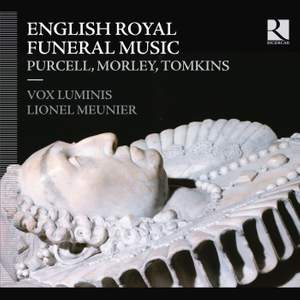
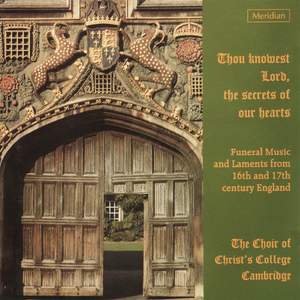
All recordingsPrices shown exclude VAT. (UK tax is not payable for deliveries to United States.) See Terms & Conditions for p&p rates. | |  | English Royal Funeral Music
Morley: | I am the resurrection and the life I know that my Redeemer liveth We brought nothing into this world Man that is born of a woman In the midst of life I heard a voice from heaven | Paisible: | The Queen’s Farewell | Purcell: | Hear my prayer, O Lord, Z15 Music for the Funeral of Queen Mary, 1695: March Thou know'st, Lord, Z 58b Canzona O dive custos Auriacae domus, Z504 Man that is born of a woman, Z27 In the midst of life, Z 17a Thou know'st, Lord, Z 58c Remember not, O Lord, our offences, Z50 | Tomkins: | A sad Pavan for these distracted times I am the resurrection and the life I know that my Redeemer liveth We brought nothing into this world I heard a voice from heaven | Weelkes: | Death hath deprived me |
Les Trompettes des Plaisirs, Lingua Franca & Vox Luminis, Lionel Meunier Much anticipated new release from the Gramophone Record of the Year winning Vox Luminis! We know now that Purcell’s three Funeral Sentences were not written for the funeral of Queen Mary in 1695. Following the tradition of the English court, it was pieces by Thomas Morley, originally written for the funeral of Elizabeth I, that were sung there. Purcell’s only contribution to the ceremony was the composition of two pieces for slide trumpets (March and Canzona), and the anthem in the archaic style Thou knowest, Lord. During the funeral procession to Westminster Abbey, a band of oboes played two marches written by John Paisible and Thomas Tollet. This recording assembles the music composed for the funeral of Queen Mary and that used at the funeral of Elizabeth I in 1603. The programme is completed by Purcell’s sublime a cappella anthems and a moving anthem by Weelkes on the death of Thomas Morley. After the success of the recording of Schütz’s Musicalische Exequien (RIC311), voted Record of the Year by Gramophone magazine, this disc will be one of the major events of spring 2013. “one might call it a classically 'English' choral sound - but any suspicions of coolness are easily dispelled by the commitment shown to the meaning of both music and text...Once again, Vox Luminis have touched the heart with their calm interpretative intelligence and vocal beauty.” Gramophone Magazine, June 2013 | 
| | | In stock - usually despatched within 1 working day. |
|
|
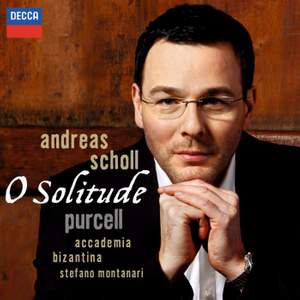
| |  | Andreas Scholl: Purcell - O Solitude
Purcell: | If music be the food of love, Z379 Sound the trumpet, beat the drum, Z335 with Christophe Dumaux (countertenor) Strike the Viol (from Come Ye Sons of Art, Z323) Fairest Isle (from King Arthur) Chacony, Z628 What power art thou? (from King Arthur, Z628) Chacony in G minor - for Two Violins, Viola and Bass Z730 One charming night (from The Fairy Queen, Z629) Sweeter than Roses (from Pausanius, the Betrayer of his Country, Z585) [Pausanius, the Betrayer of his Country. (1695), Z585 original version] An Evening Hymn 'Now that the sun hath veiled his light', Z193 Pavan for Three Violins and Bass in G minor - Z752 O solitude, my sweetest choice, Z406 O dive custos Auriacae domus, Z504 with Christophe Dumaux (countertenor) Music for a while, Z583 Here the deities approve, Z339 original version The Gordion Knot Untied - incidental music, Z597 When I am laid in earth (from Dido and Aeneas) |
The greatest countertenor of today, Andreas Scholl returns to the Decca label with a recording of vocal jewels by the great baroque composer, Henry Purcell. This is Andreas Scholl's first ever recording of the music of Purcell and his uniquely beautiful voice is perfectly suited to the English composer's plangent melodies. The album includes pieces written for the stage, the church and the private chamber, some of which Andreas Scholl has sung in recital for many years, and some he sings for the first time. Andreas Scholl's long-standing collaborators, ‘Accademia Bizantina’ bring out the Italian influence in Purcell's instrumental writing, and contribute orchestral items to the programme. 'O Solitude' is Andreas Scholl's first Decca album since the chart-topping ‘Handel: Arias For Senesino' in 2006. The album includes the well known lament 'When I Am Laid In Earth' - recently voted the UK's No.1 favourite aria in a BBC Radio 3 poll - written for the character of Dido in Purcell's opera, Dido and Aeneas. Andreas Scholl is joined for two duets by French countertenor Christophe Dumaux. “Ethereal yet visceral, Scholl's voice is the dream vehicle for Purcell...Stefano Montanari coaxes thrilling playing from Accademia Bizantina, who dance and swagger, throb and pulsate with true Latin passion. Their continuo realisations - here delicate and intimate, there audaciously jazzy - are an unceasing delight.” BBC Music Magazine, January 2011 ***** “that famously otherworldly tone [is] often breathtakingly in evidence...His decision to tackle Dido's lament has generated controversy: in fact, his performance is extraordinarily haunting...O Dive Custos is arguably the disc's high point. The Academia Bizantina, meanwhile, are on fine form for Stefano Montanari” The Guardian, 13th January 2011 **** “Scholl understands the importance of words and remains the countertenor of choice: it’s not so much the intelligence and grace that make his artistry so instantly recognisable, as the hypnotically soothing quality of his voice...Among the many joys of this exceptional recital are the accompaniments by Accademia Bizantina.” Financial Times, 21st January 2011 ***** “Few counter-tenors maintain the width of repertoire or vocal acumen of this artist...his Cold Song from “King Arthur” [is] a shivering, juddering triumph, and the entire package pleases.” The Times, 22nd January 2011 **** “his way with words has strengthened...the two countertenors combine marvellously in O dive custos” Gramophone Magazine, March 2011 “There's no doubt about the theatrical intent driving Scholl's interpretations and the flamboyant work of Italian period instrument band, Accademia Bizantina. The latter's lively continuo group and multi-hued sounds certainly catch the full flavour...few singers...can match him for style and intelligent musicianship in this repertoire.” Classic FM Magazine, March 2011 **** “[The disc] contains much in the way of sympathetic vocal and instrumental colouring, not to mention some very fine singing and playing, full-stop...Stefano Montanari's stylish violin-playing [in Fairest Isle], as elsewhere, is a treat in itself...Scholl [brings] an animated, urgent quality to his performance, the tone rich and resonant, the diction razor-sharp.” International Record Review, April 2011 | | | In stock - usually despatched within 1 working day. |
|
|
| |  | Purcell - Songs of Welcome and Farewell
Purcell: | Welcome, vicegerent of the mighty king, Z340 O dive custos Auriacae domus, Z504 Welcome to all the pleasures (from Ode for St Cecilia's Day 1683), Z339 O let me ever, ever weep (from The Fairy Queen, Z629) Incassum Lesbia, incassum rogas ('The Queen's Epicedium'), Z383 Young Thirsis' fate, Z473 Why, why are all the Muses mute?, Z343 |
“Splendidly characterful voices. Excellent.” BBC Music Magazine, June 2010 | | | In stock - usually despatched within 1 working day. |
|
|
| |  | Purcell & Macmillan - Bright Orb of Harmony
MacMillan: | O bone Jesu A Child's Prayer The Strathclyde Motets: Mitte manum tuam The Strathclyde Motets: Sedebit Dominus Rex | Purcell: | Miserere mei (canon 4 in 2), Z109 Music for the Funeral of Queen Mary, 1695: Funeral Sentences (first set) Jehova, quam multi sunt hostes mei, Z135 Remember not, O Lord, our offences, Z50 Beati omnes qui timent Dominum, Z131 Let mine eyes run down with tears, Z24 O dive custos Auriacae domus, Z504 Thou knowest, Lord |
2009 is a year of anniversaries - the three hundred and fiftieth anniversary of Henry Purcell’s birth (1659), James MacMillan’s fiftieth birthday (16 July 2009) and The Sixteen’s thirtieth anniversary. To celebrate, the ensemble has recorded live a brand new disc of music dedicated to these most innovative of British composers. Purcell’s extraordinary use of harmony sounds as modern today as it must have sounded in the seventeenth century. Putting his heartfelt Funeral Sentences alongside James MacMillan’s powerfully emotive A Child’s Prayer, written in memory of the Dunblane Tragedy, and his hauntingly beautiful O bone Jesu (a piece originally commissioned by The Sixteen) will give the listener the chance to experience the true power of this music. “Throughout, the choral sound is rich yet unfailingly transparent… the solo work is equally impressive - listen for example, to tenors Simon Berridge and Mark Dobell and bass Eamonn Dougan in Purcell's Let mine eyes run down with tears or sopranos Grace Davidson and Charlotte Mobbs in the same composer's splendid O dive custos. ..."Bright Orb of Harmony" deserves to be set among that constellation of previous dazzling recordings by an ensemble that is less a choir, more an institution.” Gramophone Magazine, June 2009 “Purity of voice, a tightly blended ensemble — the warming characteristics of Harry Christophers’s choir dominate this live recital, recorded in Guildford Cathedral. Four hundred years separate Purcell from James MacMillan, yet these composers suit each other, both skilled in penitential expression and harmonic daring. MacMillan commemorates the 1996 Dunblane shootings; the teenage Purcell writes Funeral Sentences — exquisite music in both cases.” The Times, 9th May 2009 **** “Purcell's funeral and penitential liturgical settings contain some of the most heart-rending music in the choral repertory. MacMillan's tribute to his 16th century fellow-Scot O bone Jesu… holds up well, building to a glowing ending which, like all the MacMillan pieces on this disc, shows how deeply this composer understands the expressive and acoustic possibilities of the a cappella choir. Best of all though is the exquisite miniature A Child's Prayer. Excellent performances, sensitively recorded.” BBC Music Magazine, July 2009 ***** “These performances were recorded live during the opening concert of The Sixteen's 2009 Choral Pilgrimage to celebrate both Purcell's 350th birthday and Scottish composer James MacMillan's 50th. Thus, while the anthems, motets and the first set of Funeral Sentences by Purcell presented here definitely tend towards the sombre, and MacMillan's musical language often has recourse to a stark muscularity, the darkness invariably gives way to light in the form of ecstatic melismas and lucent major-mode harmonies. Throughout, the choral sound is rich yet unfailingly transparent – as obvious in the opening Jehova quam multi sunt hostes mei of Purcell as in MacMillan's masterly O bone Jesu. But the solo work is equally impressive – listen, for example, to tenors Simon Berridge and Mark Dobell and bass Eamonn Dougan in Purcell's Let mine eyes run down with tears or sopranos Grace Davidson and Charlotte Mobbs in the same composer's splendid O dive custos. Christophers's direction is, as always, forever alert to the relationship between words and music – especially close with these two composers – while ensuring the careful delineation of the overall musical structure and each phrase, period and paragraph within it. Some minor blemishes aside, 'Bright Orb of Harmony' deserves to be set among that constellation of previous dazzling recordings by an ensemble that is less a choir, more an institution.” Gramophone Classical Music Guide, 2010 “Christophers paces [Tradiderunt me] to perfection, enabling The Sixteen to luxuriate in its rich sonorities and shape effortless phrases, each apparently voiced on a single undying breath...This terrific release offers a nourishing blend of recent Macmillan, beautifully performed and recorded, spanning the gamut from prayer-like introspection and harmonic simplicity to festive outbursts and bravura melodic displays.” Classic FM Magazine, December 2011 ***** | | | In stock - usually despatched within 1 working day. |
|
|
| |  | Purcell - Sacred Music
Purcell: | Blow up the trumpet in Sion, Z10 The Lord is king, be the people never so impatient, Z53 Lord, what is man?, Z192 Let mine eyes run down with tears, Z24 Jehova, quam multi sunt hostes mei, Z135 O dive custos Auriacae domus, Z504 Beati omnes qui timent Dominum, Z131 Out of the deep have I called, Z45 An Evening Hymn 'Now that the sun hath veiled his light', Z193 |
| | | In stock - usually despatched within 1 working day. |
|
|
| |  | The Art of the ChoristerAn anthology of music for treble voices, spanning several centuries and a wide range of traditions.
The English ‘cathedral’ tradition is defined by the sound and musicianship of choristers: in New College’s case boys aged between 9 and 13. In the space of four years, these children become remarkably proficient musicians. Indeed, we might be forgiven for thinking of them solely as musicians, such is their achievement. But they are both children and musicians. And this recording celebrates their musical and vocal prowess in a ‘snapshot’ year. A mixture of solo and ensemble items surveys a wide repertory from Tallis to Jehan Alain. This recording has a fascinating documentary value, but is much more than that: it is an anthology of wonderful choral works whose musical presentation is given even greater depth by the very special qualities of boys’ voices. | | | (also available to download from $10.75) | Usually despatched in 2 - 3 working days. (Available now to download.) |
|
|
| |  | Baroque Voices 29 - Amour & MascaradePurcell & Italy
anon.: | The furies masque The Fairey Masque Cupararee or Graysin The Ladies Masque The Goates masque The second Witches dance | Frescobaldi: | Canzon terza Canzona quinta Canzon prima (1628) Canzon sesta, from In partitura, il promo libro delle canzoni, 1628 | Mancini, F: | Quanto dolce è quell’ardore Largo Recitatif Allegro | Purcell: | Bid the virtues (from Come ye Sons of Art, Z323) O dive custos Auriacae domus, Z504 Plainte - O, Let Me Weep (from The Fairy Queen, Z629) Sound the trumpet, beat the drum, Z335 |
A new and fresh light on pieces by Henry Purcell, interspersed with music by Frescobaldi, Mancini, and several anonymous composers. | | | (also available to download from $10.75) | Usually despatched in 3 - 4 working days. (Available now to download.) |
|
|
| |  | Love's Goddess Sure was Blind
| | | Usually despatched in 2 - 3 working days. |
|
|
| |  | Purcell - Sacred Music
Purcell: | Blow up the trumpet in Sion, Z10 The Lord is king, be the people never so impatient, Z53 Lord, what is man?, Z192 Let mine eyes run down with tears, Z24 Jehova, quam multi sunt hostes mei, Z135 O dive custos Auriacae domus, Z504 Beati omnes qui timent Dominum, Z131 Out of the deep have I called, Z45 An Evening Hymn 'Now that the sun hath veiled his light', Z193 |
| | | Usually despatched in 8 - 10 working days. |
|
|
| |  | Counter-tenor Duets and SongPurcell and his contemporaries
Blow: | Ah, Heav'n! What is't I hear? Quam diligo legem tuam Paratum cor meum | Humfrey: | A hymne to God the Father | Purcell: | Sound the trumpet, beat the drum, Z335 If music be the food of love, Z379 Music for a while, Z583 In vain the am'rous flute (from Hail, Bright Cecilia!, Z328) Here the deities approve, Z339 O dive custos Auriacae domus, Z504 One charming night (from The Fairy Queen, Z629) No, resistance is but vain (from The Maid's Last Prayer or Any Rather Than Fail, Z601) I see she flies me ev'rywhere (from Aureng-Zebe or The Great Mogul, Z573) Since from my dear Astrea's sight (from Prophetess or The History of Dioclesian, Z627) An Evening Hymn 'Now that the sun hath veiled his light', Z193 | Purcell, D: | O ravishing delight |
Ryland Angel (counter-tenor), Mark Chambers (counter-tenor), Laurence Cummings (h'chord, organ), Taro Takeuchi (lute, theorbo, baroque guitar), Reiko Ichise (bass viol), Becky Davies & Laura Hird (recorder), Rodolfo Richter and Claire Duff (violin) and Emma Alter (viola) "A welcome airing, delightfully performed, of the surprisingly low-profile Purcell" - Gramophone | | | Usually despatched in 4 - 5 working days. |
|
|
| |
|