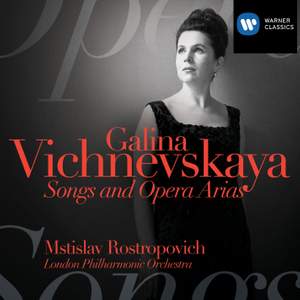
All recordingsPrices shown exclude VAT. (UK tax is not payable for deliveries to United States.) See Terms & Conditions for p&p rates. | |  | Galina Vishnevskaya sings Russian Songs
Mussorgsky: | Songs and Dances of Death | Prokofiev: | Five Poems of Anna Akhmatova, Op. 27 | Tchaikovsky: | None but the lonely heart, Op. 6 No. 6 Ni slova, o drug moy (Not a word, O my friend), Op. 6 No. 2 Do not believe, my friend Op. 6 No. 1 Otchevo? (Why?), Op. 6 No. 5 Why did I dream of you?, Op. 28 No. 3 Sred' shumnogo bala (Amid the din of the ball), Op. 38 No. 3 Na nivi zhyoltiye (On the golden cornfields), Op. 57 No.2 O ditya, pod okoshkom tvoim (Serenade), Op. 63 No. 6 Merknet slaby svet svechi, Op. 73 No. 2 |
As one of the leading interpreters of Russian music, and Benjamin Britten’s soprano of choice for some of his works, including the mighty War Requiem, it may come as a surprise to some that Galina Vishnevskaya began her professional career in 1944, singing, of all things, Viennese operettas (in Russian translation!) in the chorus of a travelling company. When the company’s leading soubrette broke her leg, Vishnevskaya graduated to lead roles, but her destiny lay elsewhere. As a girl, she had been fascinated with Tchaikovsky’s Eugene Onegin, and it was in the role of Tatiana that she made her operatic debut, in 1953, at the Bolshoi Theatre. Other roles followed, including Leonore in Fidelio (1954), Cherubino (!) in Le nozze di Figaro (1957), Madama Butterfly (1957) and Aida (1958). It was in the latter role that she made her Metropolitan Opera debut in 1962, and she added Liù (from Puccini’s Turandot) for her La Scala debut in 1964. Western critics were agog over this force of nature who had come, if not from out of nowhere, then at least from behind the Iron Curtain. They spoke of her in the same breath as Maria Callas, Renata Tebaldi, Birgit Nilsson and other giants of the era. In 1955, she married Russian cellist Mstislav Rostropovich, and together, they braved the Cold War tensions that continued to chill life in the Soviet Union. Rostropovich was, of course, a highly gifted pianist as well and accompanied his wife in recital on the stage and in the recording studio. In 1961, under the supervision of Mercury Living Presence’s executive producer Wilma Cozart-Fine, they recorded material for soprano and piano key to Vishnevskaya’s life and career. Mussorgsky’s Songs and Dances of Death she called ‘one of the most important projects of [her] career’ and wrote that the performances of this song-cycle made her feel, ‘for the first time, [her] ethnic identity as a Russian singer’. In addition to three Tchaikovsky songs recorded at these sessions, a further six were added to her discography seven years later, for Decca, these receiving their first release on CD. “Intensity is the keynote of these performances. Mme. Vishnevskaya has a rich dramatic voice of characteristically Slavonic timbre, highly charged emotionally … she is invaluably aided by accompaniments of infinite sensibility by her husband” Gramophone Magazine (Mussorgsky, Prokofiev, Tchaikovsky: 1961 recordings) “The engineers deserve special praise for the spacious recording they have given to the singer’s large voice in this first-rate recording. … I have only room to praise with equal warmth the beautifully sung and played group of Tchaikovsky’s lovely songs – still so neglected. Here Vishnevskaya has most grateful vocal lines and pours forth her voice gloriously” Gramophone Magazine (Tchaikovsky: 1968 recordings) | | | In stock - usually despatched within 1 working day. |
|
|
| |  | Elisabeth Söderström: The Russian Songbook
Grechaninov: | The Lane – Five Children’s Songs, Op. 89 | Mussorgsky: | The Nursery | Prokofiev: | The Ugly Duckling, Op. 18 | Tchaikovsky: | The Cuckoo, Op. 54 No. 8 Evening, Op. 27, No. 4 The Nightingale Op. 60 No. 4 Last Night Op. 60 No. 1 None but the lonely heart, Op. 6 No. 6 Lullaby, Op. 16 No. 1 Otchevo? (Why?), Op. 6 No. 5 Strashnaya minuta (The Fearful Moment), Op. 28 No. 6 Den' li tsarit? (Does the day reign?), Op. 47 No. 6 Spring, Op 54 No. 9 Simple Words, Op. 60, No. 5 Mezza notte Sérénade, Op. 65 No. 1 Déception, Op. 65 No. 2 Qu'importe que l'hiver, Op. 65 No. 4 Les Larmes, Op. 65 No. 5 Zakatilos solntse (The sun has set), Op. 73 No. 4 Kak nad goratcheïou zoloï, Op. 25 No. 2 Moy geni, moy angel, moy drug (My genius, my angel, my friend) Pesn' Zemfiri (Zemfira's song) Do not believe, my friend Op. 6 No. 1 Zabït tak skoro (So soon forgotten) Oh! Chante Encore!, Op.16 No.4 Spirit my heart away Why did I dream of you?, Op. 28 No. 3 To bilo ranneyu vesnoy (It happened in the early spring), Op. 38 No. 2 Sred' shumnogo bala (Amid the din of the ball), Op. 38 No. 3 If only I had known, Op.47, No.1 Was I not a blade of grass?, Op. 47 No. 7 My little garden, Op. 54 No. 4 Do not ask, Op. 57 No. 3 This, our first reunion, Op. 63 No. 4 O ditya, pod okoshkom tvoim (Serenade), Op. 63 No. 6 Rondel, Op. 65 No. 6 We sat with you, Op. 73 No. 1 Behind the window, Op 60 No. 10 |
Elisabeth Söderström was a born storyteller. She told stories not just in music, but also peppered her recitals on stage with tales and anecdotes. It made her a perfect interpreter for the collection of children’s songs by Mussorgsky, Prokofiev and Gretchaninov she recorded with Vladimir Ashkenazy in 1977–78 which appear on CD2 of this set, the first (LP) issue greeted with enthusiasm by Gramophone reviewer W.S.M. with the words ‘the best record of song to appear in 1979’. It later went on to win the 1979 Gramophone’s Solo Vocal Award. But there was more: a selection of Tchaikovsky songs over two LPs; a substantial survey of the Rachmaninov songs (‘one of the gramophone’s crown jewels’ wrote John Steane in Gramophone) as well as the complete Sibelius songs. Born in Stockholm on 7 May 1927 to a Russian mother and Swedish father, Söderström she was a talented recitalist, as much in demand in the concert hall as she was in the opera theatre. From 1991–96 she also directed the Drottingholm Festival Opera with much success. The two LPs of Tchaikovsky songs were issued in part by Decca on CD and this is their first complete release in this format. Overshadowed by his orchestral works, they are nonetheless absolute gems, with their piano parts of almost orchestral scope. Ashkenazy’s is, too, the disembodied voice that speaks a few of Pushkin’s lines in the early setting of Zemfira's song. ‘Söderström came to be known internationally in the late 1950s,’ wrote John Steane, ‘and over the next three decades, on until her retirement from singing in the early 1990s she never “blotted her copybook”. She neither sought nor won cheap success.’ Söderström passed away in Stockholm on 20 November 2009, aged 82, from complications from a stroke. This release marks the launch of an Eloquence series of notable recitals of songs and opera arias by some of the great voices of Decca and Deutsche Grammophon. “The Maikov Lullaby is enchantingly done, especially with the gentle wash of piano tone in the background from Ashkenazy … a delightful, excellently recorded recital of some songs which we know too little … Tchaikovsky wrote some exquisite songs; and it is splendid to have them being explored so skilfully, intelligently and sensitively” Gramophone Magazine (Tchaikovsky Songs) “brilliant … endearing … musicianly” Gramophone Magazine (Songs for Children) | | | In stock - usually despatched within 1 working day. |
|
|
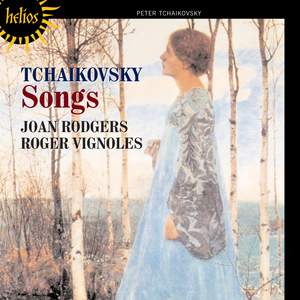
| |  | Tchaikovsky - Songs
Tchaikovsky: | Last Night Op. 60 No. 1 Zabït tak skoro (So soon forgotten) The Nightingale Op. 60 No. 4 To bilo ranneyu vesnoy (It happened in the early spring), Op. 38 No. 2 Sred' shumnogo bala (Amid the din of the ball), Op. 38 No. 3 Strashnaya minuta (The Fearful Moment), Op. 28 No. 6 Do not believe, my friend Op. 6 No. 1 The Cuckoo, Op. 54 No. 8 Lullaby, Op. 16 No. 1 Behind the window, Op 60 No. 10 O ditya, pod okoshkom tvoim (Serenade), Op. 63 No. 6 The Canary, Op. 25 No. 4 Ni slova, o drug moy (Not a word, O my friend), Op. 6 No. 2 Lullaby in a storm, Op. 54 No. 10 Spring, Op 54 No. 9 Why did I dream of you?, Op. 28 No. 3 None but the lonely heart, Op. 6 No. 6 Den' li tsarit? (Does the day reign?), Op. 47 No. 6 If only I had known, Op.47, No.1 Otchevo? (Why?), Op. 6 No. 5 |
‘I find this British singer’s identification with Tchaikovsky almost uncanny. Having heard countless performances … in my native Russia, I was totally overcome by Rodgers’ unaffectedness and sincerity … her intonation is faultless, her Russian excellent. A rare treat indeed’ (Vladimir Ashkenazy) “A lovely record” Sunday Times | | | In stock - usually despatched within 1 working day. |
|
|
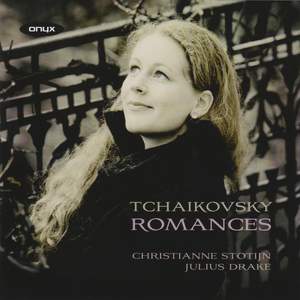
| |  | Tchaikovsky - Romances
Tchaikovsky: | Sred' shumnogo bala (Amid the din of the ball), Op. 38 No. 3 None but the lonely heart, Op. 6 No. 6 I never spoke to her, Op. 25, No. 5 Moy geni, moy angel, moy drug (My genius, my angel, my friend) Lullaby, Op. 16 No. 1 Primiren'ye (Reconciliation), Op. 25 No. 1 Zakatilos solntse (The sun has set), Op. 73 No. 4 Strashnaya minuta (The Fearful Moment), Op. 28 No. 6 The mild stars shone for us, Op. 60 No. 12 If only I had known, Op.47, No.1 The lights were being dimmed, Op. 63, No. 5 Ni slova, o drug moy (Not a word, O my friend), Op. 6 No. 2 Otchevo? (Why?), Op. 6 No. 5 Was I not a blade of grass?, Op. 47 No. 7 The gypsy song, Op. 60, No. 7 Do not believe, my friend Op. 6 No. 1 To bilo ranneyu vesnoy (It happened in the early spring), Op. 38 No. 2 The Cuckoo, Op. 54 No. 8 Den' li tsarit? (Does the day reign?), Op. 47 No. 6 Solitude ('Again, as before, alone'), Op. 73 No. 6 |
Third release on ONYX from young Dutch mezzo and rising star Christianne Stotijn Beautiful collection of 20 Tchaikovsky songs representing the whole range of his creative life from his first performed composition “My Genius, My angel, my friend,” written when we was 16, through to the last published song from the year of his death “Again, as before, alone”. Includes favourites such as “None but the Lonely Heart” and “Why?” but also rarely heard songs such as “Mild Stars Looked down”, “The Cuckoo” and “The Gypsy Song” Christianne learnt Russian especially for this recording and toured it widely before recording it with her superb pianist Julius Drake. This recording should do much to re-evaluate Tchaikovsky as one of the greatest composers of song and not just a writer of pretty tunes. “The two best-known songs open proceedings: "At the Ball", with its reminiscence of unrequited passion to the lilt of a sad waltz, and then "None but the lonely heart". Everyone conceivable from Rosa Ponselle to Frank Sinatra has recorded this, but Stotijn loses nothing in comparison with ghosts from the past. Her voice is a full-blooded mezzo but steady and true, without a hint of that vibrato that can often disturb the line in Slavonic singers... The piano parts are superbly done: in every sense these songs are duets. Tchaikovsky's songs are not nearly well enough known and this superb recital should encourage more interest in them.” Gramophone Magazine, March 2009 “…Christianne Stotijn is that artist in a thousand whose personality shines through everything she does. Her Russian characterisations and folk inflections seem spot-on in the vivid narratives of 'Had I known', 'The Bride's Lament' and 'The Cuckoo'. Here, too, as in their often wonderful Mahler recital together, Julius Drake's focused narratives make us want to hear even more from him... But Stotijn's charisma and her beautifully recorded altoish depth of tone is enough to hold me spellbound.” BBC Music Magazine, March 2009 ***** “For the most part these are angst-ridden stories of death and lost love. The two best-known songs open proceedings: 'At the Ball', with its reminiscence of unrequited passion to the lilt of a sad waltz, and then 'None but the lonely heart'. Everyone conceivable from Rosa Ponselle to Frank Sinatra has recorded this, but Stotijn loses nothing in comparison with ghosts from the past. Her voice is a full-blooded mezzo but steady and true, without a hint of that vibrato that can often disturb the line in Slavonic singers (Stotijn is from The Netherlands). The emotional climax of the selection comes with 'The Bride's Lament'. This outpouring of grief can seem over melodramatic but Stotijn and Drake find exactly the right mood. The piano parts are superbly done: in every sense these songs are duets. There are a couple of other light moments – 'Cuckoo', one of 16 children's songs composed in the 1880s, and a 'Gypsy Song' from around the same time. Tchaikovsky's songs are not nearly well enough known and this superb recital should encourage more interest in them. Highly recommended.” Gramophone Classical Music Guide, 2010 | | | In stock - usually despatched within 1 working day. |
|
|
| |
|