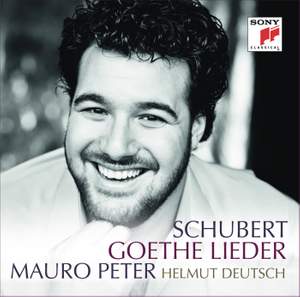
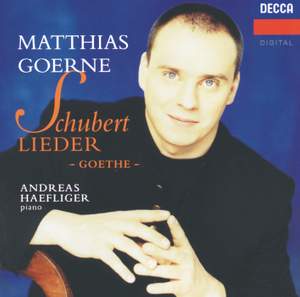
All recordingsPrices shown exclude VAT. (UK tax is not payable for deliveries to United States.) See Terms & Conditions for p&p rates. | |  | Schubert: Goethe Songs
Schubert: | Am Flusse D160 (Goethe) Schäfers Klagelied, D121 (Goethe) Meeres Stille, D216, Op. 3 No. 2 (Goethe) Heidenröslein, D257 Jägers Abendlied, Second Setting, D368 Sehnsucht, D123 Die Liebe (Klarchens Lied), D210 Trost in Tränen, D120 Rastlose Liebe, D138 Nähe des Geliebten, D162 Der Fischer, D225 (Goethe) Erster Verlust, D226 (Goethe) Der König in Thule, D367 Harfenspieler I 'Wer sich der Einsamkeit ergibt', D478 Harfenspieler II 'An die Türen will ich schleichen, D479 Harfenspieler III 'Wer nie sein Brot mit Tränen ass', D480 An Schwager Kronos, D369 An Mignon D161 Ganymed, D544 (Goethe) An die Entfernte, D765 (Goethe) Versunken D715 (Goethe) An den Mond, D259 (Goethe) Der Musensohn, D764 (Goethe) Auf dem See, D543 (Goethe) Geistes-Gruss, D142 |
| | | In stock - usually despatched within 1 working day. |
|
|
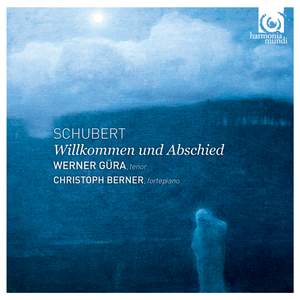
| |  | Schubert: Willkommen und Abschied
Schubert: | Heidenröslein, D257 Schlaflied D527 (Mayrhofer) Wiegenlied D867 (Seidl) Geheimes, D719 (Goethe) Ganymed, D544 (Goethe) Auf der Bruck, D853 Der Fischer, D225 (Goethe) Dass sie hier gewesen! D775 (Rückert) Bei dir allein, D866/2 Der Schiffer, D536 (Mayrhofer) Willkommen und Abschied, D767 Der Wanderer, D493 Im Walde D834 Wandrers Nachtlied I 'Der du von dem Himmel bist', D224 Der Einsame, D800 Der Winterabend (Es ist so still), D938 Herbst, D945 Rosamunde, D797: Romance 'Der Vollmond Strahlt auf Bergeshöh'n' Nachtstück, D672 (Mayrhofer) |
Werner Güra (tenor) & Christoph Berner (fortepiano Rönisch) Born in Munich, Werner Güra has a reputation especially as an interpreter of lieder. His recordings for harmonia mundi, including the great cycles of Schubert, Schumann and Wolf and vocal ensembles by Brahms and Schumann, have all been widely acclaimed. “It comprises 19 songs, all stylishly and beautifully sung by the tenor Werner Güra. The six Goethe settings include such familiar contrasts as Heidenröslein and Ganymed, while Willkommen und Abschied itself, more of a rarity, is heroically sung. The strength of Güra’s tone without any loss of quality has always been his strong point.” Sunday Telegraph, 29th January 2012 “His fresh lyric tenor combines well with Berner’s bright yet warm-toned fortepiano — he twinkles at Goethe’s ironic description of a water nymph as “eine feuchtes Weib”, literally a “damp woman” — while Berner brings drama to the piano parts of Auf der Bruck, Willkommen und Abschied and the haunting, yearning Herbst.” Sunday Times, 12th February 2012 “Berner, playing an 1872 Rönisch fortepiano, shows keen attention to every detail. Güra, outstanding in his unfussy, intense delivery, is a formidable, rousing guide.” The Observer, 26th February 2012 “Gura's strong, unaffected tenor voice is a pleasure to listen to, and Berner, who has an impressive keyboard freedom grounded in reliable technical skill, is a responsive accompanist: they perform as one, although too often their approach to a song somehow misses an essential quality of that particular piece of music.” International Record Review, March 2012 **** “Gura and his fortepianist, Christoph Berner, have mapped out a trajectory of the Romantic view of human emotional life...At each stage, both musicians show perfect sympathy with Schubert's own engagement, ideal empathy with each other, and a shrewd sensitivity to musical and expressive scale.” BBC Music Magazine, May 2012 ***** “Gura is never dull. 'Der Wanderer' is intensely 'lived', the opening bleak and desiccated...One of the most eloquent performances of all is the last song, 'Nachtstuck'...Here, singer and pianist show an acute sensitivity to harmonic colour that characterises this whole rewarding recital.” Gramophone Magazine, May 2012 | | | In stock - usually despatched within 1 working day. |
|
|
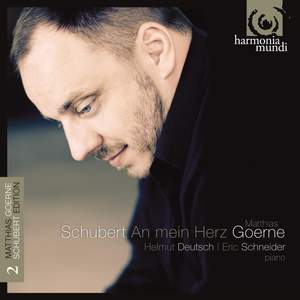
| |  | Schubert Lieder Volume 2: An Mein Herz
Schubert: | Der Jungling und der Tod, D545 (Spaun) Das Lied im Grünen, D917 Die Herbstnacht (Wehmut) D404 (Salis-Seewis) Ins stille Land, D403 Abschied von der Harfe D406 (Salis-Seewis) Drang in die Ferne, D770 An Mein Herz D860 Der Wanderer, D649 (Friedrich von Schlegel) Über Wildemann D884 (Ernst Schulze) Klage D371 Am Bach im Fruhling, D361 An die Laute D905 Des Fräuleins Liebeslauschen, D698 Augenlied, D297 (Mayrhofer) Du bist die Ruh D776 (Rückert) An die Musik D547 An eine Quelle D530 (Claudius) Der Sänger am Felsen, D482 Abschied von der Harfe D406 (Salis-Seewis) Liedesend, D473 (Mayrhofer) Das Heimweh, D456 (Winkler) Auf der Donau, D553 (Mayrhofer) Wie Ulfru fischt, D525 (Mayrhofer) Die Sternennacht D670 (Mayrhofer) Ruckweg, D476 (Mayrhofer) Geheimnis, D491 (Mayrhofer) Gondelfahrer, D808 Abendstern, D806 Der Sieg D805 (Mayrhofer) Nachtstück, D672 (Mayrhofer) Auflösung, D807 Heiss mich nicht reden, D877/2 Nur wer die Sehnsucht kennt, D877/4 An Mignon D161 Harfenspieler I 'Wer sich der Einsamkeit ergibt', D478 Am Flusse D160 (Goethe) Nähe des Geliebten, D162 Der Fischer, D225 (Goethe) Auf dem See, D543 (Goethe) Wonne der Wehmut D260 (Goethe) Willkommen und Abschied, D767 |
Matthias Goerne has received worldwide praise for his warm, fluid baritone and his profound interpretations. Highly respected as a Lieder singer, he is a frequent guest at renowned festivals and prestigious venues like the Carnegie and Wigmore Halls. From 2008 to 2011, Matthias Goerne will perform and record Schubert on 11 CDs for harmonia mundi and important venues all over the world will present the complete series of Schubert recitals with Matthias Goerne in their coming seasons. This second volume speaks of death, of the 'Wanderer', and of the relationship between Schubert and his poets . . . For this occasion the singer has called on two travelling companions who have left a lasting artistic impression on the world of lieder: Eric Schneider and Helmut Deutsch. Helmut Deutsch's career as a song accompanist began with Irmgard Seefried; he spent twelve years in an intensive collaboration with Hermann Prey, and has been the partner of many other celebrated singers. Eric Schneider has appeared notably with Christine Schäfer, Matthias Goerne, Christiane Oelze and Stephan Genz. He is a regular guest with these partners at the Schwarzenberg Schubertiade, Salzburg Festival and the Tanglewood Summer Music Festival. “Goerne… and Schneider offer grave and solemn performances of Goethe's Mignon and Harper songs, before ending on a higher note, celebrating the eternal joy of love in 'Willkommen and Abschied'.” BBC Music Magazine, February 2009 **** “Battered by Bryn Terfel dramatics, the ears cried out for a pure dose of lieder from a master of the craft. Matthias Goerne… seems to own a different shade of baritonal colour for every syllable Schubert wrote. The voice is sweet and serene, even at fff, and
the shifts that Goerne applies to the changing of seasons and the fickleness of love are done with enviable delicacy. More reticent than Fischer-Dieskau or Thomas Quasthoff to bend a line for expressive
emphasis, when Goerne takes a liberty the effect is breath stopping… T his is not an album to gorge at one go. Take it two songs a night before bedtime, and it might see you through to the end of recession.” Norman Lebrecht, Evening Standard CD of the Week “Goerne used to record for Decca, but it apparently had no interest in his 12-volume Schubert compendium, so the less ruthlessly commercial Harmonia Mundi comes to the rescue, for which the France-based company deserves the highest praise. From a vocal point of view, few male singers,
even Fischer-Dieskau, command such a rich palette of colours as Goerne does here…he goes where Dieskau never ventured: he includes two of Mignon's songs, Heiss' mich nicht reden and Nur wer die Sehnsucht kennt, as well as the Harper trilogy… In the middle Harper song, Mayrhofer's
Nachtstück and Nähe des Geliebten (Nearness of the Beloved), Goerne approaches the sublime and captures perfectly the wry wit of Goethe's sly dig at water-nymphery, Der Fischer, in which the surprise encounter of an angler with a "moist woman" is wryly underlined by Schubert. Luxury
support from Deutsch and Schneider sets the seal on an outstanding issue.” Sunday Times Classical CD of the Week “This promises to be a landmark series, up there with Hans Hotter and Fischer-Dieskau.” The Observer “Here elegy, fatalism and death-longing predominate and in such repertoire Goerne's mellow, darkly rounded timbre, expressive diction and care – rare in Lieder singers today – for a true, 'bound' line are well nigh ideal. Even at the most anguished fortissimo, his tone never grows harsh or hectoring. Perfectionism like Goerne's has inevitably provoked charges of over-calculation. Some might protest at the ultra-slow tempo for Du bist die Ruh. Yet Goerne's beauty of tone and phrasing (founded on seemingly superhuman reserves of breath), and a rapt intensity that rises to spiritual radiance in the final verse are mesmerising. At a more conventional tempo, he sings An die Musik as a simple, sincere confession of faith, with affectionate touches of rubato (and how eloquently Helmut Deutsch's left hand duets with the voice). Elsewhere Goerne's unsentimental tenderness can illuminate little-known songs that seem ordinary on the printed page – Abschied von der Harfe, say, or the quasi-operatic lament Der Sänger amFelsen. He even appropriates, successfully, two of Mignon's songs, giving one of the most desolate and – in the central section – disturbed performances of Nur wer die Sehnsucht kennt you will hear. True to form, Goerne makes an uncommonly melancholy serenader in An die Laute and DesMädchens Liebeslauschen, which never smiles. Yet he can lighten up, as in the story-telling of DerFischer and Wie Ulfru fischt. Like Deutsch on the first disc, Eric Schneider fully matches Goerne in acumen and command of colour, not least in a performance of Nachtstück of mingled grandeur, mystery and compassionate gentleness.” Gramophone Classical Music Guide, 2010 “Goerne's virtuoso vocal sculpting draws you into the inner landscape of each song, his warm, expressive baritone shaping detail often understated by lesser artists. This promises to be a landmark series, up there with Hans Hotter and Fischer-Dieskau.” The Guardian, 12th October 2008 | | | In stock - usually despatched within 1 working day. |
|
|
| |  | Ian Bostridge - Schubert Lieder
Schubert: | Die Forelle, D550 Ganymed, D544 (Goethe) Im Frühling, D882 An den Mond, D193 Geheimes, D719 (Goethe) Heidenröslein, D257 Wandrers Nachtlied II 'Über allen Gipfeln ist Ruh', D768 Erster Verlust, D226 (Goethe) Der Fischer, D225 (Goethe) Fischerweise, D881 (Schlechta) Nacht und Träume, D827 Der Zwerg, D771 (Collin) Wehmut, D772 (Collin) An die Musik D547 Du bist die Ruh D776 (Rückert) Auf dem Wasser zu singen, D774 An Sylvia, D891 Litanei auf das Fest Allerseelen, D343 Frühlingsglaube, D686 Sei mir gegrüsst! D741 (Rückert) Im Haine, D738 Der Musensohn, D764 (Goethe) Wandrers Nachtlied I 'Der du von dem Himmel bist', D224 Seligkeit D433 (Holty) Erlkönig, D328 |
Recorded 1996 & 2000 “Few discs of favourite Schubert songs match this for sheer beauty...[Bostridge] offers fresh revelation in even the best-known songs” Penguin Guide, 2010 edition **** “A voice more for Schöne Müllerin than Winterreise, Bostridge's fresh, buoyant, beautifully articulated tenor suits these Lieder perfectly. The literary and musical impulses are in perfect equilibrium, and Drake's rapport is absorbing.” BBC Music Magazine, January 2006 **** | | | In stock - usually despatched within 1 working day. |
|
|
| |  | Schumann & Schubert: Grenzen der MenschheitCD+BOOK
Schubert: | Der Fischer, D225 (Goethe) Der König in Thule, D367 Die Burgschaft, D246 Gruppe aus dem Tartarus, first version, D396 (Schiller) Hektors Abscheid, D312 Prometheus, D674 (Goethe) Grenzen der Menschheit, D716 An Schwager Kronos, D369 | Schumann: | Ballade des Harfners, Op. 98a No. 2 Wer nie sein Brot mit Tränen ass, Op. 98a No. 4 Wer sich der Einsamkeit ergibt, Op. 98a No. 6 An die Türen will ich schleichen, Op. 98a No. 8 Der Handschuh, Op. 87 Nachtlied, Op. 96 No. 1 |
Johannes Martin Kränzle (baritone), Hilko Dumno (piano), Theresa Kronthaler (mezzo soprano) ‘Grenzen der Monschheit’ takes its title from the song by Franz Schubert which is performed here by the award-winning German baritone Johannes Martin Kränzle and the pianist Hilko Dumno. The song itself is a setting of a text by Goethe, and the whole album is devoted to lieder by Schubert and Robert Schumann that set the words of Goethe and fellow great German writer Friedrich Schiller. Born in Augsburg, Germany, in 1962, the baritone Johannes Martin Kränzle has been member of the Frankfurt Opera since 1998, and performed at many of the great opera venues of the world, including La Scala in Milan, and the San Francisco Opera. He has also made several appearances at leading international festivals including Salzburg and Glyndebourne. His wide repertoire covers leading roles in the major operas of Mozart, Rossini, Wagner, and Verdi. Martin Kränzle has received various prizes at singing contests in Berlin, Vercelli (Viotti), Hanover, Perpignan, Paris (Placido Domingo), and the Primo Grande Premio in Rio de Janeiro in 1991. He was also chosen as ‘Singer of the Year’ 2011 by the leading opera magazine Opernwelt, and awarded the ‘Kölner Opernpreis’ 2012. He is currently appearing as Alberich in Wagner’s Ring cycle at the Staatsoper Berlin, La Scala, Milan and the BBC Proms with conductor Daniel Barenboim. | 
| | | Scheduled for release on 15 July 2013. Order it now and we will deliver it as soon as it is available. |
|
|
| |  | An den Mond: Lieder by Schumann, Schubert & Zelter
Schubert: | Der Fischer, D225 (Goethe) Erster Verlust, D226 (Goethe) Meeres Stille, D216, Op. 3 No. 2 (Goethe) Der König in Thule, D367 Erlkönig, D328 Grenzen der Menschheit, D716 Liebe schwarmt auf allen Wegen, D239 No. 6 (Goethe) Wandrers Nachtlied I 'Der du von dem Himmel bist', D224 Wandrers Nachtlied II 'Über allen Gipfeln ist Ruh', D768 | Schumann: | Belsazar, Op. 57 Der Handschuh, Op. 87 Die feindlichen Brüder, Op. 49 No. 2 Liederkreis, Op. 39 | Zelter: | Der König von Tule Strophe 5-7 Wand'rers Nachtlied Der Du vom Himmel bist Uber allen Gipfeln |
| | | Usually despatched in 2 - 3 working days. |
|
|
| |  | Spirit of Love
Schubert: | Geist der Liebe D233 (Kosegarten) Lachen und Weinen, D777 An die untergehende Sonne, D457 Der Fischer, D225 (Goethe) Geheimnis, D491 (Mayrhofer) Ihr Bild, D957 No. 9 Das Fischermädchen D957 No. 10 Die Sterne, D939 (Leitner) Liebesbotschaft, D957 No.1 Litanei auf das Fest Allerseelen, D343 Hoffnung, D251 (Schiller) Die Taubenpost, D965A (D957 No. 14) An die Laute D905 Im Frühling, D882 Der Jüngling auf dem Hügel, D702 Der Wanderer an den Mond D870 (Seidl) Verklarung D59 (Herder, after Pope) Minnelied D429 (Holty) Der Musensohn, D764 (Goethe) Der Jüngling an der Quelle, D300 (Salis-Seewis) Wandrers Nachtlied I 'Der du von dem Himmel bist', D224 An den Mond, D259 (Goethe) An den Mond, D193 |
| | | Usually despatched in 8 - 10 working days. |
|
|
| |  | Schubert Lieder
Schubert: | Der Musensohn, D764 (Goethe) Ganymed, D544 (Goethe) Schäfers Klagelied, D121 (Goethe) Rastlose Liebe, D138 Suleika I & II An den Mond, D296 Der Fischer, D225 (Goethe) Erlkönig, D328 Wandrers Nachtlied II 'Über allen Gipfeln ist Ruh', D768 Die Sterne, D939 (Leitner) Der Einsame, D800 Nachtstück, D672 (Mayrhofer) Der Zwerg, D771 (Collin) Im Abendrot, D799 Nachtviolen D752 (Mayrhofer) Die junge Nonne, D828 Nacht und Träume, D827 |
“The attractive selection of songs, with many favourites, consistently draws warm, easily confident singing from her, full of charm, yet she is dramatic when required...Roger Vignoles accompanies persuasively throughout” Penguin Guide, 2010 edition *** | | | (also available to download from $10.75) | Usually despatched in 8 - 10 working days. (Available now to download.) |
|
|
| |  | Volume 3 - Goethe Volume 1
Schubert: | Der Fischer, D225 (Goethe) An den Mond, D259 (Goethe) An den Mond, D296 Meeres Stille, D216, Op. 3 No. 2 (Goethe) Geistes-Gruss, D142 Der König in Thule, D367 Heidenröslein, D257 Der Schatzgräber, D256 Der Gott und die Bajadere, D254 Der Rattenfänger, D255 Bundeslied, D258 Harfenspieler I D325 (Goethe) Harfenspieler III 'Wer nie sein Brot mit Tränen ass', D480 Harfenspieler I 'Wer sich der Einsamkeit ergibt', D478 Harfenspieler II 'An die Türen will ich schleichen, D479 Mahomets Gesang D721 (Goethe) fragment Ganymed, D544 (Goethe) An Schwager Kronos, D369 Grenzen der Menschheit, D716 Prometheus, D674 (Goethe) Wandrers Nachtlied I 'Der du von dem Himmel bist', D224 Wandrers Nachtlied II 'Über allen Gipfeln ist Ruh', D768 |
Ulf Bastlein (baritone), Stefan Laux (piano) “there is real intelligence [in Bastlein's singing]; a sense that he is viewing each song as a unity and as a miniaturised drama in its own right. As a first taste of what the series might offer in future installments it is certainly the most intriguing.” The Guardian, 7th January 2000 | | | (also available to download from $6.00) | Usually despatched in 2 - 3 working days. (Available now to download.) |
|
|
| |
|