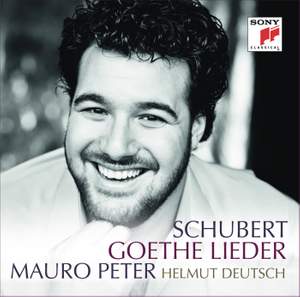
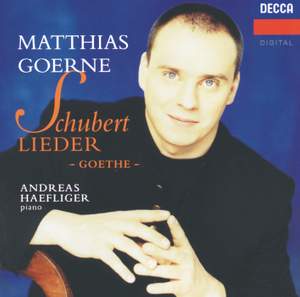
All recordingsPrices shown exclude VAT. (UK tax is not payable for deliveries to United States.) See Terms & Conditions for p&p rates. | |  | Schubert: Goethe Songs
Schubert: | Am Flusse D160 (Goethe) Schäfers Klagelied, D121 (Goethe) Meeres Stille, D216, Op. 3 No. 2 (Goethe) Heidenröslein, D257 Jägers Abendlied, Second Setting, D368 Sehnsucht, D123 Die Liebe (Klarchens Lied), D210 Trost in Tränen, D120 Rastlose Liebe, D138 Nähe des Geliebten, D162 Der Fischer, D225 (Goethe) Erster Verlust, D226 (Goethe) Der König in Thule, D367 Harfenspieler I 'Wer sich der Einsamkeit ergibt', D478 Harfenspieler II 'An die Türen will ich schleichen, D479 Harfenspieler III 'Wer nie sein Brot mit Tränen ass', D480 An Schwager Kronos, D369 An Mignon D161 Ganymed, D544 (Goethe) An die Entfernte, D765 (Goethe) Versunken D715 (Goethe) An den Mond, D259 (Goethe) Der Musensohn, D764 (Goethe) Auf dem See, D543 (Goethe) Geistes-Gruss, D142 |
| | | In stock - usually despatched within 1 working day. |
|
|
| |  | Thomas Quasthoff - Schubert: LiederSinging Masterclass from the Verbier Festival Academy
The baritone Thomas Quasthoff has been heralded by the press as "one of the great singers of our time and certainly one of the most remarkable of any time". (Los Angeles Times) He was born in Hildesheim, Germany in 1959 and began his musical studies in Hanover in 1972, studying singing with Charlotte Lehmann. Renowned for his singing of lieder and oratorios, he has worked with the most renowned orchestras and conductors worldwide at all the prestigious houses and festivals. He is a much sought-after teacher and is Professor of Music at the Hanns Eisler School for Music in Berlin. For several years he has taught at the Verbier Festival Academy. In this masterclass, he works with students on lieder by Schubert. | | | In stock - usually despatched within 1 working day. |
|
|
| |  | Ian Bostridge - Schubert Lieder
Schubert: | Die Forelle, D550 Ganymed, D544 (Goethe) Im Frühling, D882 An den Mond, D193 Geheimes, D719 (Goethe) Heidenröslein, D257 Wandrers Nachtlied II 'Über allen Gipfeln ist Ruh', D768 Erster Verlust, D226 (Goethe) Der Fischer, D225 (Goethe) Fischerweise, D881 (Schlechta) Nacht und Träume, D827 Der Zwerg, D771 (Collin) Wehmut, D772 (Collin) An die Musik D547 Du bist die Ruh D776 (Rückert) Auf dem Wasser zu singen, D774 An Sylvia, D891 Litanei auf das Fest Allerseelen, D343 Frühlingsglaube, D686 Sei mir gegrüsst! D741 (Rückert) Im Haine, D738 Der Musensohn, D764 (Goethe) Wandrers Nachtlied I 'Der du von dem Himmel bist', D224 Seligkeit D433 (Holty) Erlkönig, D328 |
Recorded 1996 & 2000 “Few discs of favourite Schubert songs match this for sheer beauty...[Bostridge] offers fresh revelation in even the best-known songs” Penguin Guide, 2010 edition **** “A voice more for Schöne Müllerin than Winterreise, Bostridge's fresh, buoyant, beautifully articulated tenor suits these Lieder perfectly. The literary and musical impulses are in perfect equilibrium, and Drake's rapport is absorbing.” BBC Music Magazine, January 2006 **** | | | In stock - usually despatched within 1 working day. |
|
|
| |  | Jana Büchner: Thoughts of Love
Lewy: | Freundschaft oder Liebe, Op. 7 | Mendelssohn: | Neue Liebe, Op. 19a No. 4 Auf Flügeln des Gesanges, Op. 34 No. 2 Andres Maienlied (‘Hexenlied') Op. 8/8 | Mendelssohn, Fanny: | Warum sind denn die Rosen so blass, Op. 1 No. 3 (Text: Heinrich Heine) Dämmrung senkte sich von oben (Text: Johann Wolfgang von Goethe) Nacht ist wie ein stilles Meer | Mozart: | Dans un bois solitaire, K308 Das Traumbild, K.530 Als Luise die Briefe, K520 Das Veilchen, K476 Fragment in E flat major, K. 307b (reconstructed by John Humphries): Allegro Abendempfindung an Laura, K523 | Schubert: | Rastlose Liebe, D138 Du bist die Ruh D776 (Rückert) Lachen und Weinen, D777 Erster Verlust, D226 (Goethe) Nähe des Geliebten, D162 Auf dem Strom, D943, Op. post. 119 Lied der Delphine, D857 No. 1 |
Jana Büchner (soprano), Hans-Pieter Fieber (horn) & Eckhart Sellheim & Britta Wideranders (piano) Jana Büchner’s selection of lieder traces the evolution of the song from Mozart and Schubert all the way through to Hensel and Mendelssohn. The works deal with the joys and sufferings of love, hence “Thoughts of Love”. Included are lieder with horn obligato and Lewy’s song (1802 - 1881) is thought to be a premiere recording. | | | Usually despatched in 2 - 3 working days. |
|
|
| |  | An den Mond: Lieder by Schumann, Schubert & Zelter
Schubert: | Der Fischer, D225 (Goethe) Erster Verlust, D226 (Goethe) Meeres Stille, D216, Op. 3 No. 2 (Goethe) Der König in Thule, D367 Erlkönig, D328 Grenzen der Menschheit, D716 Liebe schwarmt auf allen Wegen, D239 No. 6 (Goethe) Wandrers Nachtlied I 'Der du von dem Himmel bist', D224 Wandrers Nachtlied II 'Über allen Gipfeln ist Ruh', D768 | Schumann: | Belsazar, Op. 57 Der Handschuh, Op. 87 Die feindlichen Brüder, Op. 49 No. 2 Liederkreis, Op. 39 | Zelter: | Der König von Tule Strophe 5-7 Wand'rers Nachtlied Der Du vom Himmel bist Uber allen Gipfeln |
| | | Usually despatched in 2 - 3 working days. |
|
|
| |  | Schubert: Favourite Lieder
Schubert: | Die schöne Müllerin, D795 Der Wanderer, D489 Auf der Bruck, D853 Nacht und Träume, D827 An Sylvia, D891 Die Forelle, D550 Der Zwerg, D771 (Collin) Erlkönig, D328 Heidenröslein, D257 Dithyrambe, D801 Die Liebe hat gelogen D751 (Platen) Der Doppelgänger D957 No. 13 Frühlingsglaube, D686 Der Schiffer, D536 (Mayrhofer) Wandrers Nachtlied II 'Über allen Gipfeln ist Ruh', D768 Der Wanderer, D489 Der Tod und das Mädchen, D531 Ganymed, D544 (Goethe) Im Abendrot, D799 Der Musensohn, D764 (Goethe) Normans Gesang D846 (Scott, Storck) Erster Verlust, D226 (Goethe) An die Musik D547 |
Gérard Souzay (1918–2004) was born into a musical family – his father was a cellist, and his two brothers and his sister all singers. Souzay chose to study philosophy at university, and it was only after a meeting with Pierre Bernac in Paris in 1942 that he was persuaded to enter the Paris Conservatoire to study singing. He entered the concert circuit shortly after the end of the Second World War, and soon displayed the qualities that would make him one of the great voices of the 20th century – a love of words and a superb technique that combined a fine tone with a natural gift for expression. His obituaries in 2004 all commented on the qualities of his voice, and were full of epithets such as ‘warm’, ‘lyrical’, ‘supple’, ‘sensual’ and ‘vibrant’. He was keen not to be pigeonholed as a singer of French repertoire, and this 2 CD set vividly illustrates his mastery of Schubert’s lieder. The coupling of the composer’s freshest and most immediately appealing song-cycle, Die schöne Müllerin, with a generous selection of other, universally known lieder, is sure to have wide appeal beyond historical enthusiasts: the recordings are in excellent stereo. New booklet notes by Lieder authority Richard Stokes. ‘Souzay’s interpretation makes a less virile figure of the miller’s apprentice than either of the others and perhaps, because of this, makes more credible the girl’s jilting of him for the black-bearded hunter (I’m sure his beard was black!), but there is plenty of passion in his singing and a smooth treatment of the two-note quaver groups. The climactic ends of the verses “Dein ist mein Herz”, etc. ring out as well in “Ungeduld” as in “Mein!”, and at all times one is aware of a carefully thought-out presentation, an expressive treatment of the words and a sensitive response to the changing moods. The many strophic songs have plenty of nuance, and Souzay holds the interest through the five verses of “Des Baches Wiegenlied”.’ Gramophone, June 1965 “This intimate 1961 performance of Die Schöne Müllerin is notable for its textural clarity and his often daringly soft dynamics, matched in Dalton Baldwin's lyrical accompaniment. Disc two's song selection features an effortlessly graceful "Heidenröslein" and a visceral reading of "Der Zwerg".” The Independent on Sunday, 25th July 2010 “This is cultivated, beautiful singing, and Baldwin is a most sensitive accompanist.” BBC Music Magazine, December 2010 *** | | | Usually despatched in 2 - 3 working days. |
|
|
| |  | Arleen Augér
Hoiby: | The Serpent | Schoenberg: | Erwartung, Op. 17 Schenk mir deinen goldenen Kamm Op. 2 No. 2 Erhebung Op. 2 No. 3 Waldsonne Op. 2 No. 4 | Schubert: | Frühlingsglaube, D686 Der Schmetterling D633 Nacht und Träume, D827 Liebe schwarmt auf allen Wegen, D239 No. 6 (Goethe) Erster Verlust, D226 (Goethe) Gretchen am Spinnrade, D118 Heidenröslein, D257 | Schumann: | Widmung, Op. 25 No. 1 Röselein, Röselein! Op. 89 No. 6 ('Wielfried von der Neun') Er ist's! Op. 79 No. 23 (Eduard Mörike) Des Sennen Abschied, Op. 79 No. 22 Mignon ('Kennst du das Land, wo die Zitronen blühn'), Op. 79 No. 29 Singet nicht In Trauertönen Op. 98a No. 7 (Johann Wolfgang von Goethe) | Strauss, R: | Das Rosenband, Op. 36 No. 1 Mädchenblumen (4 songs), Op. 22 Die Zeitlose, Op. 10 No. 7 Efeu, Op. 22 No. 3 Freundliche Vision, Op. 48 No. 1 Herr Lenz Op. 37 No. 5 |
Recorded: BBC Studios, Pebble Mill, Birmingham, 2 January 1987 “This BBC recital from Birmingham (1987) extends Augér's run of Lieder on disc, and reminds us what a treasurable artist we lost when, six years after making this recording, she died aged 53.” BBC Music Magazine, March 2008 ***** | | | (also available to download from $10.50) | Usually despatched in 2 - 3 working days. (Available now to download.) |
|
|
| | Brahms, Strauss and Schubert: Lieder
Brahms: | Mädchenfluch (No. 9 from Neun Gesänge, Op. 69) Mädchenlied, Op. 85 No. 3 Vorschneller Schwur (No. 5 from Sieben Lieder, Op. 95) Das Mädchen (No. 1 from Sieben Lieder, Op. 95) | Schubert: | Die junge Nonne, D828 Litanei auf das Fest Allerseelen, D343 Rastlose Liebe, D138 Der Hirt auf dem Felsen, D965 (Von Chezy / Muller) Florent Héau (clarinet) Bei dir allein, D866/2 Erster Verlust, D226 (Goethe) Die Sterne, D939 (Leitner) | Strauss, R: | Schlechtes Wetter, Op. 69 No. 5 Morgen, Op. 27 No. 4 Heimliche Aufforderung, Op. 27 No. 3 Ruhe, meine Seele!, Op. 27 No. 1 Cäcilie, Op. 27 No. 2 Hat gesagt - bleibt's nicht dabei, Op. 36 No. 3 |
Katarina Jovanovic (soprano), Bruno Fontaine (piano) | | | Usually despatched in 2 - 3 working days. |
|
|
| |  | Gedda, Nicolai: Live in Budapest 1984 - Goethe Songs
Beethoven: | Wonne der Wehmut, Op. 83 No. 1 Mit einem gemalten Band Op. 83, No. 3 Aus Goethes Faust | Boito: | Dai campi, dai prati (Mefistofele) Giunto sul passo estremo (from Mefistofele) | Massenet: | O Nature, pleine de grace (from Werther) Oui ce qu'elle m'ordonne... Lorsque l'enfant (from Werther) | Mozart: | Das Veilchen, K476 | Mussorgsky: | Mephistopheles' Song of the Flea | Schubert: | Wandrers Nachtlied I 'Der du von dem Himmel bist', D224 Rastlose Liebe, D138 Schäfers Klagelied, D121 (Goethe) Erster Verlust, D226 (Goethe) | Tchaikovsky: | None but the lonely heart, Op. 6 No. 6 | Thomas, Ambroise: | Elle ne croyait pas, dans sa candeur naïve (from Mignon) Adieu, Mignon! Courage! (Mignon) | Wolf, H: | Frühling übers Jahr (No. 28 from Goethe-Lieder) Anakreons Grab (No. 29 from Goethe-Lieder) Der Schäfer (No. 22 from Goethe-Lieder) |
| |
|
| |  | Volume 16 - Goethe Volume 3
Schubert: | Wer kauft Liebesgotter?, D261 (Goethe) Versunken D715 (Goethe) Nachtgesang, D119 Erster Verlust, D226 (Goethe) Trost in Tränen, D120 Jägers Abendlied, First Setting, D215 Jägers Abendlied, Second Setting, D368 Tischlied, D234 Willkommen und Abschied, D767 Schäfers Klagelied, D121 (Goethe) Erlkönig, D328 Hoffnung, D295 Auf dem See, D543 (Goethe) Mahomets Gesang, First Setting, D549 Am Flusse D160 (Goethe) Am Flusse, D766 Johanna Sebus (Fragment), D728 An die Entfernte, D765 (Goethe) Sehnsucht, D123 Geheimes, D719 (Goethe) Der Goldschmiedsgesell, D560 Liebhaber in allen Gestalten, D558 Der Musensohn, D764 (Goethe) Der Sänger, D149 |
Johannes Kalpers (tenor), Burkhard Kehrin (piano) | | | (also available to download from $6.00) | Usually despatched in 2 - 3 working days. (Available now to download.) |
|
|
| |
|