All recordingsPrices shown exclude VAT. (UK tax is not payable for deliveries to United States.) See Terms & Conditions for p&p rates. | |  | The SeaSongs by Debussy, Fauré & Schubert
Debussy: | Trois Mélodies de Verlaine Beau Soir | Fauré: | Poème d'un jour Op. 21 L'horizon chimérique, Op. 118 Les berceaux, Op. 23 No. 1 En sourdine, Op. 58 No. 2 (Verlaine) Chanson du pêcheur Op. 4 No. 1 Larmes Op. 51 No. 1 | Schubert: | Der Schiffer, D536 (Mayrhofer) Meeres Stille, D216, Op. 3 No. 2 (Goethe) Fahrt zum Hades, D526 (Mayrhofer) Auf der Donau, D553 (Mayrhofer) Erlafsee D586 (Mayrhofer) Gondelfahrer, D808 Ruckweg, D476 (Mayrhofer) Am Strome, D539 (Mayrhofer) Gruppe aus dem Tartarus, second version, D583 (Schiller) |
Henk Neven (baritone) & Hans Eijsackers (piano) The Sea, songs of water and the sea, diverse in colour and emotion. Henk Neven on his new ONYX recording: "During the recordings of my debut album 'Auf einer Burg' in Suffolk, I visited, after a day’s work, the coastal town of Aldeburgh. It was winter-time and at six o’clock pitch dark already. I was walking along the sea. Darkness all around. Nevertheless I heard, smelt and felt the sea. Not visible but very present. We sat by the water for ages and indulged in fancies, philosophised, and written poetry lustily about the endless deep of the sea, about the horizon and what is behind it, about the similarity to our spiritual lives, about the currents that are as our lives; about the sea that takes us with it when we are tired of living; about the restless sailor who revives between storm and waves; about the solitary wife who, rocking her baby, is left alone; about the sea in which you pour out your heart… Have all these tears made the seawater so bitterly salt? The sea and the water have been a source of inspiration for many poets and their poems inspired the composers likewise. The songs that were created that way have inspired me". Henk’s debut album 'Auf einer Burg', lieder by Loewe and Schumann, ONYX4052, was praised by BBC Radio 3: "songsettings by Loewe, beautifully brought to life by baritone Henk Neven and pianist Hans Eijsackers... A world of fantasies and dreams and reflections on the passing of time and the transience of life. That’s what it says on the sleeve, and that’s exactly what they deliver so successfully. It’s the CD Review Disc of the Week and you’ll find it on ONYX Classics.” “A delightful recital … Neven’s melodies are every bit as persuasive as his lieder … the recording team does the project proud.” Classical Music, 17th November 2012 “Rarely do you hear, even in the rarefied world of French melodie and German Lieder, a baritone who sings with such subtlety in shading of dynamic and tone as the Dutch baritone Henk Neven...and this latest disc extends my admiration even further in totally exquisite singing...Altogether a most memorable song record.” Gramophone Magazine, February 2013 | | | In stock - usually despatched within 1 working day. |
|
|
| |  | Schubert: Darkness or LightSelected Schubert Lieder
Schubert: | Der Strom, D565 (poet unknown) Auf der Donau, D553 (Mayrhofer) Fahrt zum Hades, D526 (Mayrhofer) Grenzen der Menschheit, D716 Der Pilgrim, D794 (Schiller) Grablied fur die Mutter D616 (poet unknown) Hoffnung, D637 Wandrers Nachtlied II 'Über allen Gipfeln ist Ruh', D768 Die Mutter Erde, D788 (Stolberg) Der Jungling und der Tod, D545 (Spaun) An den Tod D518 (Schubart) Der Tod und das Mädchen, D531 Totengräberweiss D869 (Schlechta) Totengräberlied, D44 (Hölty) Das Grab D569 (Salis-Seewis) Totengräbers Heimwehe D842 (Craigher) Litanei auf das Fest Allerseelen, D343 |
Cornelius Hauptmann (bass) & Eric Schneider (piano) | | | In stock - usually despatched within 1 working day. |
|
|
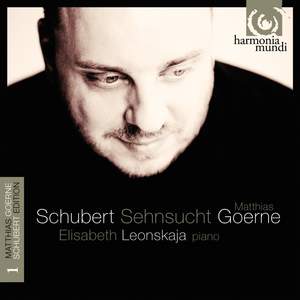
| |  | Schubert Lieder Volume 1: Sehnsucht
Schubert: | Fahrt zum Hades, D526 (Mayrhofer) Freiwilliges Versinken D700 (Mayrhofer) Das Weinen D926 (Leitner) Des Fischers Liebesgluck, D933 (Leitner) Der Winterabend (Es ist so still), D938 Memnon, D541 (Mayrhofer) Lied eines Schiffers an die Dioskuren D360 (Mayrhofer) Der Schiffer, D536 (Mayrhofer) Sehnsucht, D636 (Schiller) Der Jungling am Bache D638 An Emma, D113 Der Pilgrim, D794 (Schiller) Gruppe aus dem Tartarus, second version, D583 (Schiller) Hoffnung, D295 Grenzen der Menschheit, D716 |
“Critics have sung Mr. Goerne's praises over and over, and one can hardly add anything at this point: The voice is one of the most beautiful - most lush, most creamy - that any of us has ever heard. His singing is almost impossibly smooth. The first time you hear it, you can scarcely believe it. Even the 10th time, you have to wonder… An impressive recital. Matthias Goerne: a first-class and unforgettable lieder singer.” The New York Sun “In the sombre and elegiac songs that dominate his programme, Goerne is in his element, singing with his distinctive dark, rounded beauty and almost tortured intensity of thought and feeling. More than almost any other Lieder singer today, he combines expressive diction with an unblemished legato... In their mingled majesty and aching tenderness, Goerne's performances of two great Mayrhofer settings...are as moving as any performances I can remember.
With his deep mahogany tones and innate seriousness of manner (on the concert platform he habitually wears a haunted air), Goerne is less convincing when a certain lightness of touch is needed. While not many of his chosen songs require him to smile, one that surely does is the wistful barcarolle Des Fischers Liebesglück, whose fisherman in question sounds thoroughly depressed. It is the same in Der Jüngling am Bache, where Goerne's slow, doleful performance suggests hopeless resignation rather than the tremulous expectancy implied by poem and music.” The Telegraph, 28th April 2008 “Goerne's renowned breath control … creates the hushed legato which is his hallmarl. This comes into its own in the Mayrhofer and Leitner settings, creating the mesmeric lilt of water and of light.” BBC Music Magazine, May 2008 **** “His voice has a melting allure that draws you in completely to the sentiments of the song, and the disarming beauty of Schubert's music. These performances glow in various lights, rounding off a truly excellent first
volume of an ongoing Schubert series.” The Scotsman “Following Dietrich Fischer-Dieskau nearly 40 years on, Goerne is in his element, singing with his distinctive dark, rounded beauty and almost tortured intensity of thought and feeling. More than almost any other Lieder singer today, he combines expressive
diction with an unblemished legato, "bowing" Schubert's long lines like a master cellist (shades here of the great Hans Hotter). In their mingled majesty and aching tenderness, Goerne's performances of two great
Mayrhofer settings, Memon and Lied eines Schiffers an die Dioskuren, are as moving as any performances I can remember.” The Telegraph, 26 April 2008 Classical CD of the Week “Matthias Goerne is fast becoming the Fischer-Dieskau of his generation, the standard-setting singer of the central lieder repertoire.” International Record Review “'Do you know of any happy music?' Schubert once asked a friend. 'I don't.' Those words could stand as an epigraph to Matthias Goerne's opening salvo in a projected 11- or 12-disc survey of Schubert Lieder. Evanescence, elegy and yearning for a transcendent otherness are the keynotes of a programme that encompasses the Attic majesty and terribilità of 'Memnon' and 'Gruppe aus dem Tartarus', the disillusioned fatalism of 'Der Pilgrim' and the philosophical grandeur of 'Grenzen der Menschenheit'. In these songs Goerne, with his distinctive dark, velvet timbre, is in his element. An intense, almost tortured concentration of thought and feeling has always been his hallmark, as has an unblemished legato. The way he bows Schubert's long lines like a cellist is reminiscent of the great Hans Hotter. Goerne's rich bass resonances are heard to advantage in a performance of 'Grenzen der Menschenheit' that embraces aching tenderness as well as deep, rolling gravitas. 'Memnon' – a typical Mayrhofer allegory of the artist as tragic outsider – is equally spellbinding, illuminated by telling details like the lingering portamento on 'liebend' – 'lovingly' – as dawn's rays break through the mists. And when have the hazardous leaps of another allegorical Mayrhofer song, 'Freiwilliges Versinken been negotiated with such smoothness and hypnotic eloquence. Where doubts creep in is in the handful of songs where, pace Schubert's own words, a certain lightness of tone and spirit is implied, but Goerne's involvement is so palpable and his style so scrupulous. For two-thirds and more of this recital the interpretative rewards are uncommonly rich, with the baritone well complemented by Elisabeth Leonskaja's deep-toned (if on occasion over-pedalled), often orchestrally conceived accompaniments.” Gramophone Classical Music Guide, 2010 | | | In stock - usually despatched within 1 working day. |
|
|
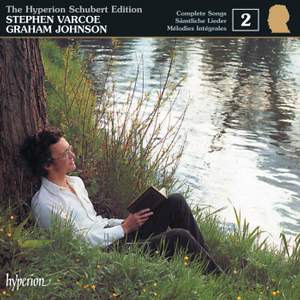
| |  | The Hyperion Schubert Edition - Complete Songs Volume 2Schubert's Water Songs
Schubert: | Fischerlied, D351 (Salis-Seewis) Fischerlied, D562 (Salis-Seewis) Fischerweise, D881 (Schlechta) Widerschein, D639 (Schlechta) Fahrt zum Hades, D526 (Mayrhofer) Selige Welt, F743 (Senn) Am Bach im Fruhling, D361 Am Flusse, D766 Der Strom, D565 (poet unknown) Auf der Donau, D553 (Mayrhofer) Der Schiffer, D536 (Mayrhofer) Wie Ulfru fischt, D525 (Mayrhofer) Der Taucher, D111 (Schiller) |
'A delightful collection of songs inspired by water' (The Guardian) | | | In stock - usually despatched within 1 working day. |
|
|
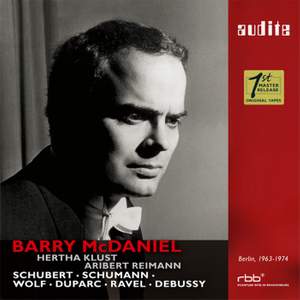
| |  | Barry McDaniel sings Schubert, Schumann, Wolf, Duparc, Ravel & Debussy
Debussy: | Le promenoir des deux amants | Duparc: | Chanson triste Lamento Le Manoir de Rosemonde Extase Soupir Phidylé | Ravel: | Trois chansons madécasses Eberhard Finke (cello) & Karlheinz Zoeller (flute) | Schubert: | Der Winterabend (Es ist so still), D938 Herbst, D945 Dass sie hier gewesen! D775 (Rückert) Der Einsame, D800 Fahrt zum Hades, D526 (Mayrhofer) Der Jungling und der Tod, D545 (Spaun) Sprache der Liebe D410 (A W von Schlegel) Fischerweise, D881 (Schlechta) Über Wildemann D884 (Ernst Schulze) Auflösung, D807 | Schumann: | Gedichte (6) und Requiem, Op. 90 Nachtlied, Op. 96 No. 1 Der Spielmann, Op. 40, No. 4 Zigeunerliedchen I & II Verratene Liebe, Op. 40, No. 5 Provencalisches Lied, Op. 139 No. 4 Mein Schöner Stern! Op. 101 No. 4 Aus den hebräischen Gesängen, Op. 25 No. 15 Ihre Stimme Op. 96 No. 3 (August von Platen) | Wolf, H: | An eine Æolsharfe (No. 11 from Mörike-Lieder) Heimweh (No. 37 from Mörike-Lieder) Lebe wohl (No. 36 from Mörike-Lieder) Nimmersatte Liebe (No. 9 from Mörike-Lieder) Der Tambour (No. 5 from Mörike-Lieder) Abschied (No. 53 from Mörike-Lieder) |
Barry McDaniel (baritone), Hertha Klust (piano) & Aribert Reimann (piano) The American baritone Barry McDaniel was one of the outstanding singers of the post-war era. As a successful opera singer and Lieder interpreter, he enjoyed a long and eventful career, both in Germany and abroad. Despite numerous performances and many recordings for radio and television, he nonetheless remained largely unnoticed by the media, partly because his name almost vanished in the shadow of Dietrich Fischer-Dieskau, who was five years his senior. Unjustly so, since the two singers were equals as artists, albeit with different characters. Today, Barry McDaniel is hardly mentioned in specialist literature and one searches in vain for CDs since, until now, recordings from radio archives have not been phonographically processed. However, Audite now presents a première double CD of Lieder sung by Barry McDaniel. These studio recordings from the archives of Radio Berlin-Brandenburg (formally Sender Freies Berlin) were made between 1963 and 1974 with Hertha Klust and Aribert Reimann as accompanists. This selection of songs by Schubert, Schumann, Wolf, Duparc, Ravel and Debussy reveals diverse facets of McDaniel’s artistic personality. His interpretations are characterised by an interleaving of knowledge and naivety, feeling and craftsmanship, expression and impeccable singing. Apart from his immaculate technique, his accent-free German is particularly remarkable. Barry McDaniel moved from the USA to Germany in 1953 in order to further his studies. He then gave his first song recitals, together with Hermann Reutter, and later began a career as an opera singer. In 1961 he was engaged at the newly re-opened Deutsche Oper Berlin, where he remained for thirty-seven years. At the same time, he gave guest performances at the Vienna Staatsoper, the Metropolitan Opera New York, the Frankfurt Opera and the Munich Opera Festival, as well as broadcasting for radio and television. In addition, Barry McDaniel gave numerous song recitals, for example in Stuttgart, Karlsruhe, Hanover, Brunswick and Berlin, including, in the latter city, the first ever song recital at the newly built Philharmonie in 1963. Today, the 81-year-old baritone declares: “Whatever I sing, I have to believe in it.” That is exactly how these recordings sound. “The American Barry McDaniel inevitably sang in the shadow of Fischer-Dieskau; but this double CD reveals his deeply thoughtful baritone, in superbly accompanied Lieder and melodie.” BBC Music Magazine, June 2012 **** | | | (also available to download from $21.75) | Usually despatched in 3 - 4 working days. (Available now to download.) |
|
|
| |  | Volume 4 - Mayrhofer Volume 1
Schubert: | Der Sieg D805 (Mayrhofer) Nachtviolen D752 (Mayrhofer) Fahrt zum Hades, D526 (Mayrhofer) An die Freunde, D654 (Mayrhofer) Aus 'Heliopolis' - I D753 (Mayrhofer) Aus 'Heliopolis' - II D754 (Mayrhofer) Liedesend, D473 (Mayrhofer) Zum Punsche D492 (Mayrhofer) Über allen Zauber Liebe D682 (Mayrhofer) fragment Der Alpenjäger D524 (Mayrhofer) Der Hirt D490 (Mayrhofer) Ruckweg, D476 (Mayrhofer) Trost, D671 (Mayrhofer) Wie Ulfru fischt, D525 (Mayrhofer) Auf der Donau, D553 (Mayrhofer) Der Schiffer, D536 (Mayrhofer) Memnon, D541 (Mayrhofer) Fragment aus dem Aeschylus D450 (Mayrhofer) Freiwilliges Versinken D700 (Mayrhofer) Der entsuhnte Orest D699 (Mayrhofer) Orest auf Tauris D548 (Mayrhofer) Philoktet D540 (Mayrhofer) Alte Liebe rostet nie, D477 (Mayrhofer) Lied eines Schiffers an die Dioskuren D360 (Mayrhofer) Gondelfahrer, D808 |
Cornelius Hauptmann (bass) & Stefan Laux (piano) “This is part of Naxos's Schubert-Lied Edition, scheduled for completion in 2005. It's the brainchild of pianists Ulrich Eisenlohr and Stefan Laux.
"Cornelius Hauptmann has been before the public for over 20 years. I first heard him in Bernstein's recordings of the Mozart Requiem and C-minor Mass. He has a smooth, attractive voice, and he sings with good diction and nice legato.” American Record Guide, Septmber/October 2000 | | | (also available to download from $6.00) | Usually despatched in 2 - 3 working days. (Available now to download.) |
|
|
| |  | Schubert: Songs for Bass
Schubert: | Prometheus, D674 (Goethe) Wie Ulfru fischt, D525 (Mayrhofer) Fahrt zum Hades, D526 (Mayrhofer) Der zürnende Barde D785 (Bruchmann) Sehnsucht, D636 (Schiller) Totengräberlied, D44 (Hölty) Selige Welt, F743 (Senn) Grenzen der Menschheit, D716 Aus 'Heliopolis' - II D754 (Mayrhofer) Der Sieg D805 (Mayrhofer) Gruppe aus dem Tartarus, second version, D583 (Schiller) Das Abendrot D627 (Schreiber) Dithyrambe, D801 Auf der Donau, D553 (Mayrhofer) Der Schiffer, D536 (Mayrhofer) Der Strom, D565 (poet unknown) An den Tod D518 (Schubart) Der Tod und das Mädchen, D531 |
| | | Usually despatched in 3 - 4 working days. |
|
|
| |  | Schubert: Lieder on Poems by Johann Mayrhofer
Schubert: | Memnon, D541 (Mayrhofer) Geheimnis, D491 (Mayrhofer) Trost, D671 (Mayrhofer) Nachtviolen D752 (Mayrhofer) Am Strome, D539 (Mayrhofer) Auf der Donau, D553 (Mayrhofer) Lied eines Schiffers an die Dioskuren D360 (Mayrhofer) Aus 'Heliopolis' - I D753 (Mayrhofer) Aus 'Heliopolis' - II D754 (Mayrhofer) Nach einem Gewitter D561 (Mayrhofer) Liane, D298 (Mayrhofer) Am See, D124 (Mayrhofer) Der Schiffer, D536 (Mayrhofer) Ruckweg, D476 (Mayrhofer) Augenlied, D297 (Mayrhofer) Fahrt zum Hades, D526 (Mayrhofer) Freiwilliges Versinken D700 (Mayrhofer) Fragment aus dem Aeschylus D450 (Mayrhofer) Orest auf Tauris D548 (Mayrhofer) Der entsuhnte Orest D699 (Mayrhofer) Der Sieg D805 (Mayrhofer) |
| | | Usually despatched in 2 - 3 working days. |
|
|
| |  | Schubert: Lieder on Poems by Johann Mayrhofer
| | | (also available to download from $10.75) | Usually despatched in 2 - 3 working days. (Available now to download.) |
|
|
| |
|