Prices shown exclude VAT. (UK tax is not payable for deliveries to United States.) See Terms & Conditions for p&p rates. | |  | Schubert: Lieder
Schubert: | Gretchen am Spinnrade, D118 Heidenröslein, D257 Lieb Minna, D222 (Stadler) Ganymed, D544 (Goethe) Geheimes, D719 (Goethe) Auf dem See, D543 (Goethe) Der Musensohn, D764 (Goethe) Suleika I, D720 Suleika II, D717 Dass sie hier gewesen! D775 (Rückert) Sei mir gegrüsst! D741 (Rückert) Du bist die Ruh D776 (Rückert) Lachen und Weinen, D777 Schlachtgesang D443 (Klopstock) An die Nachtigall, D497 Wiegenlied, D498 Am Grabe Anselmo's D504 An die Musik D547 Die Forelle, D550 Auf dem Wasser zu singen, D774 Die junge Nonne, D828 An Sylvia, D891 Ständchen 'Horch! Horch! die Lerch!', D889 |
The Lied is at the heart of Schubert’s output. Throughout his short life, and right up to the weeks immediately before his death, he took a keen interest in every aspect of this genre, which constituted the most intimate expression of the German psyche, of which Schubert was from very early on well placed to act as a vehicle for its sentiments and its torments (love, friendship, pain, loneliness), ranging widely across its joys and its sorrows in all their subtle shadings. Schubert composed quickly, occasionally writing as many as nine or ten Lieder in a single day, with a prodigious fluency that won the admiration of Schumann. A born song-writer, he loved to perform his own Lieder, accompanying himself on the piano; he admitted that he could get carried away by singing for hours on end. In Schubert’s songs, the voice is always the focus of attention, while the piano accompaniment provides a psychological backdrop. Less discriminating in his choice of poems than Schumann or Wolf, Schubert was more interested in verbal colouring and the emotional content of a text than in its literary value, and although his some six hundred Lieder are in a wide range of forms – from simple strophic songs to dramatic scenas – they are still characterised by their exceptional simplicity, freshness and spontaneity of utterance. “Arleen Auger brings her special quality of chaste intimacy to gentle, small-scale performances of 23 of Schubert's most popular songs” BBC Music Magazine, October 2010 *** | | | In stock - usually despatched within 1 working day. |
|
|
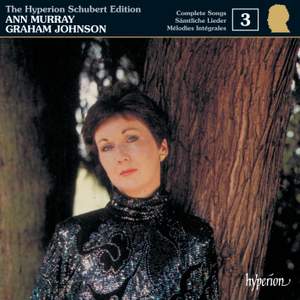
| |  | The Hyperion Schubert Edition - Complete Songs Volume 3Schubert and his Friends (I)
Schubert: | Der Jungling und der Tod, D545 (Spaun) An die Freunde, D654 (Mayrhofer) Augenlied, D297 (Mayrhofer) Ruckweg, D476 (Mayrhofer) Iphigenia, D573 (Mayrhofer) Liedesend, D473 (Mayrhofer) Namenstagslied, D695 (Stadler) Lieb Minna, D222 (Stadler) Pax vobiscum, D551 (Schober) Viola, D786 (Schober) Trost im Liede, D546 (Schober) Der Zwerg, D771 (Collin) Nacht und Träume, D827 Abschied D475 (Mayrhofer) |
'This persuasive disc is faultlessly recorded' (Gramophone) 'Simply superb' | | | In stock - usually despatched within 1 working day. |
|
|
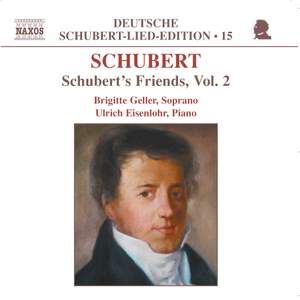
| |  | Volume 15 - Schubert’s Friends Volume 2
Schubert: | Im Haine, D738 Am See, D746 (Bruchmann) Schwestergruss, D762 (Bruchmann) Lieden der Trennung, D509 (1st version) Wehmut, D772 (Collin) Nacht und Träume, D827 Der Knabe in der Wiege, D579 (Ottenwalt) Auf einen Kirchhof, D151 Aus 'Diego Manzanares', Ilmerine D458 Widerschein, D639 (Schlechta) Des Fräuleins Liebeslauschen, D698 Trost im Liede, D546 (Schober) Todesmusik, D758 (Schober) Viola, D786 (Schober) Vergissmeinnicht D792 (Schober) Lieb Minna, D222 (Stadler) Namenstagslied, D695 (Stadler) |
Brigitte Geller (soprano) & Ulrich Eisenlohr (piano) “The flavour of the songs, composed between 1815 and 1923, is predominantly warm, as if Schubert were enjoying composition as an act of relaxation. [Eisenlohr] shows impressive poise and poetic understanding” Sunday Times | | | (also available to download from $6.00) | Usually despatched in 2 - 3 working days. (Available now to download.) |
|
|
| |
|