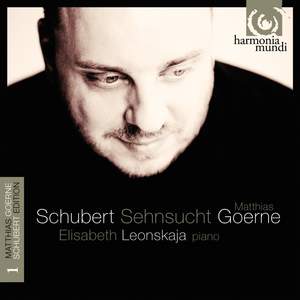
All recordingsPrices shown exclude VAT. (UK tax is not payable for deliveries to United States.) See Terms & Conditions for p&p rates. | |  | Schubert Lieder Volume 1: Sehnsucht
Schubert: | Fahrt zum Hades, D526 (Mayrhofer) Freiwilliges Versinken D700 (Mayrhofer) Das Weinen D926 (Leitner) Des Fischers Liebesgluck, D933 (Leitner) Der Winterabend (Es ist so still), D938 Memnon, D541 (Mayrhofer) Lied eines Schiffers an die Dioskuren D360 (Mayrhofer) Der Schiffer, D536 (Mayrhofer) Sehnsucht, D636 (Schiller) Der Jungling am Bache D638 An Emma, D113 Der Pilgrim, D794 (Schiller) Gruppe aus dem Tartarus, second version, D583 (Schiller) Hoffnung, D295 Grenzen der Menschheit, D716 |
“Critics have sung Mr. Goerne's praises over and over, and one can hardly add anything at this point: The voice is one of the most beautiful - most lush, most creamy - that any of us has ever heard. His singing is almost impossibly smooth. The first time you hear it, you can scarcely believe it. Even the 10th time, you have to wonder… An impressive recital. Matthias Goerne: a first-class and unforgettable lieder singer.” The New York Sun “In the sombre and elegiac songs that dominate his programme, Goerne is in his element, singing with his distinctive dark, rounded beauty and almost tortured intensity of thought and feeling. More than almost any other Lieder singer today, he combines expressive diction with an unblemished legato... In their mingled majesty and aching tenderness, Goerne's performances of two great Mayrhofer settings...are as moving as any performances I can remember.
With his deep mahogany tones and innate seriousness of manner (on the concert platform he habitually wears a haunted air), Goerne is less convincing when a certain lightness of touch is needed. While not many of his chosen songs require him to smile, one that surely does is the wistful barcarolle Des Fischers Liebesglück, whose fisherman in question sounds thoroughly depressed. It is the same in Der Jüngling am Bache, where Goerne's slow, doleful performance suggests hopeless resignation rather than the tremulous expectancy implied by poem and music.” The Telegraph, 28th April 2008 “Goerne's renowned breath control … creates the hushed legato which is his hallmarl. This comes into its own in the Mayrhofer and Leitner settings, creating the mesmeric lilt of water and of light.” BBC Music Magazine, May 2008 **** “His voice has a melting allure that draws you in completely to the sentiments of the song, and the disarming beauty of Schubert's music. These performances glow in various lights, rounding off a truly excellent first
volume of an ongoing Schubert series.” The Scotsman “Following Dietrich Fischer-Dieskau nearly 40 years on, Goerne is in his element, singing with his distinctive dark, rounded beauty and almost tortured intensity of thought and feeling. More than almost any other Lieder singer today, he combines expressive
diction with an unblemished legato, "bowing" Schubert's long lines like a master cellist (shades here of the great Hans Hotter). In their mingled majesty and aching tenderness, Goerne's performances of two great
Mayrhofer settings, Memon and Lied eines Schiffers an die Dioskuren, are as moving as any performances I can remember.” The Telegraph, 26 April 2008 Classical CD of the Week “Matthias Goerne is fast becoming the Fischer-Dieskau of his generation, the standard-setting singer of the central lieder repertoire.” International Record Review “'Do you know of any happy music?' Schubert once asked a friend. 'I don't.' Those words could stand as an epigraph to Matthias Goerne's opening salvo in a projected 11- or 12-disc survey of Schubert Lieder. Evanescence, elegy and yearning for a transcendent otherness are the keynotes of a programme that encompasses the Attic majesty and terribilità of 'Memnon' and 'Gruppe aus dem Tartarus', the disillusioned fatalism of 'Der Pilgrim' and the philosophical grandeur of 'Grenzen der Menschenheit'. In these songs Goerne, with his distinctive dark, velvet timbre, is in his element. An intense, almost tortured concentration of thought and feeling has always been his hallmark, as has an unblemished legato. The way he bows Schubert's long lines like a cellist is reminiscent of the great Hans Hotter. Goerne's rich bass resonances are heard to advantage in a performance of 'Grenzen der Menschenheit' that embraces aching tenderness as well as deep, rolling gravitas. 'Memnon' – a typical Mayrhofer allegory of the artist as tragic outsider – is equally spellbinding, illuminated by telling details like the lingering portamento on 'liebend' – 'lovingly' – as dawn's rays break through the mists. And when have the hazardous leaps of another allegorical Mayrhofer song, 'Freiwilliges Versinken been negotiated with such smoothness and hypnotic eloquence. Where doubts creep in is in the handful of songs where, pace Schubert's own words, a certain lightness of tone and spirit is implied, but Goerne's involvement is so palpable and his style so scrupulous. For two-thirds and more of this recital the interpretative rewards are uncommonly rich, with the baritone well complemented by Elisabeth Leonskaja's deep-toned (if on occasion over-pedalled), often orchestrally conceived accompaniments.” Gramophone Classical Music Guide, 2010 | | | In stock - usually despatched within 1 working day. |
|
|
| |  | Dietrich Fischer-Dieskau: Schubert & Schumann RecitalsTwo Films by Bruno Monsaingeon
Schubert: | An Schwager Kronos, D369 Hoffnung, D637 Auf der Donau, D553 (Mayrhofer) Der Strom, D565 (poet unknown) Der Wanderer, D489 Die Gotter Griechenlands D677 (Schiller) Freiwilliges Versinken D700 (Mayrhofer) Der Zwerg, D771 (Collin) Wehmut, D825 Totengräbers Heimwehe D842 (Craigher) Auf der Bruck, D853 Des Sängers Habe D832 (Schiechta) Am Fenster, D878 Fischerweise, D881 (Schlechta) Das Zugenglocklein D871 (Seidl) Der Kreuzzug D932 (Leitner) Des Fischers Liebesgluck, D933 (Leitner) Die Sterne, D939 (Leitner) Der Einsame, D800 Aus 'Heliopolis' - II D754 (Mayrhofer) Geheimes, D719 (Goethe) Im Abendrot, D799 Abschied D475 (Mayrhofer) | Schumann: | Mein Wagen rollet langsam, Op. 142 No. 4 Es leuchtet meine Liebe, Op. 127 No. 3 Abends am Strand, Op. 45 No. 3 Liederkreis, Op. 24 Dichterliebe, Op. 48 Du bist wie eine Blume, Op. 25 No. 24 Der Kontrabandiste, Op. 74 No. 10 Erstes Grün, Op. 35 No. 4 Schöne Fremde (No. 6 from Liederkreis, Op. 39) Sitz'ich allein, Op. 25, No. 1 |
SCHUBERT RECITAL (1992) SCHUMANN RECITAL (1991)
This DVD release celebrates the life of Dietrich Fischer-Dieskau, German lyric baritone and one of the most acclaimed Lieder performers of the late 20th century. Elisabeth Schwarzkopf called him ‘a born god who has it all’. He performed and recorded a great many operatic roles and dominated both the opera and concert platform for over thirty years, being regarded as one of the finest lyrical vocalists of his generation. In these two concerts from the Opera Theatre of Nuremberg, recorded in 1991 and 1992, Fischer-Dieskau performs beautiful and dramatic Lieder by Franz Schubert and Robert Schumann. 157 MINS • ALL REGIONS • NTSC 4:3 • COLOUR • L-PCM STEREO | 
| | | Usually despatched in 4 - 5 working days. |
|
|
| |  | WandererSchubert & Mahler - Lieder
Christoph Sokler (baritone) & Anne Le Bozec (piano) Christoph Sökler has devoted himself entirely to the study of the voice and has graduated with honours from a number of institutions, including the Guildhall in London. He has studied with Fischer-Dieskau and Elisabeth Schwartzkopf. His repertoire ranges from Schütz to contemporary music and he has performed throughout Europe. | | | Usually despatched in 2 - 3 working days. |
|
|
| |  | Volume 10 - Austrian Contemporaries Volume 1
“If you want to get to know some marvelous late Schubert songs for minimal outlay, Genz's intelligent, personable performances, sympathetically accompanied by Wolfram Rieger, won't disappoint” BBC Music Magazine, Febuary 2003 | | | (also available to download from $6.00) | Usually despatched in 2 - 3 working days. (Available now to download.) |
|
|
| |  | Schubert - Ausgewählte Lieder
Schubert: | Prometheus, D674 (Goethe) Meeres Stille, D216, Op. 3 No. 2 (Goethe) An die Leier, D737 (Bruchmann) Memnon, D541 (Mayrhofer) Freiwilliges Versinken D700 (Mayrhofer) Der Tod und das Mädchen, D531 Gruppe aus dem Tartarus, first version, D396 (Schiller) Nachtstück, D672 (Mayrhofer) Totengräbers Heimwehe D842 (Craigher) Der Wanderer an den Mond D870 (Seidl) Abendstern, D806 Selige Welt, F743 (Senn) Auf der Donau, D553 (Mayrhofer) Über Wildemann D884 (Ernst Schulze) Wandrers Nachtlied II 'Über allen Gipfeln ist Ruh', D768 Des Fischers Liebesgluck, D933 (Leitner) An die Laute D905 Der Musensohn, D764 (Goethe) Nachtviolen D752 (Mayrhofer) Geheimnis, D491 (Mayrhofer) Das Fischermädchen D957 No. 10 An Sylvia, D891 Im Abendrot, D799 |
| | | Usually despatched in 3 - 4 working days. |
|
|
| |  | Hans Hotter - Lieder
Brahms: | Auf dem Kirchhofe, Op. 105 No. 4 Sapphische Ode, Op. 94 No. 4 Sonntag, Op. 47 No. 3 Botschaft, Op. 47 No. 1 | Loewe, C: | Der Erlkönig, Op. 1 No. 3 (Goethe) Die wandelnde Glocke, Op. 20 No..3 Hochzeitlied, Op. 20 No. 1 | Schubert: | Grenzen der Menschheit, D716 Wandrers Nachtlied II 'Über allen Gipfeln ist Ruh', D768 Geheimes, D719 (Goethe) Prometheus, D674 (Goethe) Sei mir gegrüsst! D741 (Rückert) Am Bach im Fruhling, D361 Des Fischers Liebesgluck, D933 (Leitner) Alinde, D904 Gruppe aus dem Tartarus, second version, D583 (Schiller) | Strauss, R: | Himmelsboten zu Liebchens Himmelbett, Op. 32 No. 5 Ach weh mir unglückhaftem Mann, Op. 21 No. 4 Nichts, Op. 10 No. 2 | Wolf, H: | So lang man nüchtern ist (No. 36 from Goethe-Lieder) Ob de Koran von Ewigkeit sei? (No. 34 from Goethe-Lieder) Der verzweifelte Liebhaber (No. 14 from Eichendorff-Lieder) |
| | | Usually despatched in 3 - 4 working days. |
|
|
| |  | Schubert & Schumann: Lieder
| | | Usually despatched in 2 - 3 working days. |
|
|
| |  | Elisabeth Schumann - Schubert Lieder (1927-1945)
Schubert: | Die Post, D911 (No. 13 from Winterreise, D911) Wohin? (No. 2 from Die schöne Müllerin, D795) Im Abendrot, D799 Die Vogel D691 Du bist die Ruh D776 (Rückert) Heidenröslein, D257 Das Lied im Grünen, D917 An die Nachtigall, D497 Liebhaber in allen Gestalten, D558 Ständchen 'Horch! Horch! die Lerch!', D889 An die Musik D547 Der Jüngling an der Quelle, D300 (Salis-Seewis) Geheimes, D719 (Goethe) Auf dem Wasser zu singen, D774 Des Fischers Liebesgluck, D933 (Leitner) Der Musensohn, D764 (Goethe) Fischerweise, D881 (Schlechta) Gretchen am Spinnrade, D118 Nacht und Träume, D827 Seligkeit D433 (Holty) Nähe des Geliebten, D162 Lachen und Weinen, D777 Der Einsame, D800 Wiegenlied, D498 Der Schmetterling D633 Des Baches Wegenlied (No. 20 from Die schöne Müllerin, D795) Der Hirt auf dem Felsen, D965 (Von Chezy / Muller) Die Forelle, D550 |
Elisabeth Schumann (soprano) & George Reeves (piano) “In songs of a youthful, spring-like, artless nature, she was, and remains in some respects, supreme. There is an outgoing spontaneity, a pearly tone and absence of sophistication that appeal to the heart of the listener and that today’s singers find hard to emulate” Gramophone Magazine | | | (also available to download from $9.00) | Usually despatched in 2 - 3 working days. (Available now to download.) |
|
|
| |  | Dietrich Fischer-Dieskau: The Great EMI Recordings
Brahms: | Die schöne Magelone, Op. 33 Sviatoslav Richter (piano) Feldeinsamkeit, Op. 86 No. 2 Daniel Barenboim (piano) Vier ernste Gesänge, Op. 121 Wolfgang Sawallisch (piano) | Cornelius: | Weihnachtslieder (6), Op. 8 Hermann Reutter (piano) | Grieg: | Zur Rosenzeit (No. 5 from Seks Sange, Op. 48) Hartmut Holl (piano) | Liszt: | Es rauschen die Winde, S294 Ständchen, S301 Über allen Gipfeln ist Ruh (Wandrers Nachtlied II), S.306 Wieder mocht’ ich dir begegnen Aribert Reimann (piano) | Loewe, C: | Der Erlkönig, Op. 1 No. 3 (Goethe) Herr Oluf "Herr Oluf reitet spät und weit", Op. 2/2 Der Schatzgräber, Op. 59 No. 30 Archibald Douglas, Op. 128 Tom der Reimer "Der Reimer Thomas lag am Bach", Op. 135a Gerald Moore (piano) | Mahler: | Lieder eines fahrenden Gesellen (4 songs, complete) Daniel Barenboim (piano) Rückert-Lieder (5 songs, complete) Daniel Barenboim (piano) Der Schildwache Nachtlied (Des Knaben Wunderhorn) Verlorne Müh' (Des Knaben Wunderhorn) Das irdische Leben (Des Knaben Wunderhorn) Des Antonius von Padua Fischpredigt (Des Knaben Wunderhorn) Rheinlegendchen (Des Knaben Wunderhorn) Wo die schönen Trompeten blasen (Des Knaben Wunderhorn) Lob des hohen Verstandes (Des Knaben Wunderhorn) Revelge (Des Knaben Wunderhorn) Der Tambourg'sell (Des Knaben Wunderhorn) Daniel Barenboim (piano) Revelge (Des Knaben Wunderhorn) London Symphony Orchestra, George Szell | Mendelssohn: | Neue Liebe, Op. 19a No. 4 Gruß, Op. 19a No. 5 Auf Flügeln des Gesanges, Op. 34 No. 2 Morgengruss (Heine) Op. 47 No. 2 Venetianisches Gondellied, Op. 57 No. 5 'Wenn durch die Piazetta' Nachtlied, Op. 71 No. 6 Der Mond, Op. 86 No. 5 Wolfgang Sawallisch (piano) | Schubert: | Die schöne Müllerin, D795 Gerald Moore (piano) Winterreise D911 Gerald Moore (piano) Schwanengesang, D957 Gerald Moore (piano) Du bist die Ruh D776 (Rückert) Nacht und Träume, D827 Rastlose Liebe, D138 Nachtviolen D752 (Mayrhofer) Der Einsame, D800 Auflösung, D807 Der Wanderer an den Mond D870 (Seidl) Der Wanderer, D489 An die Musik D547 Auf der Bruck, D853 Im Frühling, D882 An Sylvia, D891 Erlkönig, D328 Nachtstück, D672 (Mayrhofer) Gruppe aus dem Tartarus, second version, D583 (Schiller) Abendstern, D806 Sei mir gegrüsst! D741 (Rückert) Lachen und Weinen, D777 Heidenröslein, D257 Der Jüngling an der Quelle, D300 (Salis-Seewis) Litanei auf das Fest Allerseelen, D343 Seligkeit D433 (Holty) Der Tod und das Mädchen, D531 An die Laute D905 Im Abendrot, D799 Digitally remastered in 2003 Die Forelle, D550 Auf dem Wasser zu singen, D774 Fischerweise, D881 (Schlechta) Des Fischers Liebesgluck, D933 (Leitner) Der Schiffer, D536 (Mayrhofer) Der Winterabend (Es ist so still), D938 Einsamkeit, D620 Das Lied im Grünen, D917 Ständchen 'Horch! Horch! die Lerch!', D889 Wohin? (No. 2 from Die schöne Müllerin, D795) Gerald Moore (piano) Gute Nacht (No. 1 from Winterreise, D911) Gerald Moore (piano) | Schumann: | Liederkreis, Op. 39 Digitally remastered in 2004 Gerald Moore (piano) Romanzen und Balladen I, Op. 45 Digitally remastered in 2004 Liederkreis, Op. 24 Digitally remastered in 2005 Hertha Klunst (piano) Die beiden Grenadiere, Op. 49 No. 1 Gerald Moore (piano) Die feindlichen Brüder, Op. 49 No. 2 Hertha Klunst (piano) Der arme Peter, Op. 53 No. 3 Hertha Klunst (piano) Tragödie Op. 64 No. 3 Hertha Klunst (piano) | Strauss, R: | Zueignung, Op. 10 No. 1 Die Nacht, Op. 10 No. 3 Allerseelen, Op. 10 No. 8 Heimkehr, Op. 15 No. 5 Ständchen, Op. 17 No. 2 All mein Gedanken ... Op. 21 No. 1 Ruhe, meine Seele!, Op. 27 No. 1 Cäcilie, Op. 27 No. 2 Heimliche Aufforderung, Op. 27 No. 3 Morgen, Op. 27 No. 4 Traum durch die Dämmerung, Op. 29 No. 1 Nachtgang Op. 29 No. 3 Blauer Sommer, Op. 31 No. 1 Ich trage meine Minne, Op. 32 No. 1 Sehnsucht Op. 32 No. 2 Liebeshymnus, Op. 32 No. 3 Das Rosenband, Op. 36 No. 1 Meinem Kinde, Op. 37 No. 3 Befreit, Op. 39 No. 4 Freundliche Vision, Op. 48 No. 1 Winterliebe Op. 48 No. 5 Winterweihe, Op. 48 No. 4 Waldseligkeit, Op. 49 No. 1 Gefunden Op. 56 No. 1 Die heiligen drei Könige aus Morgenland Op. 56 No. 6 Einerlei, Op. 69 No. 3 Schlechtes Wetter, Op. 69 No. 5 Das Bächlein, Op. 88 No. 1 Gerald Moore (piano) | Verdi: | Vanne, la tua meta gia vedo…Credo in un Dio crudel (from Otello) New Philharmonic Orchestra, Sir John Barbirolli | Wagner: | Der Tannenbaum, WWV 50 Aribert Reimann (piano) | Wolf, H: | Der Freund (No. 1 from Eichendorff-Lieder) Der Musikant (No. 2 from Eichendorff-Lieder) Verschwiegene Liebe (No. 3 from Eichendorff-Lieder) Das Ständchen (No. 4 from Eichendorff-Lieder) Heimweh (No. 12 from Eichendorff-Lieder) Der Genesene an die Hoffnung (No. 1 from Mörike-Lieder) Jägerlied (No. 4 from Mörike-Lieder) Der Tambour (No. 5 from Mörike-Lieder) Begegnung (No. 8 from Mörike-Lieder) Fussreise (No. 10 from Mörike-Lieder) Verborgenheit (No. 12 from Mörike-Lieder) Im Frühling (No. 13 from Mörike-Lieder) Auf ein altes Bild (No. 23 from Mörike-Lieder) In der Frühe (No. 24 from Mörike-Lieder) Gebet (No. 28 from Mörike-Lieder) An die Geliebte (No. 32 from Mörike-Lieder) Der Feuerreiter (No. 44 from Mörike-Lieder) Gesang Weylas (No. 46 from Mörike-Lieder) Storchenbotschaft (No. 48 from Mörike-Lieder) Abschied (No. 53 from Mörike-Lieder) Harfenspieler I (No. 1 from Goethe-Lieder) Harfenspieler II (No. 2 from Goethe-Lieder) Harfenspieler III (No. 3 from Goethe-Lieder) Anakreons Grab (No. 29 from Goethe-Lieder) Der Rattenfänger (No. 11 from Goethe-Lieder) Verborgenheit (No. 12 from Mörike-Lieder) Gerald Moore (piano) |
Plus extracts from two interviews recorded in 2000 and 2005: some parts of the interviews have previously been aired by the WFMT Radio Network and published by VAI and Gramophone, and those organisations have kindly agreed to their reissue here. However, much of this documentary has never been heard or published before. Sung texts with translations can be found on CD11 in pdf form, which can be accessed from any computer equipped with CD-ROM drive and Adobe Acrobat 6.0.
“All in all, this is a magnificent retrospective...Strongly recommended.” Gramophone Magazine, July 2010 | | | In stock - usually despatched within 1 working day. |
|
|
| |
|