All recordingsPrices shown exclude VAT. (UK tax is not payable for deliveries to United States.) See Terms & Conditions for p&p rates. | |  | Schubert Lieder Volume 1: Sehnsucht
Schubert: | Fahrt zum Hades, D526 (Mayrhofer) Freiwilliges Versinken D700 (Mayrhofer) Das Weinen D926 (Leitner) Des Fischers Liebesgluck, D933 (Leitner) Der Winterabend (Es ist so still), D938 Memnon, D541 (Mayrhofer) Lied eines Schiffers an die Dioskuren D360 (Mayrhofer) Der Schiffer, D536 (Mayrhofer) Sehnsucht, D636 (Schiller) Der Jungling am Bache D638 An Emma, D113 Der Pilgrim, D794 (Schiller) Gruppe aus dem Tartarus, second version, D583 (Schiller) Hoffnung, D295 Grenzen der Menschheit, D716 |
“Critics have sung Mr. Goerne's praises over and over, and one can hardly add anything at this point: The voice is one of the most beautiful - most lush, most creamy - that any of us has ever heard. His singing is almost impossibly smooth. The first time you hear it, you can scarcely believe it. Even the 10th time, you have to wonder… An impressive recital. Matthias Goerne: a first-class and unforgettable lieder singer.” The New York Sun “In the sombre and elegiac songs that dominate his programme, Goerne is in his element, singing with his distinctive dark, rounded beauty and almost tortured intensity of thought and feeling. More than almost any other Lieder singer today, he combines expressive diction with an unblemished legato... In their mingled majesty and aching tenderness, Goerne's performances of two great Mayrhofer settings...are as moving as any performances I can remember.
With his deep mahogany tones and innate seriousness of manner (on the concert platform he habitually wears a haunted air), Goerne is less convincing when a certain lightness of touch is needed. While not many of his chosen songs require him to smile, one that surely does is the wistful barcarolle Des Fischers Liebesglück, whose fisherman in question sounds thoroughly depressed. It is the same in Der Jüngling am Bache, where Goerne's slow, doleful performance suggests hopeless resignation rather than the tremulous expectancy implied by poem and music.” The Telegraph, 28th April 2008 “Goerne's renowned breath control … creates the hushed legato which is his hallmarl. This comes into its own in the Mayrhofer and Leitner settings, creating the mesmeric lilt of water and of light.” BBC Music Magazine, May 2008 **** “His voice has a melting allure that draws you in completely to the sentiments of the song, and the disarming beauty of Schubert's music. These performances glow in various lights, rounding off a truly excellent first
volume of an ongoing Schubert series.” The Scotsman “Following Dietrich Fischer-Dieskau nearly 40 years on, Goerne is in his element, singing with his distinctive dark, rounded beauty and almost tortured intensity of thought and feeling. More than almost any other Lieder singer today, he combines expressive
diction with an unblemished legato, "bowing" Schubert's long lines like a master cellist (shades here of the great Hans Hotter). In their mingled majesty and aching tenderness, Goerne's performances of two great
Mayrhofer settings, Memon and Lied eines Schiffers an die Dioskuren, are as moving as any performances I can remember.” The Telegraph, 26 April 2008 Classical CD of the Week “Matthias Goerne is fast becoming the Fischer-Dieskau of his generation, the standard-setting singer of the central lieder repertoire.” International Record Review “'Do you know of any happy music?' Schubert once asked a friend. 'I don't.' Those words could stand as an epigraph to Matthias Goerne's opening salvo in a projected 11- or 12-disc survey of Schubert Lieder. Evanescence, elegy and yearning for a transcendent otherness are the keynotes of a programme that encompasses the Attic majesty and terribilità of 'Memnon' and 'Gruppe aus dem Tartarus', the disillusioned fatalism of 'Der Pilgrim' and the philosophical grandeur of 'Grenzen der Menschenheit'. In these songs Goerne, with his distinctive dark, velvet timbre, is in his element. An intense, almost tortured concentration of thought and feeling has always been his hallmark, as has an unblemished legato. The way he bows Schubert's long lines like a cellist is reminiscent of the great Hans Hotter. Goerne's rich bass resonances are heard to advantage in a performance of 'Grenzen der Menschenheit' that embraces aching tenderness as well as deep, rolling gravitas. 'Memnon' – a typical Mayrhofer allegory of the artist as tragic outsider – is equally spellbinding, illuminated by telling details like the lingering portamento on 'liebend' – 'lovingly' – as dawn's rays break through the mists. And when have the hazardous leaps of another allegorical Mayrhofer song, 'Freiwilliges Versinken been negotiated with such smoothness and hypnotic eloquence. Where doubts creep in is in the handful of songs where, pace Schubert's own words, a certain lightness of tone and spirit is implied, but Goerne's involvement is so palpable and his style so scrupulous. For two-thirds and more of this recital the interpretative rewards are uncommonly rich, with the baritone well complemented by Elisabeth Leonskaja's deep-toned (if on occasion over-pedalled), often orchestrally conceived accompaniments.” Gramophone Classical Music Guide, 2010 | | | In stock - usually despatched within 1 working day. |
|
|
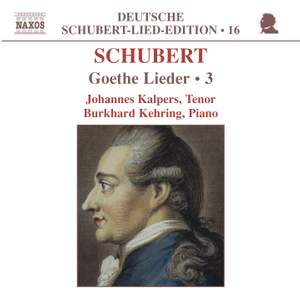
| |  | Volume 16 - Goethe Volume 3
Schubert: | Wer kauft Liebesgotter?, D261 (Goethe) Versunken D715 (Goethe) Nachtgesang, D119 Erster Verlust, D226 (Goethe) Trost in Tränen, D120 Jägers Abendlied, First Setting, D215 Jägers Abendlied, Second Setting, D368 Tischlied, D234 Willkommen und Abschied, D767 Schäfers Klagelied, D121 (Goethe) Erlkönig, D328 Hoffnung, D295 Auf dem See, D543 (Goethe) Mahomets Gesang, First Setting, D549 Am Flusse D160 (Goethe) Am Flusse, D766 Johanna Sebus (Fragment), D728 An die Entfernte, D765 (Goethe) Sehnsucht, D123 Geheimes, D719 (Goethe) Der Goldschmiedsgesell, D560 Liebhaber in allen Gestalten, D558 Der Musensohn, D764 (Goethe) Der Sänger, D149 |
Johannes Kalpers (tenor), Burkhard Kehrin (piano) | | | (also available to download from $6.00) | Usually despatched in 2 - 3 working days. (Available now to download.) |
|
|
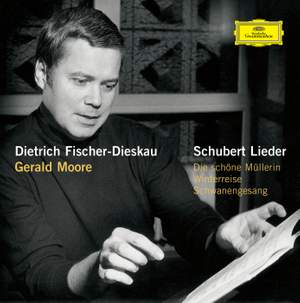
| |  | Schubert: Goethe-Lieder
Schubert: | Erlkönig, D328 Wonne der Wehmut D260 (Goethe) An den Mond, D259 (Goethe) Geheimes, D719 (Goethe) Versunken D715 (Goethe) Hoffnung, D295 Wandrers Nachtlied II 'Über allen Gipfeln ist Ruh', D768 Rastlose Liebe, D138 Jägers Abendlied, Second Setting, D368 Wandrers Nachtlied I 'Der du von dem Himmel bist', D224 An Mignon D161 Ganymed, D544 (Goethe) An Schwager Kronos, D369 Der König in Thule, D367 Am Flusse, D766 Erster Verlust, D226 (Goethe) Der Rattenfänger, D255 Meeres Stille, D216, Op. 3 No. 2 (Goethe) Schäfers Klagelied, D121 (Goethe) Heidenröslein, D257 An die Entfernte, D765 (Goethe) Der Musensohn, D764 (Goethe) |
| |
|
| |  | Follow GoetheLieder after poems by Goethe
Beethoven: | Neue Liebe, Neues Leben, Op. 75, 2 Wonne der Wehmut, Op. 83 No. 1 | Diepenbrock: | Der Fischer | Gees: | Gegenwart Gesang der Geister über den Wassern | Grieg: | Zur Rosenzeit (No. 5 from Seks Sange, Op. 48) | Loewe, C: | Der Erlkönig, Op. 1 No. 3 (Goethe) Lynceus der Turmer, auf Fausts Sternwarte singend, Op. 9, H.VIII, 3 Wandrers Nachlied, Op. 9 No. 3a | Pfitzner: | Mailied, Op. 26 No. 5 | Schoeck: | Herbstgefühl, Op. 19a No. 1 Dämmrung senkte sich von oben, Op. 19 No. 2 Nachklang, Op. 19b No. 1 | Schubert: | Meeres Stille, D216, Op. 3 No. 2 (Goethe) Erster Verlust, D226 (Goethe) Wandrers Nachtlied II 'Über allen Gipfeln ist Ruh', D768 Versunken D715 (Goethe) Jägers Abendlied, Second Setting, D368 Hoffnung, D295 | Schumann: | Freisinn, Op. 25 No. 2 An die Türen will ich schleichen, Op. 98a No. 8 Singet nicht In Trauertönen Op. 98a No. 7 (Johann Wolfgang von Goethe) | Wolf, H: | Phänomen (No. 32 from Goethe-Lieder) Blumengruss (No. 24 from Goethe-Lieder) Anakreons Grab (No. 29 from Goethe-Lieder) Frühling übers Jahr (No. 28 from Goethe-Lieder) Der Rattenfänger (No. 11 from Goethe-Lieder) |
| | | Usually despatched in 2 - 3 working days. |
|
|
| |
|