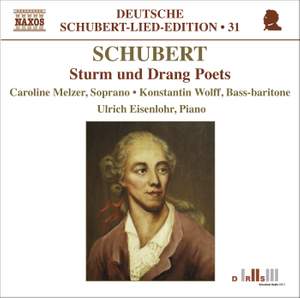
Prices shown exclude VAT. (UK tax is not payable for deliveries to United States.) See Terms & Conditions for p&p rates. | |  | Volume 31- Sturm und Drang Poets
Caroline Melzer (soprano) Konstantin Wolff (bass-baritone) & Ulrich Eisenlohr (piano) Schubert set the poetry of over 115 writers to music. He selected poems from classical Greece, the Middle Ages and the Renaissance, from eighteenth-century German authors, early Romantics, Biedermeier poets, and Heine. The Deutsche Schubert-Lied-Edition presents all Schubert’s Lieder, over 700 songs, grouped according to the poets who inspired him. Naxos’s acclaimed series of Schubert’s Lieder continues with a selection of songs including the famous Die Forelle (The Trout), Am Tage Aller Seelen (On All Souls’ Day) and others with texts by poets associated with the Sturm und Drang (Storm and Stress) literary movement. | | | (also available to download from $6.00) | Usually despatched in 2 - 3 working days. (Available now to download.) |
|
|
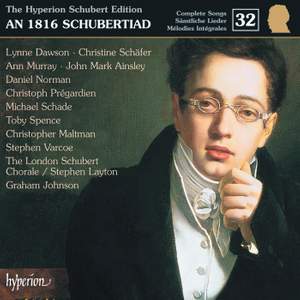
| |  | The Hyperion Schubert Edition - Complete Songs Volume 32An 1816 Schubertiad
Lynne Dawson, Christine Schäfer (sopranos), Ann Murray (mezzo soprano), John Mark Ainsley, Daniel Norman, Christoph Prégardien, Michael Schade, Toby Spence (tenors), Christopher Maltman, Stephen Varcoe (baritones), Patricia Rozario Soprano, Catherine Wyn-Rogers Mezzo (soprano), Paul Agnew, Jamie Macdougall, Philip Langridge (tenors), Simon Keenlyside, Maarten Koningsberger, Stephan Loges (baritones), Neal Davies, Michael George (basses) The London Schubert Chorale, Stephen Layton 'As ever, illuminating words complement revelatory music-making' (BBC Music Magazine) “Like the previous Schubertiads in the Edition, this disc mixes solo songs and partsongs, famil- iar and unfamiliar. The only really famous work here is Der Wanderer, that archetypal expression of romantic alienation whose popularity in Schubert's lifetime was eclipsed only by that of Erlkönig. Some of the partsongs – Zum Punsche, Naturgenuss and Schlachtgesang – cultivate a vein of Biedermeier heartiness that wears a bit thin today. Nor will Schubert's consciously archaic tribute to his teacher Salieri have you itching for the repeat button – though, like several other numbers, it shows the 19-year-old composer rivalling Mozart in his gift for musical mimicry. To compensate, though, there are partsongs like the sensual Der Entfernten, with its delicious languid chromaticisms, and the colourful setting of Gott im Ungewitter. The slight but charming setting of Das war ich is appealingly done by the light-voiced Daniel Norman, and Ann Murray brings her usual charisma and dramatic conviction to the pathetic Italian scena Didone Abbandonata. Christine Schäfer is equally charismatic in the unjustly neglected Die verfehlte Stunde (recorded here for the first time), catching perfectly the song's mingled yearning and ecstasy and negotiating the mercilessly high tessitura with ease. Other happy discoveries include Schubert's virtually unknown third setting of Des Mädchens Klage, with its soaring lines, a melancholy tale of courtly love, sung by Christoph Prégardien with as much drama and variety as the music allows, and the surging Entzückung ('music for an infant Lohengrin,' as Graham Johnson puts it), for which Toby Spence has both the flexibility and the necessary touch of metal in the tone. Doubts were fleetingly raised by Lynne Dawson's slight tremulousness in Des Mädchens Klage, and by Christopher Maltman's prominent vibrato at forte and above in an otherwise involving performance of Der Wanderer. But, these cavils apart, no complaints about the singing or the vivid accompaniments.” Gramophone Classical Music Guide, 2010 | | | Usually despatched in 2 - 3 working days. |
|
|
| |
|