Prices shown exclude VAT. (UK tax is not payable for deliveries to United States.) See Terms & Conditions for p&p rates. | |  | Schubert: Lieder
Schubert: | Gretchen am Spinnrade, D118 Heidenröslein, D257 Lieb Minna, D222 (Stadler) Ganymed, D544 (Goethe) Geheimes, D719 (Goethe) Auf dem See, D543 (Goethe) Der Musensohn, D764 (Goethe) Suleika I, D720 Suleika II, D717 Dass sie hier gewesen! D775 (Rückert) Sei mir gegrüsst! D741 (Rückert) Du bist die Ruh D776 (Rückert) Lachen und Weinen, D777 Schlachtgesang D443 (Klopstock) An die Nachtigall, D497 Wiegenlied, D498 Am Grabe Anselmo's D504 An die Musik D547 Die Forelle, D550 Auf dem Wasser zu singen, D774 Die junge Nonne, D828 An Sylvia, D891 Ständchen 'Horch! Horch! die Lerch!', D889 |
The Lied is at the heart of Schubert’s output. Throughout his short life, and right up to the weeks immediately before his death, he took a keen interest in every aspect of this genre, which constituted the most intimate expression of the German psyche, of which Schubert was from very early on well placed to act as a vehicle for its sentiments and its torments (love, friendship, pain, loneliness), ranging widely across its joys and its sorrows in all their subtle shadings. Schubert composed quickly, occasionally writing as many as nine or ten Lieder in a single day, with a prodigious fluency that won the admiration of Schumann. A born song-writer, he loved to perform his own Lieder, accompanying himself on the piano; he admitted that he could get carried away by singing for hours on end. In Schubert’s songs, the voice is always the focus of attention, while the piano accompaniment provides a psychological backdrop. Less discriminating in his choice of poems than Schumann or Wolf, Schubert was more interested in verbal colouring and the emotional content of a text than in its literary value, and although his some six hundred Lieder are in a wide range of forms – from simple strophic songs to dramatic scenas – they are still characterised by their exceptional simplicity, freshness and spontaneity of utterance. “Arleen Auger brings her special quality of chaste intimacy to gentle, small-scale performances of 23 of Schubert's most popular songs” BBC Music Magazine, October 2010 *** | | | In stock - usually despatched within 1 working day. |
|
|
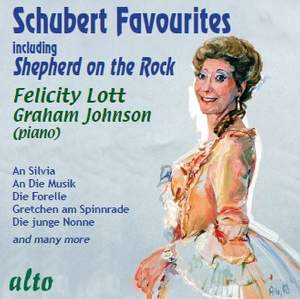
| |  | Felicity Lott sings Schubert Favourites
Schubert: | Die Forelle, D550 An Sylvia, D891 Heidenröslein, D257 Du bist die Ruh D776 (Rückert) Der Musensohn, D764 (Goethe) An die Musik D547 Auf dem Wasser zu singen, D774 Sei mir gegrüsst! D741 (Rückert) Litanei auf das Fest Allerseelen, D343 Die junge Nonne, D828 Ave Maria, D839 Im Frühling, D882 Gretchen am Spinnrade, D118 Nacht und Träume, D827 Ganymed, D544 (Goethe) Nur wer die Sehnsucht kennt, D877/4 Schlachtgesang D443 (Klopstock) Der Hirt auf dem Felsen, D965 (Von Chezy / Muller) with Michael Collins (clarinet) & Ian Brown (piano) |
| | | In stock - usually despatched within 1 working day. |
|
|
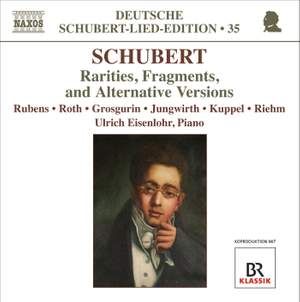
| |  | Volume 35 - Rarities, Fragments, and Alternative Versions
Schubert: | Das Madchen aus der Fremde D117 Laura am Klavier, D388 1st version Die Entzuckung an Laura D577 2nd setting. Fragments completed by Peter Reinhard van Hoorickx Song Sketch, D1a Zur Namensfeier des Herrn Andreas Siller, D83 Auf den Sieg der Deutschen, D81 Lebenstraum D39 (Baumberg) Fragments completed by Peter Reinhard van Hoorickx Lied eines Kindes D596 (poet unknown) Bel dem Grabe meines Vater D496 (Claudius) Der Knabe in der Wiege, D579 (Ottenwalt) 2nd version Nur wer die Liebe kennt ('Impromptu') D513a (Werner) Fragments completed by Peter Reinhard van Hoorickx Gruppe aus dem Tartarus, first version, D396 (Schiller) Mignon (So lasst mich scheinen), D469A Das grosse Halleluja D442 (Klopstock) Evangelium Johannes D607 (Jacobi) Fragments completed by Peter Reinhard van Hoorickx Schlachtgesang D443 (Klopstock) Gesang der Geister über den Wassern, D484 1st setting. Fragments completed by Peter Reinhard van Hoorickx Liedentwurf in A minor, D555 |
Sibylla Rubens (soprano), Detlef Roth (baritone), Reto Kuppel and Peter Riehm (violins), Daniel Grosgurin (cello), Uta Jungwirth (harp) & Ulrich Eisenlohr (piano) This is the last volume in the acclaimed Naxos Schubert-Lied edition. | | | (also available to download from $5.75) | In stock - usually despatched within 1 working day. |
|
|
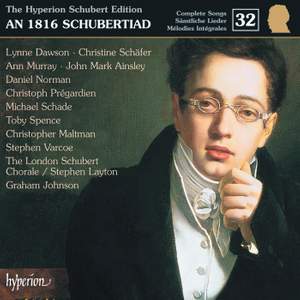
| |  | The Hyperion Schubert Edition - Complete Songs Volume 32An 1816 Schubertiad
Lynne Dawson, Christine Schäfer (sopranos), Ann Murray (mezzo soprano), John Mark Ainsley, Daniel Norman, Christoph Prégardien, Michael Schade, Toby Spence (tenors), Christopher Maltman, Stephen Varcoe (baritones), Patricia Rozario Soprano, Catherine Wyn-Rogers Mezzo (soprano), Paul Agnew, Jamie Macdougall, Philip Langridge (tenors), Simon Keenlyside, Maarten Koningsberger, Stephan Loges (baritones), Neal Davies, Michael George (basses) The London Schubert Chorale, Stephen Layton 'As ever, illuminating words complement revelatory music-making' (BBC Music Magazine) “Like the previous Schubertiads in the Edition, this disc mixes solo songs and partsongs, famil- iar and unfamiliar. The only really famous work here is Der Wanderer, that archetypal expression of romantic alienation whose popularity in Schubert's lifetime was eclipsed only by that of Erlkönig. Some of the partsongs – Zum Punsche, Naturgenuss and Schlachtgesang – cultivate a vein of Biedermeier heartiness that wears a bit thin today. Nor will Schubert's consciously archaic tribute to his teacher Salieri have you itching for the repeat button – though, like several other numbers, it shows the 19-year-old composer rivalling Mozart in his gift for musical mimicry. To compensate, though, there are partsongs like the sensual Der Entfernten, with its delicious languid chromaticisms, and the colourful setting of Gott im Ungewitter. The slight but charming setting of Das war ich is appealingly done by the light-voiced Daniel Norman, and Ann Murray brings her usual charisma and dramatic conviction to the pathetic Italian scena Didone Abbandonata. Christine Schäfer is equally charismatic in the unjustly neglected Die verfehlte Stunde (recorded here for the first time), catching perfectly the song's mingled yearning and ecstasy and negotiating the mercilessly high tessitura with ease. Other happy discoveries include Schubert's virtually unknown third setting of Des Mädchens Klage, with its soaring lines, a melancholy tale of courtly love, sung by Christoph Prégardien with as much drama and variety as the music allows, and the surging Entzückung ('music for an infant Lohengrin,' as Graham Johnson puts it), for which Toby Spence has both the flexibility and the necessary touch of metal in the tone. Doubts were fleetingly raised by Lynne Dawson's slight tremulousness in Des Mädchens Klage, and by Christopher Maltman's prominent vibrato at forte and above in an otherwise involving performance of Der Wanderer. But, these cavils apart, no complaints about the singing or the vivid accompaniments.” Gramophone Classical Music Guide, 2010 | | | In stock - usually despatched within 1 working day. |
|
|
| |
|