Browse: Schubert - Sing-Übungen D619 (Wordless)
Composer: Franz Peter Schubert (1797–1828)
-
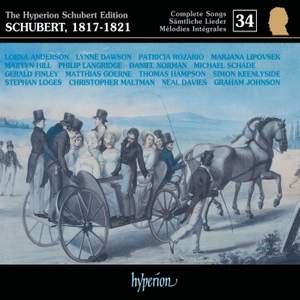
The Hyperion Schubert Edition - Complete Songs Volume 34
Schubert, 1817-1821
Lorna Anderson, Lynne Dawson, Patricia Rozario (sopranos), Marjana Lipovsek (mezzo soprano), Martyn Hill, Philip Langridge, Daniel Norman, Michael Schade (tenors), Gerald Finley, Matthias Goerne, Thomas Hampson, Simon Keenlyside, Stephan Loges, Christopher Maltman (baritones), Neal Davies (bass),...
In his guise as a wizard of an impresario, Graham Johnson has gathered together four baritones and one bass-baritone (Neil Davies) to give us a feast of finely wrought, intelligent interpretations.
Hampson's... — More…Downloads
What are FLAC and MP3? -
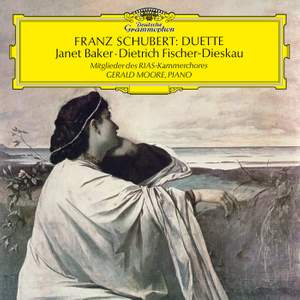
Schubert: Duets
Dame Janet Baker (mezzo-soprano), Dietrich Fischer-Dieskau (baritone), Gerald Moore (piano)
RIAS Kammerchor
Downloads
What are FLAC and MP3? -
21 CDs
$130.50 -
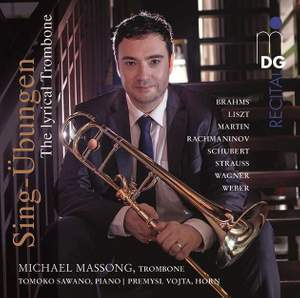
Sing-Übung: The Lyrical Trombone
Michael Massong (trombone), Tomoko Sawano (piano) & Premysl Vojta (horn)
CD
$17.00 -
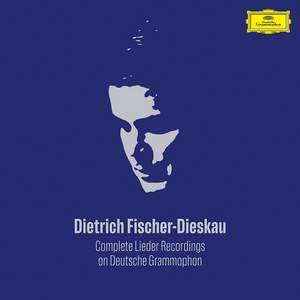
Dietrich Fischer-Dieskau: Complete Lieder Recordings on Deutsche Grammophon
Dietrich Fischer-Dieskau (baritone)
Thirty-two discs are devoted to Schubert and 12 apiece to Wolf, Brahms and Schumann. That still leaves many others, each a witness to his specially penetrating delivery of the words...The recordings... — More…
107 CDs
$365.00