Prices shown exclude VAT. (UK tax is not payable for deliveries to United States.) See Terms & Conditions for p&p rates. | |  | Schubert: Willkommen und Abschied
Schubert: | Heidenröslein, D257 Schlaflied D527 (Mayrhofer) Wiegenlied D867 (Seidl) Geheimes, D719 (Goethe) Ganymed, D544 (Goethe) Auf der Bruck, D853 Der Fischer, D225 (Goethe) Dass sie hier gewesen! D775 (Rückert) Bei dir allein, D866/2 Der Schiffer, D536 (Mayrhofer) Willkommen und Abschied, D767 Der Wanderer, D493 Im Walde D834 Wandrers Nachtlied I 'Der du von dem Himmel bist', D224 Der Einsame, D800 Der Winterabend (Es ist so still), D938 Herbst, D945 Rosamunde, D797: Romance 'Der Vollmond Strahlt auf Bergeshöh'n' Nachtstück, D672 (Mayrhofer) |
Werner Güra (tenor) & Christoph Berner (fortepiano Rönisch) Born in Munich, Werner Güra has a reputation especially as an interpreter of lieder. His recordings for harmonia mundi, including the great cycles of Schubert, Schumann and Wolf and vocal ensembles by Brahms and Schumann, have all been widely acclaimed. “It comprises 19 songs, all stylishly and beautifully sung by the tenor Werner Güra. The six Goethe settings include such familiar contrasts as Heidenröslein and Ganymed, while Willkommen und Abschied itself, more of a rarity, is heroically sung. The strength of Güra’s tone without any loss of quality has always been his strong point.” Sunday Telegraph, 29th January 2012 “His fresh lyric tenor combines well with Berner’s bright yet warm-toned fortepiano — he twinkles at Goethe’s ironic description of a water nymph as “eine feuchtes Weib”, literally a “damp woman” — while Berner brings drama to the piano parts of Auf der Bruck, Willkommen und Abschied and the haunting, yearning Herbst.” Sunday Times, 12th February 2012 “Berner, playing an 1872 Rönisch fortepiano, shows keen attention to every detail. Güra, outstanding in his unfussy, intense delivery, is a formidable, rousing guide.” The Observer, 26th February 2012 “Gura's strong, unaffected tenor voice is a pleasure to listen to, and Berner, who has an impressive keyboard freedom grounded in reliable technical skill, is a responsive accompanist: they perform as one, although too often their approach to a song somehow misses an essential quality of that particular piece of music.” International Record Review, March 2012 **** “Gura and his fortepianist, Christoph Berner, have mapped out a trajectory of the Romantic view of human emotional life...At each stage, both musicians show perfect sympathy with Schubert's own engagement, ideal empathy with each other, and a shrewd sensitivity to musical and expressive scale.” BBC Music Magazine, May 2012 ***** “Gura is never dull. 'Der Wanderer' is intensely 'lived', the opening bleak and desiccated...One of the most eloquent performances of all is the last song, 'Nachtstuck'...Here, singer and pianist show an acute sensitivity to harmonic colour that characterises this whole rewarding recital.” Gramophone Magazine, May 2012 | | | In stock - usually despatched within 1 working day. |
|
|
| |  | Schubert: Lieder
Schubert: | Gretchen am Spinnrade, D118 Heidenröslein, D257 Lieb Minna, D222 (Stadler) Ganymed, D544 (Goethe) Geheimes, D719 (Goethe) Auf dem See, D543 (Goethe) Der Musensohn, D764 (Goethe) Suleika I, D720 Suleika II, D717 Dass sie hier gewesen! D775 (Rückert) Sei mir gegrüsst! D741 (Rückert) Du bist die Ruh D776 (Rückert) Lachen und Weinen, D777 Schlachtgesang D443 (Klopstock) An die Nachtigall, D497 Wiegenlied, D498 Am Grabe Anselmo's D504 An die Musik D547 Die Forelle, D550 Auf dem Wasser zu singen, D774 Die junge Nonne, D828 An Sylvia, D891 Ständchen 'Horch! Horch! die Lerch!', D889 |
The Lied is at the heart of Schubert’s output. Throughout his short life, and right up to the weeks immediately before his death, he took a keen interest in every aspect of this genre, which constituted the most intimate expression of the German psyche, of which Schubert was from very early on well placed to act as a vehicle for its sentiments and its torments (love, friendship, pain, loneliness), ranging widely across its joys and its sorrows in all their subtle shadings. Schubert composed quickly, occasionally writing as many as nine or ten Lieder in a single day, with a prodigious fluency that won the admiration of Schumann. A born song-writer, he loved to perform his own Lieder, accompanying himself on the piano; he admitted that he could get carried away by singing for hours on end. In Schubert’s songs, the voice is always the focus of attention, while the piano accompaniment provides a psychological backdrop. Less discriminating in his choice of poems than Schumann or Wolf, Schubert was more interested in verbal colouring and the emotional content of a text than in its literary value, and although his some six hundred Lieder are in a wide range of forms – from simple strophic songs to dramatic scenas – they are still characterised by their exceptional simplicity, freshness and spontaneity of utterance. “Arleen Auger brings her special quality of chaste intimacy to gentle, small-scale performances of 23 of Schubert's most popular songs” BBC Music Magazine, October 2010 *** | | | In stock - usually despatched within 1 working day. |
|
|
| |  | Schubert - Lieder
Schubert: | Die Gotter Griechenlands D677 (Schiller) An die Musik D547 Ganymed, D544 (Goethe) Nur wer die Sehnsucht kennt, D877/4 Gretchen am Spinnrade, D118 Wonne der Wehmut D260 (Goethe) Rastlose Liebe, D138 Auf dem See, D543 (Goethe) Liebe schwarmt auf allen Wegen, D239 No. 6 (Goethe) An Sylvia, D891 An die Nachtigall, D196 (Holty) An den Mond, D193 Nachtviolen D752 (Mayrhofer) Schlaflied D527 (Mayrhofer) Die Sternenwelten, D307 (Fellinger) Romanze, D114 (Matthisson) Die junge Nonne, D828 Auf der Riesenkoppe, D611 Im Frühling, D882 Sei mir gegrüsst! D741 (Rückert) Dass sie hier gewesen! D775 (Rückert) Du bist die Ruh D776 (Rückert) Lachen und Weinen, D777 An die untergehende Sonne, D457 Im Abendrot, D799 |
The pieces selected for this recording mark out the milestones of a brief, rich and critically important career as a song composer, ranging in time from 1814 to 1826.Alongside the classic Schubert themes found here, such as deliverance and night, death, flight from the world and hope, we also encounter poets who were more than merely fixed stars in the composer's cosmos, including Johann Wolfgang von Goethe, the writer he most often set, and Johann Baptist Mayrhofer.We can hear for ourselves a captivating, evocative musical language. It speaks of the constant struggle of an individual, his bitterness, his longing, and his desire for deliverance. Yet, however deeply Schubert bathed in this Romantic current, throughout his life art remained for him the only key that might perhaps lead to a 'better world'.And so, in 1817, he took up a text by his friend Franz von Schober to compose an ode to the all-placating 'blessed art' in An die Musik D547: music, which for Schubert, as he wrote to Schober in 1818, was nothing less than 'my beloved'. Bernarda Fink, has sung in numerous opera productions and has made over fifty recordings with a repertoire ranging from Monteverdi to Brahms and Bruckner, many for harmonia mundi and with René Jacobs. She has been flatteringly referred to as the natural successor to the late Lorraine Hunt Lieberson and to both [the living] Brigitte Fassbaender and Dame Janet Baker. Gerold Huber studied with Friedemann Berger and Helmut Deutsch in Munich, then attended Dietrich Fischer-Dieskau's lied class in Berlin. In addition to his regular appearances with Christian Gerhaher, he also performs with Ruth Ziesak, Cornelia Kallisch, Diana Damrau and Franz-Josef Selig and has also performed with the Artemis Quartet. “One of the most versatile, as at ease in Baroque repertoire as in music from Handel and Mozart to Schumann, Fink's rich, warm voice boasts the perfect blend of colour and clarity.” The Observer “[Fink's] Schubert springs directly from the eloquence of her diction, her understanding of the text and the velvet-like beauty of her exquisite mezzo-soprano. Nobody who loves Schubert should forgo the pleasures of this fine singing and playing. One of the records of the year, no doubt” Sunday Times, 24th August 2008 ***** “We're conscious throughout of a great voice superbly controlled, though [Fink] doesn't give nearly enough attention to words or expressive detail.” Tim Ashley, The Guardian, 12th September 2008 *** “Supported by Huber's faultless articulation, Fink's tender tone and perfect diction relect every nuance of emotion in the modulations of 'Im Frühling' and 'Dass sie hier gewesen'” The Independent, 7th September 2008 “The clear, unfettered lyrical mezzo of Bernardo Fink makes this a winning new Schubert recital…” BBC Music Magazine, October 2008 **** “This superlative disc, worthy of 10 stars establishes the mezzo Bernarda Fink as one of today’s great artists. The simplicity of her approach to Schubert is part of her magic. No arch mannerisms, no exaggerated
emotion, but no lack of passion and insight. On every track you will find inspiration working at full intensity. She has the poise of a Ludwig. Even in the best known songs, she brings a fresh sense of adventure. Gerhard
Huber is he accomplished pianist.” Sunday Telegraph | | | In stock - usually despatched within 1 working day. |
|
|
| |  | Schubert: Lieder
Schubert: | Lied eines Schiffers an die Dioskuren D360 (Mayrhofer) Nachtstück, D672 (Mayrhofer) Auf der Donau, D553 (Mayrhofer) Abendstern, D806 Auflösung, D807 Geheimes, D719 (Goethe) Versunken D715 (Goethe) Schäfers Klagelied, D121 (Goethe) An die Entfernte, D765 (Goethe) Am Flusse, D766 Willkommen und Abschied, D767 Die Gotter Griechenlands D677 (Schiller) An die Leier, D737 (Bruchmann) Am See, D746 (Bruchmann) Alinde, D904 Wehmut, D772 (Collin) Über Wildemann D884 (Ernst Schulze) Auf der Riesenkoppe, D611 Sei mir gegrüsst! D741 (Rückert) Dass sie hier gewesen! D775 (Rückert) Der Geistertanz D494 (Matthisson) |
“Bostridge reveals his expanding mastery in the widest variety of expression, with the subtlest range of tone, and with a deliberate hardening of the characteristically sweet voice in some of the more dramatic songs...In all this Drake is the perfect partner, ranging wide in his tonal palette too” Penguin Guide, 2010 edition **** | | | In stock - usually despatched within 1 working day. |
|
|
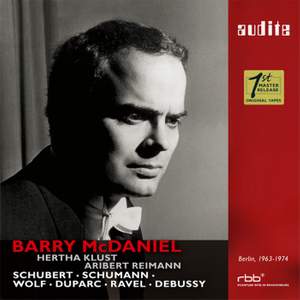
| |  | Barry McDaniel sings Schubert, Schumann, Wolf, Duparc, Ravel & Debussy
Debussy: | Le promenoir des deux amants | Duparc: | Chanson triste Lamento Le Manoir de Rosemonde Extase Soupir Phidylé | Ravel: | Trois chansons madécasses Eberhard Finke (cello) & Karlheinz Zoeller (flute) | Schubert: | Der Winterabend (Es ist so still), D938 Herbst, D945 Dass sie hier gewesen! D775 (Rückert) Der Einsame, D800 Fahrt zum Hades, D526 (Mayrhofer) Der Jungling und der Tod, D545 (Spaun) Sprache der Liebe D410 (A W von Schlegel) Fischerweise, D881 (Schlechta) Über Wildemann D884 (Ernst Schulze) Auflösung, D807 | Schumann: | Gedichte (6) und Requiem, Op. 90 Nachtlied, Op. 96 No. 1 Der Spielmann, Op. 40, No. 4 Zigeunerliedchen I & II Verratene Liebe, Op. 40, No. 5 Provencalisches Lied, Op. 139 No. 4 Mein Schöner Stern! Op. 101 No. 4 Aus den hebräischen Gesängen, Op. 25 No. 15 Ihre Stimme Op. 96 No. 3 (August von Platen) | Wolf, H: | An eine Æolsharfe (No. 11 from Mörike-Lieder) Heimweh (No. 37 from Mörike-Lieder) Lebe wohl (No. 36 from Mörike-Lieder) Nimmersatte Liebe (No. 9 from Mörike-Lieder) Der Tambour (No. 5 from Mörike-Lieder) Abschied (No. 53 from Mörike-Lieder) |
Barry McDaniel (baritone), Hertha Klust (piano) & Aribert Reimann (piano) The American baritone Barry McDaniel was one of the outstanding singers of the post-war era. As a successful opera singer and Lieder interpreter, he enjoyed a long and eventful career, both in Germany and abroad. Despite numerous performances and many recordings for radio and television, he nonetheless remained largely unnoticed by the media, partly because his name almost vanished in the shadow of Dietrich Fischer-Dieskau, who was five years his senior. Unjustly so, since the two singers were equals as artists, albeit with different characters. Today, Barry McDaniel is hardly mentioned in specialist literature and one searches in vain for CDs since, until now, recordings from radio archives have not been phonographically processed. However, Audite now presents a première double CD of Lieder sung by Barry McDaniel. These studio recordings from the archives of Radio Berlin-Brandenburg (formally Sender Freies Berlin) were made between 1963 and 1974 with Hertha Klust and Aribert Reimann as accompanists. This selection of songs by Schubert, Schumann, Wolf, Duparc, Ravel and Debussy reveals diverse facets of McDaniel’s artistic personality. His interpretations are characterised by an interleaving of knowledge and naivety, feeling and craftsmanship, expression and impeccable singing. Apart from his immaculate technique, his accent-free German is particularly remarkable. Barry McDaniel moved from the USA to Germany in 1953 in order to further his studies. He then gave his first song recitals, together with Hermann Reutter, and later began a career as an opera singer. In 1961 he was engaged at the newly re-opened Deutsche Oper Berlin, where he remained for thirty-seven years. At the same time, he gave guest performances at the Vienna Staatsoper, the Metropolitan Opera New York, the Frankfurt Opera and the Munich Opera Festival, as well as broadcasting for radio and television. In addition, Barry McDaniel gave numerous song recitals, for example in Stuttgart, Karlsruhe, Hanover, Brunswick and Berlin, including, in the latter city, the first ever song recital at the newly built Philharmonie in 1963. Today, the 81-year-old baritone declares: “Whatever I sing, I have to believe in it.” That is exactly how these recordings sound. “The American Barry McDaniel inevitably sang in the shadow of Fischer-Dieskau; but this double CD reveals his deeply thoughtful baritone, in superbly accompanied Lieder and melodie.” BBC Music Magazine, June 2012 **** | | | (also available to download from $21.00) | Usually despatched in 3 - 4 working days. (Available now to download.) |
|
|
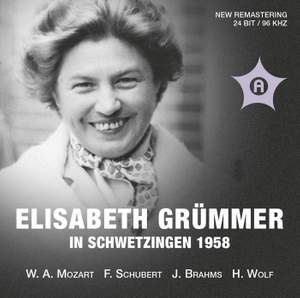
| |  | Elisabeth Grümmer in Schwetzingen 1958Recorded on 30th May 1958
Brahms: | An eine Äolsharfe, Op. 19 No. 5 Von waldbegranzter Hohe (No. 1 from Acht Lieder und Gesänge, Op. 57) Geheimnis, Op. 71 No. 3 Das Mädchen (No. 1 from Sieben Lieder, Op. 95) | Mozart: | Im Frühlingsanfang, K597 Abendempfindung an Laura, K523 Die Verschweigung, K518 Das Veilchen, K476 | Schubert: | Suleika II, D717 Dass sie hier gewesen! D775 (Rückert) Rastlose Liebe, D138 Wiegenlied D867 (Seidl) Frühlingsglaube, D686 Fischerweise, D881 (Schlechta) Hertha Klust (piano) Lachen und Weinen, D777 Hertha Klust (piano) An eine Quelle D530 (Claudius) Hertha Klust (piano) An die Nachtigall, D497 Hertha Klust (piano) | Schumann: | Die Soldatenbraut Op. 64 No. 1 Der Page, Op. 30 No. 2 Die Stille (No. 4 from Liederkreis, Op. 39) Frühlings Ankunft Op. 79/20 Widmung, Op. 25 No. 1 Der Nussbaum, Op. 25 No. 3 | Wolf, H: | Sie blasen zum Abmarsch (No. 28 from Spanisches Liederbuch: Weltliche Lieder) Liebe mir im Busen zundet (No. 17 from Spanisches Liederbuch: Weltliche Lieder) Mögen alle bösen Zungen (No. 13 from Spanisches Liederbuch: Weltliche Lieder) Bedeckt mich mit Blumen (No. 26 from Spanisches Liederbuch: Weltliche Lieder) In dem Schatten meiner Locken (No. 2 from Spanisches Liederbuch: Weltliche Lieder) |
The bonus recital in this collection was recorded in Berlin in 1956. | | | Usually despatched in 2 - 3 working days. |
|
|
| |  | Schubert - Arpeggione Sonata & Lieder transcriptions
The highly acclaimed violist Antoine Tamestit releases his third album on Naïve. Dedicated to the music of Franz Schubert, in particular the Arpeggione Sonata, it also features the celebrated French soprano, Sandrine Piau in The Shepherd on the Rock. Antoine Tamestit has transcribed Schubert’s music for the viola, featuring the multi-award winning Sandrine Piau - recently voted the Singer of the Year at the Victoires de la Musique Classique in 2009. She performs two Schubert lieder: ‘Ich schleiche bang und still herum’ and ‘Der hirt auf dem felsen’. The recording features the Arpeggione Sonata – the only substantial work in existence written for the now extinct string instrument, the arpeggione. After his success in international competitions in Paris, New York, and Munich, Antoine Tamestit won the Credit Suisse Young Artist Award in January 2008, which gave him the opportunity to play with the Vienna Philharmonic and Riccardo Muti at the Lucerne Festival. He has subsequently recorded two albums for Ambroisie/Naïve ‘Bach: Ligeti’ and ‘Shostakovich / Schnittke’. “This little 58-minute Schubertiad a la francaise makes a very good case for the viola as a Schubertian soulmate par excellence...Piau's irresistably radiant soprano, together with the viola...transforms the music's pastoral into a haunting evocation of the poignant exhilaration of mortality.” BBC Music Magazine, September 2010 **** | | | (also available to download from $10.50) | Usually despatched in 3 - 4 working days. (Available now to download.) |
|
|
| |  | Elisabeth Grümmer sings Mozart, Schubert, Brahms & Wolf
Brahms: | An eine Äolsharfe, Op. 19 No. 5 Von waldbegranzter Hohe (No. 1 from Acht Lieder und Gesänge, Op. 57) Geheimnis, Op. 71 No. 3 Das Mädchen (No. 1 from Sieben Lieder, Op. 95) | Mozart: | Non più, tutto ascoltai - Non temer, amato bene, K490 Basta Vicesti... Ah non lasciarmi no. K295a Im Frühlingsanfang, K597 Abendempfindung an Laura, K523 Die Verschweigung, K518 Das Veilchen, K476 | Schubert: | Suleika II, D717 Dass sie hier gewesen! D775 (Rückert) Rastlose Liebe, D138 Wiegenlied D867 (Seidl) Frühlingsglaube, D686 | Wolf, H: | Sie blasen zum Abmarsch (No. 28 from Spanisches Liederbuch: Weltliche Lieder) Liebe mir im Busen zundet (No. 17 from Spanisches Liederbuch: Weltliche Lieder) Mögen alle bösen Zungen (No. 13 from Spanisches Liederbuch: Weltliche Lieder) Bedeckt mich mit Blumen (No. 26 from Spanisches Liederbuch: Weltliche Lieder) In dem Schatten meiner Locken (No. 2 from Spanisches Liederbuch: Weltliche Lieder) |
Compared to Elisabeth Grümmer’s rank as a singer, her recordings are shamefully few in number, giving these radio recordings a special documentary significance. “Whoever has heard Elisabeth Grümmer singing cannot forget the way this lovely voice, at once ethereal and yet full sounding, effortlessly flows along,” wrote Lafranco Rasponi. “The radiant and robust soprano Elisabeth Grümmer made all too few recordings. These…are cherishable.” BBC Music Magazine, May 2010 **** | | | (also available to download from $10.50) | Usually despatched in 2 - 3 working days. (Available now to download.) |
|
|
| |  | Volume 24 - Romantic Poets Volume 1
Schubert: | Die junge Nonne, D828 Die Liebe hat gelogen D751 (Platen) Frühlingsglaube, D686 Morgenlied, D685 Abendröte, D690 Der Schmetterling D633 Das Mädchen D652 (Schlegel) Der Knabe, D692 Die Rose, D745 Der Wanderer, D649 (Friedrich von Schlegel) Die Berge, D634 Der Fluss, D693 Die Vogel D691 Die Sterne, D684 Die Gebüsche, D646 Du liebst mich nicht D756 (Platen) Dass sie hier gewesen! D775 (Rückert) Du bist die Ruh D776 (Rückert) Lachen und Weinen, D777 Rosamunde, D797: Romance 'Der Vollmond Strahlt auf Bergeshöh'n' |
Julia Borchert (soprano) & Ulrich Eisenlohr (piano) | | | (also available to download from $6.00) | Usually despatched in 2 - 3 working days. (Available now to download.) |
|
|
| |  | Schubert: 23 Selected Songs
Schubert: | Adelaide, D95 An die Leier, D737 (Bruchmann) Atys D585 Auflösung, D807 Das Rosenband, D280 (Klopstock) Dass sie hier gewesen! D775 (Rückert) Der Einsame, D800 Der Jüngling an der Quelle, D300 (Salis-Seewis) Der Winterabend (Es ist so still), D938 Die Gotter Griechenlands D677 (Schiller) Die Sommernacht, D289 (Klopstock) Fischerweise, D881 (Schlechta) Heidenröslein, D257 Herbst, D945 Im Abendrot, D799 Liebhaber in allen Gestalten, D558 Nachtstück, D672 (Mayrhofer) Nacht und Träume, D827 Die Sternennacht D670 (Mayrhofer) Stimme der Liebe D412 (Stolberg) Geheimnis, D491 (Mayrhofer) Die Sterne, D684 Wandrers Nachtlied II 'Über allen Gipfeln ist Ruh', D768 |
Ernst Haefliger (tenor) Jorg Ewald Dahler (piano) | | | Usually despatched in 4 - 5 working days. |
|
|
| |
|