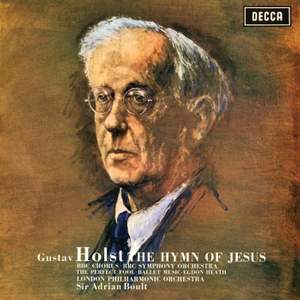
Prices shown exclude VAT. (UK tax is not payable for deliveries to United States.) See Terms & Conditions for p&p rates. | |  | Holst - The Hymn of Jesus & Choral Symphony
Michael Rippon, Norma Burrowes, Michael Langdon, Robert Tear, Steuart Bedford, Philip Langridge, Sir John Tomlinson, Elise Ross & Felicity Palmer English Opera Group, English Chamber Orchestra, London Philharmonic Choir & Orchestra & Royal Liverpool Philharmonic Choir & Orchestra, David Atherton & Sir Adrian Boult | | | In stock - usually despatched within 1 working day. |
|
|
| |  | British Music Collection - Gustav Holst
Janet Baker (mezzo-soprano), Robert Tear (tenor), Thomas Hemsley (baritone), Osian Ellis (harp) Purcell Singers, English Chamber Orchestra, St Paul Chamber Orchestra, London Philharmonic Orchestra, BBC Symphony Orchestra, Grimethorpe Colliery Band, Imogen Holst, Christopher Hogwood, Adrian Boult, Elgar Howarth | | | In stock - usually despatched within 1 working day. |
|
|
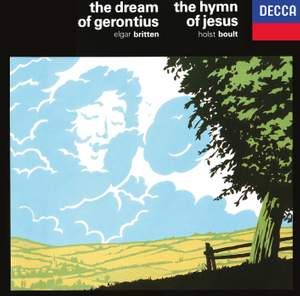
| |  | Elgar: The Dream of Gerontius
Delius: | Sea Drift John Shirley-Quirk London Symphony Chorus, Royal Philharmonic Orchestra, Richard Hickox | Elgar: | The Dream of Gerontius, Op. 38 Peter Pears, John Shirley-Quirk, Yvonne Minton The Choir of King's College, Cambridge, London Symphony Chorus, London Symphony Orchestra, Benjamin Britten | Holst: | The Hymn of Jesus, H140 BBC Chorus, BBC Symphony Orchestra, Adrian Boult |
| | | (Sorry, download not available in your country) | In stock - usually despatched within 1 working day. |
|
|
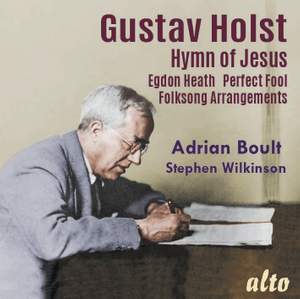
| |  | Holst: Vocal WorksFirst release on CD (except The Hymn of Jesus)
Holst: | 12 Humbert Wolfe settings, Op. 48 Sir Peter Pears (tenor) & Benjamin Britten (piano) Ave Maria, H49, Op. 9b The Purcell Singers, Imogen Holst Three Folk Songs The Purcell Singers, Imogen Holst The Song of the Blacksmith. Hampshire Folk-song The Purcell Singers, Imogen Holst Pastoral, H92 The Purcell Singers, Imogen Holst The Swallow leaves her nest, H119 The Purcell Singers, Imogen Holst Of one that is so fair and bright, H130, Op. 34 No. 3 The Purcell Singers, Imogen Holst Bring us in good ale The Purcell Singers, Imogen Holst The Hymn of Jesus, H140 BBC Chorus & BBC Symphony Orchestra, Sir Adrian Boult |
An inspired arrangement between Decca and Imogen Holst, led to a series of pioneering recordings of her father Gustave Holst’s music, which appeared on Argo and are now comprehensively released on CD as part of the Eloquence series. This collection opens with the Pears/Britten recording of a substantial English song cycle never before published on CD, the twelve Humbert Wolfe settings, beautifully sung and mercurially played. Wolfe, largely forgotten today, ‘was a civil servant, essentially a Londoner, and a miniaturist with an individual brand of whimsy and, at his best, a real feeling for words’ (Gramophone). Imogen Holst’s original notes for the LPs – ‘acutely perceptive, objective and candid’ noted Gramophone’s reviewer Lionel Salter – are here reprinted as are the full texts. Much of the music was practically unknown at the time of this recording (beautifully captured by legendary Decca engineer Kenneth Wilkinson in London’s Kingsway Hall) and well overdue for publication. The collection is rounded off by Boult’s celebrated 1961 recording of The Hymn of Jesus. Recording producers: David Harvey (Humbert Wolfe Songs, Ave Maria, Three Welsh Folk Songs, The Song of the Blacksmith, Two Part-Songs, Two Carols); Christopher Raeburn (The Hymn of Jesus) Recording engineers: Kenneth Wilkinson (Humbert Wolfe Songs, Ave Maria, Three Welsh Folk Songs, The Song of the Blacksmith, Two Part-songs, Two Carols); Alan Reeve (The Hymn of Jesus) Recording location: Kingsway Hall, London, United Kingdom, March 1962 (The Hymn of Jesus), December 1965 (Humbert Wolfe Songs, Ave Maria, Three Welsh Folk Songs, The Song of the Blacksmith, Two Part-songs, Two Carols) “most beautifully sung” Gramophone Magazine (Two Part-Songs) “Britten’s accompanying matches the unfailing understanding of the singing, and with its excellent quality this can be warmly recommended” Gramophone Magazine (Humbert Wolfe Songs) “a tremendous piece of invention” Gramophone Magazine (The Evening Watch) “this is a fine and vital performance that vividly conveys the exultant and the mystical nature of the Hymn” Gramophone Magazine (The Hymn of Jesus) | | | This item is currently out of stock at the UK distributor. You may order it now but please be aware that it may be six weeks or more before it can be despatched. |
|
|
| |  | Holst: | The Cloud Messenger, H111 The Hymn of Jesus, H140 Ave Maria, H49, Op. 9b The Evening-watch, H159 Seven Part-songs, H162 A Choral Fantasia, H177 A Dirge for Two Veterans, H121 Ode to Death, H144 This have I done for my true love, H128, Op. 34 No. 1 Four Part-songs |
Della Jones (mezzo-soprano), Susanna Spicer (alto), Mark Milhofer (tenor), Patricia Rozario (soprano) London Symphony Orchestra, London Symphony Chorus, Finzi Singers, Joyful Company of Singers, City of London Sinfonia, Finzi Singers, Richard Hickox, Paul Spicer “The Cloud Messenger is a 43-minute work of considerableimaginative power. Before its previoussingle-issue release it had been virtually forgottensince its disastrous premiere under Holst'sbaton in 1913. It shows the composer alreadyworking on an epic scale-–-something that castslight on the subsequent eruption of The Planets.It's marvellous to have the work on disc, though,as you might expect, it's uneven. Those whoadmire the ascetic rigour of his later music mayshare Imogen Holst's reservations, and find thescore disappointingly 'backward'. There arecertainly echoes of Vaughan Williams's A SeaSymphony and several older models. On theother hand, the glittering approach to the sacredcity on Mount Kailasa and the stylised orientalismof the climactic dance are new to Britishmusic; another world, that of 'Venus', is foreshadowedin the closing pages.One of the few incontrovertible masterpiecesin Holst's output, the familiar Hymn of Jesus hasseldom received a better performance on disc.The choral singing itself is splendidly crisp, butthe lively acoustic can blunt the impact ofHolst's acerbic harmonies.” Gramophone Classical Music Guide, 2010 | | | (also available to download from $21.75) | Usually despatched in 2 - 3 working days. (Available now to download.) |
|
|
| |  | Holst: Collectors' Edition
Holst: | The Planets, Op. 32 London Philharmonic Orchestra & Geoffrey Mitchell Choir, Sir Adrian Boult The Perfect Fool, Op. 39/H 150: Ballet Music London Symphony Orchestra, André Previn Egdon Heath, a homage to Thomas Hardy, Op.47 London Symphony Orchestra, André Previn A Somerset Rhapsody, Op.21 No. 2 Bournemouth Sinfonietta, Norman del Mar Brook Green Suite Bournemouth Sinfonietta, Norman del Mar A Fugal Concerto, H152 Op. 40 No. 2 Jonathan Snowden (flute) & David Theodore (oboe) English Chamber Orchestra, Yehudi Menuhin Beni Mora, Op. 29 No. 1 BBC Symphony Orchestra, Sir Malcolm Sargent St Paul's Suite, Op. 29 No. 2 Royal Philharmonic Orchestra, Sir Malcolm Sargent Choral Hymns from the Rig Veda, Op. 26: 2nd Group, H98 London Symphony Chorus, women’s voices Ode to Death, H144 London Symphony Chorus & London Philharmonic Orchestra, Sir Charles Groves Psalm 86 Ian Partridge (tenor) & Ralph Downes (organ) A Choral Fantasia, H177 Dame Janet Baker (mezzo-soprano) & Ralph Downes (organ) The Purcell Singers & English Chamber Orchestra, Imogen Holst Suite No. 1 for Military Band in E flat major, Op. 28 No. 1, H105 Central Band of the Royal Air Force, Imogen Holst Suite No. 2 for Military Band in F major, Op. 28 No. 2, H106 Central Band of the Royal Air Force, Imogen Holst A Moorside Suite BMC (Oxford) Band, Imogen Holst Hammersmith - Prelude and Scherzo, H178, Op. 52 Central Band of the Royal Air Force, Wing Commander J.L. Wallace Choral Hymns from the Rig Veda, Op. 26: 4th Group, H100: Hymn to Manas Baccholian Singers of London The Homecoming, H120 (Hardy) Baccholian Singers of London A Dirge for Two Veterans, H121 Baccholian Singers of London & Philip Jones Brass Ensemble, Ian Humphris Choral Folksongs (6), Op. 36b, H136 Baccholian Singers of London Six Choruses for male voices, H186 Baccholian Singers of London & English Chamber Orchestra, Ian Humphris Eight Canons, H187: The Fields of Sorrow Baccholian Singers of London Eight Canons, H187: David’s Lament for Jonathan Baccholian Singers of London Eight Canons, H187: Truth of all Truth Baccholian Singers of London Bring us in good ale The King’s Singers Vedic Hymns, Op. 24: Varuna Frederick Harvey (baritone) & Gerald Moore (piano) Turn back, O man Richard Seal (organ) Choir of Chichester Cathedral, John Birch Lullay my liking, H129, Op. 34 No. 2 Arranged for boys’ voices by Imogen Holst London Boy Singers, Jonathan Steele Personent Hodie Bach Choir & Jacques Orchestra, Sir David Willcocks In the Bleak Mid-winter (Cranham) Edwin Bates (organ) Rodney Christian Fellowship Festival Choir, Rodney Smith Bishton The Hymn of Jesus, H140 Choristers of St. Paul’s Cathedral Choir, London Symphony Chorus & London Philharmonic Orchestra, Sir Charles Groves Short Festival Te Deum, H145 London Symphony Chorus & London Philharmonic Orchestra, Sir Charles Groves First Choral Symphony, Op. 41, H155 Felicity Palmer (soprano) London Philharmonic Choir & London Philharmonic Orchestra, Sir Adrian Boult The Wandering Scholar, Op. 50 Michael Rippon (Louis), Norma Burrowes (Alison), Michael Langdon (Father Philippe) & Robert Tear (Pierre) English Opera Group & English Chamber Orchestra, Steuart Bedford At the Boar’s Head – A musical interlude in one act, Op. 42 Philip Langridge (Prince Hal), John Tomlinson (Falstaff), Elise Ross (Hostess), Felicity Palmer (Doll Tearsheet), David Wilson-Johnson (Pistol), Peter Hall (Peto), Richard Suart (Bardolph) & Michael George (Poins)
Men’s voices of the Liverpool Philharmonic Choir & Royal Liverpool Philharmonic Orchestra, David Atherton |
Renowned above all for the colour and splendour of The Planets, Holst created a uniquely idiosyncratic and outward-looking body of work, informed by his personal enthusiasms; for education, native folksong, the European avant-garde and Indian mysticism. This collection surveys all the musical genres in which he made his mark, from brass band to opera, in performances by some of his most noted champions. Gustav Holst was born in Cheltenham on 21st September 1874. He learnt the piano from early age but, suffering from asthma and short sight, he found it hard. At the age of seven his mother died. He began to compose at Cheltenham Grammar School with Berlioz’s treatise on instrumentation as his guide and at seventeen he was conducting local village choirs. The neuritis in his right arm had convinced his father that he would never become a solo pianist so he was allowed a few months in Oxford to learn counterpoint before moving to London to study composition with Stanford. He entered the Royal College of Music in 1893 but did not win a scholarship until two years later – Stanford found him hardworking rather than brilliant. His compositions tended to be saturated with imitations of Wagner. In 1895 he met Vaughan Williams and for the rest of his life they would play sketches of their latest compositions to each other. He was invited to conduct the Hammersmith Socialist Choir in William Morris’s house where he met his future wife. He became fascinated by Hindu literature and philosophy to such an extent that he decided to learn Sanskrit – his Rig Veda settings are testament to this interest. He had also studied the trombone at college and it was this which brought him employment, with the Carl Rosa Opera and the Scottish Orchestra, if detracting him from his wish to compose. Luckily he was appointed a teacher first in Dulwich and then at St. Paul’s in Hammersmith where he would be director of music, a position he held for the rest of his life. With security of income he was able to devote himself more to composition and a string of works by which he is best known, chief of which is The Planets, appeared. Their success made publishers want to revisit his earlier works and he found the extra work of correcting proofs time-consuming. His later works were more intense and the public found them harder to understand and it is only now, with a greater chance to listen to them, that we can fathom their genius. His final years were blighted by illnesses which started after falling from the rostrum and hitting his head, he suffered from headaches and sleeplessness. In 1927 Cheltenham gave him his own festival and in 1930 he accepted the gold medal of the Royal Philharmonic Society. In 1932 he went to Harvard University to lecture but a severe attack of haemorrhagic gastritis caused him to return home and spent the next eighteen months in and out of clinics and, although In frequent pain, he kept on composing. In May 1934 he had an operation in London died on the 25th. “This adroitly assembled set should sell like a bonfire and fully deserves to.” MusicWeb International, June 2012 “[Boult's 'Planets'] remains one the finest around” The Guardian, 28th June 2012 | | | In stock - usually despatched within 1 working day. |
|
|
| |
|