Glazunov: Raymonda, Op. 57: Entr'acte act I (Intermezzo)

This page lists all recordings of Raymonda, Op. 57: Entr'acte act I (Intermezzo), by Alexander Konstantinovich Glazunov (1865-1936) on CD & download (MP3 & FLAC). Generally, more recent releases are listed first, but with priority given to those that are in stock.

Prices shown exclude VAT. (UK tax is not payable for deliveries to United States.)
See Terms & Conditions for p&p rates.

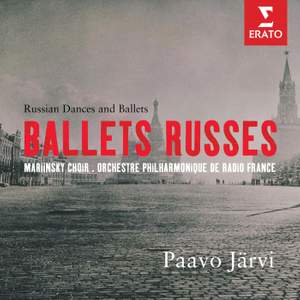
Ballets Russes

Ballets Russes

Russian Dances and Ballets


Borodin:

Prince Igor: Polovtsian Dances

Glazunov:

Raymonda, Op. 57: Entr'acte act I (Intermezzo)

Glinka:

Valse-Fantaisie in B minor for orchestra, G. ii213

Khachaturian:

Masquerade: Waltz

Sabre Dance from Gayane

Liadov:

Dance of the Amazon, Op. 65

Prokofiev:

The Love for Three Oranges: March

Romeo and Juliet: Dance of the Knights

Shostakovich:

Polka from The Golden Age, Op. 22

Jazz Suite No. 2 - Waltz No. 2

Tahiti Trot (Tea for Two), Op. 16

Tchaikovsky:

Polonaise (from Eugene Onegin, Op. 24)

The Nutcracker: Waltz of the Flowers

Waltz from Eugene Onegin, Op. 24


Although folk dances have a special place in Russian music, being raised to the status of character dances in works for the stage, the more classical forms taken over from the west are not neglected. During the nineteenth century the waltz, for example, tended more and more towards ‘pure’ music, giving rise to some highly virtuosic works in the manner of those by Weber or Liszt.

Thus, in 1856 Glinka (1804-1857), founder of the Russian nationalist school, produced the definitive version of a Valse which had already aroused the enthusiasm of Berlioz. Its slightly melancholy principal theme reappears as a refrain between episodes in various keys, which give rise to passages of instrumental dialogue and to such bold strokes such as the cantabile for solo trombone in the third episode. Witty or ironic comments by the flutes or strings turn it virtually into a fantasia – which Shostakovich was to recall later.

Scenes at parties and balls abound in opera. Tchaikovsky composed the waltz for Act Two of Eugene Onegin (1877) – with a chorus in its original version – so as to reflect the humdrum pretentiousness of the lesser, countrified aristocracy: it is closer to the waltz in Faust than to those he was to write for his ballets. This is in clear contrast to the majestic Act Three Polonaise, with its trio incorporating the traditional mazurka, which as the dance of aristocratic St Petersburg receptions is in a differ­ent class altogether.

Marius Petipa, who became chief ballet master at the imperial ballet in 1869, restored to the art of dance the nobility and charm which had been killed off by an emphasis on technique. Tchaikovsky provided him with music suffused with the poetic inspiration lacking in the more straightforwardly rhythmic scores of composers like Drigo and Pugni. He was, however, criticised by those ballet-lovers who found his music too symphonic; his waltzes, refined rather than brilliant and frivolous, are often tinged with dramatic lyricism, even a sense of anxiety. The unusual flavour of the Waltz of the Flowers from The Nutcracker (1892) is largely created by the mysterious other-worldly horn-calls answered by rippling clarinet figures.

Raymonda (1898) is a medieval romance choreographed by Petipa to music by Glazunov. Always melodious, subtle and graceful, it is sometimes highly evocative, as in the trance-like atmosphere in the dreamy slow-motion accompanying the heroine’s sleep (andante sostenuto) in the interlude before the second scene.

The tradition of the grand ballet d’action persisted right up to the revolution brought about by Sergei Diaghilev. Reacting against the ‘double pirouettes and detestable sets of thirty-two fouettés’, the director of the Ballets Russes sought the character of the various folk-dances of Russia and other countries, which he remodelled for the stage using a basically classical technique. In his Parisian season in 1909 he presented the second act of Prince Igor (1887) against the background of a tawny-coloured desert steppe. The Polovtsian Dances, alternating spellbinding movements for the women and pounding, savage rhythms for the warriors, were directed by Mikhail Fokine: when a tumultuous wave of dancers rushed downstage at the end, stopping dead just short of the foot­lights, it brought the house down!

Even Anatole Liadov, the composer of backwoods Russia, gave in to the infatuation of the Russian intelligentsia of around 1900 with ancient Greece. His Dance of the Amazon (1910), for Ida Rubinstein, employs two Greek chants, heavily reworked: the first theme suggests the Amazon riding on horseback, the second (meno mosso) emphasises the oriental atmosphere; brass and percussion suggest warlike activity – ushered in by a fanfare.

After the 1917 Revolution it was thought that the creations of the Tsarist era would be unappealing to the sensibilities of the new Bolshevik listener. New themes and characters – stadiums and factories, sportsmen and workers – figured in ‘futurist’ (that is, revolutionary) musical experiments. In Shostakovich’s ballet The Golden Age (1930), which portrays the misadventures of a Soviet football team in a capitalist country, a clownish polka caricatures decadent western society. In Tahiti Trot (1928) Shostakovich pulled off the challenge of re-orchestrating Vincent Youmans’ Tea for Two in record time, and in so doing exploited all the expressive and comic possibilities, as well as the shock tactics, of avant-garde experiments. But offerings like these, from an enfant terrible ‘who had nothing to say to the people’, led the Communist Party, around 1932, to rein back cultural activity and reinstate a classical, academic aesthetic, which also extended to opera and ballet.

The music of Prokofiev’s Love for Three Oranges (Chicago, 1921; Leningrad, 1927), precise, sturdily constructed and freshly coloured – as in the festive march from Act Two – was perfectly accessible, and yet it was later ignored in the USSR because of its libretto, which makes a feature of absurdity. Romeo and Juliet (1935/6, staged in 1940), on the other hand, with its universal subject, gained unanimous acceptance. The characterisation was exemplary: in the sombre, hieratic Dance of the Knights, with its great sweeps of sound, the menacing thrusts of the basses and brass powerfully convey the arrogance of a clan – as against the fresh sensitivity of youth portrayed by the central theme.

Although Khachaturian was also suspected of ‘formalism’, his artistic approach always coincided with that of the regime. His incidental music for a 1940 production of Lermontov’s The Masked Ball portrays well the spiritual emptiness of imperial society: the entirely unsentimental waltz turns like a roundabout, relentlessly driven forward by the pursuit of pleasure. With Gayaneh (1943) Khachaturian goes back to his native Armenia. Part of the ballet’s final celebrations honouring the upbeat heroine of the ‘happy collective farm’ is the frenzied Sabre Dance, the middle section of which recalls an earlier pas de deux. It is an authentic piece of Transcaucasian folklore.

Following his Lady Macbeth of the Mtsensk district, Shostakovich had fallen victim, in 1936, to official criticism. He attempted to redeem himself, or at least to behave himself, by writing lighter works, frothier, more facile – i.e. proletarian – for films, ballets, variety stages and what the USSR referred to as ‘jazz’ orchestras, which are more like our light music ensembles. The Suite No.2 for jazz orchestra (1938) was composed for one such group, run by Victor Knushevitsky. The main, somewhat sentimental, theme in its Waltz No.2, played on the saxophone, ends in a sort of good-natured refrain. This piece was used as music for film commercials in the West – and then as title music for Stanley Kubrick’s last film: what finer example of popularity could there be?

Virgin Premium - 0293192

(CD)

$11.25

In stock - usually despatched within 1 working day.

Ballets Russes

Ballets Russes

Russian Dances and Ballets


Borodin:

Prince Igor: Polovtsian Dances

Glazunov:

Raymonda, Op. 57: Entr'acte act I (Intermezzo)

Glinka:

Valse-Fantaisie in B minor for orchestra, G. ii213

Khachaturian:

Masquerade: Waltz

Sabre Dance from Gayane

Liadov:

Dance of the Amazon, Op. 65

Prokofiev:

The Love for Three Oranges: March

Romeo and Juliet: Dance of the Knights

Shostakovich:

Polka from The Golden Age, Op. 22

Jazz Suite No. 2 - Waltz No. 2

Tahiti Trot (Tea for Two), Op. 16

Tchaikovsky:

Polonaise (from Eugene Onegin, Op. 24)

The Nutcracker: Waltz of the Flowers


Virgin - 5456092

(CD)

$15.50

In stock - usually despatched within 1 working day.

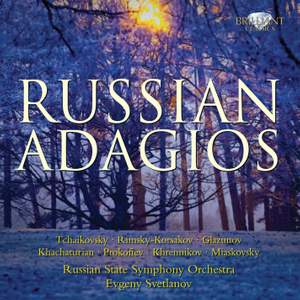
Russian Adagios

Russian Adagios


Glazunov:

Raymonda, Op. 57: Entr'acte act I (Intermezzo)

Raymonda, Op. 57: Entr'acte act III

Khachaturian:

Gayane: Adagio

Khrennikov:

Adagio (The Hussar Ballad)

Miaskovsky:

Symphony No. 27 in C minor, Op. 85: Adagio

Prokofiev:

Cinderella, Op. 87: Adagio of Cinderella and the Prince

Rimsky Korsakov:

Nocturne from Pan Voyevoda, opera

Tchaikovsky:

The Nutcracker: Adagio

The Sleeping Beauty, Op. 66: Rose Adagio


A collection of famous Russian Adagios, some well-known (Tchaikovsky, Khachaturian), some true discoveries (Miaskovsky, Khrennikov).

Nobody captures the Slavic warmth, passion and bittersweet melancholy better than the great, legendary Russian conductor Evgeny Svetlanov and his wonderful Russian Sate Orchestra.

The apparently innate Russian genius for composing soulful melodies, combined with the influence of 200 years of Russian ballet, has resulted in a repertoire of dramatic and opulent scores.

Opera, symphonies, concertos, songs and chamber works from Russian composers are all infused with the spirit of Mother Russia – her suffering, her dramatic and eventful history, her people and their way of life.

This collection of heartfelt adagios includes famous excerpts from Tchaikovsky’s The Nutcracker and The Sleeping Beauty, and Glazunov’s Raymonda, Prokoviev’s Cinderella and the famous adagio from Spartacus by Khachaturian.

There are some rarer pieces as well – Rimsky-Korsakov’s Nocturne ‘Moonlight’ from his opera Pan Voyevoda and Khrennikov’s Hussar Ballad, as well as the wistful slow movement from Miaskovsky’s last symphony (No.27), written after he had been denounced by Stalin’s henchmen as being guilty of ‘Western Formalism’ (a charge levelled by Khrennikov).

Miaskovsky composed this work as he was ill with the cancer that would eventually kill him, and through it he harks back to the Russia of Tchaikovsky’s music – a nostalgic and dignified farewell in the face of Stalin’s tyrannical ignorance.

Brilliant Classics - up to 30% off

Brilliant Classics - 9238

(CD)

Normally: $7.25

Special: $6.16

Usually despatched in 4 - 5 working days.

Salut d'Amour

Salut d'Amour


Bazzini:

La Ronde des lutins, Op. 25

Dvorak:

Slavonic Dance No. 10 in E minor, Op. 72 No. 2

Elgar:

Salut d'amour, Op. 12

Gershwin:

It Ain't Necessarily So (from Porgy and Bess)

Glazunov:

Raymonda, Op. 57: Entr'acte act I (Intermezzo)

Gluck:

Orfeo ed Euridice - Dance of the Furies

Kroll:

Banjo and Fiddle

Paganini:

Introduction & Variations on 'Nel cor più non mi sento' by Paisiello

Sarasate:

Danza Española No. 6: Zapateado, Op. 23, No. 2

Strauss, R:

Violin Sonata in E flat major, Op. 18


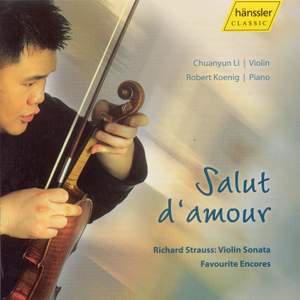
Li Chuanyun (Violin); Robert Koenig (Piano)

Hailed by the international media as “a massive talent with astonishing dynamic and expressive range…,” Chuanyun Li is one of the foremost violinists of his generation from China and internationally. An active member of the Yip’s Children Arts Centre since 1986, he has studied under the sponsorship of entrepreneur Mr Choi Kin Chung with Professor Yaoji Lin from Central Conservatory of Music in Beijing and won numerous prizes, including the 1st Prize in the 5th Wieniawski International Youth Violin Competition at 11. He studied with Dorothy DeLay, Itzhak Perlman and Hyo Kang in the Juilliard School of Music and continued his studies with DeLay and Kurt Sassmannshaus at the University of Cincinnati Conservatory of Music and with Joey Corpus in New York City with the support of the Clarisse B Kampel Foundation. Li has toured extensively in China, Japan and the US and collaborated with such orchestras as the Rotterdam Philharmonic with Valery Gergiev, Detroit Symphony with Neemi Järvi, Hong Kong Philharmonic with Edo de Waart, Queensland Symphony Orchestra with Michael Christie, China National Symphony with Xincao Li and Singapore Symphony with Lan Shui, among others. Hänssler Classic is proud to present the first recording of this exciting young artist to be made available outside of China.

Hänssler - HAEN98278

(CD)

$17.00

(also available to download from $10.50)

Usually despatched in 2 - 3 working days. (Available now to download.)

White Nights

White Nights


Bull, O:

Saeterjentens Søndag (The Herdgirl's Sunday)

Glazunov:

Raymonda, Op. 57: Entr'acte act I (Intermezzo)

Petit Adagio from Scene IV of The Seasons

Grieg:

In Folk Style (Kansanlaulun tapaan), from Two Nordic Melodies, Op. 63

Melartin:

Pastorale from Suite Lyrique no. 3

Rimsky Korsakov:

Nocturne from Pan Voyevoda, opera

Sibelius:

Nocturne from Belshazzar's Feast, Suite, Op. 51

Intermezzo

Dance of the Nymphs

Interlude (Miranda) from The Tempest, Op. 109

Melisande

Pastorale

Impromptu

Svendsen:

Romance (Romanssi)


Ondine - ODE9642

Download only from $10.50

Available now to download.

David Oistrakh Edition Vol. 3

David Oistrakh Edition Vol. 3


Albéniz:

Love Song No. 6 (Six Songs)

Brahms:

Hungarian Dance No. 8 in A minor

Hungarian Dance No. 9 in E minor

Hungarian Dance No. 20 in E minor

Hungarian Dance No. 5

Debussy:

Passepied

Beau Soir

Falla:

Suite populaire espagnole

Glazunov:

Raymonda, Op. 57: Entr'acte act I (Intermezzo)

Gluck:

Orfeo ed Euridice (Orphée et Euridice): Dance of the Blessed Spirits

Granados:

Danza española, Op. 37 No. 5 'Andaluza'

Rachmaninov:

Daisies, Op. 38 No. 3

Vocalise, Op. 34 No. 14

Schumann:

Widmung, Op. 25 No. 1

Romance in A major, Op. 94 No. 2

Vitali, T:

Chaconne in G minor


David Oistrakh (violin), Inna Kollegorskaya (piano)

Melodiya - MELCD1000742

(CD)

$15.50

This item is currently out of stock at the UK distributor. You may order it now but please be aware that it may be six weeks or more before it can be despatched.

Copyright © 2002-13 Presto Classical Limited, all rights reserved.