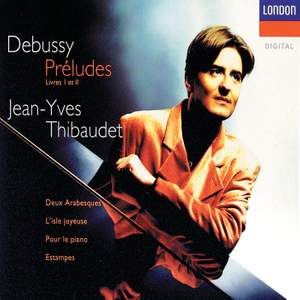
All recordingsPrices shown exclude VAT. (UK tax is not payable for deliveries to United States.) See Terms & Conditions for p&p rates. | |  | Debussy: Clair de luneand other piano works
| 
| | | (Sorry, download not available in your country) | In stock - usually despatched within 1 working day. |
|
|
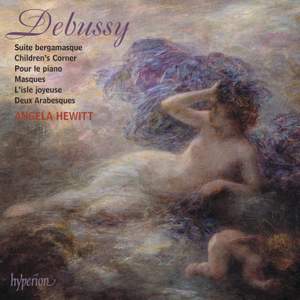
| |  | Debussy: Solo Piano Music
Angela Hewitt’s previous forays into the French repertoire have been praised for their ‘tenderness, Gallic wit, verve, and—the most important ingredient of all—charm’. These qualities are very much to the fore in this new disc of Debussy featuring some of the composer’s most sunlit, delightful and popular works. Children’s Corner was written for Debussy’s beloved daughter (though not, as Hewitt explains, for her to play immediately). Hewitt embraces the music’s wit, artful references and gentle beauty. The atmospheric Suite bergamasque includes the famous ‘Clair de lune’. Also included are the tragic Masques and gorgeously exuberant L’isle joyeuse. Hewitt and Debussy are a perfect match. “Hewitt’s spectrum of touch, her fluency and sense of colour are deployed with equal enchantment in the first of the two arabesques, her lightness, rhythmic precision and varieties of tonal weight making the second arabesque into a glistening, fanciful filigree...Hewitt brilliantly and sensitively points up the traits that lend the music such distinctive character and evocative presence, not least in an account of “L’Isle joyeuse” that is pure, ravishing radiance.” The Telegraph, 5th October 2012 ***** “There's not a trace of the "impressionistic" about her treatment of any of them: this is Debussy portrayed in clean, bright colours and sharply focused detail, with every rhythm precisely etched...it's undeniably high-class playing, even when you don't agree with some of its details.” The Guardian, 4th October 2012 **** “This is one of the better offerings for Debussy's 150th anniversary...This generously filled disc finds Hewitt utterly persuasive in the three suites at its heart...Hyperion caputres the sound marvellously. Hewitt has the knack of noticing details without letting them detract from the musical flow...Special mention should be made of 'Clair de lune': it is quite an achievement for its lyrical beauty to be heard afresh.” BBC Music Magazine, December 2012 ***** “Hewitt has put together an ideal introduction to Debussy, but it’s one that can be enjoyed equally by experienced listeners – thanks to the artless touch and precise colours the Canadian pianist brings to each piece.” Financial Times, 27th October 2012 **** | | | In stock - usually despatched within 1 working day. |
|
|
| |  | Jean-Bernard Pommier plays Debussy
Claude Debussy was an excellent pianist, and Marguerite Long, who worked with him, admired “the suppleness, caress and depth of his touch”, as well as his “full, intense sonority, free of any harshness in the attack, like Chopin”. After the elegant, delicate Arabesques of 1888, in 1901 Debussy published his first important piano work, Pour le piano, in the tradition of the great baroque keyboard masters whom he so admired; it was to his dear daughter Chouchou, born in 1905, that he dedicated the six simple miniatures of Children’s Corner, a blend of emotion, playfulness and humour. “When one can’t afford to travel, one must make do with the imagination,” he said, commenting on the Estampes, whose heady sonorities and magical evocations refer to the Orient, Spain, and the spirit of France; Debussy was also capable of irony, as in La Plus que lente, composed in 1910 as “café music”. Less well-known, the Pièce pour le Vêtement du blessé was composed for a charity during the First World War devoted to dressing the wounds of soldiers. Marguerite Long described L’Isle joyeuse (1904) as an exuberant, “joyful gust of wind” and “a celebration of rhythm”; it is also a superb exploration of tone-colour and nuance. “Pommier's Debussy selection displays many facets of both the composer and performer. Children's Corner is spirited and the Estampes particularly engaging. The highlight is a wonderfully droll La plus que lente.” BBC Music Magazine, December 2009 | | | In stock - usually despatched within 1 working day. |
|
|
| |  | Debussy - Complete Works for Solo Piano Volume 3
Jean-Efflam Bavouzet here offers the third volume in his series devoted to the complete works for piano by Debussy. The music now moves to a more playful strand in Debussy’s compositional career, with generally shorter pieces of the salon genre, including the two famous collections Children’s Corner and Suite bergamasque. In addition to these well-known works are several that are more rarely heard. Two such are La plus que lente, which seems to look ahead to the Études of 1915, and Élégie. Roger Nichols describes the former as ‘one of his most delightful pieces… the harmonic turns are particularly sophisticated and enchanting’. The Élégie was written in 1915 following the composer’s move to the coast. The outbreak of the First World War had initially depressed Debussy into a state of creative sterility but the move was to prove most productive. The Élégie was written for a charity and, dedicated to Queen Alexandra, honours the role of women in wartime. It is now rarely performed but Roger Nichols writes, ‘it is one of the composer’s most extraordinary works… and we are left wondering what on earth Debussy would have written in the 1920s and beyond’. Bavouzet’s previous two volumes have been very well received both critically and commercially. In a recent review of volume two the LA Times wrote, ‘In what may turn out to be the greatest complete recorded survey of the composer’s piano music yet, Jean-Efflam Bavouzet… plays with such bracing clarity that hearing the early Romantic pieces, one feels like jumping into an icy pond after an hour in the sauna’. Of the same volume International Record Review has noted, ‘I had the highest praise for Jean-Efflam Bavouzet’s first volume of Debussy, and the present disc is fully the equal of that one in terms of colour, refinement of touch, spontaneity and technical finish… Bavouzet has written that his Debussy playing has been influenced by that of Gieseking, Michelangeli and Richter. You may hear something of each of these pianists in his playing but more than that you will hear his own distinctive and special voice’. This series is a deeply personal project for Bavouzet who has been involved in all aspects of the recording process. “This third volume confirms Jean-Efflam Bavouzet's winning affinity for Debussy's music. Such familiar pieces as the Suite bergamasque, Deux Arabesques or Children's Corner come across with their colours luminous, their ideas voiced fluently and the moods atmospherically fixed.” The Telegraph, 31st May 2008 “Fiercely energised yet superfine, his performances are not for those with comfortable drawing-room notions of Debussy.” Gramophone Magazine, July 2008 “…this delightful disc places Debussy's two most modest cycles (Children's Corner and Suite bergamasque) within a broadly chronological sequence of pieces spanning the composer's career.” BBC Music Magazine, June 2008 ***** “Volume 3 of Jean-Efflam Bavouzet's superb Debussy cycle links mostly early miniatures with the Suite bergamasque and Children's Corner. Once more he turns conventional notions of 'impressionism' topsy-turvy, cleansing Debussy of years of dust and accretion and recreating him in every bar in a sparkling and pristine light. Fiercely energised yet superfine, his performances are not for those with comfortable drawing- room notions of Debussy, and rarely in my experience has a pianist so faultlessly or precisely achieved his aims. All sentimentality is erased from the Nocturne's enchanting evanescence and just when he momentarily has you wishing that his formidable directness would melt into something more heart-easing, he makes you gasp at his flawless balance of sense and sensibility. He makes something audaciously epic out of Hommage à Haydn and the startling hesitancy in the opening of 'The Snow is Dancing' is convincing rather than idiosyncratic. His recital ends on a desolating note with the Berceuse héroïque's phantom battle-cries and bugle-calls memorably evoked. The superbly recorded disc includes his own remarkable essay. This could well be the finest and most challenging of all Debussy piano cycles. A greater study in contrast in 'composer and interpreter' would be hard to imagine then between Bavouzet and Pascal Rogéacute;. Where Bavouzet breaks out into blazing Mediterranean sunlight, Rogéacute; (radically enriching his earlier Decca Debussy discs) is happy to withdraw into shadow-land. Time and again his playing suggests emotion recollected in tranquillity rather than turmoil; and in, say, 'Hommage à Rameau' or the Sarabande from Pour le piano he discovers the mysterious, still centre of Debussy's art. 'Poissons d'or' is a marvellous distillation of indolence and flashing disruption, and 'Mouvement' is a perky and vivacious rejoinder to all former introspection. And so too is the Toccata, played with unerring ease and grace, and with many ear-catching details. To summarise, the ever-elusive truth lies somewhere between Rogéacute; the dreamer, Bavouzet the sinewy but always musical athlete, Thibaudet, the teasing wit and sophisticate and, of course, the legendary Gieseking. You pays your money and you takes your choice…” Gramophone Classical Music Guide, 2010 “Debussy playing does not come any better than this” Penguin Guide, 2011 edition | | | (also available to download from $10.75) | In stock - usually despatched within 1 working day. |
|
|
| |  | Debussy - Images
“Simon Trpceski turns to Debussy's withdrawn poetry and fantasy with an ease and delicacy that suggest, once more, a wholly exceptional artist. He is, perhaps above all, harmonically aware, with every change of colour and sonority subtly underpinned, making you doubly aware of Debussy's chiaroscuro, his infinite play of light and shade. The First Arabesque could hardly be more charming or insinuating, the Second thrown off with all the requisite perkiness and vivacity. In Children's Corner Trpceski's 'Dr Gradus' is truly modérément and a far cry from a once fashionable virtuoso rush as well as much received French wisdom. His 'Golliwogg' is superbly cantankerous and up-front, though with plenty of sly winks and nudges when required, and in extreme contrast, in 'Et la lune descend sur le temple qui fut' (Images, Bk 2) you will hear an ideally balanced chording and a tonal translucency inseparable from great Debussy-playing. The end, too (pianissimo and lointain) is memorably evocative. True, there is a momentary loss of focus at the end of 'Poissons d'or' where the final shift of emphasis is blurred, but such tiny lapses are like spots on the sun. Trpceski's way with 'Clair de lune' makes you long to hear him in the complete Suite bergamasque.” Gramophone Classical Music Guide, 2010 “Following his fire-eating Chopin recital, Simon Trpceski retreats into Debussy's more withdrawn poetry and fantasy with an ease and delicacy that suggest, once more, a wholly exceptional artist.” Gramophone Magazine, March 2008 “[Of Images Book II] He [Simon Trpceski] turned ordinary notes into gently shimmering cascades of colour, finally building up to the rollicking, occasionally jazzy ‘Poissons d’or.’ His playing was so perfect that it took an effort to remember to breathe while listening” The Toronto Star | | | In stock - usually despatched within 1 working day. |
|
|
| |  | Debussy - Complete Piano Works Volume 2
“Everything is beautifully phrased, and Pascal Rogé has a fabulous touch, difficult passagework often pouring out of him like a stream of glittering gemstones.” BBC Music Magazine, May 2007 *** “A model of piano recording” Daily Telegraph | | | In stock - usually despatched within 1 working day. |
|
|
| |  |
Also available as part of the Debussy - The Piano Works box set, ALC4002. | | | In stock - usually despatched within 1 working day. |
|
|
| |  | Debussy: Complete Solo Piano Music, Vol.1
| | | (Sorry, download not available in your country) | In stock - usually despatched within 1 working day. |
|
|
| |  | Debussy: Works for Piano
| | | In stock - usually despatched within 1 working day. |
|
|
| |  | Irene Scharrer: The complete electric & selected acoustic recordingsThe Matthay School Volume 3
Bach, J S: | Cantata BWV147 'Herz und Mund und Tat und Leben': Jesu, bleibet meine Freude Prelude & Fugue Book 1 No. 3 in C sharp minor, BWV848 | Boyce: | Trio Sonata No. 12 in G major: Gavotte | Chopin: | Étude Op. 10 No. 5 in G flat major 'Black Key' Waltz No. 14 in E minor, Op. post., KKIVa:15, B 56 Impromptu No. 1 in A flat major, Op. 29 Impromptu No. 4 in C sharp minor, Op. 66 'Fantaisie-Impromptu' Impromptu No. 4 in C sharp minor, Op. 66 'Fantaisie-Impromptu' Etude Op. 10 No. 11 in E flat major Étude Op. 10 No. 12 in C minor ‘Revolutionary' Étude Op. 25 No. 1 in A flat major 'Aeolian Harp' Étude Op. 25 No. 9 in G flat major 'Butterfly' Étude Op. 25 No. 6 in G sharp minor Étude Op. 25 No. 11 in A minor 'Winter Wind' Étude Op. 25 No. 12 in C minor Trois Nouvelles Études: Étude in F minor Trois Nouvelles Études: Étude in D flat major Scherzo No. 2 in B flat minor, Op. 31 Nocturne No. 13 in C minor, Op. 48 No. 1 abridged Prelude Op. 28 No. 8 in F sharp minor Étude Op. 25 No. 2 in F minor Piano Sonata No. 2 in B flat minor, Op. 35 'Marche funèbre': 3rd movement (Funeral March) Waltz No. 6 in D flat major, Op. 64 No. 1 'Minute Waltz' | Debussy: | Arabesque No. 2 Reflets dans l'eau (No. 1 from Images pour piano - Book 1) Poissons d'or (No. 3 from Images pour piano - Book 2) | Goodhart: | Tipperary - Five Variations | Liszt: | Hungarian Rhapsody, S244 No. 12 in C sharp minor Concert Paraphrase on Rigoletto, S.434 after Verdi's opera Gnomenreigen, S145 No. 2 Fantasy on Hungarian Folk-tunes, S123 abridged | Litolff: | From Concerto symphonique, No. 4 Op. 102: Scherzo | Mendelssohn: | Song without Words, Op. 67 No. 4 in C major 'Spinning Song' or 'Bee's Wedding' Andante and Rondo capriccioso in E major Op. 14 | Mozart: | Piano Sonata No. 5 in G, K283 | Paradies: | Toccata | Purcell: | Toccata Prelude | Saint-Saëns: | Piano Concerto No. 2 in G minor, Op. 22: Allegro scherzando abridged | Scarlatti, D: | Keyboard Sonata K14 in G major Keyboard Sonata K1 in D minor Keyboard Sonata K11 in C minor Keyboard Sonata K159 in C major 'La caccia' | Schumann: | Intermezzo from Faschingsschwank aus Wien, Op. 26 | Scott, C: | Danse nègre, Op.58 No.5 (W89) | Sinding: | Frühlingsrauschen (Rustle of Spring), Op. 32 No 3 |
IRENE SCHARRER, though perhaps the least remembered of the major Matthay pupils, was the earliest to record, beginning in 1909 at the age of 21.That in itself is a credit to her early fame, which she established through an extrovert, but always musical, virtuosity. She excelled in such works as the Chopin Etudes, nine of which she recorded, and in other brilliant pieces such as those here by Scarlatti and Liszt, but the poise and refinement of her Chopin nocture or the slow movement of the Mozart sonata reveal another side to her playing that is sadly underrepresented on disc. Her final recording, of the Litolff Scherzo, was also her most famous; in its day it was a best seller and was responsible for putting that work on the musical map. This set reissues for the first time all Scharrer’s electrical recordings and also an example of every work she recorded in the acoustic era (pre 1925) that was not later remade as an electrical recording. For completeness, a discography of all her other acoustic recordings is also included. “Her playing is a revelation and shows her to be a far more charismatic player than her distant cousin Harriet Cohen...What charm and brio, what joie de vivre! If the fingers sometimes run away with themselves with an occasional loss of detail, who can possibly object in the face of such uninhibited, joyous bravura?...This is an invaluable release.” Gramophone Magazine, November 2012 | | APR - APR6010 (CD - 2 discs) Normally: $19.25 Special: $15.40 |
| | Usually despatched in 2 - 3 working days. |
|
|
| |
|