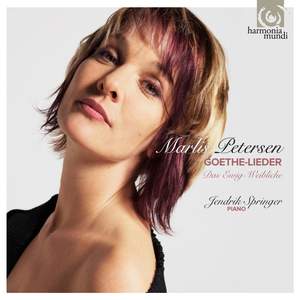
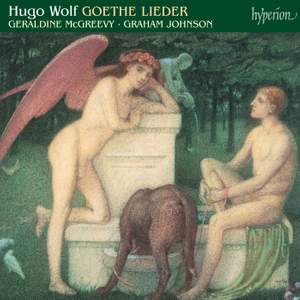
All recordingsPrices shown exclude VAT. (UK tax is not payable for deliveries to United States.) See Terms & Conditions for p&p rates. | |  | Goethe-Lieder: Das ewig Weibliche
Braunfels: | Die Trommel gerühret (first version), Op. 29 No. 2 | Diepenbrock: | Kennst du das Land? (Mignon) | Ives, C: | Illmenau | Kempff: | Wandrers Nachtlied, Op. 61 No. 4 | Krenek: | Monolog der Stella, Op. 57 | Liszt: | Freudvoll und leidvoll, S.280 Über allen Gipfeln ist Ruh (Wandrers Nachtlied II), S.306 | Medtner: | Wandrers Nachtlied II aus 'Neun Lieder von W. Goethe', Op. 6 No. 1 | Mendelssohn, Fanny: | Ach, um deine feuchten Schwingen, H306 | Schubert: | Suleika I, D720 | Schumann: | Nachtlied, Op. 96 No. 1 So lasst mich scheinen Op. 98a No. 9 (Johann Wolfgang von Goethe) | Sommer, H: | Ach neige, du Schmerzenreiche Wandrers Nachtlied | Tchaikovsky: | None but the lonely heart, Op. 6 No. 6 | Trojahn: | Bewundert viel und viel gescholten | Wagner: | Meine Ruh ist hin, Op. 5 No 6 | Wolf, H: | Philine (No. 8 from Goethe-Lieder) Mignon I 'Heiß mich nicht reden' (No. 5 from Goethe-Lieder) |
For her first solo CD, Marlis Petersen and her partner Jendrik Springer have devised this programme of 19 lieder, from nearly two centuries of music, centreing on the concept of the 'Eternal Feminine'. "For this CD we made a selection of songs sung by several female characters from Goethe’s dramas (Stella, Klärchen, Gretchen, Mignon, Philine, Suleika and Helena). Among them are a number of poems which have been set to music countless times in the past two centuries, but are today often known only in a standard setting: if one speaks of 'Gretchen am Spinnrade' or Klärchen’s 'Freudvoll and leidvoll' (to take just two examples), then each of us thinks immediately of the compositions by Franz Schubert and Ludwig van Beethoven respectively. These poems too are on our CD, but set by Richard Wagner and Franz Liszt! By choosing composers who are not usually associated with the lied genre (Ernst Krenek, Charles Ives) or in certain cases probably completely unknown to some listeners (Nikolay Medtner, the pianist Wilhelm Kempff), we wanted to encourage a fresh approach to the poems, one not cluttered by listening traditions. However, to make the selection of songs as varied and balanced as possible, we have also included a few well-known settings like Schubert’s 'Was bedeutet die Bewegung' or Robert Schumann’s 'So laßt mich scheinen'. Furthermore, Manfred Trojahn has contributed a new setting of words portraying Helen of Troy, thus bringing our survey right up to date. Between the individual groups and at the end we have placed a setting of Goethe’s second ‘Wanderer’s Night Song’, 'Über allen Gipfeln ist Ruh'. This is intended to serve as a restingpoint, an emotional ‘reset’; at the same time, it gave us the possibility of presenting a single poem in the interpretation of six different composers: the naive idyll of Hans Sommer and the threatening, doom-laden atmosphere of Nikolay Medtner’s setting are worlds away from each other. It was a thrill and a delight for us to explore this virtually inexhaustible musical treasure-trove in order to come up with an interesting selection of songs that amply repay discovery. We hope you will be as fascinated by this rich diversity as we were!" Marlis Petersen/Jendrik Springer “the sheer range of Petersen's soprano and her interests enables her to compel and convince as much in 1821 Schubert as in German composer Manfred Trojahn's settings from 2008...Most fascinating and seductive of all are the rare settings of Goethe's Uber allen Gipfeln ist Ruh” BBC Music Magazine, May 2012 ***** “There are real treats here and on her best form Marlis Petersen is the kind of silvery-toned lyric soprano for whom some of these Goethe settings hold no fear. She is a natural Mignon in Alphonse Diepenbrock's Kennst du das Land and an appealing Helen of Troy in Manfred Trojahn's Bewundert viel und viel gescholten...it's a compelling piece, packed with drama as Helen contemplates her place in world history” International Record Review, May 2012 BBC Music Magazine
Choral & Song Choice - May 2012 |
| | | In stock - usually despatched within 1 working day. |
|
|
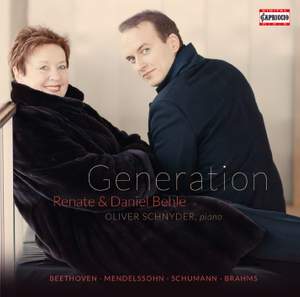
| |  | Renate & Daniel Behle: Generation
Beethoven: | An die ferne Geliebte (To the distant beloved), Op. 98 | Brahms: | Von ewiger Liebe, Op. 43 No. 1 Die Mainacht, Op. 43 No. 2 Liebesglut, Op. 47, No. 2 Sonntag, Op. 47 No. 3 Unbewegte laue Luft (No. 8 from Acht Lieder und Gesänge, Op. 57) Feldeinsamkeit, Op. 86 No. 2 Versunken, Op. 86 No. 5 Wie Melodien zieht es mir, Op. 105 No. 1 Ballade, Op. 10 No. 1 ‘Edward' | Liszt: | Über allen Gipfeln ist Ruh (Wandrers Nachtlied II), S.306 Es muss ein Wunderbares sein, S. 314 | Mendelssohn: | Hexenlied, Op. 8 No. 8 | Schumann: | Belsazar, Op. 57 | Wagner: | Träume (No. 5 from Wesendonck-Lieder) Im Treibhaus (No. 3 from Wesendonck-Lieder) Der Engel (No. 1 from Wesendonck-Lieder) | Wolf, H: | Mignon I 'Heiß mich nicht reden' (No. 5 from Goethe-Lieder) Mignon II 'Nur wer die Sehnsucht kennt' (No. 6 from Goethe-Lieder) Mignon III 'So lasst mich scheinen' (No. 7 from Goethe-Lieder) Mignon IV 'Kennst du das Land' (No. 9 from Goethe-Lieder) |
For this new recording on Capriccio mother and son unite. For more than fifteen years Renate Behle has been one of the world’s most outstanding interpreters of dramatic roles. With her “warm, sumptuous, full voice” whose “sound is etched in one’s memory” (Financial Times), she has thrilled audiences and critics alike on nearly every major opera stage in the world. Here she performs a recital of works by Mendelssohn, Schumann, Beethoven and Brahms amongst others, with her son Daniel, a tenor in great demand on the major opera and concert stages of the world. | | | (also available to download from $10.50) | Usually despatched in 2 - 3 working days. (Available now to download.) |
|
|
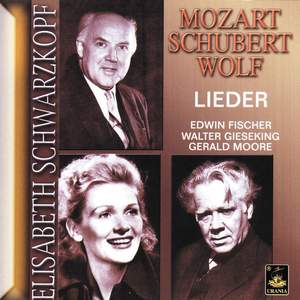
| |  | Elisabeth Schwarzkopf interprets songs by Wolf, Schubert & Strauss
A document out of the ordinary: Elisabeth Schwarzkopf's Lieder recordings with her accompanist Michael Raucheisen, made on 6th January 1958 at the RIAS studios in Berlin, are an impressive example of the fruitful cooperation between these two artists. They performed together as early as 1942, at the beginning of Schwarzkopf's glittering career, and more than one and a half decades later this artistic partnership drew to a close with these recordings.These interpretations of selected songs by Wolf, Schubert and Strauss, made available for the first time, reveal new facets of her creative art.The CD is completed with music by Purcell, Arne and Quilter - Elisabeth Schwarzkopf and Michael Raucheisen at the height of their abilities. | | | Usually despatched in 3 - 4 working days. |
|
|
| |  | Christine Brewer
Opening concert of the 2007/8 Wigmore Hall season Notes on the encore by Christine: ‘A City Called Heaven’ negro spiritual I grew up in a family of singers, many of whom sang gospel music. My brothers and I quite often joined our mother in the church to sing gospel music and spirituals. This music has always been an important part of my life, so I try to include spirituals in my programs whenever I can. I find in the spirituals that no matter what the obstacles are, there is a deep underlying sense of hope and joy. This is what draws me to such music and gives me such joy to sing. ‘Ich liebe dich’ Richard Strauss: This is one of the many Strauss lieder that I have sung for years, and that Roger and I have performed and recorded. This song also exudes such utter joy that it's difficult not to just want to burst out in laughter at the end of it. It has one of the most exuberant postludes of any of Strauss' songs, and I love it! ‘Mira’ Bob Merrill: I started performing Mira about 20 years ago when I did little recitals and concerts around St. Louis. This song spoke to me right away, because it is about a girl who is missing her hometown where everyone knows her name. I grew up in a town of 500 and now live in a town of about 3,500, so I truly know what it is like to walk down the street and know most of the townspeople. There is a comfort in that for me, and I miss it when I am travelling around the world. I think I sang this song as an encore the very first time that I sang at the Wigmore Hall. It became one of Bill Lyne's favourites and he asked me to sing it at his farewell concert. So it has become a standard for me at the Wigmore, and one that always makes me think of home and all those folks there as well as my friends here in London when I sing it! “For all the power and musical intelligence she brings to Wagner's Wesendonck Lieder and Wolf's Mignon songs, the second half signals a complete change of mood in the Britten and John Carter's spiritual- based Cantata. This is singing of rare charm and versatility, at both ends of a vast emotional spectrum.” Sunday Telegraph, 22nd June 2008 “Already in town for jury duty on the Wigmore Hall International Song Competition, [Christine Brewer] gave on Saturday a recital of radiant passion and power … generous sound, long phrases effortlessly controlled, subtle gradations of tone … The music’s emotional volatility was admirably caught. Clamour capsized into sorrow; voice and piano kept questioning and shading each other. Vignoles’s subtle gifts proved vital here … In the four Britten-Auden cabaret songs Brewer was at her unbuttoned best. After cabaret came spirituals, packaged by the American John Carter into a baroque-tinged cantata. Vignoles’s elaborate fingerwork never interfered
with Brewer’s exultant glow.” The Times Concert Review “Recorded at the opening concert of the current Wigmore Hall season, this is very much a recital of two halves. The first finds the American soprano’s glorious, soaring voice in Isolde mode: it is the ideal instrument for Wagner’s Wesendonck-Lieder, and Brewer is in rapturous form here, making as much of the words as she does of Wagner’s music. It is rare, and wonderful, to hear this kind of voice in Wolf’s dramatic setting of Mignon’s Nur wer die Sehnsucht kennt, but Brewer’s tone is perhaps too fruity in his other three songs for the waiflike heroine of Goethe’s Wilhelm Meister. In the second half, she lets her hair down in Britten’s Cabaret songs, and sings the negro spirituals of John Carter’s Cantata with heartrending empathy and simplicity.” Sunday Times, 1st June 2008 *** “American soprano Christine Brewer is blessed with both a huge and beautiful voice, and the intelligence to make good use of it. …a thoroughly enjoyable recital.” BBC Music Magazine, June 2008 **** | | | Usually despatched in 3 - 4 working days. |
|
|
| |  | Wolf: Lieder
| | | (also available to download from $10.50) | Usually despatched in 2 - 3 working days. (Available now to download.) |
|
|
| |  | Marjana Lipovšek sings Lieder
| | | Usually despatched in 3 - 4 working days. |
|
|
| |  | Irmgard Seefried
Brahms: | Die Trauernde, Op. 7 No. 5 Schwesterlein, WoO posth. 37 No. 1 Volkslied Trost in Tränen, Op. 48 No. 5 Unbewegte laue Luft (No. 8 from Acht Lieder und Gesänge, Op. 57) Ständchen, Op. 106 No. 1 Es träumte mir (No. 3 from Acht Lieder und Gesänge, Op. 57) Nicht mehr zu dir zu gehen, Op. 32 No. 2 | Schubert: | Nur wer die Sehnsucht kennt, D877/4 Heiss mich nicht reden, D877/2 So lasst mich scheinen, D877 No. 3 Kennst du das Land (Mignons Gesang), D321 Der König in Thule, D367 Gretchen am Spinnrade, D118 | Wolf, H: | Mignon I 'Heiß mich nicht reden' (No. 5 from Goethe-Lieder) Mignon II 'Nur wer die Sehnsucht kennt' (No. 6 from Goethe-Lieder) Mignon III 'So lasst mich scheinen' (No. 7 from Goethe-Lieder) Mignon IV 'Kennst du das Land' (No. 9 from Goethe-Lieder) |
Irmgard Seefried in Conversation with John Amis
25 July 1965 | |
|
| |  | Strauss & Wolf Lieder
Liszt: | Es muss ein Wunderbares sein, S. 314 | Strauss, R: | Gefunden Op. 56 No. 1 Die Nacht, Op. 10 No. 3 Morgen, Op. 27 No. 4 Allerseelen, Op. 10 No. 8 Ruhe, meine Seele!, Op. 27 No. 1 Du meines Herzens Krönelein, Op. 21 No. 2 Begegnung (Meeting), AV 72 Heimkehr, Op. 15 No. 5 Ach Lieb, ich muß nun scheiden!, Op. 21 No. 3 Die Zeitlose, Op. 10 No. 7 Zueignung, Op. 10 No. 1 | Tchaikovsky: | None but the lonely heart, Op. 6 No. 6 | Wolf, H: | Der Genesene an die Hoffnung (No. 1 from Mörike-Lieder) In der Frühe (No. 24 from Mörike-Lieder) Der Gärtner (No. 17 from Mörike-Lieder) Anakreons Grab (No. 29 from Goethe-Lieder) Verschwiegene Liebe (No. 3 from Eichendorff-Lieder) In dem Schatten meiner Locken (No. 2 from Spanisches Liederbuch: Weltliche Lieder) Bedeckt mich mit Blumen (No. 26 from Spanisches Liederbuch: Weltliche Lieder) Mühvoll komm ich und beladen (No. 7 from Spanisches Liederbuch: Geistliche Lieder) Mignon I 'Heiß mich nicht reden' (No. 5 from Goethe-Lieder) Mignon II 'Nur wer die Sehnsucht kennt' (No. 6 from Goethe-Lieder) Mignon III 'So lasst mich scheinen' (No. 7 from Goethe-Lieder) Mignon IV 'Kennst du das Land' (No. 9 from Goethe-Lieder) Wie lange schon war immer mein Verlangen (No. 11 from Italienisches Liederbuch) Nimmersatte Liebe (No. 9 from Mörike-Lieder) |
| | | Usually despatched in 3 - 4 working days. |
|
|
| |  | Irmgard Seefried - Salzburg Recital, 1957
Beethoven: | Wonne der Wehmut, Op. 83 No. 1 Die Trommel geruhret Freudvoll und leidvoll from Egmont | Mozart: | Das Veilchen, K476 Das Kinderspiel, K598 | Schubert: | Suleika I, D720 Suleika II, D717 Heidenröslein, D257 Der König in Thule, D367 Ganymed, D544 (Goethe) Gretchen am Spinnrade, D118 Im Frühling, D882 Ave Maria, D839 | Schumann: | Lied der Suleika, Op. 25 No. 9 | Wolf, H: | Mignon I 'Heiß mich nicht reden' (No. 5 from Goethe-Lieder) Mignon II 'Nur wer die Sehnsucht kennt' (No. 6 from Goethe-Lieder) Mignon III 'So lasst mich scheinen' (No. 7 from Goethe-Lieder) Mignon IV 'Kennst du das Land' (No. 9 from Goethe-Lieder) Blumengruss (No. 24 from Goethe-Lieder) Die Bekehrte (No. 27 from Goethe-Lieder) Anakreons Grab (No. 29 from Goethe-Lieder) Frühling übers Jahr (No. 28 from Goethe-Lieder) |
| | | Usually despatched in 3 - 4 working days. |
|
|
| |  | Mignon-Vertonungen
Ulrike Sonntag (soprano), Gisela Andreas (piano) | | | Usually despatched in 2 - 3 working days. |
|
|
| |
|