Prices shown exclude VAT. (UK tax is not payable for deliveries to United States.) See Terms & Conditions for p&p rates. | |  | The Very Best of Elisabeth Schwarzkopf
Bach, J S: | Cantata BWV51 'Jauchzet Gott in allen Landen': Aria Bist du bei mir, BWV508 | Beethoven: | O wär' ich schon mit dir vereint (Marzelline) | Heuberger: | Gehen wir ins Chambre séparée) from The Opera Ball | Humperdinck: | Brüderchen, komm tanz mit mir (Dance Duet from Hänsel und Gretel) | Lehár: | Viljalied (from Die lustige Witwe) | Mozart: | Non so più cosa son, cosa faccio (from Le nozze di Figaro) Porgi amor (from Le nozze di Figaro) E Susanna non vien! … Dove sono i bei momenti (from Le nozze di Figaro) In quali eccessi ... Mi tradì quell'alma ingrate (from Don Giovanni) Come scoglio (from Così fan tutte) Ridente la calma, K152 | Schubert: | An die Musik D547 Das Lied im Grünen, D917 Nachtviolen D752 (Mayrhofer) Der Musensohn, D764 (Goethe) | Siecynski: | Wien, du Stadt meiner Traüm | Smetana: | Endlich allein (from Die verkaufte Braut) | Strauss, J, II: | Klänge der Heimat (from Die Fledermaus) | Strauss, R: | Da geht er hin (from Der Rosenkavalier, Op. 59) Es gibt ein Reich (from Ariadne auf Naxos) Das war sehr gut, Mandryka (from Arabella) Frühling (from Vier Letzte Lieder) Im Abendrot (from Vier Letzte Lieder) Muttertändelei, Op. 43 No. 2 Zueignung, Op. 10 No. 1 | trad.: | Gsätzli | Wagner: | Einsam in trüben Tagen (from Lohengrin) | Weber: | Wie nahte mir der Schlummer … Leise, leise, fromme Weise (from Der Freischütz) | Wolf, H: | Auch kleine Dinge (No. 1 from Italienisches Liederbuch) Mein Liebster hat zu Tische mich geladen (No. 25 from Italienisches Liederbuch) Ich hab in Penna einen Liebsten (No. 46 from Italienisches Liederbuch) Verschling der Abgrund meines Liebsten Hütte Wiegenlied im Sommer (from Sechs Lieder für eine Frauenstimme) In dem Schatten meiner Locken (No. 2 from Spanisches Liederbuch: Weltliche Lieder) Mignon IV 'Kennst du das Land' (No. 9 from Goethe-Lieder) Mausfallen-Sprüchlein (from Lieder für eine Frauenstimme) |
Multi-award winning opera singer Elisabeth Schwarzkopf, praised for the ‘pristine beauty of her lyric soprano’ (The Guardian), was revered in opera houses worldwide and is perhaps most famous for her Mozart roles. However, she was also at home on the concert stage and this collection combines her acclaimed portrayals of Donna Elvira, Countess Almaviva and Richard Strauss’s Marschallin, among others, with her affecting interpretations of lieder and song-cycles. | 
| | | In stock - usually despatched within 1 working day. |
|
|
| |  | Virgins, Vixens & Viragos: Susan Graham
Susan Graham’s eagerly awaited new ONYX CD is a characteristically wide ranging recital which covers a wide spectrum of female emotions as experienced by the virgins, vixens and one of the most frightening of viragos – Lady Macbeth, all captured here in song. In addition to these emotional extremes, there are also lighter issues for a girl to confront, in the Poulenc, and a fruitless pursuit of a boy in the Sondheim to lighten the mood! Susan is one of the great mezzo sopranos of our time, renowned for her operatic performances, and for her recitals. Her earlier CD for ONYX ‘Un frisson francais – A century of French Song' was widely praised. “It’s hard to think of another contemporary singer who could pull off the tour de force Graham achieves here, with numbers ranging over a period of almost 300 years...Graham is in her element as the vixens” Sunday Times, 2nd December 2012 “Graham is an artist to treausre, a striking mezzo whose powerful silky voice can achieve Janet Baker-like expressiveness, with a gift for French song but also a mile-wide impish streak...Porter's anatomically witty lament and Sondheim's wicked Girl from Ipanema parody leave one chuckling for all the right reasons. All told, a gem.” BBC Music Magazine, February 2013 **** “I can't think of another singer today who could match Susan Graham in an eclectic programme ranging across three centuries, four languages and a diverse array of idioms...In glowing voice, Graham opens with a richly imagined, deeply felt performance of Purcell's quasi-operatic scena, culminating in repeated cries on 'Gabriel' of almost excruciating intensity...a recital of rare versatility and panache” Gramophone Magazine, March 2013 “ Her Berlioz performance is wonderful: here she deploys gorgeous, full tone and, as so often on this disc, treats us to some very expressive singing...This is a delicious recital. Susan Graham’s lustrous voice and intelligent approach to a well-conceived and nicely varied programme gave me consistent pleasure, as did the pianism of Malcolm Martineau, which is splendid at every turn.” MusicWeb International, March 2013 | | | In stock - usually despatched within 1 working day. |
|
|
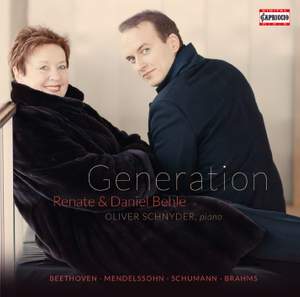
| |  | Renate & Daniel Behle: Generation
Beethoven: | An die ferne Geliebte (To the distant beloved), Op. 98 | Brahms: | Von ewiger Liebe, Op. 43 No. 1 Die Mainacht, Op. 43 No. 2 Liebesglut, Op. 47, No. 2 Sonntag, Op. 47 No. 3 Unbewegte laue Luft (No. 8 from Acht Lieder und Gesänge, Op. 57) Feldeinsamkeit, Op. 86 No. 2 Versunken, Op. 86 No. 5 Wie Melodien zieht es mir, Op. 105 No. 1 Ballade, Op. 10 No. 1 ‘Edward' | Liszt: | Über allen Gipfeln ist Ruh (Wandrers Nachtlied II), S.306 Es muss ein Wunderbares sein, S. 314 | Mendelssohn: | Hexenlied, Op. 8 No. 8 | Schumann: | Belsazar, Op. 57 | Wagner: | Träume (No. 5 from Wesendonck-Lieder) Im Treibhaus (No. 3 from Wesendonck-Lieder) Der Engel (No. 1 from Wesendonck-Lieder) | Wolf, H: | Mignon I 'Heiß mich nicht reden' (No. 5 from Goethe-Lieder) Mignon II 'Nur wer die Sehnsucht kennt' (No. 6 from Goethe-Lieder) Mignon III 'So lasst mich scheinen' (No. 7 from Goethe-Lieder) Mignon IV 'Kennst du das Land' (No. 9 from Goethe-Lieder) |
For this new recording on Capriccio mother and son unite. For more than fifteen years Renate Behle has been one of the world’s most outstanding interpreters of dramatic roles. With her “warm, sumptuous, full voice” whose “sound is etched in one’s memory” (Financial Times), she has thrilled audiences and critics alike on nearly every major opera stage in the world. Here she performs a recital of works by Mendelssohn, Schumann, Beethoven and Brahms amongst others, with her son Daniel, a tenor in great demand on the major opera and concert stages of the world. | | | (also available to download from $10.75) | Usually despatched in 2 - 3 working days. (Available now to download.) |
|
|
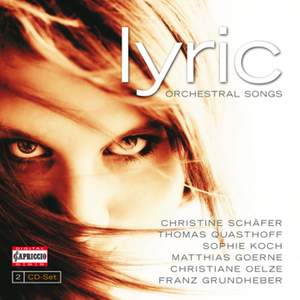
| |  | Lyric: Orchestral Songs
Bloch, E: | Poèmes D’automne for Mezzo-Soprano and Orchestra Sophie Koch (mezzo) Deutsches Symphonie-Orchester Berlin, Steven Sloane Two Psalms for Soprano & orchestra Christiane Oelze (soprano) Deutsches Symphonie-Orchester Berlin, Steven Sloane | Mahler: | Rückert-Lieder (5 songs, complete) Christine Schäfer (soprano) Deutsches Symphonie-Orchester Berlin, Christoph Eschenbach Lieder eines fahrenden Gesellen (4 songs, complete) Thomas Quasthoff (bass-baritone) Kölner Rundfunk-Sinfonie-Orchester, Gary Bertini | Schreker: | Lieder (5) für tiefe Stimme und Orchester Mechthild Georg (mezzo) WDR Rundfunkorchester Köln, Peter Gülke | Wellesz: | Leben, Traum und Tod, Op. 55 Regina Klepper (soprano), Sophie Koch (mezzo) Deutsches Symphonie-Orchester Berlin, Roger Epple | Wolf, H: | Mignon IV 'Kennst du das Land' (No. 9 from Goethe-Lieder) Er ist's (No. 6 from Mörike-Lieder) Anakreons Grab (No. 29 from Goethe-Lieder) Denk es, o Seele! (No. 39 from Mörike-Lieder) An den Schlaf (No. 29 from Mörike-Lieder) Mitsuko Shirai (mezzo) Radio-Symphonie-Orchester Berlin, David Shallon | Zemlinsky: | Lied der Baumwollpacker (from Symphonische Gesänge, Op. 20) Totes braunes Mädel (from Symphonisches Gesänge, Op. 20) Afrikanischer Tanz (from Symphonisches Gesänge, Op. 20) Franz Grundheber (baritone) Philharmonisches Staatsorchester Hamburg, Gerd Albrecht Lyric Symphony Op. 18: Friede mein Herz Matthias Goerne (baritone) Orchestre de Paris, Christoph Eschenbach |
These recordings taken from the legendary Capriccio-Archive bring some of the world’s leading singers together. “A flavoursome two-disc compliation garnering the distinctive character of these singers, often in less familiar and fascinating repertoire” BBC Music Magazine, April 2012 **** | | | (also available to download from $21.75) | Usually despatched in 2 - 3 working days. (Available now to download.) |
|
|
| |  | Elisabeth Schwarzkopf interprets songs by Wolf, Schubert & Strauss
A document out of the ordinary: Elisabeth Schwarzkopf's Lieder recordings with her accompanist Michael Raucheisen, made on 6th January 1958 at the RIAS studios in Berlin, are an impressive example of the fruitful cooperation between these two artists. They performed together as early as 1942, at the beginning of Schwarzkopf's glittering career, and more than one and a half decades later this artistic partnership drew to a close with these recordings.These interpretations of selected songs by Wolf, Schubert and Strauss, made available for the first time, reveal new facets of her creative art.The CD is completed with music by Purcell, Arne and Quilter - Elisabeth Schwarzkopf and Michael Raucheisen at the height of their abilities. | | | Usually despatched in 3 - 4 working days. |
|
|
| |  | Christine Brewer
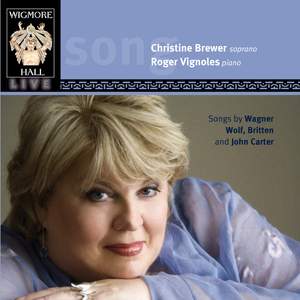
Opening concert of the 2007/8 Wigmore Hall season Notes on the encore by Christine: ‘A City Called Heaven’ negro spiritual I grew up in a family of singers, many of whom sang gospel music. My brothers and I quite often joined our mother in the church to sing gospel music and spirituals. This music has always been an important part of my life, so I try to include spirituals in my programs whenever I can. I find in the spirituals that no matter what the obstacles are, there is a deep underlying sense of hope and joy. This is what draws me to such music and gives me such joy to sing. ‘Ich liebe dich’ Richard Strauss: This is one of the many Strauss lieder that I have sung for years, and that Roger and I have performed and recorded. This song also exudes such utter joy that it's difficult not to just want to burst out in laughter at the end of it. It has one of the most exuberant postludes of any of Strauss' songs, and I love it! ‘Mira’ Bob Merrill: I started performing Mira about 20 years ago when I did little recitals and concerts around St. Louis. This song spoke to me right away, because it is about a girl who is missing her hometown where everyone knows her name. I grew up in a town of 500 and now live in a town of about 3,500, so I truly know what it is like to walk down the street and know most of the townspeople. There is a comfort in that for me, and I miss it when I am travelling around the world. I think I sang this song as an encore the very first time that I sang at the Wigmore Hall. It became one of Bill Lyne's favourites and he asked me to sing it at his farewell concert. So it has become a standard for me at the Wigmore, and one that always makes me think of home and all those folks there as well as my friends here in London when I sing it! “American soprano Christine Brewer is blessed with both a huge and beautiful voice, and the intelligence to make good use of it. …a thoroughly enjoyable recital.” BBC Music Magazine, June 2008 **** “For all the power and musical intelligence she brings to Wagner's Wesendonck Lieder and Wolf's Mignon songs, the second half signals a complete change of mood in the Britten and John Carter's spiritual- based Cantata. This is singing of rare charm and versatility, at both ends of a vast emotional spectrum.” Sunday Telegraph, 22nd June 2008 “Recorded at the opening concert of the current Wigmore Hall season, this is very much a recital of two halves. The first finds the American soprano’s glorious, soaring voice in Isolde mode: it is the ideal instrument for Wagner’s Wesendonck-Lieder, and Brewer is in rapturous form here, making as much of the words as she does of Wagner’s music. It is rare, and wonderful, to hear this kind of voice in Wolf’s dramatic setting of Mignon’s Nur wer die Sehnsucht kennt, but Brewer’s tone is perhaps too fruity in his other three songs for the waiflike heroine of Goethe’s Wilhelm Meister. In the second half, she lets her hair down in Britten’s Cabaret songs, and sings the negro spirituals of John Carter’s Cantata with heartrending empathy and simplicity.” Sunday Times, 1st June 2008 *** “Already in town for jury duty on the Wigmore Hall International Song Competition, [Christine Brewer] gave on Saturday a recital of radiant passion and power … generous sound, long phrases effortlessly controlled, subtle gradations of tone … The music’s emotional volatility was admirably caught. Clamour capsized into sorrow; voice and piano kept questioning and shading each other. Vignoles’s subtle gifts proved vital here … In the four Britten-Auden cabaret songs Brewer was at her unbuttoned best. After cabaret came spirituals, packaged by the American John Carter into a baroque-tinged cantata. Vignoles’s elaborate fingerwork never interfered
with Brewer’s exultant glow.” The Times Concert Review | | | Usually despatched in 3 - 4 working days. |
|
|
| |  | Wolf: Lieder
| | | (also available to download from $10.75) | Usually despatched in 2 - 3 working days. (Available now to download.) |
|
|
| |  | Elisabeth Schwarzkopf: Farewell Recital in Amsterdam, 1977
Liszt: | Die drei Zigeuner, S.320 | Mahler: | Ich atmet' einen linden Duft (Rückert-Lieder) | Schubert: | Der Einsame, D800 Gretchen am Spinnrade, D118 Seligkeit D433 (Holty) Der Lindenbaum (No. 5 from Winterreise, D911) | Schumann: | Der Nussbaum, Op. 25 No. 3 | Strauss, R: | Ruhe, meine Seele!, Op. 27 No. 1 Ach, was Kummer, Qual und Schmerzen, Op. 49 No. 8 | Wolf-Ferrari: | Vado di notte, come fa la luna | Wolf, H: | Mignon IV 'Kennst du das Land' (No. 9 from Goethe-Lieder) Die Zigeunerin (No. 7 from Eichendorff-Lieder) Ich esse nun mein Brot nicht trocken mehr Ich hab in Penna einen Liebsten (No. 46 from Italienisches Liederbuch) Trau nicht der Liebe (No. 67 from Spanisches Liederbuch: Weltliche Lieder) O wär dein Haus durchsichtig wie ein Glas Wie lange schon war immer mein Verlangen (No. 11 from Italienisches Liederbuch) An den Schlaf (No. 29 from Mörike-Lieder) Heimweh (No. 37 from Mörike-Lieder) Denk es, o Seele! (No. 39 from Mörike-Lieder) Das verlassene Mägdlein (No. 7 from Mörike-Lieder) |
| | | Usually despatched in 2 - 3 working days. |
|
|
| |  | Irmgard Seefried
Brahms: | Die Trauernde, Op. 7 No. 5 Schwesterlein, WoO posth. 37 No. 1 Volkslied Trost in Tränen, Op. 48 No. 5 Unbewegte laue Luft (No. 8 from Acht Lieder und Gesänge, Op. 57) Ständchen, Op. 106 No. 1 Es träumte mir (No. 3 from Acht Lieder und Gesänge, Op. 57) Nicht mehr zu dir zu gehen, Op. 32 No. 2 | Schubert: | Nur wer die Sehnsucht kennt, D877/4 Heiss mich nicht reden, D877/2 So lasst mich scheinen, D877 No. 3 Kennst du das Land (Mignons Gesang), D321 Der König in Thule, D367 Gretchen am Spinnrade, D118 | Wolf, H: | Mignon I 'Heiß mich nicht reden' (No. 5 from Goethe-Lieder) Mignon II 'Nur wer die Sehnsucht kennt' (No. 6 from Goethe-Lieder) Mignon III 'So lasst mich scheinen' (No. 7 from Goethe-Lieder) Mignon IV 'Kennst du das Land' (No. 9 from Goethe-Lieder) |
Irmgard Seefried in Conversation with John Amis
25 July 1965 | |
|
| |  | Strauss & Wolf Lieder
Liszt: | Es muss ein Wunderbares sein, S. 314 | Strauss, R: | Gefunden Op. 56 No. 1 Die Nacht, Op. 10 No. 3 Morgen, Op. 27 No. 4 Allerseelen, Op. 10 No. 8 Ruhe, meine Seele!, Op. 27 No. 1 Du meines Herzens Krönelein, Op. 21 No. 2 Begegnung (Meeting), AV 72 Heimkehr, Op. 15 No. 5 Ach Lieb, ich muß nun scheiden!, Op. 21 No. 3 Die Zeitlose, Op. 10 No. 7 Zueignung, Op. 10 No. 1 | Tchaikovsky: | None but the lonely heart, Op. 6 No. 6 | Wolf, H: | Der Genesene an die Hoffnung (No. 1 from Mörike-Lieder) In der Frühe (No. 24 from Mörike-Lieder) Der Gärtner (No. 17 from Mörike-Lieder) Anakreons Grab (No. 29 from Goethe-Lieder) Verschwiegene Liebe (No. 3 from Eichendorff-Lieder) In dem Schatten meiner Locken (No. 2 from Spanisches Liederbuch: Weltliche Lieder) Bedeckt mich mit Blumen (No. 26 from Spanisches Liederbuch: Weltliche Lieder) Mühvoll komm ich und beladen (No. 7 from Spanisches Liederbuch: Geistliche Lieder) Mignon I 'Heiß mich nicht reden' (No. 5 from Goethe-Lieder) Mignon II 'Nur wer die Sehnsucht kennt' (No. 6 from Goethe-Lieder) Mignon III 'So lasst mich scheinen' (No. 7 from Goethe-Lieder) Mignon IV 'Kennst du das Land' (No. 9 from Goethe-Lieder) Wie lange schon war immer mein Verlangen (No. 11 from Italienisches Liederbuch) Nimmersatte Liebe (No. 9 from Mörike-Lieder) |
| | | Usually despatched in 3 - 4 working days. |
|
|
| |
|