All recordingsPrices shown exclude VAT. (UK tax is not payable for deliveries to United States.) See Terms & Conditions for p&p rates. | |  | JS Bach & Couperin: Works for Keyboard
Jean-Luc Ho (harpsichord) In this recording, Jean-Luc Ho pairs Bach's French Overture (Ouverture nach Französischer Art) with the Huitième Ordre, one of Couperin's most celebrated works. Both are played with the French art de toucher le clavecin (the art of playing the harpsichord), as expounded by Couperin and adopted by Bach, bringing to light the connection between these two masterpieces of the harpsichord repertoire. | 
| | | In stock - usually despatched within 1 working day. |
|
|
| |  | Glenn Gould and András Schiff play Bach
“It’s not inappropriate that Alto have coupled Gould and Schiff in Bach; as the quotation on the back of the CD reminds us, Schiff was impressed by Gould’s playing which he found so different from everyone else’s. Schiff’s own Goldbergs are cut from very different cloth...but the coupling is still apt.” MusicWeb International, March 2012 | | | In stock - usually despatched within 1 working day. |
|
|
| |  | Bach - French Suite No. 5
Piotr Andersjewski (piano) | | | In stock - usually despatched within 1 working day. |
|
|
| |  | Volume 52 of the Glenn Gould Complete Jacket CollectionBach: The French Suites, Vol. 2 & Overture in the French Style
The Canadian musician Glenn Gould was undoubtedly one of the greatest pianists of all time. To mark the 75th anniversary of his birth, and the 25th anniversary of his death, Sony BMG Masterworks presents this seminal artist’s vinyl recordings as re-mastered CDs, designed to replicate the exact artwork of the original gramophone records in miniaturised form. Already issued as part of an 80-CD box set (88697130942), these albums are now being made available individually. | | | In stock - usually despatched within 1 working day. |
|
|
| |  |
“EMI’s Great Recordings of the Century is exactly what it says: these classic interpretations warrant a place in everybody’s collection” The Times | | | In stock - usually despatched within 1 working day. |
|
|
| |  |
Kenneth Weiss (harpsichord Jean-Henri Hemsch 1761) | | | In stock - usually despatched within 1 working day. |
|
|
| |  | International Van Cliburn Competition 2005
“A brilliant pianist and a million-volt presence onstage” Dallas Morning News | | | In stock - usually despatched within 1 working day. |
|
|
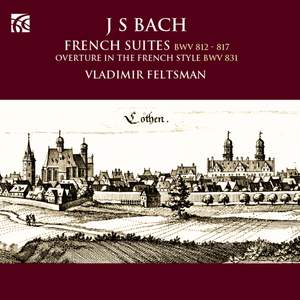
| |  | JS Bach: French Suites & Overture in the French Style
| | | In stock - usually despatched within 1 working day. |
|
|
| |  | J.S Bach: Italian Concerto & French Overture
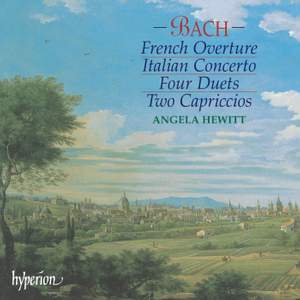
Angela Hewitt's recordings of J S Bach's keyboard works are rapidly being seen as the definitive modern survey on the piano. Such is her natural affinity for Bach's style, her aliveness to his dancing rhythms and her sensitive use of the modern instrument, that she is the natural successor to a prestigious line of great Bach pianists. This disc includes works from the second and third volumes of Bach's Clavierübung (Keyboard Practice). In the Italian Concerto and French Overture Bach demonstrates not only his skill as translating to the keyboard two of the most popular orchestral genres of the time, but also his natural assimilation of their respective national characteristics, while remaining true to his own style. These are among his happiest inspirations. The Italian Concerto brims with joyous thematic invention and allusions to solo and orchestral contrasts, while the French Overture (often called a Partita) is a lively dance suite. The Four Duets, rather like more mature Two-part Inventions, and the youthful Capriccios complete a sunny and inspirational disc. “Here is an attractive recital of five varied pieces or suites of pieces, familiar and not so familiar, played with Hewitt's expected intelligence and finish and not a little verve. In her very readable introduction, Hewitt quotes a contemporary review of the Italian Concerto describing Bach not only as a great master but as someone 'who has almost alone taken possession of the clavier', and whose compositions are exceedingly difficult to play 'because the efficiency of his own limbs sets his standards'. They still are, and Hewitt conveys the feeling that the challenges aren't just to be met but should be sensed as integral to successful performance. By giving the quick numbers plenty of pace she makes the music sound difficult in the right way. No question of hustling them along, but rather of touching the core of the rhythmic energy and of making all the lines, throughout the texture, directional and lively. Hewitt's isn't a monumental Bach, rooted to the spot, but one that makes us curious as to what lies around the next corner. The brilliant outer movements of the Italian Concerto, the long fugal section of the French Overture, the second and fourth of the Duets (those extraordinary studies in two-part writing) are all successes of her musical dynamic and high-stepping style. And the Echo movement of the French Overture (track 28) has a positively theatrical allure, like something out of Rameau – wonderful! What she can't disguise, however, is that some of the movements in this great suite 'in the French style' lie uneasily on the piano, especially when the sonorities characteristic of a two- manual harpsichord are transcribed as if for a piano without sustaining pedal. If only she'd allow herself a dab of it now and then; the music needs to hang in the air a bit, and the 18th- century harpsichord was, after all, an instrument of mass as well as point, richer in colour and weight of sound than Hewitt's pencil-lines and sometimes rather brittle and over-articulated manner suggest. On the other hand, her characterisation of the two early Capriccios in terms of the modern piano is a tour de force – sparky, fresh, as if improvised. The greatness of the rest of the music here may put them in the shade, a little, but they're delightful. Bach aged 17, trying his hand at programme music? Well, the Capriccio 'on the departure of his beloved brother' remained his only example of it, but it's a reminder too that there was nothing he couldn't do. A stimulating disc, and beautiful sound.” Gramophone Classical Music Guide, 2010 | | | In stock - usually despatched within 1 working day. |
|
|
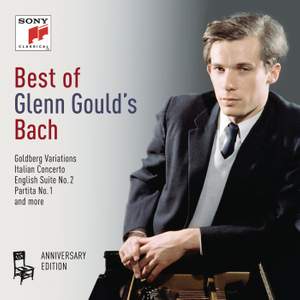
| |  | The Best of Glenn Gould's Bach
Bach, J S: | Goldberg Variations, BWV988: excerpts (aria and variations I-VII; 1955 recording) Partita No. 1 in B flat major, BWV825 Chromatic Fantasia in D minor, BWV903a English Suite No. 2 in A minor, BWV807 Toccata in E minor, BWV914 Two-part Invention No. 1 in C major, BWV772 Three-part Invention (Sinfonia) No. 1 in C major, BWV787 Two-part Invention No. 8 in F major, BWV779 Three-part Invention (Sinfonia) No. 8 in F major, BWV794 Two-part Invention No. 11 in G minor, BWV782 Three-part Invention (Sinfonia) No. 11 in G minor, BWV797 French Overture in B minor, BWV831 French Suite No. 5 in G major, BWV816: Allemande French Suite No. 5 in G major, BWV816: Gavotte French Suite No. 5 in G major, BWV816: Gigue Goldberg Variations, BWV988: Variation 30 1981 digital recording Goldberg Variations, BWV988: Aria 1981 digital recording Italian Concerto, BWV971 Aria Variata in A minor, BWV989 ‘alla Maniera Italiana' Keyboard Concerto in D minor (after Marcello), BWV974 The Well-Tempered Clavier, Book 1 (extracts) (Preludes and Fugues Nos. 1 & 5) The Well-Tempered Clavier, Book 2 (extracts) (Preludes and Fugues Nos. 14 & 17) Prelude & Fugue in B flat major on the name B-A-C-H, BWV898 The Art of Fugue, BWV1080: Contrapunctus VII a 4 per augmentationem et diminutionem Glenn Gould (organ) The Art of Fugue, BWV1080: Contrapunctus VIII Glenn Gould (organ) The Art of Fugue, BWV1080: Contrapunctus IX a 4 alla duodecima Glenn Gould (organ) Keyboard Concerto No. 5 in F minor, BWV1056 Columbia Symphony Orchestra, Vladimir Golschmann Goldberg Variations, BWV988 (DVD - a film by Bruno Monsaingeon; 1981) |
So much has been written about the sensation caused by Gould’s first studio recording of the Goldberg Variations in June 1955 that it is hardly necessary to repeat the story of this “birth of a legend” here. But even though it was this recording that laid the foundations for Gould’s international reputation as a Bach interpreter, its roots lie much further back. From the very outset his Bach had been as unconventional as it was distinctive – and so it remains, in spite of regular attempts to enthrone a “new Glenn Gould”. (Conversely, this has meant that every new recording of Bach’s keyboard works is judged by Gould’s standards.) His habit of slouching over the piano, the expansive gestures of his hands and arms, his stabbing nonlegato (almost always without the use of the sustaining pedal), his breathtaking polyphony and his often extreme tempi all result in a kind of pianism that seems to come from another planet, reminding us of Stefan George’s poem in Schoenberg’s Second String Quartet, “Entrückung” (Rapt Otherworldliness): “I breathe air from another planet.” [...] DVD: The Goldberg Variations (1981) directed by Bruno Monsaingeon Picture format: 4:3 NTSC; colour; DVD-5 Language: English (with subtitles in French and German) This is a mid-priced release on the Sony Classical label, containing x2 CDs & a DVD, packaged in a ltd edition, deluxe, hardbound book. | | | Usually despatched in 3 - 4 working days. |
|
|
| |
|