All recordingsPrices shown exclude VAT. (UK tax is not payable for deliveries to United States.) See Terms & Conditions for p&p rates. | |  | Fauré: Thème & Variations & Barcarolles
Giulio Biddau is a young Sardinian pianist who has studied with Aldo Ciccolini, who suggested that he record the complete Barcarolles by Gabriel Fauré. Biddau adds to that the little-recorded, ‘Theme and Variations’. Winner of Spedidam in Aix-en-Provence, Giulio appears regularly on major European stages. This is the first hard evidence of his exceptional qualities, a great pianist of tomorrow. “Biddau's recording is as lovely as the pieces deserve. His tone is liquescent, yet his touch is firm - a happy combination in this context, as when his fingerwork controls the occasional sprays of pianistic fioritura that Faure writes. He also seems to understand the subtle, sometimes elusive quality of Faure's inspiration.” International Record Review, June 2012 | | | Usually despatched in 3 - 4 working days. |
|
|
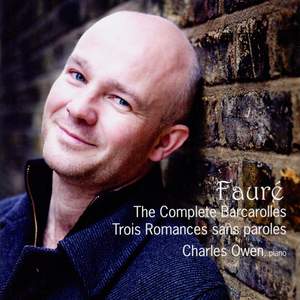
| |  | Fauré: The Complete Barcarolles & Trois Romances Sans Paroles
Following a critically acclaimed recording of Fauré’s Complete Nocturnes (AV2133), Charles Owen surveys the composer’s Complete Barcarolles, uniquely coupled with Trois Romances sans paroles. Pianist Charles Owens follows a critically acclaimed release of Fauré’s popular Nocturnes (AV2133) with a relative rarity – a complete survey of the composer’s Barcarolles uniquely coupled with Trois Romances sans paroles, Fauré’s first published works for piano. The Barcarolles straddle the turn of the 20th century and span a four-decade period, from 1880 – 1921. The works’ dedicatees were a veritable roll call of Parisian musical elite. Though written and published separately, they hang together well through their combination of mystery, humanity and inner poetry. Yet it is a rare pianist who plays all thirteen, a bill that Charles Owen lives up to brilliantly. “Fauré's piano music is at last emerging in its full measure of energy and brilliance. Charles Owen buys enthusiastically into this truer picture of the music...On the technical front Owen is absolutely secure, with fine observation of the music's often multiple layering” BBC Music Magazine, September 2011 **** “Owen is the least insistent or interventionalist of pianists. He never invests the music with undue weight or significance. His performances glide gracefully, often in near strict tempo on their own momentum, quite without distortion or idiosyncrasy.” Gramophone Magazine, September 2011 “Owens gives beautifully measured accounts of these charming works, enjoying the lavishness of the writing but carefully teasing out the all-important melodies with a silver spoon. He makes enterprising use of the pedals, and the colour evinced in Nos. 1, 3 and 6 are particularly charismatic.” International Record Review, September 2011 “These are the urbane descendants of Chopin's pianistic brilliants, gentlemanly and understated. Charles Owen's beautifully judged and articulated performance deftly reveals the intricacy of Fauré's craft without loss of line, from the seemingly carefree balletic shimmer of the 1885 G flat major to the darker harmonies of the 1915 E flat major.” The Independent on Sunday, 3rd July 2011 | | | Usually despatched in 4 - 5 working days. |
|
|
| |  | Fauré: Barcarolles Nos. 1-13
Like Chopin’s Barcarolles, Fauré’s work shows equal measures of limpidity and gravity, brightness and great depth. Delphine Bardin started playing the piano at the age of five and went on to study piano as a graduate at the Paris Conservatory under Pierre-Laurent Aimard, and chamber music under Christian Ivaldi. In 1997 she won the Clara Haskil prize, one of the most prestigious piano competitions in the world. Numerous solo engagements followed including invitations from Birmingham, Carnegie Hall, the Concertgebouw, the Wigmore Hall and the Palais des Beaux-Arts in Brussels. Since then, Delphine Bardin has been travelling the world both as a chamber musician and soloist. She has also formed two duos: one with the cellist Ophélie Gaillard and another with Sarah Louvion, flute soloist with the Frankfurt Opera. She also regularly plays quintet concert programmes with the Benaïm Quartet. “Delphine Bardin's performances show an admirable and recognisably French clarity and taste...The playing is lucid and clear” Gramophone Magazine, September 2010 | | | (also available to download from $10.50) | Usually despatched in 4 - 5 working days. (Available now to download.) |
|
|
| |  | Fauré: Barcarolles Nos. 1-13
| | | (also available to download from $10.50) | Usually despatched in 8 - 10 working days. (Available now to download.) |
|
|
| |  |
| | | Usually despatched in 4 - 5 working days. |
|
|
| |  |
Pierre-Alain Volondat (piano) “Volondat displays poetry and sensitivity, adding introversion or passion as appropriate. With more Faure and works by Franck and Dukas to come, Volondat promises to be a valuable addition to the Naxos stable.” BBC Music Magazine | | | (also available to download from $6.00) | Usually despatched in 2 - 3 working days. (Available now to download.) |
|
|
| |  | Fauré - Complete Works for Piano
| | | In stock - usually despatched within 1 working day. |
|
|
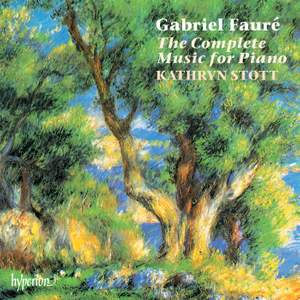
| |  | Fauré - Complete Piano Music
“Fauré's piano works are among the most subtly daunting in all keyboard literature. Encompassing Fauré's entire creative life, they range through an early, finely wrought eroticism via sporting with an aerial virtuosity as teasing and light as the elements themselves (the Valsescaprices) to the final desolation of his last years. There, in his most powerful works ( Barcarolles Nos 7-11, Nocturnes Nos 11-13), he faithfully mirrors a pain that 'scintillates in full consciousness', a romantic agony prompted by increasing deafness and a lack of recognition that often seemed close to oblivion. Few compositions have reflected a darker night of the soul, and Fauré's anguish, expressed in both numbing resignation and unbridled anger, could surely only be exorcised by the articulation of such profound and disturbing emotional complexity. The task for the pianist, then, is immense, but in Kathryn Stott Fauré has a subtle and fearless champion. How thrilled Fauré would have been by the sheer immediacy of Stott's responses. Time and again she throws convention to the winds, and although it would be surprising if all her performances were consistent successes, disappointments are rare. Sometimes her rubato and luxuriant pedalling soften the outlines of Fauré's starkest, most austere utterances. But such quibbles remain quibbles. The Fourth Nocturne is gloriously supple, and the 13 Barcarolles show Stott acutely responsive to passion and finesse alike. The Pièces brèves, too, are played with rare affection. Stott proves herself a stylish and intriguing pianist.” Gramophone Classical Music Guide, 2010 | | | In stock - usually despatched within 1 working day. |
|
|
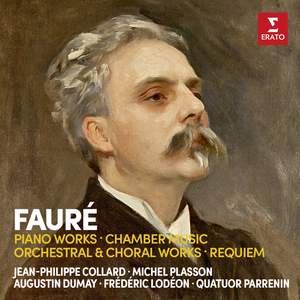
| |  | Fauré - Piano Works
The most authorative complete recording of Fauré’s intoxicating pianistic flowers. The fact that Verlaine found his composer in Gabriel Fauré – that Clair de lune from Fêtes galantes and La Bonne Chanson rank among the composer’s most outstanding successes – does not mean that Fauré should only been seen as the composer of hazy dreams, of quicksilver emotions, of startled outpourings for fair turn-of-the-century listeners. The Nocturnes alone – composed over a span of almost 40 years (1883–1922) – would suffice to prevent any identification of the composer, trained in the rigorous discipline of the Niedermeyer School, with the impressionist poet. Verlaine delights in the uncertainty of feelings and landscapes, thereby entertaining a confusion between a hazy exterior and the irresolutions of an aching soul – a continuing game of deceit. In Fauré, on the other hand, one finds no such ambiguity: his consciousness does not allow itself to dissolve into a world where objects have completely lost their outline. Northern mists, a murky chiaroscuro, an unhealthy twilight, this is what suits Verlaine’s equivocal Nocturnes. Fauré is a man from the South: his Night retains all the luminosity and brightness of the Mediterranean, paths can be made out and emotions do not stray off into an uneasy twilight zone. | | | Usually despatched in 4 - 5 working days. |
|
|
| |  | Fauré: The Complete Piano Works
| | | Usually despatched in 8 - 10 working days. |
|
|
| |
|