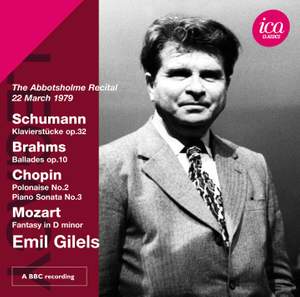
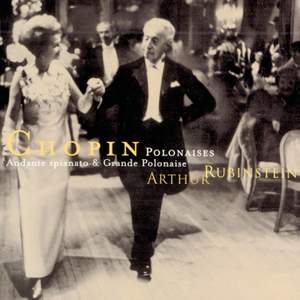
Chopin: Polonaise No. 2 in E flat minor, Op. 26 No. 2

This page lists all recordings of Polonaise No. 2 in E flat minor, Op. 26 No. 2, by Frédéric François Chopin (1810-49) on CD, SACD & download (MP3 & FLAC). Generally, more recent releases are listed first, but with priority given to those that are in stock.

Recommendations

Editor's Choice
August 2012

All recordings

Prices shown exclude VAT. (UK tax is not payable for deliveries to United States.)
See Terms & Conditions for p&p rates.

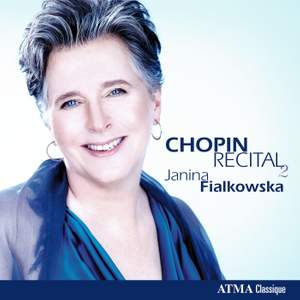
Chopin Recital 2

Chopin Recital 2


Chopin:

Polonaise No. 2 in E flat minor, Op. 26 No. 2

Waltz No. 14 in E minor, Op. post., KKIVa:15, B 56

Waltz No. 3 in A minor 'Grande Valse Brillante', Op. 34 No. 2

Waltz No. 8 in A flat major, Op. 64 No. 3

Ballade No. 2 in F major, Op. 38

Prelude Op. 28 No. 10 in C sharp minor

Prelude Op. 28 No. 11 in B major

Prelude Op. 28 No. 13 in F sharp major

Fantasia in F minor, Op. 49

Nocturne No. 16 in E flat major, Op. 55 No. 2

Mazurka No. 5 in B flat major, Op. 7 No. 1

Mazurka No. 50 in A minor 'Notre Temps'

Mazurka No. 32 in C sharp minor, Op. 50 No. 3

Scherzo No. 2 in B flat minor, Op. 31


Janina Fialkowski’s first Chopin recital received marvellous reviews and ATMA is delighted to release a second collection.

“This is some of Chopin’s greatest music and the playing is sheer bliss.” Sunday Times. “Her technical brilliance is matched by the vivid originality of her interpretations.” Independent – Album of the Week.

“you only have to listen to the Scherzo No 2 to realise she remains a supreme Chopin stylist, combining temperament with an unsentimental touch.” Financial Times, 19th May 2012 ****

“to an even greater extent than before, her performances blaze and challenge with a potent and highly individual sense of drama...For Fialkowska, Chopin can take on something of the dark-hued austerity of late Liszt...there is never any doubting her strength of purpose. All this is a striking advance on earlier recordings, with their earlier recordings, with their more conventional notion of interpretation, and to crown it all Fialkowska has been superbly recorded.” Gramophone Magazine, August 2012

“This is a rich and illuminating find. From the outset you sense Janina Fialkowska's innate, developmental grasp of drama - of the connection between phrases and their dynamic character. Then there's the sheer life in her playing, reflected in the perfectly nourished and shrewdly apportioned sound...her pacing and exceptional graps of musical narrative is a masterclass in the art of pianistic rhetoric.” BBC Music Magazine, August 2012 *****

GGramophone Magazine

Editor's Choice - August 2012

BBC Music Magazine Awards 2013

Instrumental Award Winner

Atma - ACD22666

(CD)

$17.75

(also available to download from $11.00)

In stock - usually despatched within 1 working day.

Chopin: Polonaises

Chopin: Polonaises


Chopin:

Polonaise No. 7 in A flat major, Op. 61 'Polonaise-fantaisie'

Polonaise No. 1 in C sharp minor, Op. 26 No. 1

Polonaise No. 2 in E flat minor, Op. 26 No. 2

Polonaise No. 3 in A major, Op. 40 No. 1 'Military'

Polonaise No. 4 in C minor, Op. 40, No. 2

Polonaise No. 5 in F sharp minor, Op. 44

Polonaise No. 6 in A flat major, Op. 53 'Héroïque'

Polonaise No. 8 in D minor, Op. 71 No. 1

Polonaise No. 9 in B flat major, Op. 71 No. 2

Polonaise No. 10 in F minor, Op. 71 No. 3

Andante spianato & Grande Polonaise, Op. 22


Polonaise: almost always, as soon as the word is uttered, it conjures up the name of Frédéric Chopin. And what could be more natural with a creative genius who was constantly attracted to the genre? His first work, published in Warsaw, was entitled ‘Polonaise for pianoforte dedicated to her Excellency the Countess Victoire Skarbek by Friderik Chopin, aged eight years’; and right up to the concluding Polonaise-Fantaisie, Op.61, fourteen other similar compositions had punctuated the all-too-brief career of the Polish maestro. Before Chopin, a number of musicians had devoted themselves to the polonaise since its appearance in the sixteenth century under the name of ‘Polish Dance’, before assuming that simply of ‘Polonaise’ (‘Polish’) in the following century. Gradually this dance in triple time had extended its influence to the whole of Europe. Undoubtedly some admirable polonaises had been written, but at the expense of the original essence of a proud, manly and noble dance. To Frédéric Chopin fell the honour of reviving that initial virility – of recreating the polonaise.

Franz Liszt had not been mistaken when, shortly after the premature death of his friend, he wrote: ‘His Polonaises... are among his most inspired creations; in no way do they remind us of those over-ornate, pretty-pretty pieces à la Pompadour... Their vigorous rhythm sets us quivering; it rouses us from our usual torpid indifference. The noblest sentiments of the Poland of old come to life in them. A sense of firm determination allied to gravity is what strikes us from the start. For the most part soldierly in spirit, they express gallantry and valour on a note of simplicity which typifies these qualities in a warrior nation. They exude a calm and thoughtful strength, and we feel we are back with those Poles of earlier days depicted in their chronicles.’

There could be no better commentary to introduce the Polonaise in A flat Op.53 (1843), one of Chopin’s most celebrated achievements whose usual nickname, the ‘Heroic’, sums up manly determination and fervour and a distinctly narrative character which has led some to detect in it an underlying programme. The ‘Military’ Polonaise in A major, Op.40 No.1 (1838), again paints a portrait of a valiant and combative people, an image which owes much to a rising melodic pattern and a verticality of composition issuing from vast and powerful chords. In complete contrast, the Polonaise in C minor, Op.40 No.2 (1839), is notable for its mood of distress. Is this not the bitterness and despondency of defeat at the close of day, seemingly born of the bass notes underlying the sombre chords from the right hand?

Four years before these two works of perfection Chopin had completed the two Polonaises Op.26. Created by a composer only twenty-five years old, they underline just how early in his career he had acquired a quite inimitable idiom. What vigour, indeed, in the first of these, in C sharp minor, which, if it does not make a clean break with the somewhat ornate manner of the polonaises of his even earlier youth (cf. Opus 71), already demonstrates an impressive authority. As for the second, the drama prefigured in the pianissimo of its opening bars is subsequently developed with an imagination expressed in sound which is astonishingly modern. The Polonaise in F sharp minor, Op.44 (1841) remains undoubtedly one of Chopin’s most enigmatic and disconcerting pieces. Its originality lies in its association of the polonaise with Chopin’s other favourite dance, the mazurka, and this association generates a strange atmosphere which Liszt, again, has wonderfully defined: ‘It is like the recounting of a dream in the first glimmering of a grey and misty winter dawn, a dream that follows a long, sleepless night, a dream-poem intermingling impression and reality which have no connection with one another, but which curiously coalesce.’

Published posthumously by Julien Fontana in 1871, the three Polonaises Op.71 – in D minor, B flat and F minor respectively – were written before their composer had finally left Poland. They are therefore the work of an adolescent who dazzled the aristocrats of Warsaw with his extraordinary talents. If here we are still far removed from the dramatic impact of the works which were to follow, we cannot fail to respond to the freshness and pianistic inventiveness of three compositions of great promise, made evident in a distinctive sense for contrast (No.1) or full-flavoured popular appeal (No.2).

As the orchestra plays an extremely limited and secondary role the Andante spianato et grande polonaise brillante in E flat can be performed without detriment on the solo piano. This work, so rich in lyricism and sparkle, was written between 1830 and 1834 and crowns that period of stylistic brilliance begun before his departure from Poland. Imbued with all the insouciance of a young composer intent on winning over his public, this work derives its impact from the contrast between the peaceful atmosphere and half-toned cantabile of the Andante, and the triumphant high spirits of the polonaise which follows.

With the Polonaise-Fantaisie in A flat, Op.61 (1846), Chopin made his last incursion into the world of the polonaise. The listener must not be put off by the evident multiformity of a masterpiece which is remarkable for the variety and complexity of the feelings and moods it expresses. The Polonaise-Fantaisie belongs among those works one gradually gets to grips with, constantly improving one’s appreciation of the inexhaustible wealth of poetry and the compositional audacities which, as with the fourth Ballade, place it among its author’s most visionary achievements.

Virgin Premium - 0293162

(CD)

$11.50

In stock - usually despatched within 1 working day.

Chopin: Scherzos, Nocturnes & Mazurkas

Chopin: Scherzos, Nocturnes & Mazurkas


Chopin:

Scherzo No. 1 in B minor, Op. 20

Scherzo No. 4 in E major, Op. 54

Polonaise No. 2 in E flat minor, Op. 26 No. 2

Mazurka No. 42 in G major, Op. 67 No. 1

Mazurka No. 5 in B flat major, Op. 7 No. 1

Mazurka No. 45 in A minor, Op. 67 No. 4

Mazurka No. 43 in G minor, Op. 67 No. 2

Nocturne No. 4 in F major, Op. 15 No. 1

Nocturne No. 6 in G minor, Op. 15 No. 3

Nocturne No. 5 in F sharp major, Op. 15 No. 2

Nocturne No. 18 in E major, Op. 62 No. 2


Dina Yoffe (piano)

The Latvian pianist Dina Yoffe is a professor at the Anton Rubinstein International Academy in Germany and has worked with many celebrated orchestras and conductors. She has made numerous recordings for radio, television and phonographic companies including Chopin’s 24 Preludes, Fantasy in F minor and 19 Waltzes. She performs here on a 1848 Pleyel fortepiano.

Frederick Chopin Institute - The Real Chopin - NIFCCD012

(CD)

$17.75

In stock - usually despatched within 1 working day.

Chopin - 11 Polonaises

Chopin - 11 Polonaises


Chopin:

Polonaise No. 1 in C sharp minor, Op. 26 No. 1

Polonaise No. 2 in E flat minor, Op. 26 No. 2

Polonaise No. 3 in A major, Op. 40 No. 1 'Military'

Polonaise No. 4 in C minor, Op. 40, No. 2

Polonaise No. 5 in F sharp minor, Op. 44

Polonaise No. 6 in A flat major, Op. 53 'Héroïque'

Polonaise No. 7 in A flat major, Op. 61 'Polonaise-fantaisie'

Andante spianato & Grande Polonaise, Op. 22

Polonaise No. 8 in D minor, Op. 71 No. 1

Polonaise No. 9 in B flat major, Op. 71 No. 2

Polonaise No. 10 in F minor, Op. 71 No. 3

Fantasia in F minor, Op. 49

Tarantella in A flat major, Op. 43

Barcarolle in F sharp major, Op. 60

Trois Nouvelles Études

Rondo in C major for two pianos, Op. 73

with Pierre Barbizet


The French pianist Samson François (1924–1970) recorded three complete Chopin sequences: the ballades, which brought him his first great success on record, the nocturnes and the polonaises. François learned his Chopin from Alfred Cortot, from whom he inherited a visionary style which suits the polonaises particularly well. (By an irony, Cortot himself played these works relatively rarely and recorded almost none of them.)

It was Chopin that François chose for his first recordings, which he made at the end of the 1940s on the Brunswick label. He recorded the polonaises twice: first in mono in 1958; then the present stereo version, made in the Salle Wagam in 1968 and 1969. There is no fundamental change of conception. If the mono recording benefits from the natural acoustic of the Salle de la Mutualité and at times offers something more rapt, it also affords less bel canto in the right hand too: the effect is more battling than dancing,so to speak.

Above all, these polonaises achieve a dramatic tension that sets them apart from other contemporary versions on disc: neither Rubinstein, supremely elegant as always, nor Stefan Askenaze, who cherishes the dance element, approach these works with such intensity.

The couplings are a handful of late works recorded at the end of sessions devoted to the nocturnes: the Trois Nouvelles Etudes, the Tarentelle, the Fantaisie in F minor and the F sharp Barcarolle share the same overcast outlook, and to that extent are a perfect foil to the often exuberant polonaises.

François played all the Chopin that was published in his day: even the C major Rondo for two pianos of 1828, reworked for four hands from an earlier solo piece, and recorded here with the pianist’s lifelong friend Pierre Barbizet.

All tracks are newly transferred and remastered to ART standard at Abbey Road Studios.

Award: Diapason d’Or

“François is not always immaculate, but his playing has real character and flair. The tempos are often unusually brisk, although he never sounds harried or hustled. This is sovereign playing that emphasises Gallic grace.” BBC Music Magazine, March 2009 ****

EMI Great Recordings of the Century - 2126952

(CD - 2 discs)

$17.00

In stock - usually despatched within 1 working day.

Chopin: Polonaises

Chopin: Polonaises


Chopin:

Polonaise No. 1 in C sharp minor, Op. 26 No. 1

Polonaise No. 2 in E flat minor, Op. 26 No. 2

Polonaise No. 3 in A major, Op. 40 No. 1 'Military'

Polonaise No. 4 in C minor, Op. 40, No. 2

Polonaise No. 6 in A flat major, Op. 53 'Héroïque'

Polonaise No. 7 in A flat major, Op. 61 'Polonaise-fantaisie'

Andante spianato & Grande Polonaise, Op. 22


Caroline Sageman (piano)

Caroline Sageman was, and to this day remains the youngest laureate in the whole history of the International Chopin Piano Competition in Warsaw. She was only seventeen. Here, she gives us a disc devoted to Chopin’s Polonaises — a very little frequented repertoire.

Released or re-released in last 6 months

Super Audio CD

Format:

Hybrid Multi-channel

Lyrinx - LYR2256

(SACD)

$18.75

Usually despatched in 2 - 3 working days.

Legends of the XX century – Yakov Flier, piano

Legends of the XX century – Yakov Flier, piano


Chopin:

Polonaise No. 2 in E flat minor, Op. 26 No. 2

Nocturne No. 18 in E major, Op. 62 No. 2

Waltz No. 6 in D flat major, Op. 64 No. 1 'Minute Waltz'

Nocturne No. 13 in C minor, Op. 48 No. 1

Mazurka No. 21 in C sharp minor, Op. 30 No. 4

Barcarolle in F sharp major, Op. 60

Mozart:

Fantasia in C minor, K396

Schumann:

Fantasie in C major, Op. 17


Yakov Flier (piano)

Yakov Flier auditioned for the Moscow Conservatory at the age of only eleven and in later years, taught there himself. At the height of his performing career, he developed problems with a finger on his right hand, which became paralised. He recovered and in 1959, returned as a concert pianist. In 1966 he was awarded the title of People’s Artist of the USSR.

Melodiya Legends of the XX century - MELCD1001813

(CD)

$16.00

Usually despatched in 2 - 3 working days.

Chopin: Complete Works for Cello and Piano

Chopin: Complete Works for Cello and Piano


Chopin:

Introduction and Polonaise Brillante in C, Op. 3

Variations brilliantes in B flat major on 'Je Vends des Scapulaires', Op. 12

Grand Duo for Cello and Piano (on themes from Meyerbeer's Robert le Diable)

Polonaise No. 2 in E flat minor, Op. 26 No. 2

Cello Sonata in G minor, Op. 65


Sergei Istomin (cello), Viviana Sofronitsky (piano)

On this recording, Sofronitsky performs on copies of two of Chopin’s favourite pianos; a Conrad Graf piano ca. 1819 and a Pleyel piano of 1830.

Passacaille - PAS968

(CD)

$17.75

Usually despatched in 2 - 3 working days.

Chopin: Polonaises

Chopin: Polonaises

All tracks were recorded at RCA Studios, Hollywood, USA


Chopin:

Polonaise No. 1 in C sharp minor, Op. 26 No. 1

Recorded 21 May 1951

Polonaise No. 2 in E flat minor, Op. 26 No. 2

Recorded 21 May 1951

Polonaise No. 3 in A major, Op. 40 No. 1 'Military'

Recorded 28 September 1950

Polonaise No. 4 in C minor, Op. 40, No. 2

Recorded 27 September 1950

Polonaise No. 5 in F sharp minor, Op. 44

Recorded 23 May 1951

Polonaise No. 6 in A flat major, Op. 53 'Héroïque'

Recorded 28 September 1950

Polonaise No. 7 in A flat major, Op. 61 'Polonaise-fantaisie'

Recorded 13 December 1950

Andante spianato & Grande Polonaise, Op. 22

Recorded 14 December 1950 (track 8) and 25 May 1951 (track 9)


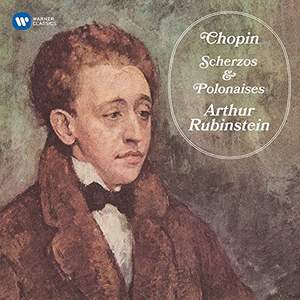
Arthur Rubinstein recorded the first seven Polonaises of Chopin three times. The fine performances heard here, from the middle period of his recording career, still stand as among the best, for Rubinstein was one of only a handful of pianists able to imbue these Polish works with such rhythm, nobility and vigour.

“These impressive pieces are played with authority and a fine sense of their inner meaning and have been faithfully reproduced.” The New Records, May 1952

Rubinstein’s first, 1935/6 recording of the Polonaises is available on Naxos 8110661.

Reissue Producer and Audio Restoration Engineer: Mark Obert-Thorn

“a parade of rhythmic oomph, colour, ferocity, élan, defiance and nobility” BBC Music Magazine, April 2010 *****

Historical Recordings - up to 25% off

Naxos Historical Great Pianists - 8111346

(CD)

Normally: $8.50

Special: $6.80

(also available to download from $9.25)

Usually despatched in 2 - 3 working days. (Available now to download.)

Chopin - The Great Polonaises

Chopin - The Great Polonaises


Chopin:

Polonaise No. 1 in C sharp minor, Op. 26 No. 1

Polonaise No. 2 in E flat minor, Op. 26 No. 2

Polonaise No. 3 in A major, Op. 40 No. 1 'Military'

Polonaise No. 4 in C minor, Op. 40, No. 2

Polonaise No. 5 in F sharp minor, Op. 44

Polonaise No. 6 in A flat major, Op. 53 'Héroïque'

Polonaise No. 7 in A flat major, Op. 61 'Polonaise-fantaisie'

Andante spianato & Grande Polonaise, Op. 22

Warsaw Philharmonic Orchestra, Kazimierz Kord


To celebrate the 200th anniversary of Chopin’s birth we are reissuing on Helios some of the finest performances from Garrick Ohlsson’s complete Chopin project, originally recorded for the American label Arabesque and reissued on Hyperion as a 16 CD boxed set (CDS44351/66) in 2008. Sadly unacknowledged at the time of their original issue (very few of the original discs received much review coverage), these CDs include some of the greatest contemporary Chopin playing and include definitive performances of the complete etudes and mazurkas. It’s worth remembering the not only did Garrick win the 1970 Chopin competition (the only American to do so), but he also won the special prize for Mazurka playing, that most idiomatically Polish genre of Chopin’s output.

“…Ohlsson applies an exceptionally wide tonal range, bringing out all the passion and drama of the C sharp minor Op. 26 No. 1, for example, but also remaining alive to its moments of introversion and dark melancholy. In the wonderful Polonaise-Fantasy he encapsulates these contrasts while maintaining a real sense of impetus, driving irresistibly towards the work's exciting conclusion.” BBC Music Magazine, February 2010 *****

“Ohlsson’s Polonaises are as impressive as those of Rubinstein” MusicWeb International

Helios - CDH55382

(CD)

$8.75

Usually despatched in 2 - 3 working days.

Chopin - 24 Preludes, Op. 28

Chopin - 24 Preludes, Op. 28


Chopin:

Preludes (24), Op. 28

Polonaise No. 1 in C sharp minor, Op. 26 No. 1

Polonaise No. 2 in E flat minor, Op. 26 No. 2

Prelude Op. 45 in C sharp minor (No. 25)


Laure Favre-Kahn (piano)

In May 2001 Laure Favre-Kahn was unanimously awarded first prize in the International Piano Pro Piano Competition in New York. In October of the same year she played at the Carnegie Recital Hall and was voted Pro Piano Artist of the Year. Her recording of Chopin’s complete waltzes on TransArt was awarded the Classique d’Or by RTL. Live recording.

Transart - TR150

(CD)

$17.75

Usually despatched in 2 - 3 working days.

Page: 

 1   2   3 

 Next >>

Copyright © 2002-13 Presto Classical Limited, all rights reserved.