Prokofiev: Romeo and Juliet: Dance of the Knights

This page lists all recordings of Romeo and Juliet: Dance of the Knights, by Sergei Sergeievitch Prokofiev (1891-1953) on CD, SACD & DVD. Generally, more recent releases are listed first, but with priority given to those that are in stock.

Prices shown exclude VAT. (UK tax is not payable for deliveries to United States.)
See Terms & Conditions for p&p rates.

Essential 20th Century Classics

Essential 20th Century Classics


includes

Adams, J:

Short Ride in a Fast Machine

Barber, S:

Adagio for Strings, Op. 11

Bernstein:

Candide - Overture

Copland:

Fanfare for the Common Man

Debussy:

Images for orchestra: II. Ibéria

Holst:

The Planets: Jupiter

Jenkins, K:

The Armed Man: Agnus Dei

Khachaturian:

Spartacus: Adagio of Spartacus & Phrygia

Lloyd Webber, A:

Requiem: Pie Jesu

Nyman:

The Heart Asks Pleasure First

Orff:

Carmina Burana: O Fortuna

Prokofiev:

Romeo and Juliet: Dance of the Knights

Ravel:

Boléro

Reich:

Nagoya Marimbas

Rutter:

Pie Jesu (from Requiem)

Shostakovich:

Romance (from The Gadfly)


This programme contains a representative collection of important works written between 1901 and 2000. This period is sometimes thought of as the era of ‘modern’ music, when composers sought to break free from the Romantic styles of the 19th century by experimenting with daring new harmonies and forms, but much of the music written after 1900 still harked back to the familiar style of the past. The first CD opens with composers who still wrote in the Romantic style, including Rachmaninov, Prokofiev, Khachaturian, Holst and Elgar, and we also hear part of the slow movement of the most successful concerto written during the 20th century, the Concierto de Aranjuez by Rodrigo. Then come the early innovators who broke new ground like the Second Viennese School of Webern, Berg and Schoenberg, as well as others who continued to use the more traditional methods of composition but who wrote in a more advanced style such as Stravinsky and Bartók. These are followed by later composers who wrote in a wide range of so-called ‘modern’ styles including Takemitsu, Tavener and Adès. The large and prolific school of American composers active during the 20th century is represented by some extremely popular pieces like Barber’s Adagio for Strings, Gershwin’s Rhapsody in Blue and Copland’s Fanfare for the Common Man, as well as more adventurous works by Ives, Reich and Adams. The set also includes extracts from choral pieces by Boulez, Pärt, Tavener, Rutter and Jenkins, and ends with one of the 20th century’s most successful choral works, Orff’s Carmina Burana.

Released or re-released in last 6 months

EMI Essential - 7234372

(CD - 2 discs)

$9.00

In stock - usually despatched within 1 working day.

Magical Music Box

Magical Music Box


Dukas:

The Sorcerer's Apprentice

Grieg:

In the Hall of the Mountain King (from Peer Gynt)

Khachaturian:

Sabre Dance from Gayane

Mozart, L:

Cassation in G 'Toy Symphony': Allegro

Mussorgsky:

A Night on the Bare Mountain

Pictures at an Exhibition: The Old Castle

Pierné, G:

Marche des petits soldats de plomb

Prokofiev:

Romeo and Juliet: Dance of the Knights

Rimsky Korsakov:

Flight of the Bumble Bee

Snegurochka: Dance of the Tumblers

Saint-Saëns:

Le carnaval des animaux: Aquarium

Danse macabre, Op. 40

Tchaikovsky:

The Nutcracker: Dance of the Sugar Plum Fairy

and excerpts from the John Lanchbery ballet Tales of Beatrix Potter


Bringing magic and music together in a fun, interactive collection this compilation encourages children to explore their imaginations, expand their minds with fun facts and stories and listen to some of the world’s greatest Classical Music. The collection features Dance of the Sugar Plum Fairy, The Sorcerer’s Apprentice, Flight of the Bumble Bee and many other well-loved favourites. Children will be invited to see how sorcerers, magical toys, wondrous heroes and fantastical creatures come to life in Classical Music.

A fully illustrated 32 page booklet presents a mystical journey through magical music encouraging the young ready to hear, see and recreate as much as possible. The text is designed to be read either by an older child of 5 or 6 or with an adult for the younger children. The writer is Sarah Breeden noted for the fun and informative programmes she has written for the BBC Children’s Proms.

EMI Classical Clubhouse - 9554772

(CD)

$7.50

In stock - usually despatched within 1 working day.

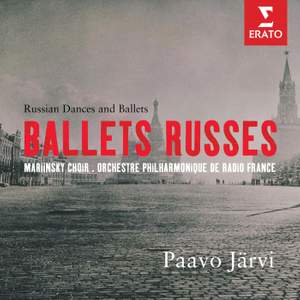
Ballets Russes

Ballets Russes

Russian Dances and Ballets


Borodin:

Prince Igor: Polovtsian Dances

Glazunov:

Raymonda, Op. 57: Entr'acte act I (Intermezzo)

Glinka:

Valse-Fantaisie in B minor for orchestra, G. ii213

Khachaturian:

Masquerade: Waltz

Sabre Dance from Gayane

Liadov:

Dance of the Amazon, Op. 65

Prokofiev:

The Love for Three Oranges: March

Romeo and Juliet: Dance of the Knights

Shostakovich:

Polka from The Golden Age, Op. 22

Jazz Suite No. 2 - Waltz No. 2

Tahiti Trot (Tea for Two), Op. 16

Tchaikovsky:

Polonaise (from Eugene Onegin, Op. 24)

The Nutcracker: Waltz of the Flowers

Waltz from Eugene Onegin, Op. 24


Although folk dances have a special place in Russian music, being raised to the status of character dances in works for the stage, the more classical forms taken over from the west are not neglected. During the nineteenth century the waltz, for example, tended more and more towards ‘pure’ music, giving rise to some highly virtuosic works in the manner of those by Weber or Liszt.

Thus, in 1856 Glinka (1804-1857), founder of the Russian nationalist school, produced the definitive version of a Valse which had already aroused the enthusiasm of Berlioz. Its slightly melancholy principal theme reappears as a refrain between episodes in various keys, which give rise to passages of instrumental dialogue and to such bold strokes such as the cantabile for solo trombone in the third episode. Witty or ironic comments by the flutes or strings turn it virtually into a fantasia – which Shostakovich was to recall later.

Scenes at parties and balls abound in opera. Tchaikovsky composed the waltz for Act Two of Eugene Onegin (1877) – with a chorus in its original version – so as to reflect the humdrum pretentiousness of the lesser, countrified aristocracy: it is closer to the waltz in Faust than to those he was to write for his ballets. This is in clear contrast to the majestic Act Three Polonaise, with its trio incorporating the traditional mazurka, which as the dance of aristocratic St Petersburg receptions is in a differ­ent class altogether.

Marius Petipa, who became chief ballet master at the imperial ballet in 1869, restored to the art of dance the nobility and charm which had been killed off by an emphasis on technique. Tchaikovsky provided him with music suffused with the poetic inspiration lacking in the more straightforwardly rhythmic scores of composers like Drigo and Pugni. He was, however, criticised by those ballet-lovers who found his music too symphonic; his waltzes, refined rather than brilliant and frivolous, are often tinged with dramatic lyricism, even a sense of anxiety. The unusual flavour of the Waltz of the Flowers from The Nutcracker (1892) is largely created by the mysterious other-worldly horn-calls answered by rippling clarinet figures.

Raymonda (1898) is a medieval romance choreographed by Petipa to music by Glazunov. Always melodious, subtle and graceful, it is sometimes highly evocative, as in the trance-like atmosphere in the dreamy slow-motion accompanying the heroine’s sleep (andante sostenuto) in the interlude before the second scene.

The tradition of the grand ballet d’action persisted right up to the revolution brought about by Sergei Diaghilev. Reacting against the ‘double pirouettes and detestable sets of thirty-two fouettés’, the director of the Ballets Russes sought the character of the various folk-dances of Russia and other countries, which he remodelled for the stage using a basically classical technique. In his Parisian season in 1909 he presented the second act of Prince Igor (1887) against the background of a tawny-coloured desert steppe. The Polovtsian Dances, alternating spellbinding movements for the women and pounding, savage rhythms for the warriors, were directed by Mikhail Fokine: when a tumultuous wave of dancers rushed downstage at the end, stopping dead just short of the foot­lights, it brought the house down!

Even Anatole Liadov, the composer of backwoods Russia, gave in to the infatuation of the Russian intelligentsia of around 1900 with ancient Greece. His Dance of the Amazon (1910), for Ida Rubinstein, employs two Greek chants, heavily reworked: the first theme suggests the Amazon riding on horseback, the second (meno mosso) emphasises the oriental atmosphere; brass and percussion suggest warlike activity – ushered in by a fanfare.

After the 1917 Revolution it was thought that the creations of the Tsarist era would be unappealing to the sensibilities of the new Bolshevik listener. New themes and characters – stadiums and factories, sportsmen and workers – figured in ‘futurist’ (that is, revolutionary) musical experiments. In Shostakovich’s ballet The Golden Age (1930), which portrays the misadventures of a Soviet football team in a capitalist country, a clownish polka caricatures decadent western society. In Tahiti Trot (1928) Shostakovich pulled off the challenge of re-orchestrating Vincent Youmans’ Tea for Two in record time, and in so doing exploited all the expressive and comic possibilities, as well as the shock tactics, of avant-garde experiments. But offerings like these, from an enfant terrible ‘who had nothing to say to the people’, led the Communist Party, around 1932, to rein back cultural activity and reinstate a classical, academic aesthetic, which also extended to opera and ballet.

The music of Prokofiev’s Love for Three Oranges (Chicago, 1921; Leningrad, 1927), precise, sturdily constructed and freshly coloured – as in the festive march from Act Two – was perfectly accessible, and yet it was later ignored in the USSR because of its libretto, which makes a feature of absurdity. Romeo and Juliet (1935/6, staged in 1940), on the other hand, with its universal subject, gained unanimous acceptance. The characterisation was exemplary: in the sombre, hieratic Dance of the Knights, with its great sweeps of sound, the menacing thrusts of the basses and brass powerfully convey the arrogance of a clan – as against the fresh sensitivity of youth portrayed by the central theme.

Although Khachaturian was also suspected of ‘formalism’, his artistic approach always coincided with that of the regime. His incidental music for a 1940 production of Lermontov’s The Masked Ball portrays well the spiritual emptiness of imperial society: the entirely unsentimental waltz turns like a roundabout, relentlessly driven forward by the pursuit of pleasure. With Gayaneh (1943) Khachaturian goes back to his native Armenia. Part of the ballet’s final celebrations honouring the upbeat heroine of the ‘happy collective farm’ is the frenzied Sabre Dance, the middle section of which recalls an earlier pas de deux. It is an authentic piece of Transcaucasian folklore.

Following his Lady Macbeth of the Mtsensk district, Shostakovich had fallen victim, in 1936, to official criticism. He attempted to redeem himself, or at least to behave himself, by writing lighter works, frothier, more facile – i.e. proletarian – for films, ballets, variety stages and what the USSR referred to as ‘jazz’ orchestras, which are more like our light music ensembles. The Suite No.2 for jazz orchestra (1938) was composed for one such group, run by Victor Knushevitsky. The main, somewhat sentimental, theme in its Waltz No.2, played on the saxophone, ends in a sort of good-natured refrain. This piece was used as music for film commercials in the West – and then as title music for Stanley Kubrick’s last film: what finer example of popularity could there be?

Virgin Premium - 0293192

(CD)

$11.25

In stock - usually despatched within 1 working day.

Ballets Russes

Ballets Russes

Russian Dances and Ballets


Borodin:

Prince Igor: Polovtsian Dances

Glazunov:

Raymonda, Op. 57: Entr'acte act I (Intermezzo)

Glinka:

Valse-Fantaisie in B minor for orchestra, G. ii213

Khachaturian:

Masquerade: Waltz

Sabre Dance from Gayane

Liadov:

Dance of the Amazon, Op. 65

Prokofiev:

The Love for Three Oranges: March

Romeo and Juliet: Dance of the Knights

Shostakovich:

Polka from The Golden Age, Op. 22

Jazz Suite No. 2 - Waltz No. 2

Tahiti Trot (Tea for Two), Op. 16

Tchaikovsky:

Polonaise (from Eugene Onegin, Op. 24)

The Nutcracker: Waltz of the Flowers


Virgin - 5456092

(CD)

$15.50

In stock - usually despatched within 1 working day.

The Most Beautiful Ballets

The Most Beautiful Ballets


Adam:

Giselle: Finale

Delibes:

Coppelia (highlights)

Khachaturian:

Spartacus: Adagio of Spartacus & Phrygia

Sabre Dance from Gayane

Prokofiev:

Romeo and Juliet: Dance of the Knights

Romeo and Juliet: Love Dance

Stravinsky:

Finale from The Firebird

Tchaikovsky:

Swan Lake, Op. 20 (excerpts)

Sleeping Beauty, Op. 66 (excerpts)

The Nutcracker Ballet, Op. 71 (Excerpts)


The Orchestra of the Royal Opera House, Covent Garde, Mark Elmer & Barry Wordsworth

RCA Classical Masters - 88691936602

(CD)

$7.50

Usually despatched in 3 - 4 working days.

Chicago Symphony Orchestra Brass Live

Chicago Symphony Orchestra Brass Live

Recorded live in Orchestra Hall at Symphony Center December 16, 17 and 18, 2010


Bach, J S:

Passacaglia & Fugue in C minor, BWV582

arr. Crees

Elgar:

Nimrod (from Enigma Variations)

arr. Kreines

Gabrieli, G:

Canzon duo decimi toni

Sacrae Symphoniae No. 6

Sonata Pian e Forte

Canzon septimi toni No. 2

Grainger:

Lincolnshire Posy

arr. Higgins

Lisbon (Dublin Bay)

arr. Higgins

Horkstow Grange

arr. Higgins

Rufford Park Poachers

arr. Higgins

The Brisk Young Sailor (who returned to wed his true love)

arr. Higgins

Lord Melbourne

arr. Higgins

The Lost Lady Found

arr. Higgins

The Sussex Mummers' Christmas Carol

arr. Kreines

Jeurissen:

Tristan Fantasy (after Wagner)

Prokofiev:

Montagues And Capulets (from Romeo and Juliet)

arr. Kreines

Romeo and Juliet: Dance of the Knights

arr. Kreines

Romeo and Juliet - Suite No. 1, Op. 64a: Death of Tybalt

arr. Kreines

Revueltas:

Sensemayá

arr. Roberts

Walton:

Crown Imperial

arr. Kreines


Chicago Symphony Orchestra Brass, Dale Clevenger, Michael Mulcahy, Mark Ridenour & Jay Friedman

The legendary brass section of the Chicago Symphony Orchestra, long recognised for its power, dynamism and lyricism, takes centre stage in the latest release from the Grammy®-winning CSO Resound label. Cheered for their performances and recordings of Mahler, Bruckner and Strauss, the CSO Brass turns its focus to works by Gabrieli, William Walton and J.S. Bach, as well as symphonic works arranged for brass and percussion by Silvestre Revueltas (Sensemayá) and Prokofi ev (Three Scenes from Romeo and Juliet). Percy Grainger’s Lincolnshire Posy, beloved by generations of wind ensemble devotees, is transcribed here in a stunning arrangement by San Francisco Symphony trombonist, Timothy Higgins. Virtuoso arrangements by Joseph Kreines of three scenes from Prokofiev’s Romeo and Juliet and Walton’s Crown Imperial feature the entire brass ensemble in thrilling fashion.

A musical force in Chicago and around the world, the Chicago Symphony Orchestra is consistently hailed as one of the fi nest international orchestras. Its expansive catalogue of more than 900 recordings has earned 62 Grammy Awards—more than any other orchestra in the world.

Super Audio CD

Format:

Hybrid Multi-channel

CSO Resound - CSOR9011103

(SACD)

$19.25

Usually despatched in 3 - 4 working days.

Presto 2

Presto 2


Bach, J S:

Orchestral Suite No. 3 in D major, BWV1068: Air ('Air on a G String')

Barber, S:

Adagio for Strings, Op. 11

Bizet:

L'amour est un oiseau rebelle 'Habanera' (from Carmen)

Brahms:

Symphony No. 3 in F major, Op. 90

Charpentier, M-A:

Overture Te Deum

Chopin:

Prelude Op. 28 No. 20 in C minor

Philippe Giusiano (piano)

Étude Op. 10 No. 3 in E major 'Tristesse'

Philippe Giusiano (piano)

Elgar:

Pomp and Circumstance March No. 1 in D major, Op. 39 No. 1

Grieg:

Peer Gynt Suites Nos. 1 & 2

Handel:

Sarabande

Liszt:

Ständchen

Brigitte Engerer

Lully:

Marche pour la cérémonie des Turcs

Mahler:

Symphony No. 5 in C sharp minor - Adagietto

Mozart:

Symphony No. 40 in G minor, K550

Prokofiev:

Romeo and Juliet: Dance of the Knights

Rachmaninov:

Piano Concerto No. 2 in C minor, Op. 18

Philippe Bianconi (piano)

Ravel:

Boléro

Schubert:

Piano Quintet in A major, D667 'The Trout'

Esther Brayer & Jean-Frédéric Neuburger

Quatuor Ebène

Ständchen 'Leise flehen meine Lieder', D957 No. 4

Brigitte Engerer

Tchaikovsky:

Swan Lake (Prelude)

Vivaldi:

Nisi Dominus (Psalm 126), RV608

with Carlos Mena


Pierre Charvet (presenter)

Les Siècles, François-Xavier Roth

PRESTO 2 is written and presented by Pierre Charvet, of FRANCE5, where Presto is a regular TV programme designed to familiarise viewers with classical music.

Directed by François-René Martin, of Mirare, Presto uses split-screen technology and graphic animation by Gregoire Pont, to illustrate four centuries of music, played by François Xavier Roth and his orchestra Les Siècles.

1 DVD, 2h 12min

PAL 16:9, Stereo, Language : Fr

No subtitles

NB: This is taken from a television-programme rather than a recital and therefore features some voice-over during the pieces.

DVD Video

Region: 0

Format: PAL

Bel Air Classiques - BAC058

(DVD Video)

$33.75

Usually despatched in 3 - 4 working days.

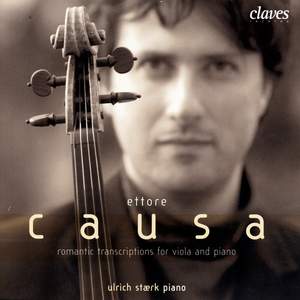
Romantic Transcriptions for Viola and Piano

Romantic Transcriptions for Viola and Piano


Brahms:

Sonatensatz (Scherzo from the F.A.E. sonata), WoO 2

Lerchengesang Op. 70 No. 2

arr. Ettore Causa

Hungarian Dance No. 1 in G minor

arr. Watson Forbes

Hungarian Dance No. 3 in F major

arr. Watson Forbes

Chopin:

Étude Op. 25 No. 7 in C sharp minor

arr. Alexander Glazunov & Ettore Causa

Étude Op. 10 No. 6 in E flat minor 'Lacrimosa'

arr. Glazunov/Ettore Causa

Debussy:

Romance

arr. Milton Katims

Fauré:

Les berceaux, Op. 23 No. 1

arr. Ettore Causa

Granados:

Danza española, Op. 37 No. 2 'Orientale'

arr. Milton Katims

Mendelssohn:

Song without Words for Cello & Piano, Op. 109

arr. Milton Katims

Prokofiev:

Romeo and Juliet: Dance of the Knights

arr. Wadim Borissovsky

Rachmaninov:

Daisies, Op. 38 No. 3

arr. Jasha Heifetz & Ettore Causa

Saint-Saëns:

Allegro Appassionato in B minor Op. 43

arr. Ettore Causa

Schumann:

Abendlied, Op. 85 No. 12

arr. Ettore Causa

Scriabin:

Prelude, Op. 9 No. 1 in C sharp minor for the left hand

arr. Wadim Borissovsky

Tchaikovsky:

Valse sentimentale, Op. 51 No. 6

arr. Alan Arnold

Chanson triste, Op. 40 No. 2

arr. Johann Palaschko

Ysaye:

Rêve d'enfant, Op. 14

arr. Ettore Causa


Ettore Causa (viola) Ulrich Staerk (piano)

Claves - 502609

(CD)

$18.50

Usually despatched in 4 - 5 working days.

Making Tracks

Making Tracks

Angelica and Adrian's favourite music from their BBC Radio 3 show


Grieg:

In the Hall of the Mountain King (from Peer Gynt)

Mancini, H:

The Pink Panther

Orff:

Carmina Burana: O Fortuna

Prokofiev:

Romeo and Juliet: Dance of the Knights

Yupanqui:

Huayra


20% off Naxos

Naxos - 8557561

(CD)

Normally: $15.25

Special: $12.20

Usually despatched in 2 - 3 working days.

Copyright © 2002-13 Presto Classical Limited, all rights reserved.