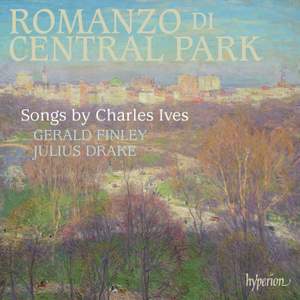
All recordingsPrices shown exclude VAT. (UK tax is not payable for deliveries to United States.) See Terms & Conditions for p&p rates. | |  | Ives - Romanzo di Central Park
“Gerald Finley has everything and more in his darkly full-bodied voice to match the often formidable technical and expressive requirements of Ives’s songbook—reinforced by Drake’s elastic, expressive piano … this is a must-buy album” The Times “This is a highly successful follow-up to Gerald Finley and Julius Drake’s first Ives recital from 2005. Here there is the same sort of mix, from familiar songs such as The Circus Band and Watchman! To an early requiem for the family cat and the intriguing title song, Romanzo (di
Central Park), with its obbligato violin part atmospherically played by Magnus Johnston. Finley is his usual charismatic self, at home as much in the hymnody as the parody, and he is careful not to over-sentimentalise the more homely numbers while injecting pathos into the war songs. Drake
projects Ives’s often complex accompaniments with clarity and style” The Telegraph “…outstandingly well sung and played, equally well recorded, and highly recommendable to all lovers of fine songs and fine singing.” BBC Music Magazine, March 2008 ***** “…some of the early songs in a conventional style are treated with the same seriousness that Finley would apply to Lieder. The contemplative ones are delivered with an impressive serenity and Finley has his own way of attacking the razzle-dazzle of something like "The Circus Band" or "They Are There!".” Gramophone Magazine, April 2008 “This is the second volume of Ives songs from this accomplished team; their first Ives volume (reviewed above) contained some of the blockbusters like Charlie Rutlage and General WilliamBooth but the mood of this volume is fairly sedate. In particular some of the early songs in a conventional style are treated with the same seriousness that Finley would apply to Lieder. An unusual but effective feature here is the provision of violin obbligato both for the jingoistic wartime song They Are There! and the mawkish take-off Romanzo (di Central Park). Sentimentality is a Victorian characteristic but in Songs MyMother Taught Me, as elsewhere in Ives, the emotion is genuine so it invariably convinces. Many of the songs are transposed down – hard work for the pianist and it makes some of the textures rather dense. The contemplative ones are delivered with an impressive serenity and Finley has his own way of attacking the razzledazzle of something like The Circus Band or TheyAre There! He's close-miked, which works best in the intimacy of the quieter songs.” Gramophone Classical Music Guide, 2010 BBC Music Magazine
Choral & Song Choice - March 2008 |
| | | In stock - usually despatched within 1 working day. |
|
|
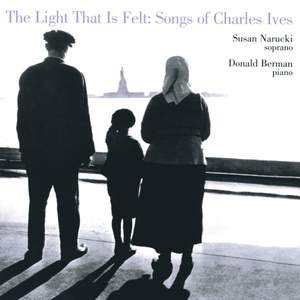
| |  | The Light That Is Felt - Songs of Charles Ives
Susan Narucki (soprano) & Donald Berman (piano) Charles Ives composed nearly 200 songs throughout his life. Wiley Hitchcock, in the thorough introduction to his 2004 critical edition 129 Songs, described the Ives song canon as “the contents of a kind of scrapbook or commonplace book or chapbook, or even a desk drawer. Into such a receptacle Ives tossed irregularly, if not casually, his reactions —in the form of songs—to memories, personalities, places, events, discoveries, ideas, visions, and fantasies in his life.” Whether popular tale or personal reflection, this concept of the songs as memorabilia is realized in a most powerful way: the songs emotionally and viscerally evoke memory. This new recording of 27 songs features superlative performances by soprano Susan Narucki, renowned for her authoritative interpretations of contemporary American music, and Donald Berman, whose recordings of Ives’s piano music have been critically acclaimed. | | | Usually despatched in 2 - 3 working days. |
|
|
| |  | Charles Ives - Twelve Songs
In Summer 2007, invited by Kent Nagano to the Munich Opera Festival, singer Theo Bleckmann met the group Kneebody to create a new song cycle from works by Charles Ives.Twelve compositions for voice and piano/ensemble/orchestra, written by this significant American composer at the start of the 20th century, were to be reworked. Ives characteristically combines the folk voice of America with classical forms and traditions from Europe. Everyday American music, quotes from marches, hymns and dances are brought into play, but he doesn't write music to please: instead, he uses contrasting elements and sonic irritations to create an image of America that sketches the inner character of this New World society after the War of Independence. Extensive re-workings by Theo Bleckmann and Kneebody put Ives' music in a context alongside elements of jazz, electronics and improvisation. The singer Theo Bleckmann is part of a close circle of Winter & Winter artists who have collaborated since 2004 on Der Kastanienball; since then have come Las Vegas Rhapsody, Berlin, and now Twelve Songs by Charles Ives: a homage to an exceptional composer. “Ives's songs, given the jazz treatment for the first time, thrive in this idiom. I didn't know what to expect, but it works. The vocal approach is sympathetic; the harmony is respected, at least as a starting-point; and the humour of some of these songs is exploited.” Gramophone Magazine, April 2009 | | | Usually despatched in 3 - 4 working days. |
|
|
| |  | Ives - Songs Volume 5
Janna Baty, Lielle Berman, Patrick Carfizzi, Jennifer Casey Cabot, Michael Cavalieri, Robert Gardner, Ian Howell, Sara Jakubiak, Sumi Kittelberger, Ryan MacPherson, Tamara Mumford, Mary Phillips, David Pittsinger, Matthew Plenk, Kenneth Tarver, Leah Wool, Enrico Sartori, Douglas Dickson, Laura Garritson, J.J. Penna & Eric Trudel Charles Ives wrote almost two hundred songs. Although his reputation rests on orchestral, chamber and piano music, it is Ives's songs that represent the heart of his creative thinking. The expressive variety encountered is accordingly vast: indeed, the gradual evolution of Ives’s songwriting is analogous to the wider evolution of American music during the late nineteenth and early twentieth centuries. This new edition includes all the songs that Ives completed. The alphabetic approach ensures that each volume (of which this disc is the fourth of six) contains a representative cross-section “These songs, with all their quirks and flights of fantasy, [are] among the most important of the 20th century in any language.” The Guardian | | | (also available to download from $6.00) | Usually despatched in 2 - 3 working days. (Available now to download.) |
|
|
| |  | Vocal Music by Crumb and Ives
| | | Usually despatched in 2 - 3 working days. |
|
|
| |  | Antonín Dvorák und seine Zeit
Brahms: | Die Mainacht, Op. 43 No. 2 Von ewiger Liebe, Op. 43 No. 1 Vier Ernste Gesänge, Op. 121 | Cadman: | Four American Indian Songs, Op. 45 | Dvorak: | Vier Lieder, Op. 2 Abendlieder, Op. 3 Four Songs, Op. 82: No. 1, ‘Leave Me Alone’ Am Bache, Op. 82 No. 4 Gypsy Melodies (7), Op. 55 (B104) Moravian Duets, Op. 32, B. 60 & B. 62 Liebeslieder (8), Op. 83: extracts Biblical Songs, Op. 99: selection | Farwell: | Three Indian Songs, Op. 32 | Grieg: | Zur Rosenzeit (No. 5 from Seks Sange, Op. 48) Seks Sange, Op. 48 No. 6 'Ein Traum' | Ives, C: | Songs My Mother Taught Me | MacDowell: | Eight Songs, Op. 47 | Mahler: | Urlicht (from Symphony No. 2) |
“The real stars of the show, though, are Wolfram Rieger whose delicately imagined piano accompaniments illuminate every second of the programme; and Hampson himself - magnificent not only in Dvořák's Gypsy and Biblical songs, but in the strong, primitive contours of American-Indian songs set, in true National-Romantic style, by Arthur Farwell and Charles Wakefield Cadman, and in Ives's own 'Songs my Mother taught me'.” BBC Music Magazine, December 2005 **** “It was the brainchild of Thomas Hampson, who contributes some of the key sections in this fascinating survey of Dvořák as song-composer and the influences both on him and from him. Hampson's four Gypsy Songs include the most famous of all, usually translated as 'Songs my mother taught me', before a half-hour devoted to 13 of Dvořák's Moravian Duets, enchantingly sung by Bonney and Breedt... The final 'World of Faith' section, provides a satisfying climax: Brahms's Four Serious Songs are beautifully sung by George Zeppenfeld, with velvet tone, Mahler's Knaben Wunderhorn setting 'Urlicht', later used in the Resurrection Symphony, is sung by Breedt, and five of Dvořák's Biblical Songs are powerfully and sensitively delivered by Hampson. Altogether an illuminating package.” Gramophone Magazine, March 2006 | | | Usually despatched in 3 - 4 working days. |
|
|
| |  | The Art of Susan Graham
Berg: | Sieben frühe Lieder | Berlioz: | La Damnation de Faust, Op. 24: Chanson gothique 'Autrefois un roi de Thulé' Dieu! Que viens-je d'entendre?…Il m'en souvient ... Je l'aime donc? (from Béatrice et Bénédict) | Brahms: | He, Zigeuner, greife in die Saiten ein! (No. 1 from Zigeunerlieder, Op.103) Hochgetürmte Rimaflut, wie bist du trüb (No. 2 from Zigeunerlieder, Op.103) Wißt ihr, wann mein Kindchen am allerschönsten ist? (No. 3 from Zigeunerlieder, Op.103) Lieber Gott, du weißt, wie oft bereut ich hab' (No. 4 from Zigeunerlieder, Op.103) Brauner Bursche führt zum Tanze (No. 5 from Zigeunerlieder, Op.103) Röslein dreie in der Reihe blühn so rot (No. 6 from Zigeunerlieder, Op.103) Kommt dir manchmal in den Sinn (No. 7 from Zigeunerlieder, Op.103) Rote Abendwolken ziehn am Firmament (No. 8 from Zigeunerlieder, Op.103) | Chausson: | Poème de l'amour et de la mer, Op. 19 | Debussy: | Proses Lyriques Fantoches Songs from Le livre de Baudelaire | Gluck: | O del mio dolce ardor (from Paride ed Elena) Non, je n'espere plus... O toi qui prolongeas mes jours (from Iphigénie en Tauride) O malheureuse Iphigenie! (from Iphigénie en Tauride) Non, cet affreux devoir... Je t'implore et je tremble (from Iphigénie en Tauride) Qu'entends-je? Qu'a-t-il dit?... Amour, viens rendre a mon ame (from Orphée et Eurydice) J'ai perdu mon Eurydice (from Orphée et Eurydice) | Hahn, R: | A Chloris O mon bel inconnu: 'O mon bel inconnu' Brummell: 'Air de la Lettre' Mozart: 'Etre adore' O mon bel inconnu: 'C'est tres vilain d'etre infidele' Ciboulette: 'C'est pas Paris, c'est sa banlieue' | Handel: | Di te mi rido (from Alcina) Mi lusinga il dolce affetto (from Alcina) | Heggie: | Who will walk with me? (from Dead Man Walking) He will gather us around (from Dead Man Walking) | Honegger: | Les Aventures du roi Pausole: 'Si vous saviez' | Ives, C: | The Things our Fathers Loved The Housatonic at Stockbridge Swimmers Memories: (A) Very Pleasant; (B) Rather Sad Ann Street Serenity ‘1, 2, 3' Songs My Mother Taught Me The Circus Band The Cage The Indians Like a Sick Eagle September Soliloquy, or a Study in 7ths and Other Things Farewell to Land Thoreau | Mahler: | Liebst Du um Schönheit (Rückert-Lieder) | Messager: | L'Amour masque: 'J'ai deux amants' Fortunio: 'Je ne vois rien..Lorsque je n'etais qu'une enfant' Coups de roulis: 'Les hommes sont biens tous les memes' Passionnement: 'L'amour est un oiseau rebelle' Les P'tites Michu: 'Vois-tu, je m'en veux' La Petite Fonctionnaire: 'Je regrette mon Pressigny' Les Dragons de l"Imperatrice: 'Amour, amour, quel est donc ton pouvoir' L'Amour masque: 'Mon reve' | Moore, B: | Sexy Lady | Mozart: | Non so più cosa son, cosa faccio (from Le nozze di Figaro) Parto, parto, ma tu ben mio (from La Clemenza di Tito) Voi che sapete (from Le nozze di Figaro) Deh, per questo istante solo (from La Clemenza di Tito) Non ho colpa (from Idomeneo) Dunque Sperar Poss'io...Il Tenero Momento (from Lucio Silla) | Poulenc: | Quatre poemes de Guillaume Apollinaire | Ravel: | Shéhérazade | Rorem: | Sonnet (Santa Fe Songs) Clouds Early in the morning The Serpent Now Sleeps the Crimson Petal Opus 101 (Santa Fe Songs) I Strolled Across an Open Field To a Young Girl Jeanie with the Light Brown Hair Ode For Poulenc Little Elegy Alleluia Look down fair moon O you to whom I often and silently come I will always love you The Tulip Tree The Wintry Mind (Santa Fe Songs) I am Rose The Lordly Hudson O Do Not Love Too Long Far-Far-Away For Susan A Journey Sometimes with one I love Love Orchids Stopping by Woods on a Snowy Evening Do I love you more than a day? Ferry Me Across the Water The Sowers (Santa Fe Songs) That shadow, my likeness | Simons, Moises: | Toi c'est moi: 'C'est ca la vie, c'est ca l'amour' Toi c'est moi: 'Vagabonde' | Yvain: | Yes: 'Yes' |
| | | Usually despatched in 4 - 5 working days. |
|
|
| |
|