Prices shown exclude VAT. (UK tax is not payable for deliveries to United States.) See Terms & Conditions for p&p rates. | |  | José van Dam: Recital at La Monnaie de Munt
Brahms: | Wie rafft' ich mich auf Op. 32,1 (v.Platen) Ich schleich umher betrübt und stumm, Op. 32 No. 3 Der Strom, der neben mir verrauschte, Op. 32 No. 4 Wehe, so willst du mich wieder, Op. 32 No. 5 Du sprichst, daß ich mich täuschte, Op. 32 No. 6 Meine Liebe ist grün, Op. 63 No. 5 Dein blaues Auge, (No. 8 from Acht Lieder und Gesänge, Op. 59) Auf dem Kirchhofe, Op. 105 No. 4 Von ewiger Liebe, Op. 43 No. 1 | Duparc: | Le Manoir de Rosemonde Soupir La Vie antérieure Chanson triste | Ibert: | Chansons (4) de Don Quichotte | Poulenc: | Chansons gaillardes | Wolf, H: | Songs (3) on poems by Michelangelo Buonarroti |
This CD is the first in a new Cypres Archive series of recitals from La Monnaie. This theatre has played host to some of the most famous recitalists in the world and José van Dam has been chosen to launch the collection, as one of the greatest Belgian artists. There have been many fine evenings at La Monnaie and the label will release at least one CD per year in this series. | | | Usually despatched in 2 - 3 working days. |
|
|
| |  | Brahms & Wolf: Lieder
Brahms: | Vier ernste Gesänge, Op. 121 Wie rafft' ich mich auf Op. 32,1 (v.Platen) Nicht mehr zu dir zu gehen, Op. 32 No. 2 Ich schleich umher betrübt und stumm, Op. 32 No. 3 Der Strom, der neben mir verrauschte, Op. 32 No. 4 Wehe, so willst du mich wieder, Op. 32 No. 5 Du sprichst, daß ich mich täuschte, Op. 32 No. 6 Bitteres zu sagen denkst du, Op. 32 No. 7 So stehn wir, ich und meine Weide, Op. 32 No. 8 Wie bist du, meine Königin Op. 32 No. 9 | Wolf, H: | Songs (3) on poems by Michelangelo Buonarroti Harfenspieler I (No. 1 from Goethe-Lieder) Harfenspieler II (No. 2 from Goethe-Lieder) Harfenspieler III (No. 3 from Goethe-Lieder) |
| | | Usually despatched in 4 - 5 working days. |
|
|
| |  | Fischer-Dieskau 85th Birthday Edition: Brahms LiederBerlin Philharmonie, 1972 (live)
Brahms: | Nachtwandler, Op. 86 No. 3 Wehe, so willst du mich wieder, Op. 32 No. 5 Abenddämmerung, Op. 49 No. 5 Meerfahrt, Op. 96 No. 4 Wie rafft' ich mich auf Op. 32,1 (v.Platen) Geheimnis, Op. 71 No. 3 Wir wandelten, wir zwei zusammen Op. 96/2 Botschaft, Op. 47 No. 1 Lindes Rauschen in den Wipfeln, Op. 3, No. 6 Regenlied (No. 3 from Acht Lieder und Gesänge, Op. 59) Ständchen, Op. 106 No. 1 Wie bist du, meine Königin Op. 32 No. 9 Fruhlingslied, Op. 85, No. 5 Unüberwindlich, Op. 72 No. 5 Sonntag, Op. 47 No. 3 Der Gang zum Liebchen, No. 1, Op. 48 Wehe, so willst du mich wieder, Op. 32 No. 5 Feldeinsamkeit, Op. 86 No. 2 |
These releases from the archives of the RIAS and the Sender Freies Berlin document the unequalled quantitative and qualitative spectrum which baritone Fischer-Dieskau acquired during the five decades of his career. They offer a fascinating insight into the breadth of his repertoire as well as his artistic approach, with which he maintained a careful balance of development and continuity until the end. These recordings – spanning Beethoven’s sacred songs Op. 48 of 1806, through Schumann, Brahms, Mahler and Reger, to Heinrich Sutermeister’s expressive psalm setting of 1948 – demonstrate the essential Fischer-Dieskau. Not only do they document the artistic partnership with pianists such as Hertha Klust, Daniel Barenboim, Cord Garben, Aribert Reimann and Tamás Vásáry, but also the delightful collaboration with the organist Ulrich Bremsteller. Furthermore, Dietrich Fischer-Dieskau can be heard together with his wife and musical partner, Julia Varady. This is a documentary edition both in the sense of a historic and an artistic legacy: it reveals the riches of lieder from the last two centuries which Fischer-Dieskau, in his role of musical chronicler, made accessible for the present age; and it is an impressive record of an incomparable interpretational art, according to which word and music were always treated and realised as a unit. | | | Usually despatched in 3 - 4 working days. |
|
|
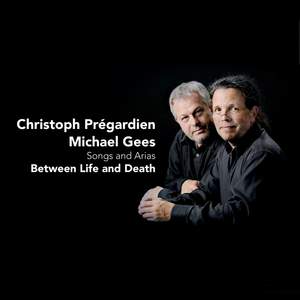
| |  | Between Life and Death - Songs & Arias
Bach, J S: | Komm süsser Tod, BWV478 | Brahms: | Feldeinsamkeit, Op. 86 No. 2 Wie rafft' ich mich auf Op. 32,1 (v.Platen) | Loewe, C: | Edward, Op. 1 No. 1 (Herder) Der Erlkönig, Op. 1 No. 3 (Goethe) | Mahler: | Urlicht (from Symphony No. 2) Revelge (Des Knaben Wunderhorn) Ich bin der Welt abhanden gekommen (Rückert-Lieder) | Mendelssohn: | Neue Liebe, Op. 19a No. 4 | Mozart: | Abendempfindung an Laura, K523 | Schubert: | Schwanengesang D744 (Senn) Auflösung, D807 Der Jungling und der Tod, D545 (Spaun) Der Tod und das Mädchen, D531 Kriegers Ahnung D 957, No. 2 | Schumann: | Stirb, Lieb’ und Freud! Op.35, No. 2 | Tchaikovsky: | Kuda, Kuda 'Lensky's Aria' (from Eugene Onegin) | Weber: | Nein! länger trag' ich nicht die Qualen…Durch die Wälder (from Der Freischütz) | Wolf, H: | Denk es, o Seele! (No. 39 from Mörike-Lieder) Anakreons Grab (No. 29 from Goethe-Lieder) Ein Ständchen Euch zu bringen kam ich her (No. 22 from Italienisches Liederbuch) Dereinst, Gedanke mein (No. 22 from Spanisches Liederbuch: Weltliche Lieder) |
The selection of songs and arias on this double SACD set reflect on the fundamental question of life and death and cover a period of almost two centuries, the composers featured ranging from Bach through to Tchaikovsky. They are performed by one of the great lyric tenors of our age Christophe Prégardien, accompanied by the pianist Michael Gees. The common theme in the music of this recording is the most fundamental of all, existence itself, life and death. The composers represented are Bach, Mahler, Schubert, Schumann, Mozart, Brahms, Loewe, Wolf, Mendelssohn, and Tchaikovsky. The songs and arias performed here range over almost two centuries with eleven compositions and many musical forms, the simple song with piano accompaniment, the narrative, expansive ballad, the great opera aria and more. Christoph Prégardien is widely regarded as among the foremost lyric tenors of our time and frequently collaborates with conductors such as Ricardo Chailly, John Elliot Gardiner, Nicolaus Harnoncourt, and Phillipe Herreweghe. He is represented on disc with more than a hundred and twenty titles, including most of his current repertoire. His recordings of German Romantic Lied repertory, particularly his recent releases on Challenge Classics of Schubert’s Die Schöne Müllerin, (CC72292), and Schwanengesang, (CC72302), have been highly acclaimed by the public and press and have received many major international awards. “…far from being depressing, the programming here, both thoughtful and vividly imaginative, serves to stimulate the senses and lift the spirit. A fresh and unmannered introductory performance of Bach's 'Komm, süsser Tod' leads with both tonal and spiritual ease into an equally direct rendering of 'Urlicht' from Mahler's Second Symphony - artfully and beautifully accompanied by Gees. with a quietly impassioned and sensitively paced performance of Mahler's valedictory 'Ich bin der Welt abhanden gekommen', the final track fades into thin air, concluding an anthology to savour slowly, and return to many times.” BBC Music Magazine, February 2010 **** “Such a programme demands exceptional resources in its singer, and there is probably no one presently more suited than Christoph Prégardien. His tenor, always centred as a high baritone, extends into the bass range right down to the low D of "Der Tod und das Mädchen". He can also call upon a silvery spiritual quality which serves well in songs such as Brahms's "Feldeinsamkeit" and as a final blessing over the whole recital in that last phrase of Mahler's "Ich bin der Welt abhanden gekommen". Michael Gees is one with the singer in the dedication of his own skills and in the imaginative sympathy that informs his touch.” Gramophone Magazine, March 2010 | | | Usually despatched in 4 - 5 working days. |
|
|
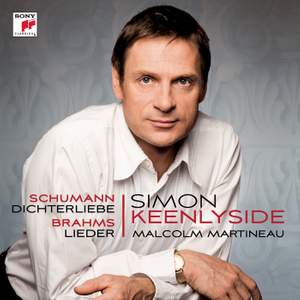
| |  | Schumann - Dichterliebe
Brahms: | Nachtigallen schwingen, Op. 6 No. 6 Lerchengesang Op. 70 No. 2 Nicht mehr zu dir zu gehen, Op. 32 No. 2 Über die Heide Op. 86 No. 4 Wie rafft' ich mich auf Op. 32,1 (v.Platen) Auf dem Kirchhofe, Op. 105 No. 4 Von ewiger Liebe, Op. 43 No. 1 O kühler Wald, Op. 72 No. 3 Es schauen die Blumen, Op. 96 No. 3 Feldeinsamkeit, Op. 86 No. 2 Nachtwandler, Op. 86 No. 3 Verzagen, Op. 72 No. 4 An eine Äolsharfe, Op. 19 No. 5 Nachtigall, Op. 97 No. 1 Abenddämmerung, Op. 49 No. 5 An die Nachtigall, Op. 46 No. 4 (Text: L.C.H. Hölty) | Schumann: | Dichterliebe, Op. 48 |
“Here is a singer-actor who has it all…” The Sunday Times “In a league of his own…” The Sunday Telegraph “The king of barnstorming performances…” The Independent Sony Music Entertainment UK is pleased to present the first of three albums by British baritone Simon Keenlyside, who has recently signed a new exclusive recording contract with the Sony UK company. The first recording under this exciting new agreement features Schumann’s Dichterliebe, Op.48, and a selection of Lieder by Brahms, sensitively accompanied by pianist Malcolm Martineau. Simon Keenlyside was born in London and studied zoology at Cambridge before attending the Royal Northern College of Music for vocal studies. One of the world’s most sought-after and charismatic singers, he has appeared at many of the world’s major opera houses and concert halls, and is noted for his versatility and highly charged performances. Highlights of his career so far include his acclaimed performance of Billy Budd at the ENO, Prospero in the world premiere of Thomas Ades' The Tempest, at the Royal Opera House, Covent Garden; Count Almaviva in Milan and Vienna under Muti; Don Giovanni in Ferrara under Abbado and Pelleas in San Francisco, Geneva and Paris. Simon Keenlyside won the 2006 Olivier Award for outstanding achievement in Opera for his performance of Billy Budd at ENO and Winston in the world premiere of 1984 at the Royal Opera House, Covent Garden, and in 2007 he won a Gramophone Award for Tales Of Opera, his album of operatic arias recorded for Sony Music in Germany. “Throughout, the baritone combines a detailed approach with an overview, demonstrating an exceptional ability to seek out the meaning of both text and music, holding them together in one single image. …a great Lieder singer at the peak of his powers. He is well served by his accompanist, who deploys a huge range of tone and colour with an equally firm artistic intent.” BBC Music Magazine, November 2009 ***** | | | Usually despatched in 3 - 4 working days. |
|
|
| |  | Edition Fischer-Dieskau Vol. 4 - Beethoven & Brahms Lieder
Beethoven: | Maigesang, Op. 52 No. 4 Marmotte, Op. 52 No. 7 Zärtliche Liebe 'Ich liebe dich', WoO 123 In questa tomba oscura, WoO.133 Andenken, WoO 136 Neue Liebe, Neues Leben, Op. 75, 2 Mephistos Flohlied, Op. 75, 3 Wonne der Wehmut, Op. 83 No. 1 Sehnsucht, Op. 83, 2 An die Hoffnung, Op. 94 | Brahms: | Heimkehr, Op. 7 No. 6 Ein Sonett, Op. 14 No. 4 (Herder) Wie rafft' ich mich auf Op. 32,1 (v.Platen) Botschaft, Op. 47 No. 1 Abenddämmerung, Op. 49 No. 5 Es träumte mir (No. 3 from Acht Lieder und Gesänge, Op. 57) Eine gute, gute Nacht (No. 6 from Acht Lieder und Gesänge, Op. 59) Dein blaues Auge, (No. 8 from Acht Lieder und Gesänge, Op. 59) Sommerabend, Op. 85 No. 1 Mondenschein, Op. 85 No. 2 Ständchen, Op. 106 No. 1 |
Hans Mayer wrote “He knew exactly what he wanted to sing and how to go about it. The word ‘magnetism’ – so frequently misappropriated for all types of advertising – fully applied in his case.” Beginning in the late 1940s “FiDi,” as he was already known in his Berlin years, elevated lied singing to an unparalleled level associated with his mellifluous baritone, superb vocal technique, and the credibility of his interpretations. Fortunately the persuasive powers of his early years are attested to not only by ear witnesses but by many radio recordings. These two sets of lieder by Johannes Brahms and Ludwig van Beethoven are taken from two recording sessions held at Berlin’s RIAS broadcasting company in 1951/52. Beethoven’s lieder did not belong to the standard repertoire at the time, and it was Fischer-Dieskau who first popularized them. | | | Usually despatched in 3 - 4 working days. |
|
|
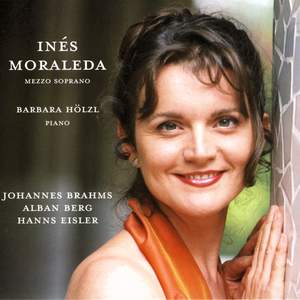
| |  | Lieder
Berg: | Im Zimmer Liebesode Die Nachtigall Sommertage | Brahms: | Geheimnis, Op. 71 No. 3 Ständchen, Op. 106 No. 1 Sonntag, Op. 47 No. 3 Mädchenlied, Op. 107 No. 5 Wiegenlied, Op. 49 No. 4 (Lullaby) Die Mainacht, Op. 43 No. 2 Salamander, Op. 107 No. 2 Von ewiger Liebe, Op. 43 No. 1 Meine Liebe ist grün, Op. 63 No. 5 O kühler Wald, Op. 72 No. 3 Heimweh, Op. 63 No. 8 Auf dem Kirchhofe, Op. 105 No. 4 Wie rafft' ich mich auf Op. 32,1 (v.Platen) | Eisler: | Die Sünde Vater und Mutter Der Tod |
Ines Moraleda (mezzo soprano) & Barbara Holzl (piano) | | | Usually despatched in 2 - 3 working days. |
|
|
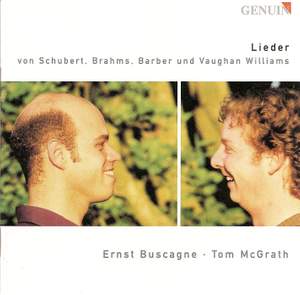
| |  | Lieder
Barber, S: | Three Songs, Op. 45 Now Have I Fed and Eaten up the Rose (J.Joyce) A Green Lowland of Pianos (C.Milosz) O Boundless, Boundless Evening (Ch. Middelton) | Brahms: | Wie rafft' ich mich auf Op. 32,1 (v.Platen) Die Mainacht, Op. 43 No. 2 Unbewegte laue Luft (No. 8 from Acht Lieder und Gesänge, Op. 57) Wie bist du, meine Königin Op. 32 No. 9 Von ewiger Liebe, Op. 43 No. 1 | Schubert: | Lieder nach Gedichten von Goethe: Der Sänger, D149 Der Musensohn, D764 (Goethe) Ganymed, D544 (Goethe) Wandrers Nachtlied I 'Der du von dem Himmel bist', D224 Erlkönig, D328 | Vaughan Williams: | Songs of Travel |
Ernst Buscagne (baritone), Tom McGrath (piano) | |
|
| |  | Lieder
Brahms: | Feldeinsamkeit, Op. 86 No. 2 Wie rafft' ich mich auf Op. 32,1 (v.Platen) Die Mainacht, Op. 43 No. 2 | Gatscha: | Abbitte Schlummerlied Mit schwarzen Segeln Sommers Ende In ein altes Stammbuch Mach mich zum Wächter deiner Weiten Siziliane Die Fahrt | Schubert: | Frühlingsglaube, D686 An Sylvia, D891 An die Musik D547 Lied eines Schiffers an die Dioskuren D360 (Mayrhofer) Der Einsame, D800 Fischerweise, D881 (Schlechta) Auf dem Wasser zu singen, D774 Meeres Stille, D216, Op. 3 No. 2 (Goethe) | Schumann: | Aus den östlichen Rosen, Op. 25 No. 25 Zum Schluß, Op. 25 No. 26 Widmung, Op. 25 No. 1 |
Robert Brooks (tenor), Ingrid Hedlund (piano) | | | Usually despatched in 2 - 3 working days. |
|
|
| |
|