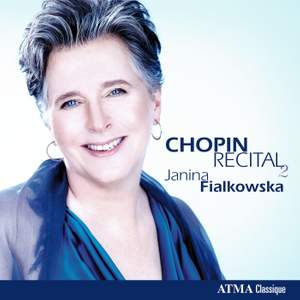
All recordingsPrices shown exclude VAT. (UK tax is not payable for deliveries to United States.) See Terms & Conditions for p&p rates. | |  | Chopin Recital 2
Chopin: | Polonaise No. 2 in E flat minor, Op. 26 No. 2 Waltz No. 14 in E minor, Op. post., KKIVa:15, B 56 Waltz No. 3 in A minor 'Grande Valse Brillante', Op. 34 No. 2 Waltz No. 8 in A flat major, Op. 64 No. 3 Ballade No. 2 in F major, Op. 38 Prelude Op. 28 No. 10 in C sharp minor Prelude Op. 28 No. 11 in B major Prelude Op. 28 No. 13 in F sharp major Fantasia in F minor, Op. 49 Nocturne No. 16 in E flat major, Op. 55 No. 2 Mazurka No. 5 in B flat major, Op. 7 No. 1 Mazurka No. 50 in A minor 'Notre Temps' Mazurka No. 32 in C sharp minor, Op. 50 No. 3 Scherzo No. 2 in B flat minor, Op. 31 |
Janina Fialkowski’s first Chopin recital received marvellous reviews and ATMA is delighted to release a second collection. “This is some of Chopin’s greatest music and the playing is sheer bliss.” Sunday Times. “Her technical brilliance is matched by the vivid originality of her interpretations.” Independent – Album of the Week. “you only have to listen to the Scherzo No 2 to realise she remains a supreme Chopin stylist, combining temperament with an unsentimental touch.” Financial Times, 19th May 2012 **** “to an even greater extent than before, her performances blaze and challenge with a potent and highly individual sense of drama...For Fialkowska, Chopin can take on something of the dark-hued austerity of late Liszt...there is never any doubting her strength of purpose. All this is a striking advance on earlier recordings, with their earlier recordings, with their more conventional notion of interpretation, and to crown it all Fialkowska has been superbly recorded.” Gramophone Magazine, August 2012 “This is a rich and illuminating find. From the outset you sense Janina Fialkowska's innate, developmental grasp of drama - of the connection between phrases and their dynamic character. Then there's the sheer life in her playing, reflected in the perfectly nourished and shrewdly apportioned sound...her pacing and exceptional graps of musical narrative is a masterclass in the art of pianistic rhetoric.” BBC Music Magazine, August 2012 ***** | | | (also available to download from $10.75) | In stock - usually despatched within 1 working day. |
|
|
| |  | Chopin: Waltzes Nos. 1 -14
| | | In stock - usually despatched within 1 working day. |
|
|
| |  | Mendelssohn & Chopin: Cello Sonatas
Pieter Wispelwey and his gut-string cello partner for a second time with Paolo Giacometti in a programme of Chopin and Mendelssohn. But there is a another great musical figure on this disc – the cellist and composer Karl Davidoff, who studied with Moscheles and Mendelssohn’s violinist and composer friend Ferdinand David. Davidoff’s brilliant arrangements of the Chopin Waltzes Op. 64 form a sparkling interlude between Mendelssohn’s brilliant 2nd sonata, and Chopin’s late and great sonata for cello and piano. “it's the two sonatas that show them both at their best – the Mendelssohn is dashingly well played, set out off like a rocket in the opening movement and only pausing for breath in the third-movement Adagio, while in the Chopin it's Giacometti who frequently takes the lead, though the interweaving of cello and piano is beautifully engineered by both players.” The Guardian, 15th September 2011 **** “[Giacometti] and Pieter Wispelwey give Mendelssohn’s D major Cello Sonata Op 58 with fluency and panache. Between that sonata and an eloquently voiced one of Chopin’s in G minor, Wispelwey shows his mettle in some Chopin waltz arrangements.” The Telegraph, 7th October 2011 **** “That Paolo Giacometti has opted for a twangy fortepiano of the period may not add to the beauty of the performance but it makes for a better balance between the instruments than if a modern Steinway was used. It also allows for the pianist to articulate perfectly in really fast speeds. The clarity and precision are also remarkable.” Gramophone Magazine, December 2011 “[The Mendelssohn is] a wonderfully uplifting outburst of high spirits, generously and elegantly formed. Wispelwey always brings such a range of texture to his articulation and such airy luminescence to lyric passages that he is a well-nigh ideal exponent, matched by the ultra-sensitive Paolo Giacometti” BBC Music Magazine, December 2011 *** | | | In stock - usually despatched within 1 working day. |
|
|
| |  | Chopin: Piano Adagio
Chopin: | Nocturne No. 2 in E flat major, Op. 9 No. 2 Arthur Rubinstein (piano) Berceuse in D flat major, Op. 57 Evgeny Kissin (piano) Waltz No. 7 in C sharp minor, Op. 64 No. 2 Arthur Rubinstein (piano) Cantabile in B Flat Major (Andantino) Cyprien Katsaris (piano) Étude Op. 10 No. 6 in E flat minor 'Lacrimosa' Sviatoslav Richter (piano) Nocturne No. 10 in A flat major, Op. 32 No. 2 Arthur Rubinstein (piano) Piano Sonata No. 1 in C minor, Op. 4: Menuetto Cyprien Katsaris (piano) Piano Sonata No. 1 in C minor, Op. 4: 3rd Movement Cyprien Katsaris (piano) Piano Concerto No. 2 in F minor, Op. 21: II. Larghetto Étude Op. 10 No. 3 in E major 'Tristesse' Waltz No. 8 in A flat major, Op. 64 No. 3 Arthur Rubinstein (piano) Piano Concerto No. 1 in E minor Op. 11: Romance Piano Trio in G minor Op. 8: Adagio sostenuto Yo-Yo Ma (cello), Emanuel Ax (piano), Pamela Frank (violin) |
| | | In stock - usually despatched within 1 working day. |
|
|
| |  | Chopin - The Complete Waltzes
“Clearly born for Chopin, her playing is a marvel of the most refined fluency and affection …. Fliter will make lesser pianists wonder at her effortless musical grace and unfaltering command,” (Gramophone on Ingrid Fliter’s debut album for EMI Classics) Following universal praise for her EMI Classics debut album of Chopin piano works, Gilmore Artist Award winner Ingrid Fliter has recorded the composer’s complete waltzes for release as the music world prepares to celebrate his 200th birthday in 2010. Ms. Fliter, the silver medal winner at the Frederic Chopin Competition in Warsaw in 2000, names Chopin as the composer who speaks most clearly to her: “[His music] is like looking into a kaleidoscope of human life. He concentrates all his ideas, all his creative energy, in a very short space of time. He creates a whole world in each little piece.” “It wouldn't be an overstatement,” continues Ms. Fliter, “to say that if it had not been for Chopin's music I would not have been born. My mother noticed my father for the first time while he was playing some Chopin waltzes during a party! I have a vivid memory of being a child and of Chopin’s music, performed by Arthur Rubinstein, playing everywhere - in the living room, in the kitchen, in the car. So I grew up loving Chopin's music and accepting it as part of my everyday life. “One of the most difficult things to achieve while playing Chopin’s music is a good balance between his romantic soul and his classical expression. Through years of study, I have been touched to discover his darker side, his sense of the tragic, which plays a fundamental role in his music, as much as the ‘joie de vivre’ does. When I play Chopin, I have the feeling that the public reacts with a breath of satisfaction, saying ‘Ah, Chopin!’ What I hope every time I play this music is that I can keep the freshness.” Today Ingrid Fliter performs Chopin regularly, both in recital and with orchestra: “[Her] Chopin group was simply spellbinding. The music seemed to flow from her with an utterly natural lyrical impulse, graced with power, luminous delicacy and a spectrum of tonal coloring that combined to mark her out as one of the most instinctive and eloquent Chopin interpreters playing today.” (Daily Telegraph); “Yes, there was a rich sweetness to Fliter's playing … but plenty of fibre and muscle as well. Not for nothing has Fliter been compared to her great compatriot Martha Argerich: there's a similar vitality, an engaging restlessness that imbued some of Chopin's most dreamy sub-plots with enough snappiness and tang to keep us on our toes.” (The Times) Ingrid Fliter was born in Buenos Aires in 1973 and began her piano studies there. She gave her first public recitals at the age of eleven and made her professional debut with orchestra at the Teatro Colón at the age of 16. In 1992, she moved to Europe, where she continued her studies in Freiburg, Rome and Imola. Already the winner of several competitions in Argentina, she went on to win prizes at the Cantu International Competition and the Ferruccio Busoni Competition in Italy and at the Frederic Chopin Competition in Warsaw. The international spotlight focused on Ingrid Fliter when she was named the recipient of the prestigious 2006 Gilmore Artist Award, made every four years by an anonymous panel of judges who assess a number of pianists over a period of time without their knowledge. The Gilmore Artist Award is made to an exceptional pianist who, regardless of age or nationality, possesses broad and profound musicianship and charisma and who desires and can sustain a career as a major international concert artist. The four previous Gilmore Award winners have included EMI Classics artist Leif Ove Andsnes (2002) and Virgin Classics’ Piotr Anderszewski (1998). Ingrid Fliter performs extensively with major orchestras and in recital in North and South America, Europe Asia and the Middle East. Her autumn 2009 recitals in, among others, Boston, Milan and London’s Wigmore Hall, feature an all-Chopin second half, including a group of waltzes. Her winter/spring 2010 recital programme for performance in, among others, New York, Michigan and Chicago’s Orchestra Hall, has an all-Chopin first half, including waltzes. Ms. Fliter appears with orchestras on both sides of the Atlantic in 2009-2010 in concertos by Chopin, Beethoven, Ravel, Mozart and Haydn. She performs Chopin’s Piano Concerto No. 1 with the Cincinnati Symphony and the Royal Liverpool Philharmonic Orchestra/Vassily Petrenko and his Piano Concerto No. 2 with the Cleveland Orchestra/Vladimir Ashkenazy and the Austin, Nashville and Toronto symphonies. In September 2007, Ingrid Fliter joined the roster of BBC Radio 3’s New Generation Artists scheme for a period of two years during which she appeared with many of the BBC’s orchestras and participated in some of the UK’s most prominent festivals, including the City of London Festival and the BBC Proms. This CD is produced in collaboration with BBC Radio 3's New Generation Artists scheme. Ingrid Fliter is an exclusive EMI recording artist. On the release of her first CD in 2008, The Telegraph wrote, “The warmth of her playing and the lyrical impulse of her interpretations are combined with discretion in matters of dynamics, pianistic decoration and tonal colour to make these pieces flow from her fingers with the spontaneity of someone deeply immersed in the music's idiom.” “An exciting technique and keen intelligence animated by an impetuous temperament… a remarkable talent.” (The New York Times) "[Ingrid Fliter] made the music sound as though it were being born under her fingers" (Washington Post) “…her playing magically combines a personalised poetic impulse with an exhilaratingly choreographed virtuosity. She is dazzling and imaginative in the brilliante waltzes… yet she is equally attuned to the more reflective pieces.” BBC Music Magazine, Christmas 2009 ***** “a recital that seduces and surprises in equal measure, the search for hidden shadows stripping away the patina of glossy and superficial accretions to hint at a more pronounced and pertinent strain of melancholia within...the young Argentinean stamps her authority with a finesse far beyond her years.” Michael Quinn, bbc.co.uk, 6th November 2009 “…Ingrid Fliter sets a new benchmark for the complete waltzes. From beginning to end, this is among the finest Chopin recordings of recent years. Fliter's "timing", by which I mean her phrasing and rubato, is judged to perfection; her tempi are near ideal; she never loses sight of Chopin the poet or reinvents him as a red-blooded virtuoso.” Gramophone Magazine, December 2009 | | | In stock - usually despatched within 1 working day. |
|
|
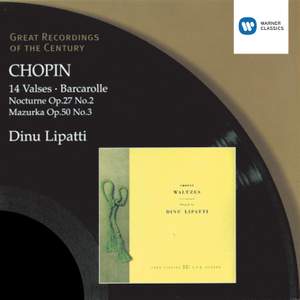
| |  | Dinu Lipatti plays Chopin
| | | In stock - usually despatched within 1 working day. |
|
|
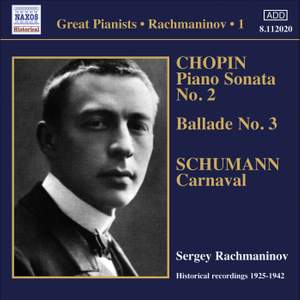
| |  | Rachmaninov - Solo Piano Recordings Volume 1Victor Recordings 1925-1942
Chopin: | Ballade No. 3 in A flat major, Op. 47 Recorded on 13th April 1925 Nocturne No. 2 in E flat major, Op. 9 No. 2 Recorded on 5th April 1927 Waltz No. 7 in C sharp minor, Op. 64 No. 2 Recorded on 5th April 1927 Waltz No. 8 in A flat major, Op. 64 No. 3 Recorded on 5th April 1927 Waltz No. 14 in E minor, Op. post., KKIVa:15, B 56 Recorded on 18th February 1930 Piano Sonata No. 2 in B flat minor, Op. 35 'Marche funèbre' Recorded on 18th February 1930 | Liszt: | Polish Songs S480 No. 1 "Maiden's Wish" (after Chopin) Recorded on 27th February 1942 Polish Songs S480 No. 6 "Die Heimkehr (Narzeczony, Homeward)" (after Chopin) Recorded on 27th February 1942 | Schumann: | Carnaval, Op. 9 Recorded on 9th, 10th and 12th April 1929 Der Kontrabandiste, Op. 74 No. 10 Recorded on 27th February 1942 |
Restoration Engineer: Ward Marston Rachmaninov’s formidable piano technique was notable for its precision, rhythmic drive, refined legato, crystalline clarity and sensitivity to melodic line. While avoiding sentimentality, he sought and expressed music’s emotional essence. Though fleet fingered, he had, in Arthur Rubinstein’s words, “the secret of the golden, living tone which comes from the heart”, awing listeners with the aristocratic quality of his playing. This is particularly evident in his interpretations of Chopin, Schumann and Liszt, whose great Romantic spirit matched his own. Even today, his recordings remain classics. “Exceptional transfers of justly famous performances Rachmaninov brings this music vividly to life with a unique blend of rubato, unsentimentality, solidity of line and virtuosity.” BBC Music Magazine, June 2009 ***** “Here is a reminder and a remembrance of a matchless idiosyncrasy and mastery… Try this great pianist in Chopin's E flat Nocturne, Op 9 No 2, played in the style of the greatest Russian singers, with a melting cantabile and with a freedom and rubato that can make even the ever-elfin Cherkassky sound sober by comparison.” Gramophone Magazine, October 2009 “His 1929 recording of Carnaval is wonderfully incisive. By subtle, barely perceptible touches of rubato, he makes each figure in Schumann’s gallery of characters so vivid, you can see them.” Sunday Times, 26th April 2009 *** | | | (also available to download from $9.00) | In stock - usually despatched within 1 working day. |
|
|
| |  | Chopin - Piano Works
“…her playing is now enriched immeasurably by a poetic depth and subtle expressive imagination.” BBC Music Magazine, August 2008 **** “‘Fliter is very much her own person, with essential sparks of individual imagination that show a fertile mind as well as a phenomenal technique at work … In the second half came a Chopin group that was simply spellbinding. The music seemed to flow from her with an utterly natural lyrical impulse, graced with power, luminous delicacy and a spectrum of tonal colouring that combined to mark her out as one of the most instinctive and eloquent Chopin interpreters playing today” The Telegraph | | | In stock - usually despatched within 1 working day. |
|
|
| |  | Rubinstein plays Chopin
| | | In stock - usually despatched within 1 working day. |
|
|
| |  |
“All these performances suggest a fastidious musical intelligence with an immaculate technique…Harmonia Mundi’s sound is as crystalline as the playing, and these scrupulously modern and sensitive performances are among the finest available.” Gramophone | | | In stock - usually despatched within 1 working day. |
|
|
| |
|