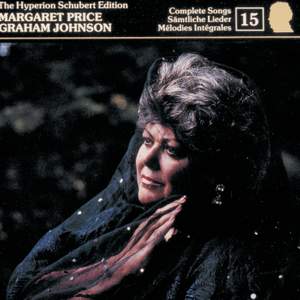
All recordingsPrices shown exclude VAT. (UK tax is not payable for deliveries to United States.) See Terms & Conditions for p&p rates. | |  | The Hyperion Schubert Edition - Complete Songs Volume 15Schubert and the Nocturne III
Schubert: | An die untergehende Sonne, D457 Der Mondabend, D141 Klage an den Mond, D436 Die Mainacht, D194 Der Unglückliche, D713 An die Sonne D270 Der Morgenkuss, D264 Kolmas Klage, D217 Ins stille Land, D403 Gondelfahrer, D808 Der Winterabend (Es ist so still), D938 Der Wanderer an den Mond D870 (Seidl) Im Freien D880 Am Fenster, D878 Sehnsucht D879 Der blinde Knabe D833 Die junge Nonne, D828 |
| | | In stock - usually despatched within 1 working day. |
|
|
| |  | WandererSchubert & Mahler - Lieder
Christoph Sokler (baritone) & Anne Le Bozec (piano) Christoph Sökler has devoted himself entirely to the study of the voice and has graduated with honours from a number of institutions, including the Guildhall in London. He has studied with Fischer-Dieskau and Elisabeth Schwartzkopf. His repertoire ranges from Schütz to contemporary music and he has performed throughout Europe. | | | Usually despatched in 2 - 3 working days. |
|
|
| |  | Schubert - Schwanengesang & Songs After Seidl
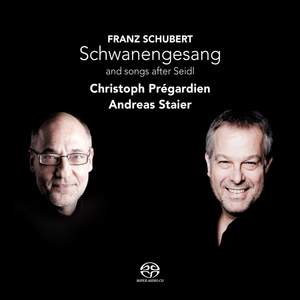
The eminent lyric tenor Christoph Prégardien is represented on disc with more than a hundred and twenty titles. His recordings of the German Romantic Lied repertoire have been highly acclaimed by public and press alike and have received many major international awards. He recently began a new long-term collaboration with Challenge Classics, the first fruit of which was a recording of Schubert’s “Schöne Müllerin” with pianist Michel Gees, (CC72292). On this recording of another of Schubert’s great lieder cycles, “Schwanengesang”, he is joined by the highly-regarded pianist Andreas Staier. Written in August 1828 shortly before his death, the 14 songs by Franz Schubert given the collective title of “Schwanengesang” by his publisher Tobias Haslinger are in reality made up of two sets. There are seven songs on texts by Ludwig Rellstab and six on texts by Heinrich Heine in a common manuscript along with a single Lied, Die Taubenpost, on a poem by his friend Gabriel Seidl (D 965 A). Die Taubenpost is perhaps Schubert’s last song, possibly even his last complete composition of all, although Der Hirt auf dem Felsen was apparently also written in October 1828. The Viennese poet Gabriel Seidl was the source of a whole series of poetic texts that Schubert set to music between 1826 and 1828. Some of these were solo lieder and some were polyphonic songs. “…an outstanding performance. …deeply engaged robustly expressive singing whose rhythmic rigour and details of phrasing and articulation reveal an exciting commitment to this great cycle. …with Staier's fortepiano providing a wonderful mixing and misting of the tonal palette in songs like 'Die Stadt', the performances are also graced with an exceptionally lively and well-balanced recording.” BBC Music Magazine, January 2009 ***** “Planning a CD programme around Schwanengesang is always tricky. The vastly experienced duo of Christoph Prégardien and Andreas Staier here come up with a solution as satisfying as any. They preface the quasi-cycle with the bleak, windswept Rellstab setting Herbst, which Schubert unaccountably omitted from the Rellstab sequence that opens Schwanengesang. Then, at they end, they follow Die Taubenpost – always in danger of jarring after the Weltschmerz of the Heine group – with other, complementary, Seidl settings, ending with the blissful nocturnal homecoming of Im Freien. Prégardien's dulcet tenor, subtly and gracefully deployed, is heard to advantage both in these Seidl songs and in Schwanengesang. Where so many singers seem to 'think' the whole collection in the minor key, as it were, Prégardien is eagerly expectant in 'Liebesbotschaft' and sings a smiling, seductive 'Fischermädchen'. His 'Ständchen', taken at an easy, mobile tempo, is likewise all caressing charm, while 'Abschied' is blithely insouciant, the wistfulness of the final verse lightly touched – and how well the delicate, slightly veiled sonorities of Staier's fortepiano complement the voice, here and elsewhere. In the anguished Heine songs Prégardien's less extreme style than, say, Peter Schreier, is scarcely less moving, whether in the rhythmically incisive 'Der Atlas' (where the fortepiano's percussive resonance brings uncommon clarity to Schubert's quasi-orchestral textures), or an 'Am Meer' of aching tenderness, the final stab of pain all the more affecting for being understated. 'Die Stadt', taken at an unusually urgent tempo, emerges in a single grim sweep, with the fortepiano's sustaining pedal creating a mysterious haze impossible to replicate on a modern grand. Prégardien occasionally adds discreet, graceful embellishments to his lines, especially apt in 'Ständchen'. While it is absurd to speak of an outright 'winner' in such a crowded field, Prégardien and the ever-illuminating Staier join the roster of indispensable Schwanenengesang recordings.” Gramophone Classical Music Guide, 2010 “Prégardien's dulcet tenor, subtly and gracefully deployed, is heard to advantage both in these Seidl songs and in Schwanengesang. Where so many singers seem to "think" the whole collection in the minor key, as it were, Prégardien is eagerly expectant in "Liebesbotschaft" and sings a smiling, seductive "Fischermädchen". ..."Abschied" is blithely insouciant, the wistfulness of the final verse lightly touched - and how well the delicate, slightly veiled sonorities of Staier's fortepiano complement the voice, here and elsewhere. While it is absurd to speak of an outright "winner" in such a crowded field, Prégardien and the ever-illuminating Staier join Schreier, Hotter, (EMI, 10/94) Fischer-Dieskau, 1962 vintage (EMI) and Brigitte Fassbaender (DG) on my roster of indispensable Schwanengesang recordings.” Gramophone Magazine, April 2009 | | | Usually despatched in 4 - 5 working days. |
|
|
| |  | Schubert: Lieder
Schubert: | Das Lied im Grünen, D917 Der Schmetterling D633 An die Nachtigall, D497 An die Nachtigall, D196 (Holty) Der Wachtelschlag D742 (Sauter) Im Freien D880 Die Vogel D691 Fischerweise, D881 (Schlechta) Die Gebüsche, D646 Im Haine, D738 Im Abendrot, D799 Die Sterne, D939 (Leitner) Nacht und Träume, D827 Der liebliche Stern, D861 (Schulze) Rosamunde, D797: Romance 'Der Vollmond Strahlt auf Bergeshöh'n' Der Einsame, D800 Schlaflied D527 (Mayrhofer) An Sylvia, D891 Das Mädchen D652 (Schlegel) Minnelied D429 (Holty) Die Liebe hat gelogen D751 (Platen) Du liebst mich nicht D756 (Platen) An die Laute D905 Der Blumenbrief D622 (Schreiber) Die Männer sind méchant, D866 No. 3 Seligkeit D433 (Holty) |
Remastered Quadro Recording (RQR) | | | Usually despatched in 2 - 3 working days. |
|
|
| |  | Lieder
“This is an unusual and wholly absorbing recital by a soprano often, mistakenly, considered no more than a singer with a lovely voice. In 1972, at the height of her appreciable powers, Janowitz impressed her Salzburg audience with this, her first recital at the Festival. Her discerning choice comprises some notable songs by Schubert rarely heard in recital and ones by his contemporary Hüttenbrenner, which Janowitz sang from manuscript copies, seldom performed since the composer's day. These are surely their first recordings. Has there ever been such a lovely, poised account of the great Schiller-inspired song, DieGötter Griechenlands or such an ingratiating one of Sehnsucht, the Mayrhofer setting? The first offering, Im Freien, has its winning cantilena filled with gloriously sustained, long-breathed tone. The programme ends with Einsamkeit. This grandly imaginative if slightly impersonal quasi-cantata, to a Mayrhofer text, a composition that Schubert himself thought so highly of, is a kind of a panorama of a life, ending in a wonderfully reposeful final section. Janowitz and her impressive partner perform it with total conviction, sustaining interest throughout. Although not in Schubert's class – who is? – Hüttenbrenner reveals a talent apparently well able to encompass the meaning of poems in fluent and often imaginative writing. Orfeo provide no texts, let alone translations, but the delightful Spinnerlied must be about spinning: it's an artlessly charming song. Der Hügel is obviously about more serious matters, and in its sad course comes closes to Schubert in depth of feeling. Frühlingsliedchen has a simple, spring-like joy to it, and an appealingly varied, strophic form. Janowitz takes the measure of them all, and adds to a gently vibrant tone many tints and touches of half-voice. They could not have a better advocate. The recording catches the full glow of the singer's voice. The only drawback, that absence of texts, isn't serious enough to stop acquiring this issue, given that Janowitz virtually tells you in her utterance what the songs are about.” Gramophone Classical Music Guide, 2010 | | | Usually despatched in 3 - 4 working days. |
|
|
| |  | Volume 10 - Austrian Contemporaries Volume 1
“If you want to get to know some marvelous late Schubert songs for minimal outlay, Genz's intelligent, personable performances, sympathetically accompanied by Wolfram Rieger, won't disappoint” BBC Music Magazine, Febuary 2003 | | | (also available to download from $6.00) | Usually despatched in 2 - 3 working days. (Available now to download.) |
|
|
| |  | Gundula Janowitz (Vol. 1)
Schubert: | Im Freien D880 Gott im Fruhling D448 (Uz) Der blinde Knabe D833 Die Sterne, D939 (Leitner) Suleika I, D720 Suleika II, D717 | Strauss, R: | Waldseligkeit, Op. 49 No. 1 Einerlei, Op. 69 No. 3 Wiegenlied, Op. 41 No. 1 Befreit, Op. 39 No. 4 | Verdi: | Requiem Christa Ludwig (mezzo soprano), Carlo Bergonzi (tenor), Ruggero Raimondi (bass) Orchestra & Chorus Salzburg Festival, Herbert von Karajan |
| | | Usually despatched in 4 - 5 working days. |
|
|
| |
|