Prices shown exclude VAT. (UK tax is not payable for deliveries to United States.) See Terms & Conditions for p&p rates. | |  | 13/8/1960 Live, Munich
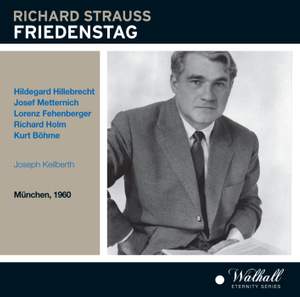
Josef Metternich (Kommandant), Hildegard Hillebrecht (Maria, his wife), Max Proebstl (Wachtmeister), Richard Holm (Schütze), Benno Kusche (Konstabel), Albrecht Peter (Musketier), Wolfgang Anresos (Hornist), Hand Hermann Nissen (Offizier), Josef Knapp (Front offizier), Kurt Böhme (Der Holsteiner, Kommandant), Lorenz Fehenberger (Bürgermeister) & Karl Hoppe (Prälat) Chorus and Orchestra of the Bavarian State Opera, Joseph Keilberth One of Strauss' rarer operas, 'Friedenstag' (1938) occupies a particularly interesting place in his life. It was conceived and written during the late 1930s, at the time when his relationship with the Nazis was at its most difficult. Although the libretto was by Josef Gregor, he had been recommended to Strauss by the Jewish poet Stefan Zweig (librettist of the earlier opera Die schweigsame Frau (1936), who became black-listed by the Nazis and left Germany in 1938. 'Friedenstag' is cast in a single act and, as its name suggests, is a celebration of the ideal of peace. The style is relatively austere, concerning a story set in the early 17th century on the last day of the Thirty Years War. The Commandant of a fortress under siege resolves to die rather than surrender, but then news of peace arrives and he and his former enemy embrace with vows to work for a better world. Male voices dominate (see the cast list) and there is an important role for the chorus. However, there is a significant role for the Commandant's wife and her dignified aria is a memorable inspiration. It was dedicated to Viorica Ursuleac and her husband Clemens Krauss, the lead and conductor respectively in the premiere on July 24, 1938 and on the subsequent recording. 'Friedenstag' has been recorded relatively few times, just as it is seldom performed in the theatre. It is also a one act opera which lacks an obvious partner. Good sound – unique cast including the legendary Fehenberger. “Blending drive with lyricism, Keilberth does some fine things” The Guardian, 10th May 2012 *** | | | Usually despatched in 3 - 4 working days. |
|
|
| |  |
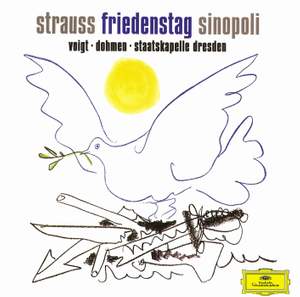
Albert Dohmen (Kommandant), Deborah Voigt (Maria), Alfred Reiter (Wachtmeister), Tom Martinsen (Konstabel), André Eckert (Musketier), Jürgen Commichau (Hornist), Jochen Schmeckenbecher (Offizier), Matthias Henneberg (Frontoffizier), Johan Botha (Piedmonteser), Attila Jun (Holsteiner), Jon Villars (Bürgermeister), Sami Luttinen (Prälat), Sabine Brohm (Frau aus dem Volk) Staatskappelle Dresden & Staatsopernchor Dresden, Giuseppe Sinopoli Jewelcase + O Card. Friedenstag is at once Richard Strauss’ (1864-1949) last operatic collaboration with his librettist Stefan Zweig and his first with Joseph Gregor. The themes of the opera – set in the mid 17th century are about the highest humanitarian and liberal ideals – themes Zweig devised from the factual events from the Thirty Years War. The challenge that faced Strauss and Gregor was how to express this message in the Third Reich, where such well intentioned themes could be hijacked by the Nazis as reflecting the regimes ideal and proclaiming it ‘the first Nazi opera’. Zweig by the time this work was composed had fled Germany, but remained on cordial terms with Strauss, and it has been argued that of all their operatic collaborations this is the one where Zweig’s lofty ideals are most obvious. However, a combination of Strauss’s music which descends to an empty jingoistic martial style in places, and the abandonment of Zweig’s words on reconciliation in place of a long chorus of rejoicing and triumphalism – music to Goebel’s ears no doubt. The work stands apart from the canon of Strauss’s operas, and has only a tenuous hold on the repertoire – an example of lofty ideals sacrificed on the alter of political expediency. Gregor steered the composer towards less controversial operatic themes such as Daphne. Rare repertoire ‘Sinopoli's recording has magnificent, committed and full-throated choral singing, and this makes the final scene sound as Fidelio-like as Strauss undoubtedly wished. Albert Dohmen, who has sung Wotan but here sounds at times more like Alberich, is a powerful Commandant.’ Gramophone, December 2001 “This strong account shows [the work's] qualities.” BBC Music Magazine, September 2010 **** | | | Usually despatched in 4 - 5 working days. |
|
|
| |  | Richard Strauss Edition
Strauss, R: | Also sprach Zarathustra, Op. 30 Tod und Verklärung, Op. 24 Waltz Sequence No. 2 (from Der Rosenkavalier, Op. 59) Till Eulenspiegels lustige Streiche, Op. 28 Don Juan, Op. 20 Ein Heldenleben, Op. 40 Metamorphosen Eine Alpensinfonie, Op. 64 Don Quixote, Op. 35 Tanzsuite aus Klavierstücken von François Couperin Aus Italien, Op. 16 Macbeth, Op. 23 Salome: Dance of the Seven Veils Suite for orchestra from Der Bürger als Edelmann (The Bourgeois Gentleman) Op. 60 Schlagobers, Op. 70: Waltz Josephs Legende Violin Concerto in D minor, Op. 8 Sinfonia Domestica, Op. 53 Horn Concerto No. 1 in E flat major, Op. 11 Horn Concerto No. 2 in E flat major, AV132 Oboe Concerto in D Duett-Concertino for Clarinet, Bassoon & Strings Parergon zur Symphonia Domestica for piano (left hand) & orchestra, Op. 73 Burleske for Piano and orchestra in D minor Panathenäenzug - Symphonic etudes in form of a passacaglia, Op. 74 Violin Concerto in D minor, Op. 8 (version for violin and piano) Allegretto in E Major, AV 149 Study in G Major, AV 141 "Daphne" Cello Sonata in F major, Op. 6 Romance for cello and piano in F Major, AV 75 Variations on a Bavarian folksong (for string trio), TrV 109 Quartettsatz Es-Dur, AV211 String Quartet in A major, Op. 2 Sextet from Capriccio, Op. 85 Piano Trio No. 1 in A major, AV 37 Piano Trio No. 2 in D major, AV 53 Romance for Clarinet and Orchestra, AV 61 version for clarinet and piano Introduction, Theme and Variations for Horn and Piano, AV52 Serenade in G major, AV32 Festmarsch Arabischer Tanz Liebesliedchen, Op. 96 No. 1 Piano Quartet in C minor, Op. 13 Horn Concerto No. 1 in E flat major, Op. 11 version for horn and piano Horn Concerto No. 2 in E flat major, AV132 version for horn and piano Andante for Horn and Piano in C major Fugue for Piano, Op. 81 Gavotte for Piano Suite in B flat major, Op. 4 Das Schloß am Meere AV 92 4 Märsche Five Piano Pieces Op. 3 Hochzeitpräludium AV 108 Enoch Arden Op. 38 Piano Sonata Op. 5 Symphony No. 2, Op. 12 version for piano Feierlicher Einzug der Ritter des Johanniter-Ordens, Op. 103 Wanderers Sturmlied, Op. 14 Festive Prelude for large orchestra & organ, Op. 61 Olympische Hymne Taillefer, Op. 52 Der Rosenkavalier Elisabeth Schwarzkopf (Marschallin), Otto Edelmann (Ochs), Christa Ludwig (Octavian), Eberhard Wächter (Faninal), Teresa Stich-Randall (Sophie), Nicolai Gedda (Ein Sänger), Ljuba Welitsch (Marianne Leitmetzerin), Paul Kuen (Valzacchi), Kersten Meyer (Annina) Philharmonia Chorus & Philharmonia Orchestra, Herbert von Karajan Elektra Alessandra Marc (Elektra), Deborah Voigt (Chrysothemis), Hanna Schwarz (Klytaemnestra), Samuel Ramey (Orest), Siegfried Jerusalem (Aegisth) Konzertvereinigung Wiener Staatsopenchor & Wiener Philharmoniker, Giuseppe Sinopoli Salome Gwyneth Jones (Salome), Dietrich Fischer-Dieskau (Jokanaan), Richard Cassilly (Herod), Mignon Dunn (Herodias), Wieslaw Ochmann (Narraboth), Ursula Boese (Page) Orchester der Hamburgischen Staatsoper, Karl Böhm Ariadne auf Naxos Deborah Voigt (Ariadne/Prima Donna), Natalie Dessay (Zerbinetta), Anne Sofie von Otter (Der Komponist), Ben Heppner (Bacchus) Staatskapelle Dresden, Giuseppe Sinopoli Die Frau ohne Schatten Jess Thomas (Kaiser), Ingrid Bjoner (Kaiserin), Martha Mödl (Amme), Dietrich Fischer-Dieskau (Barak), Inge Borkh (Färberin), Hans Hotter (Geisterbote), Georg Paskuda (Erscheinung eines Jünglings), Gerda Sommerschuh (Stimme des Falken), Herta Töpper (Stimme von Oben), Carl Hoppe (Einäugige), Max Proebstl (Einarmige), Paul Kuen (Bucklige) Bayerischer Staatsopernchor & Bayerischer Staatsorchester, Joseph Keilberth Friedenstag Albert Dohmen (Kommandant), Deborah Voigt (Maria), Alfred Reiter (Wachtmeister), Tom Martinsen (Konstabel), André Eckert (Musketier), Jürgen Commichau (Hornist), Jochen Schmeckenbecher (Offizier), Matthias Henneberg (Frontoffizier), Johan Botha (Piedmonteser), Attila Jun (Holsteiner), Jon Villars (Bürgermeister), Sami Luttinen (Prälat), Sabine Brohm (Frau aus dem Volk) Staatskappelle Dresden & Staatsopernchor Dresden, Giuseppe Sinopoli Four Last Songs Zueignung, Op. 10 No. 1 Die Nacht, Op. 10 No. 3 Morgen, Op. 27 No. 4 Befreit, Op. 39 No. 4 Wiegenlied, Op. 41 No. 1 Freundliche Vision, Op. 48 No. 1 Waldseligkeit, Op. 49 No. 1 Die heiligen drei Könige aus Morgenland Op. 56 No. 6 Charlotte Margiono (soprano) Radio Filharmonisch Orkest Holland, Edo de Waart Heimkehr, Op. 15 No. 5 Seitdem dein Aug' in meines schaute, Op. 17 No. 1 All mein Gedanken ... Op. 21 No. 1 Glückes genug Op. 37 No. 1 In goldener Fülle Op. 49 No. 2 Sehnsucht Op. 32 No. 2 Anton Dermota (tenor), Richard Strauss (piano) Schlechtes Wetter, Op. 69 No. 5 Blick vom oberen Belvedere, Op. 88 No. 2 Du meines Herzens Krönelein, Op. 21 No. 2 Ach Lieb, ich muß nun scheiden!, Op. 21 No. 3 Hilde Konetzni (soprano), Richard Strauss (piano) Ach weh mir unglückhaftem Mann, Op. 21 No. 4 Wozu noch, Mädchen Op. 19 No. 1 Das Rosenband, Op. 36 No. 1 Winterliebe Op. 48 No. 5 Ruhe, meine Seele!, Op. 27 No. 1 Heimliche Aufforderung, Op. 27 No. 3 Alfred Poell (baritone), Richard Strauss (piano) Zueignung, Op. 10 No. 1 Traum durch die Dämmerung, Op. 29 No. 1 Meinem Kinde, Op. 37 No. 3 Wiegenlied, Op. 41 No. 1 Freundliche Vision, Op. 48 No. 1 Cäcilie, Op. 27 No. 2 Maria Reining (soprano), Richard Strauss (piano) Du meines Herzens Krönelein, Op. 21 No. 2 Ich trage meine Minne, Op. 32 No. 1 Die Nacht, Op. 10 No. 3 Seitdem dein Aug' in meines schaute, Op. 17 No. 1 Breit' über mein Haupt Op. 19 No. 2 Ich liebe dich Op. 37 No. 2 Zueignung, Op. 10 No. 1 Heimliche Aufforderung, Op. 27 No. 3 Anton Dermota (tenor), Richard Strauss (piano) Heimkehr, Op. 15 No. 5 All mein Gedanken ... Op. 21 No. 1 Ständchen, Op. 17 No. 2 Waldseligkeit, Op. 49 No. 1 Lea Piltti (soprano), Richard Strauss (piano) Acht Gedichte aus 'Letzte Blätter', Op. 10 Mitsuko Shirai (mezzo), Hartmut Holl (piano) Heimkehr, Op. 15 No. 5 Du meines Herzens Krönelein, Op. 21 No. 2 Ach Lieb, ich muß nun scheiden!, Op. 21 No. 3 Mädchenblumen (4 songs), Op. 22 O wärst du mein Op. 26 No. 2 Morgen, Op. 27 No. 4 Traum durch die Dämmerung, Op. 29 No. 1 Ich trage meine Minne, Op. 32 No. 1 Befreit, Op. 39 No. 4 Gefunden Op. 56 No. 1 Einst kam der Bock als Bote, Op. 66 No. 2 O lieber Kunstler sei ermahnt, Op. 66 No. 6 Es war einmal eine Wanze, Op. 66 No. 9 Die Handler und die Macher, Op. 66 No. 11 Drei Lieder der Ophelia Op. 67 Wanderers Gemutsruhe, Op. 67 No. 6 Mitsuko Shirai (mezzo), Hartmut Holl (piano) |
35 CD + CD-ROM (including Stephen Jay Taylor's 'Richard Strauss: The Man and his Music') A superb collection of some of the greatest performances of Richard Strauss’s orchestral, operatic, chamber and vocal works, brought together in a stunning 35-CD edition of fantastic value. The collection begins with a survey of Strauss’s orchestral music, including the supremely popular symphonic poems - Don Juan, Don Quixote, Also sprach Zarathustra, Till Eulenspiegel, Tod und Verklärung, Eine Alpensinfonie and Ein Heldenleben are included, together with comparatively rare orchestral works such as the wonderful Burlesque for piano and orchestra. These recordings, performed by the Staatskapelle Dresden and conducted by Rudolf Kempe, are a particular highlight of this box set, some of the greatest recordings of the classical catalogue. Of Kempe’s Aus Italien, Gramophone stated:‘The Dresden orchestra play superbly and this version undoubtedly sweeps the board’. Of another release in the series, Gramophone commented: ‘the splendour of the Dresden orchestra is most impressive: at that period and under this conductor they may have had equals in this music but surely no superiors’. An extensive survey of Strauss’s chamber music, performed by major international instrumentalists including Wolfgang Sawallisch (piano), Erno Sebestyen (violin), Wenn-Sinn Yang (cello) and the Sinnoffer Quartet. Includes definitive performances of Strauss’s best-loved operas – Der Rosenkavelier, Elektra, Salome, Die Frau ohne Schatten, Ariadne auf Naxos plus the rarely heard Friedenstag. In particular, Herbert von Karajan’s Der Rosenkavalier remains unsurpassed.‘It really does triumph over them all - even the outstanding 1969 Solti/Decca - and the triumph is, almost entirely, Schwarzkopf's own’, wrote Gramophone. This comprehensive box set concludes with 3 CDs of Lieder, including the enduringly popular Four Last Songs sung by Charlotte Margiono and a disc of historical recordings accompanied by Richard Strauss on piano. A truly unique set (the only one on the market!):The Richard Strauss Edition. Contains a wealth of repertoire: the complete Orchestral Works, the complete Chamber Music, a generous selection of songs, the most famous operas and a disc of rare choral works. A fitting tribute to one of the most important Late-Romantic composers, who for such a long period reflected his “Zeitgeist” in his fascinating and highly personal music. A star studded line-up of famous Strauss interpreters: Rudolf Kempe and his Staatskapelle Dresden (a Strauss orchestra par excellence!), Herbert von Karajan, Joseph Keilberth, Wolfgang Sawallisch, Giuseppe Sinopoli, Karl Böhm, and vocalists Elisabeth Schwarzkopf, Alessandra Marc, Deborah Voigt, Anne Sofie von Otter, Dietrich Fischer-Dieskau and Charlotte Margiono. Containing a historical recording of songs accompanied by Richard Strauss himself on the piano. Liner notes included on CD-ROM. | | | In stock - usually despatched within 1 working day. |
|
|
| |
|