Haydn: String Quartets (complete)

This page lists all recordings of String Quartets (complete), by Franz Joseph Haydn (1732-1809) on CD & download (MP3 & FLAC). Generally, more recent releases are listed first, but with priority given to those that are in stock.

Recommendations

Rosette

All recordings

Prices shown exclude VAT. (UK tax is not payable for deliveries to United States.)
See Terms & Conditions for p&p rates.

Haydn: String Quartets (complete)

Haydn: String Quartets (complete)


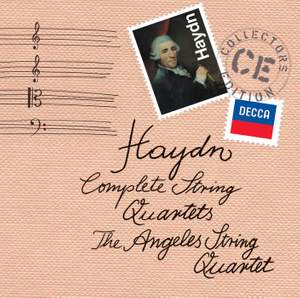
The Angeles String Quartet

“The most relevant comparisons for this collection are the Aeolian Quartet on Decca and the Kodály Quartet on Naxos. The all-digital Naxos series features performances that are, in the main, musically reliable and technically proficient.
But turn back to the 1973-6 Aeolian series, and every work becomes an event, every quirk of harmony, rhythm or timing is etched with maximum relish.
Comparative disc layouts begin to differ from CD 3, and the Angeles omit The Seven LastWords, a work which, beautiful as it is, wasn't originally written for string quartet. Recordingwise, Philips favours a warm, open sound, balanced much as you would hear it from the centre stalls in a smallish-size concert hall. Decca's analogue recordings are closer, dryer, more sensitive to extraneous noise and commonly balanced in favour of Emanuel Hurwitz's first violin.
It's a clear and intimate sound frame and the leader bias actually suits the divertimento-style early quartets, but Philips's more refined engineering makes for less strenuous listening in concert-length sessions. A handful of edits are the only blots on Philips's otherwise immaculate aural landscape.
The svelte texture of the Angeles' pooled sound, their consistent evenness in full chords and the musical like-mindedness of individual players, whether in excited prestos or in shared rubato is admirable. As to contrasts in playing styles, think of the relatively smooth-toned Juilliard or Emerson Quartets (Angeles) as compared with the internally differentiated Amadeus Quartet (Aeolian). The Angeles are generally lighter, faster and subtler in their use of tone colouring whereas the Aeolians' roster of virtues includes strong (even emphatic) characterisation, consistently flexible phrasing and a more pungent approach to rhythm.
Surfing the set for good sampling points brings us, initially, to the early quartets, where both groups sport some superb first-violin solo work, tastefully inflected with Lenski, more candidly expressive with Hurwitz. A particularly telling comparison is provided by the quietly contrapuntal Minuet of Op 17 No 1, where the Angeles' seamless legato contrasts against the Aeolians' near staccato. The exquisite Adagio of Op 20 No 6 is another good place to compare, the Angeles with their perfectly timed pauses, warm cello line and overall restraint set against the more romantic, even rhapsodic, Aeolian. Listening to the first bars of Op 33 No 1 is like eavesdropping on a small gathering mid-conversation, where the cello line gradually gains in urgency. The Angeles' sotto voce handling of the scherzo to Op 33 No 3 is wonderful: it's rather more pensive than the Aeolians and marks much more of a contrast with the chirping trio.
Op 50 No 4's Andante anticipates the dramatic interjections that trouble various late Schubert slow movements. Both groups are effective here, though when the cello marks an expected change of key two minutes or so into the movement, it's the Aeolian's Derek Simpson who makes the biggest impact: you can almost see the rosin erupt from his strings. In Op 50 No 5 late Beethoven springs more readily to mind, but there the Angeles' extra speed and restraint is more effective. Note how beautifully they negotiate the quiet alternation between upper and lower voices towards the end of Op 50 No 6's Poco adagio and the sudden blossoming that follows.
Then again, Op 54 No 1's mobile Allegretto second movement harbours the potential to switch from tenseness to lyrical effusiveness, which the Angeles exploit to the full, as they do for the rhapsodising Adagio of Op 54 No 2. Late Beethoven is evoked once more, this time the Cavatina from Op 130.
Beam up around three minutes into the Adagio of the Lark Quartet (Op 64 No 5) and you'll note how skilfully the Angeles cue a ritardando, while the bracing finale to Op 74 No 3 has just the right bounce to offset all the breathless excitement. The Sunrise Quartet (Op 76 No 4) opens like a spring flower (never more so than in the Angeles' ecstatically controlled performance) and Op 77 No 1's cheeky Allegro moderato bounds in with perfectly modulated high spirits.
Turning to other competition, the Lindsays, Amadeus, Vienna Konzerthaus, Quatuor Mosaïques, Pro Arte and Takács, all have added substantiallyto the Haydn quartet discography, and all have their value. However, in this particular context it really is a head-to-head contest between two 'complete' sets similarly presented.
Richard Wigmore contributes detailed annotation, quite different from Lindsay Kemp's overview for Decca, but just as useful and equally well written. The Angeles appeal perhaps primarily for their restrained expressiveness and consistent attention to detail. Philips's superior recording is another bonus. The Aeolians generate more immediate heat but, ultimately, the Angeles' intelligence and cooler blending pay the higher musical dividends.”
Gramophone Classical Music Guide, 2010

Philips Collectors Edition - 4646502

(CD - 21 discs)

$157.50

(Sorry, download not available in your country)

In stock - usually despatched within 1 working day.

Haydn: String Quartets (complete)

Haydn: String Quartets (complete)


Angeles String Quartet

Decca Collectors Edition - 4783695

(CD - 21 discs)

$116.50

(Sorry, download not available in your country)

Usually despatched in 2 - 3 working days.

Haydn: String Quartets (complete)

Haydn: String Quartets (complete)


Aeolian String Quartet

Decca Collectors Edition - 4552612

(Sorry, download not available in your country)

Haydn: String Quartets (complete)

Haydn: String Quartets (complete)


Buchberger Quartet

A major recording project that will receive extensive review coverage in the major magazines.

Comprehensive PDF booklet essay on the music, the interpretations, sources and research.

Haydn’s string quartets span his creative life – from the 1750s and the Opp. 1&2 sets through to his last unfinished quartet in D minor Op.103 of 1803. When the first quartets were written Bach had been dead only a few years and Handel had five years to live. When the last quartet was being worked on, Beethoven had finished his ground breaking Third Symphony. Arguably, Haydn’s greatest contribution to music is as the father of the string quartet rather than his oftgiven title as ‘Father of the Symphony’. His quartets developed from divertimenti and cassations, which were little more than light music for the entertainment of wealthy patrons and royalty, to some of the most profound and visionary music by any composer. In the same way as Bach’s ‘48’ have been described as a summation of all that had gone before, and the major influence upon all that would follow, Haydn’s quartets chart the development of the medium from ‘background’ music of high quality, to the major art form of the later works. They influenced Mozart, Beethoven, Schubert, Brahms, Schoenberg and beyond spanning the end of the Baroque, the Classical period in its entirety and the beginning of the Romantic age.

During his lifetime, the world had seen huge social and political upheavals – the French Revolution, the Napoleonic Wars which had been fought across Europe (reflected upon in ‘Mass in Time of War, and the Nelson Mass), and the foundation of the United States of America in 1776. Acutely aware of the politics of his age, Haydn’s development as a composer reflects these turbulent times.

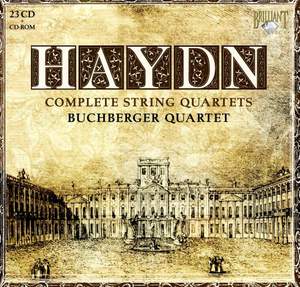
Any cycle of the Haydn String Quartets is a major achievement. The Buchberger Quartet’s interpretations are based on scrupulous research into sources – both contemporaneous and modern, and interpretational style – dynamics, repeats and tempi. This complete recorded cycle is the culmination of a five-year project which has seen the Buchbergers perform all the quartets with illustrated talks and introductions to each work.

Brilliant Classics - up to 30% off

Brilliant Classics - 93889

(CD - 23 discs)

Normally: $64.75

Special: $51.80

Usually despatched in 4 - 5 working days.

Haydn: String Quartets (complete)

Haydn: String Quartets (complete)


Haydn’s string quartets represent one of the greatest developments in the history of music. Here, they are presented complete, from the earliest divertimenti to the sophisticated ‘Apponyi’, ‘Erdödy’ and ‘Lobkowitz’ quartets written at the end of the eighteenth century.

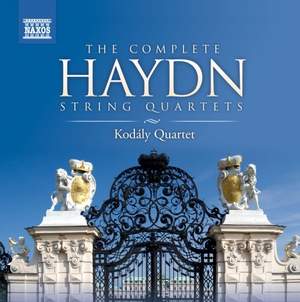
“Naxos is lucky to have such a polished, beautifully balanced group as the Kodály Quartet to record Haydn.” Gramophone

“The playing has both warmth and refinement of detail and the readings are full of character. They never leave the impression that they are too studied or lacking in spontaneity; indeed, one often has the feeling in these studio recordings that one is listening to live music-making.” Penguin Guide, 2011 edition

Penguin Guide

Rosette Winner

Naxos - 8502400

(CD - 24 discs)

$111.50

Usually despatched in 2 - 3 working days.

Haydn: Complete Edition

Haydn: Complete Edition


includes:

Haydn:

Symphonies Nos. 1 - 104 (complete)

Austro-Hungarian Haydn Orchestra, Adam Fischer

Violin Concerto No. 1 in C major, Hob.VIIa:1

Federico Guglielmo (violin)

L’Arte dell’Arco (on period instruments), Federico Guglielmo

Violin Concerto No. 4 in G major, Hob.VIIa:4

Federico Guglielmo (violin)

L’Arte dell’Arco (on period instruments), Federico Guglielmo

Violin Concerto No. 3 in A major, Hob.VIIa:3 'Melker Konzert'

Federico Guglielmo (violin)

L’Arte dell’Arco (on period instruments), Federico Guglielmo

Cello Concerto No. 1 in C major, Hob. VIIb:1

Christine Walevska (cello)

English Chamber Orchestra, Edo de Waart

Cello Concerto No. 2 in D major, Hob. VIIb:2 (Op. 101)

Christine Walevska (cello)

English Chamber Orchestra, Edo de Waart

Keyboard Concerto No. 11 in D major, HobXVIII:11

Keyboard Concerto No. 4 in G major, Hob.XVIII:4

Keyboard Concerto No. 3 in F major with French horns and strings, Hob.XVIII:3

Organ Concerto, Hob. XIV:11 in C major

Organ Concerto, Hob. XIV:12 in C major

Trumpet Concerto in E flat major, Hob. VIIe:1

Horn Concerto No. 1 in D major, Hob.VIId:3

Horn Concerto No. 2 in D major, Hob.VIId:4

Concerti A Due Lire for The King of Naples, Nos. 1-5

Mass, Hob. XXII: 9 in C major 'Paukenmesse'

Mass, Hob. XXII: 6 in G major 'Nicolaimesse'

Mass, Hob. XXII:14 in B flat major 'Harmoniemesse'

Mass, Hob. XXII: 8 in C major - Missa Cellensis 'Mariazellermesse'

Mass, Hob. XXII: 5 in C major 'Cäcilienmesse'

Mass, Hob. XXII: 4 in E flat major 'Große Orgelmesse'

Stabat Mater

The Seasons

The Creation

La vera constanza

Die Feuersbrunst oder das abgebrannte Haus Marionetten, Hob.XXIXb:A

La fedeltà premiata

L'infedeltà delusa

Il ritorno di Tobia

String Quartets (complete)

String Quartet, Op. 51 'Seven Last Words'

Piano Trios (complete)

Baryton Trios Nos. 1-126 (complete)

Divertimento

Piano Sonatas Nos. 1-62 (complete)

The Seven Last Words of Our Saviour on the Cross, Hob XX/2 (Choral version)


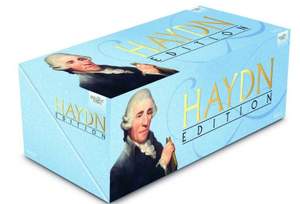
The supreme, voluptuary realist of French painting, Jean Ingres, exclaimed that Haydn was music’s alpha and omega: ‘Whoever studies music, let his daily bread be Haydn…the first who created everything, discovered everything, taught everything to the rest!’ While an intervening century or two of musicology might tell us that if Haydn was father to the symphony and string quartet, there were some interesting midwives among his contemporaries, Haydn’s sheer industry remains unequalled; but so too his creative facility and fertility in returning to the well time and time again, and never returning empty. In this first volume of Brilliant Classics’s survey of Haydn’s music, issued to mark the 200th anniversary of his death in 1809, are many of his most famous works: all 104 symphonies, his two oratorios of imperishable power and beauty, The Creation and The Seasons, as well as another with much no less striking music, The Return of Tobit. There are several of the operas he wrote for the court at Eszterhaza, where he was more or less a servant-prisoner for most of his adult life, and – a first on disc – a complete recording of the 126 trios written at the behest of the court’s prince for an obsolete string instrument, the baryton, in which the prince had himself attained a modest accomplishment. Most of the string quartets are here too, in recordings made especially for Brilliant by the Buchberger Quartet, and historically informed interpretations of the complete piano sonatas on instruments of Haydn’s day. This is a significant contribution to the anniversary of one of the great composers, with much new material, and at an unbeatable price.

ADDITIONAL INFORMATION

Bonus CD-ROM contains song texts and a specially commissioned essay exploring Haydn’s music, genre by genre, by the renowned Haydn authority, Richard Wigmore New recordings of bayton fios and other chamber works made especially for this set and not previously released.


Extra postage costs:
As this set is very heavy (around 4.5kg) we unfortunately need to charge some extra postage costs to certain countries.
UK and most of Western Europe: No extra charges - Normal rates apply.
Rest of World: Varies by country. Please contact us for further details.

Brilliant Classics - up to 30% off

Brilliant Classics Complete Editions - 93782

(CD - 150 discs)

Normally: $166.00

Special: $124.50

In stock - usually despatched within 1 working day.

Copyright © 2002-13 Presto Classical Limited, all rights reserved.