Bartók: String Quartets Nos. 1-6 (complete)

This page lists all recordings of String Quartets Nos. 1-6 (complete), by Béla Bartók (1881-1945) on CD, SACD & download (MP3 & FLAC). Generally, more recent releases are listed first, but with priority given to those that are in stock.

Recommendations

First Choice
April 2002
Editor's Choice
May 2008

All recordings

Prices shown exclude VAT. (UK tax is not payable for deliveries to United States.)
See Terms & Conditions for p&p rates.

Bartók: String Quartets Nos. 1-6 (complete)

Bartók: String Quartets Nos. 1-6 (complete)


Indisputably one of the cornerstones of the string quartet repertoire, as well as one of the masterpieces of the 20th century, Bartók’s six string quartets have been labeled ‘the greatest quartets since Beethoven’. Now, for the first time, the six quartets have been compiled onto two (rather than three) CDs with scholarly notes by Arnold Whitall. When issued as a set on LP, it won the Gramophone Award for Best Chamber Music Recording.

Released or re-released in last 6 months

Australian Eloquence - 4807120

(CD - 2 discs)

$14.25

(Sorry, download not available in your country)

In stock - usually despatched within 1 working day.

Bartók: String Quartets Nos. 1-6 (complete)

Bartók: String Quartets Nos. 1-6 (complete)


Mikrokosmos String Quartet

Super Audio CD

Format:

Hybrid Multi-channel

Hungaroton Bartók New Series - HSACD32513-14

(SACD - 2 discs)

$26.75

In stock - usually despatched within 1 working day.

Bartók: String Quartets Nos. 1-6 (complete)

Bartók: String Quartets Nos. 1-6 (complete)


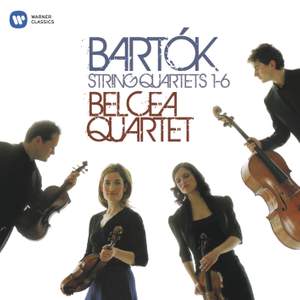
"The more we immersed ourselves in these works, the more beauty and richness we discovered in them and we very much hope that this appeal will even still increase in future because we definitely consider these quartets to be the greatest masterpieces of the last century in our repertoire." Belcea Quartet

The First Quartet is the most romantic in spirit and actually harbours a love story. It marks an affectionate withdrawal from a late Romantic fin-de-siècle. The Second (1915-1917) takes us some way towards the gritty, hard-hitting Bartók of the mid-late 1920s. By 1927 Bartók, a superb pianist by any standards, was enjoying a worldwide concert career, and soaking up what that world had to offer in musical terms. One probable influence was Alban Berg’s Lyric Suite, an expressive masterpiece that thrives on a plethora of complexities. Bartók’s Third Quartet does likewise, a work that on one level seems to mimic a Hungarian rhapsody (the alternation of fast and slow music) while on the other takes tiny thematic cells and develops them into a teeming nest of musical activity. Bartók’s next two quartets are both cast unconventionally in five movements of a symmetrical, arch-like design. The Fourth (1928) has at its centre an evocative though austere example of Bartók’s ‘night music’ that opens with a rhapsodic cello solo leading in turn to imitated birdsong. The Fifth Quartet (1934) is built on a far larger scale. Bartok modifies the arch form by placing a scherzo at its centre, a syncopated dance movement in Bulgarian rhythm, framed by two slow movements using similar chord sequences. The air of ineffable sadness that hangs over Bartók’s last quartet (1938) reflects not only a swiftly sickening Europe but personal tragedy: his mother’s journey towards death would end in December 1939. All four movements open with the same, heart-rendering ‘mesto’ (sad) motto. Never has a quartet cycle ended quite so equivocally, or sounded a truer warning, one that even today inspires both awe and gratitude.

“Try the first few minutes of Quartets Nos2 and 3, and marvel at the gradation of forte and fortissimo, of piano and pianissimo, which helps to give entire movements far more convincing shape than less precisely observant ensembles achieve. In short, the Belceas are more than worthy rivals to the best on disc.” Gramophone Magazine, May 2008

“The playing in these endlessly fascinating and rewarding pieces is supremely accomplished. Distinguished Bartók cycles in recent years include those by the Alban Berg (EMI), Emerson (DG) and the Takács Quartets - but none more vividly conveys the music's visceral excitement.” BBC Music Magazine, March 2008 *****

“Bartók's quartets are one of the great musical collision points between modernism and romanticism.
How to handle the tension between their expressive gestures and constructivist designs is one of the abiding issues for performers and one reason why even the plethora of fine available recordings cannot remotely exhaust their riches. Getting the best of all worlds interpretatively is hardly a realistic aim. Even so, there are long stretches where the Belceas come as close to the ideal as any ensemble on disc.
Try the first few minutes of Quartets Nos 2 and 3, and marvel at the gradation of forte and fortissimo, of piano and pianissimo, which helps to give entire movements far more convincing shape than less precisely observant ensembles achieve. Try the outer movements of No 5 and marvel at the gear-changes negotiated smoothly, instantly and unanimously, yet never as ends in themselves, always accompanied by a sense of expressive-dramatic purpose. Try virtually every movement in fact, and revel, as the Belceas do, in the interplay of the lines, even in passages where others seem thankful just to come through unscathed.
Clearly immense thought has been given to tone quality. In the first movement of No 1, for instance, the Belceas point the periodic arrivals on consonant harmonies by withdrawing vibrato, and instantly the as yet not fully mature Bartók's straggly structure gains sharpness of profile.
They apply the same ploy in the much tauter environment of the first movement of No 5, and with similarly revelatory results. At the other extreme, their sustained tonal intensity makes the most barbaric onrushes exhilarating rather than exhausting, neither too streamlined nor too effortful. When the score is bare of instructions, as in the first slow movement of No 5, they take it at its word and uncover a hypnotic, staring blankness. And when the invitation to humour is extended, as in the finale of the same quartet, they seize it with full-blooded, yet never selfserving, relish.
Before surrendering to the power of these performances, one wondered if there was going to be enough ethnic tang and zest, enough wildness and strangeness, enough sultry longing.
We've certainly heard more of those qualities in the first two quartets. Yet the central movement of No 2 is marked molto capriccioso, not barbaro, and that's exactly what comes across, while the coda is pushed daringly close to the edge, sounding like the distant fluttering of giant moths – not as precisely by the book as the Emersons but vastly more imaginative and emotionally telling – while the slow finale has a superbly intense accumulation at its heart.
Pushed for a general reservation, perhaps when a 'speaking' quality is needed in the quasirecitatives, the first violin's colleagues don't quite match her for idiomatic insight. And do the Belceas get to the heart of the matter in the trauma-shaded No 6? Not quite – not by comparison with The Lindsays, anyway, who are generally more prepared to tolerate rough edges for the sake of emotional revelation.
In short, the Belceas are more than worthy rivals to the best on disc and EMI's recording quality is just right.”
Gramophone Classical Music Guide, 2010

GGramophone Awards 2008

Finalist - Chamber

GGramophone Magazine

Editor's Choice - May 2008

EMI - 3944002

(CD - 2 discs)

$21.75

In stock - usually despatched within 1 working day.

Bartók: String Quartets Nos. 1-6 (complete)

Bartók: String Quartets Nos. 1-6 (complete)


GGramophone Awards 1989

Record of the Year

DG Grand Prix - 4776322

(CD - 2 discs)

$15.25

In stock - usually despatched within 1 working day.

Bartók: String Quartets Nos. 1-6 (complete)

Bartók: String Quartets Nos. 1-6 (complete)


“The Alban Berg bring all their usual sophistication and Viennese hothouse climate to works which are sometimes illuminated by them, and equally often obscured.” BBC Music Magazine, August 2006 ***

EMI Gemini - 3609472

(CD - 2 discs)

$11.25

In stock - usually despatched within 1 working day.

Bartók: String Quartets Nos. 1-6 (complete)

Bartók: String Quartets Nos. 1-6 (complete)


Keller Quartet

“For knife-edge precision the Emerson and Alban Berg Quartets reign supreme in this repertoire, but the Kellers get closer to the meaning behind the notes than any ensemble since the Hungarian Quartet. Superb value.” BBC Music Magazine, May 2006 ****

Apex - 2564626862

(CD - 2 discs)

$10.50

In stock - usually despatched within 1 working day.

Bartók: String Quartets Nos. 1-6 (complete)


Ode Records - CDMANU1551/3

(CD - 2 discs)

$17.00

In stock - usually despatched within 1 working day.

Bartók: String Quartets Nos. 1-6 (complete)

Bartók: String Quartets Nos. 1-6 (complete)


Guarneri String Quartet

Béla Bartók, born in 1881, is considered by many to be the greatest Hungarian composer as well as one of the most significant musical voices of the 20th century. Self-taught and originally trained as a pianist, he combined elements of his homeland’s traditional folk music with the influences of his contemporaries to produce a highly distinctive, immediately recognisable style.

Bartok’s six string quartets, to which this 2CD compilation is dedicated, represent a milestone in the history of the genre and provide a unique insight into the way the composer’s musical language developed over four decades. It’s a fascinating stylistic journey, beginning with the First Quartet of 1907 – a work very much in the shadow of late Beethoven. Moving onto the Second (1917), written during a period of intense musical isolation, we encounter the influences of Strauss, Debussy and late Schoenberg before being subjected to the full-scale expressionism of the Third and Fourth Quartets (1927 and 1928 respectively). The Fifth, composed six years later, adopts a five-movement arch-like structure and is a strong contrast to the Sixth and final Quartet of 1938: deeply reflective and pessimistic in tone, this was to be Bartok’s last work before fleeing to the US to escape the spectre of fascist Europe.

Together with driving rhythms, sharp dissonances and even quarter tones, this cycle presents a huge challenge musically and technically to even the most accomplished quartets. The Guarneri, however, is on fine form here and delivers a first-rate performance brimming with character. A gem of a recording.

“Although this disc is hampered by a slightly compressed dynamic range, the Guarneri's Bartok strikes a balance between percussive energy and mournful introversion.” BBC Music Magazine, June 2012 ****

“Magnificently played” Gramophone Magazine

Newton Classics - 8802111

(CD - 2 discs)

$16.50

Usually despatched in 2 - 3 working days.

Bartók: String Quartets Nos. 1-6 (complete)

Bartók: String Quartets Nos. 1-6 (complete)


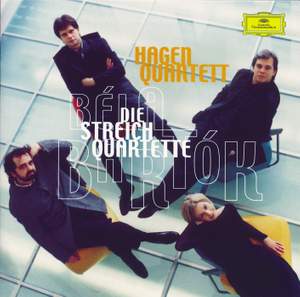
Béla Bartók’s six quartets are considered the most important cycle of works in the genre after those of Beethoven. Like Beethoven, the form of the quartet spanned Bartók’s creative life, across the years 1908–39. The First Quartet shows the young composer influenced by Max Reger, Wagner and late Beethoven – composers who also exerted an influence on Bartók’s contemporary Arnold Schoenberg’s First Quartet, a work Bartók knew well.

The Second Quartet saw the mature Bartókian style emerge – repeated fragments within the octave, scales without a fixed final note, and the unmistakable sound of Hungarian folk music. The sixth and final work is haunted by grief, personal and political. Bartók was deeply unsettled and alarmed by the political situation in Europe and the rise of the Nazis, and his mother fell ill at the time of this quartet’s composition; he decided to leave his native Hungary for America, from where he would never return.

Recordings made in 1995 and 1998.

New booklet notes.

‘Six very different musical worlds illuminated with laser-like precision – and with a few quirky gestures added for effect. A major addition to the Bartók quartet discography.’ Gramophone, August 2000

‘Both the Fifth and Sixth Quartets are packed full of the most delicate ideas, shimmering, self-communing music with occasional bursts of unchecked passion (No.6’s Marcia) or humour (the close of No.5’s finale and No.6’s Burletta).’ Gramophone, August 2000

“The Hagens provide tremendous fire and virtuosity, but also total accuracy and technical finesse, in these great works.” BBC Music Magazine, October 2010 *****

Newton Classics - 8802011

(CD - 2 discs)

$16.50

Usually despatched in 2 - 3 working days.

Bartók: String Quartets Nos. 1-6 (complete)

Bartók: String Quartets Nos. 1-6 (complete)


Sony Tandem - 88697099392

(CD - 2 discs)

$12.25

Usually despatched in 8 - 10 working days.

Page: 

 1   2 

 Next >>

Copyright © 2002-13 Presto Classical Limited, all rights reserved.