All recordingsPrices shown exclude VAT. (UK tax is not payable for deliveries to United States.) See Terms & Conditions for p&p rates. | |  | István Kertész conducts Kodaly & Bartók
Bartók: | Bluebeard's Castle, Sz. 48, Op. 11 Walter Berry (bass-baritone) & Christa Ludwig (mezzo-soprano) London Symphony Orchestra | Kodály: | Háry János, Op. 15 Peter Ustinov (narrator), György Melis (baritone), Erzsébet Komlóssy (contralto), Márgit László (soprano), Olga Szönyi (mezzo soprano), László Palócz (bass-baritone), Zsolt Bende (baritone) Wandsworth School Boys’ Choir, Edinburgh Festival Chorus & London Symphony Orchestra |
István Kertész’s recordings on Decca are legendary and many of them are now on CD on Eloquence – some for the first time. This generous 2CD set offers a unique coupling of two ‘fairy tale’ pieces by Hungarian composers: Kodály’s Hary Janos (a ‘singspiel’), a light-hearted tale of the imaginary adventures of the Hungarian general (with Peter Ustinov, no less, as the hilarious actor/narrator), and Bartók’s one-act operatic thriller, Duke Bluebeard’s Castle. The extensive notes in the booklet include a conversation between producer Erik Smith with Kertész and Christa Ludwig, who sings the part of Judith in the Bartók. The recordings were some of Decca’s best and even today sound absolutely spectacular. “the Edinburgh Festival Chorus and the Wandsworth schoolboys deserve special commendation for their valour […] something of a virtuoso performance in its own right which Ustinov obviously enjoyed hugely […] technically the whole thing is a tour de force – and that includes particularly vivid orchestral sound; partly it is the sheer superlative panache of the orchestral playing under Kertesz” Gramophone Magazine (Háry János) “this issue of Bartók's early opera must count as one of Decca's great operatic recordings, to be treasured by all who appreciate this marvellous score. Rival versions, past and present, are left at the post” Gramophone Magazine (Bartók) “sets new standards … the Decca remastering reaches demonstration quality” Penguin Guide *** (Bartók) | 
| | | (Sorry, download not available in your country) | In stock - usually despatched within 1 working day. |
|
|
| |  | Bartók: Bluebeard's Castle, Sz. 48, Op. 11
Despite occasional successful staging’s of this opera, it is concert performances that stir up the feelings of audiences most. I have witnessed many times in performances of this psycho-drama that listeners, staring at the faces of the two singers for sixty minutes, or following a surtitled or printed libretto translation during Bartók’s deeply emotional music, were confronted with themselves. The prologue is very important; this is in fact a story about us. Usually, after the opera has ended, discussions break out, dividing men and women. Whereas everybody seems to understand why Judit cannot resist her desire to open all the doors, Bluebeard’s character remains controversial. Is it right or wrong, necessary or unnecessary to keep certain doors closed? Why does he need to lock Judit up after she has discovered his secrets? Is the blood real, or does it exist only in Judit’s fearful imagination? This Bluebeard is not a killer, even if he has a bad reputation and Judita sees blood everywhere. All the earlier wives are alive in his heart, behind closed doors. Bartók, who was himself a closed, shy man, seems to have been fascinated by strange-looking characters who turn out to feel endless love. This links Bluebeard to the Miraculous Mandarin. “Polgár makes a compassionate Bluebeard, imbuing the part with an appropriate sense of resignation and regret... Komlósi sings [Judith] with admirable insight. Fischer conducts with meticulous care for detail, and has even managed to procure a keyboard xylophone - the rare instrument Bartok specifies for the torture-chamber scene...while there may have been more spectacular versions of this great work, none is more thoroughly idiomatic than Fischer's.” BBC Music Magazine, September 2011 ***** “As both singers are native Hungarians, the contour and timbre of the vocal lines have an organic unity even to an ear unschooled in Eastern European tongue.” Gramophone Magazine, Awards Issue 2011 “Fischer is especially successful at drawing out the pained poignance of the score...The result is a performance dominated by sadness, one that draws out sympathy (for both characters) more than it horrifies us; and Fischer manages to keep the psychological intensity growing as we move from door to door.” International Record Review, September 2011 | | | In stock - usually despatched within 1 working day. |
|
|
| |  | Bartók - Bluebeard's Castle
Bartók showed little interest in opera, until the libretto for Bluebeard’s Castle by Béla Balázs arrived on his desk. Something about the character of Bluebeard, and his intense loneliness, appealed to him. When Bartók completed the work in 1911 it was banned by the Hungarian Commision of Fine Arts. It wasn’t until 1918 that the Italian conductor Egisto Tango disinterred the score and realised its worth. The work was then performed in Berlin in German, and in Hungarian in Florence. Kodály described the work as the ‘Hungarian Pelléas’, and the dual between Romantic and impressionistic influences certainly links the two works. Berg’s Wozzeck was premiered in 1925 conducted by Erich Kleiber, then banned by the Nazis as decadent in the 1930s. Since then though it has become recognised as one of the masterpieces of 20th-century opera. Structured as a normal opera, but without arias and recitatives, the second act is in effect a fourmovement symphony. The opera also has significant symphonic interludes. Berg made a concert suite from material from the opera in 1924, and it met with instant success. | | | In stock - usually despatched within 1 working day. |
|
|
| |  | Bartók: Bluebeard's Castle, Sz. 48, Op. 11DSD recording, live at the Barbican January 2009
Sung in Hungarian (spoken prologue in English) Text in Hungarian with English translation. Valery Gergiev is joined by two outstanding singers for his latest LSO Live release featuring Bartók's one-act opera. Despite being one of the greatest ever interpreters of the role of Bluebeard on stage, this is Sir Willard White's first complete recording of Bluebeard's Castle. His Judith is the outstanding young Russian-born, Berlin-based mezzo Elena Zhidkova. Sir Willard performs extensively around the world during 2009 including appearances at The Metropolitan Opera in New York and La Scala in Milan. Elena Zhidkova will appear with the LSO and Gergiev at the BBC Proms and make her debut at the Mariinsky Theatre. She also performs in Palermo, Dresden, Leipzig, Amsterdam, Prague and Tokyo as well as returning to La Scala. Bartók's only opera is a dark and intense work, involving only two characters. Bluebeard's young bride persuades him to open seven doors in his castle in order to let light into the grim interior. Behind each she finds increasingly disturbing sights, until behind the final door she discovers Bluebeard's former wives and learns her fate. CONCERT REVIEW: 'Who needs weeping walls and blood-stained jewels when you have the voice of Elena Zhidkova? As Bluebeard's wife she made us see and feel it all' The Times “Sonority wins over emotional display with Willard White’s Duke, but Elena Zhidkova makes partial amends as the anguished Judit.” The Times, 8th August 2009 *** “…Gergiev and his superlative orchestral forces and vocal soloists, supported by magnificent sound quality, present the enigmatic piece with great power, leaving us, as adequate performances always do, feeling stunned and somewhat bewildered. Willard White's Bluebeard, exceptionally firm of tone, implacable but tormented without ever indulging his pain, is magnificent. He needs to be to counter the superb Elena Zhidkova...” BBC Music Magazine, October 2009 ***** “For the perfect introduction to Bartók's Bluebeard look no further. …the pivotal moment is the sombre burbling of the lake of tears… where Judith is transfixed by the water's unearthly hush and Bluebeard explains, "tears, my Judith, tears, tears…". Gergiev sustains a pretty slow tempo while clarinet and low strings embrace both protagonists with long, expressive lines. The opera's later episodes, such as the accelerating blood-rush as Judith susses the shocking truth (Gergiev and his players are on tremendous form here), Bluebeard pondering his past wives and the overwhelming moment when Judith at last joins them, all suggest similar levels of thoughtfulness, sense of theatre and sensitivity to mood.” Gramophone Magazine, October 2009 “Gergiev takes to the potent compound of searing psychology, soaring poetry...with characteristic gusto, at pains to stress the pulsing drama at the heart of the seemingly undramatic premise of the work...White’s Bluebeard is a biting, granite-edged performance of inscrutable and intimidating stature.” Michael Quinn, bbc.co.uk, 1st October 2009 | | | In stock - usually despatched within 1 working day. |
|
|
| |  | Bartók: Bluebeard's Castle, Sz. 48, Op. 11
Visually-stunning staging by Hungarian director Miklós Szinetár “Georg Solti's Grammy-winning recording is more idiomatic than some much praised rivals both in his intense, atmospheric conducting (he was briefly Bartók's pupil) and his native Hungarian singers. Here it provides the soundtrack to cinema director Miklós Szinetár's vivid interpretation, capturing both author Balázs's Pelléas-like mysticism and more contemporary psychodrama. Sylvia Sass is deeply impressive, vocally incisive but sensitive and smoulderingly dramatic.” BBC Music Magazine, July 2008 ***** “His two soloists could not have been better chosen, for both the dark-timbred Kolos Kovats and the rich-voiced Sylvia Sass are totally convincing in their roles....Solti's orchestral commentary is superbly controlled: the taut grip for which his conducting is celebrated is felt at its most magnetic, and the powerful closing scene is haunting.” Penguin Guide, 2011 edition | | | Usually despatched in 2 - 3 working days. |
|
|
| |  | Bartók: Bluebeard's Castle, Sz. 48, Op. 11(Opera in One Act - Libretto by Béla Balázs) Sung in Hungarian
This recording was made after the Bournemouth Symphony Orchestra’s end-of-season concert, described by The Times as “a spectacular finale… A knockout dramatic punch; feverishly beautiful orchestral playing; two characters, the Duke and his new wife Judith, tactile and writhing, deeply felt… Alsop inspired the Bournemouth players to excel”. “…the performance is greatly helped by fine playing from the Bournemouth Symphony Orchestra, and Alsop's sweepingly dramatic view of the score. The vocal contributions, however, are less distinguished.” BBC Music Magazine, January 2008 *** “Alsop and the Bournemouth Symphony Orchestra prove worthy interpreters of Bartók’s psyco-drama. Alsop bathes the score in an impressionist glow, dark and glistening. She gives her excellent soloists… ample room to define the drama, while tightening the screws where appropriate, making for a suitably chilling climax.” Financial Times “…this Bluebeard is more than good enough to introduce a great and compelling work but if pressured to choose while ignoring of the price-tag I would opt for John Tomlinson's Bluebeard under Bernard Haitink.” Gramophone Magazine, February 2008 | | | (also available to download from $6.00) | Usually despatched in 2 - 3 working days. (Available now to download.) |
|
|
| |  | Bartók: Bluebeard's Castle, Sz. 48, Op. 11Sung in English (translation by Chester Kallman)
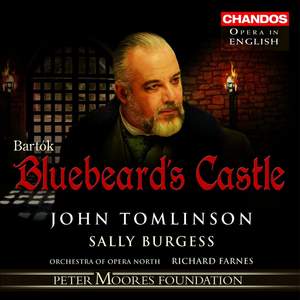
“This new version… is splendidly recorded, and Farnes coaxes some superb playing from the orchestra. Sally Burgess makes a fine Judith, bringing out the firmness of her love for Bluebeard, as well as her vulnerability. …Tomlinson… is as commanding as ever, and to listen to this performance as a whole is to marvel anew at the richness and inventiveness of Bartók's score.” BBC Music Magazine, July 2006 ***** “Burgess manages to make Judith the multi-dimensional character she deserves to be...John Tomlinson's Bluebeard broods magnificently, his voice and personality as overpowering as the atmosphere of his castle...let me introduce the third member of the cast: the Orchestra of Opera North conducted by Richard Farnes, who provide vivid colours and deep shadows” Andrew McGregor, bbc.co.uk, 8th August 2006 “This recording grew from performances by Opera North but the absence of a visual element hardly matters. Nor in this instance does the language issue either. Bluebeard is perfect food for the mind's theatre, the tale of a man alone (as John Tomlinson reminds us in the cryptic spoken prologue) and while under normal circumstances Hungarian would win over any translation, here vivid vocal acting and clarity of diction more than compensate. And there's Farnes's conducting, which even from as early as the introduction counters the pervading darkness with deftly pointed woodwind phrases and a light, expressive curve to the string lines. Tomlinson's Bluebeard is godlike, cautioning and doleful, the voice hugely resonant. Sally Burgess sounds old enough to know better than to stray thoughtlessly from her father's home. When Judith first views the castle's interior she sounds suitably tremulous and awestruck, though when she blurts out the words 'tell me why the doors are bolted?' an air of petulance spells trouble: her command to 'open!' cues forceful thwacks on timps and bass drum. And so the drama unfolds, Burgess's Judith, shrewish and fatally curious, Tomlinson's Bluebeard, inwardly tortured but fired by Judith's dark beauty. The instruments of torture, the armaments, mountains of gold, tender flowers and spacious kingdom, all are graphically tone-painted, Farnes delivering with distinction every time – though when Burgess gasps at the kingdom newly revealed she keeps her high C fairly short. Tomlinson's most sensitive moment, as so often with him in this work, comes when he recalls his former wives, and Farnes's comes at the 'lake of tears', the perfect dovetailing of winds and strings, mournful but also extremely beautiful. The later climactic moments are delivered with enormous power, the sum effect very moving. For a thoroughly sympathetic, theatrically effective English-language Bluebeard's Castle, this new release is about as good as it's likely to get.” Gramophone Classical Music Guide, 2010 “Moving and powerful, this English Bluebeard is as good as it gets. …while under normal circumstances I'd favour Hungarian above any translation, here vivid vocal acting and clarity of diction more than compensate. And there's Farnes's conducting, which even from as early as the introduction counters the pervading darkness with deftly pointed woodwind phrases and a light, expressive curve to the string lines. Tomlinson's Bluebeard is godlike, cautioning and doleful, the voice hugely resonant. Tomlinson's most sensitive moment, as so often with him in this work, comes when he recalls his former wives (track 19), and Farnes's comes at the 'lake of tears', the perfect dovetailing of winds and strings, mournful but also extremely beautiful.” Gramophone Magazine, July 2006 BBC Music Magazine
Opera Choice - July 2006 |
| | | (also available to download from $10.50) | Usually despatched in 2 - 3 working days. (Available now to download.) |
|
|
| |  | Leaving Home - Orchestral Music in the 20th CenturyA Conducted Tour by Sir Simon Rattle. Volume 4 - Three Journeys Through Dark Landscapes
| | Excerpts from: | Bartók: | Bluebeard's Castle, Sz. 48, Op. 11 Music for Strings, Percussion & Celesta, BB 114, Sz. 106 Concerto for Orchestra, BB 123, Sz.116 | Lutoslawski: | Concerto for Orchestra Jeux vénitiens Symphony No. 3 | Shostakovich: | Symphony No. 4 in C minor, Op. 43 Symphony No. 5 in D minor, Op. 47 Symphony No. 14 in G minor, Op. 135 |
Recording Date: 1996
Running Time: 50 min
Picture Format: 4:3
Sound Format: PCM Stereo
Language: D, GB
Menu Languages NTSC: D, F, GB
Subtitle Languages NTSC: F, I, JP, SP
| | | Usually despatched in 2 - 3 working days. |
|
|
| | | |  | Documents of the Munich Years, Volume 5
| | | Usually despatched in 2 - 3 working days. |
|
|
| |
|