All recordingsPrices shown exclude VAT. (UK tax is not payable for deliveries to United States.) See Terms & Conditions for p&p rates. | |  | Bartók: Concertos
Bartók: | Concerto for Orchestra, BB 123, Sz.116 City of Birmingham Symphony Orchestra, Sir Simon Rattle Music for Strings, Percussion & Celesta, BB 114, Sz. 106 Philadelphia Orchestra, Eugene Ormandy Viola Concerto, BB 128, Sz. 120 Ed. Tibor Serly Tabea Zimmermann (viola) Symphonieorchester des Bayerischen Rundfunks, David Shallon Concerto for 2 pianos, percussion & orchestra, BB 121, Sz. 115 Katia Labèque, Marielle Labèque, Silvio Gualda & Jean-Pierre Drouet City of Birmingham Symphony Orchestra Sonata for Two Pianos & Percussion, BB 115, Sz. 110 Katia Labèque, Marielle Labèque, Silvio Gualda & Jean-Pierre Drouet |
The rhythmic excitement and plangent melodic shapes of Eastern European folk music come together in perfect balance in the works of Bela Bartók's maturity, where the range of colour and drama cover an entire world of experience and emotion, life-enhancing and deeply satisfying. | | | In stock - usually despatched within 1 working day. |
|
|
| |  | Stravinsky: Le sacre du printemps & Bartók: Sonata for two Pianos and Percussion
Frank-Immo Zichner & Frank Gutschmidt (pianos) This CD pairs two major works of the 20th century. Stravinsky’s groundbreaking ballet score Le Sacre du Printemps appears in the composer’s own arrangement for two pianos, whilst the other work on the disc is Bartok’s Sonata for Two Pianos and Percussion. The keyboard players are Frank-Immo Zichner and Frank Gutschmidt, and the percussionists in the Bartok piece are Dominic Oelze and Torsten Schönfeld. While the full score of Stravinsky’s ground-breaking 1912 ballet Le Sacre du Printemps experiments with novel playing techniques and highly innovative orchestration, in the composer’s own arrangement for two pianos, recorded here, it is the rhythmical aspects of the music that are prominent. The Hungarian composer Béla Bartók became acquainted with “Le Sacre” through this version in the 1920s, and it greatly influenced his composing technique. Although Stravinsky moved away from folk music after his Russian period, it played an important part in Bartók’s music throughout his life. The Sonata for Two Pianos and Percussion incorporates a synthesis of the stylistic developments of his own time and folk music. | | | (also available to download from $10.50) | Usually despatched in 4 - 5 working days. (Available now to download.) |
|
|
| |  | ritual obsessions
Duo d'Accord, eardrum percussion duo The basis for this interpretation of The Rite of Spring was Stravinsky's own reduction of the score for piano for four hands. These musicians have adapted it for the broader possibilities of two pianos and then added the timpani and percussion parts from the orchestral version. | |
|
| |  | Rihm/Bartok: Schrift-Um-Schrift
Graumacher Piano Duo, Franz Schindlbeck & Jan Schlichte (percussion) Bartók wrote this sonata in 1937, having already written his epoch-making Music for Strings, Percussion and Celesta. Rihm’s work is dated 1993/2007. It enjoys a successive development of discrete musical events and attenuated sounds, transformed into a space filled with echoes and resonances. “This performance is a model of sustained alertness, the recording admirably spacious and sonorous.” Gramophone Magazine, March 2011 “Bartok’s Sonata for Two Pianos and Percussion is a marvel of 20th-century music, an uncanny fusion of the cerebral and the visceral, the folkloristic and geometrical. It is played here with a keen ear for both kinds of attribute, coolly, passionately and altogether thrillingly” Sunday Times, 28th November 2010 **** “Schrift-Um-Schrift was composed by Wolfgang Rihm as a companion piece to Bartók's great sonata, and certainly uses the pairs of percussionists and pianists to create a shimmering, delicate soundworld that occasionally snaps into focus with much more sharply defined musical objects...Alongside it the Bartók sonata seems a model of clarity and vivid originality” The Guardian, 6th January 2011 *** | | | Usually despatched in 2 - 3 working days. |
|
|
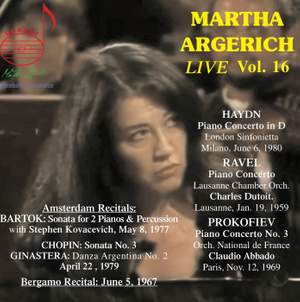
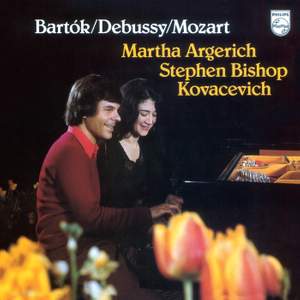
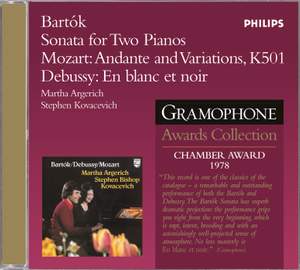
| |  | Argerich & Kovacevich play Bartók, Debussy & Mozart
An addition the DECCA Originals range to mark the 70th birthday of Stephen Kovacevich [17 October]. The original LP release containing Bartók's Sonata for two pianos and percussion with works by Mozart & Debussy won a Gramophone Award in 1978 for Best Chamber Music recording. Stephen Kovacevich's recordings of Bartók have long been regarded as reference recordings, and also included in this reissue are his acclaimed performances of the Sonatina and Out of Doors. Booklet contains an appreciation by David Gutman. “this performance of Bartok's Sonata for Two Pianos and Percussion remains peerless. The couplings are no less compelling.” BBC Music Magazine, April 2011 ***** “Recorded in 1977, this strongly atmospheric and finely characterized performance of the Sonata for Two Pianos and Percussion still remains a top choice. This is most imaginative playing and the recording is exceptionally wide-ranging and truthful. It is difficult to imagine a more eloquent or better-recorded account of this powerful work. The rapport between the artists produces undoubted electricity” Penguin Guide, 2011 edition | | | Usually despatched in 2 - 3 working days. |
|
|
| |  | Edition Géza Anda Vol. 4: Bartok
Bartók: | Piano Concerto No. 1, BB 91, Sz. 83 WDR Sinfonieorchester Köln, Michael Gielen Piano Concerto No. 2, BB 101, Sz. 95 WDR Sinfonieorchester Köln, Ferenc Fricsay Contrasts for violin, clarinet & piano, BB 116, Sz. 111 with Paul Blöcher (clarinet) & Tibor Varga (violin) Piano Suite, BB 70, Sz. 62, Op. 14 Sonata for Two Pianos & Percussion, BB 115, Sz. 110 with Georg Solti (piano), Karl Peinkofer (percussion) & Ludwig Porth (percussion) |
This fourth and final volume of the Géza Anda edition of recordings from the archives of the WDR, issued by Audite, culminates in music by Béla Bartók to which Anda was devoted from the beginning of his career. Bartók’s piano concertos, the first two of which are presented here as impressive live recordings from 1952 and 1957, both with the Cologne Radio Symphony Orchestra, achieved their final public breakthrough thanks to Anda’s efforts. His enthusiasm for chamber music as well as his gift in performing together with world-famous Hungarian colleagues are revealed in two recordings from 1953. To bring this edition to a close, Géza Anda can be heard once more as a soloist in a rousing performance of the Suite for piano Op 14 from 1955. | | | Usually despatched in 3 - 4 working days. |
|
|
| |  |
Ákos Hernádi (Piano); Károly Mocsári (Piano); Franz Lang (Percussion); Jochen Schorer (Percussion) The current program provides a fascinating overview of Bartók's chamber music for multiple pianos. The composer's own arrangement of the searing, expressionist score for his ballet, "The Miraculous Mandarin" reveals the audacity of Bartók's creative vision with a clarity that is often lost in the popular orchestral version. This rare recording of the two piano version will delight Bartók fans everywhere. Next, the Hernádi/Mocsári Duo is joined by a pair of percussionist in a thrilling performance of the Sonata for Two Pianos and Percussion. Arguably, one of the greatest chamber music pieces of the 20th century. | | | (also available to download from $10.50) | Usually despatched in 2 - 3 working days. (Available now to download.) |
|
|
| |  | Bartók plays Bartók
Béla Bartók, Ditta Pasztory (pianos), Harry J Baker, Edward J Rubsan (percussion) Recorded 1940 | | | Usually despatched in 3 - 4 working days. |
|
|
| |  | Goeb: Symphony No. 3 & Bartok: Sonata for 2 Pianos and Percussion
Bartók: | Sonata for Two Pianos & Percussion, BB 115, Sz. 110 Gerson Yessin (piano), Raymond Viola (piano), Elayne Jones (percussion), Alfred Howard (percussion) | Goeb: | Symphony No. 3 |
| |
|
| |  | Works for Two Pianos and Percussion
Mark Clinton and Nicole Narboni (duo-pianists) The Shepherd School Percussion Ensemble | | | This item is currently out of stock at the UK distributor. You may order it now but please be aware that it may be six weeks or more before it can be despatched. |
|
|
| |
|