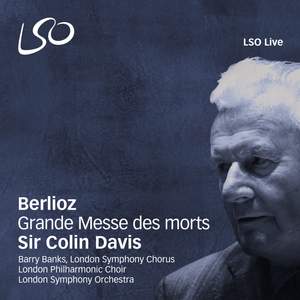
All recordingsPrices shown exclude VAT. (UK tax is not payable for deliveries to United States.) See Terms & Conditions for p&p rates. | |  | Berlioz: Grande Messe des Morts, Op. 5 (Requiem)
Sir Colin Davis is a revered Berlioz expert and his LSO live Berlioz recordings have been one of the most widely acclaimed series’ of classical recordings of recent years and collected numerous awards, including two Grammy Awards for Les Troyens. The release of the monumental Grande Messe des morts marks the completion of this cycle and further confirms Sir Colin’s status as one of the greatest living conductors of Berlioz’s music. Recorded in St Paul’s Cathedral, a fitting acoustic for the work, the London Symphony Orchestra opened the 50th anniversary of the City of London Festival with the requiem, joined by English lyric tenor Barry Banks and two of London’s finest choirs, the London Symphony Chorus and London Philharmonic Choir. Grand Messe des Morts is a popular Berlioz creation, yet remains a rare and special treat. A requiem whose text derives from the traditional Latin Requiem Mass, it was composed, uniquely, by a man with no firm religious belief. Throughout the piece there is an extreme variation of dynamics. Poignant, reflective music is contrasted with four blazing brass ensembles, ensuring a very powerful and grand listening experience. “the enigmatic rising phrases that launch the work continue to reverberate hauntingly in the surrounding silences, and the tone of the combined LSO and LPO choirs — singing beautifully and bringing out the music’s profound sadness — is wonderfully enhanced. Colin Davis fits the work to the conditions with a master hand. Memorable.” Sunday Times, 17th March 2013 “The orchestral playing is superb throughout...Sir Colin Davis, too, is in a class apart as a Berlioz interpreter and this performance simply confirms that. This is, from start to finish, magnificent. It’s astonishing to think that when this recording was made he was a few weeks shy of his eighty-fifth birthday for there is no want of energy here...Berlioz found in Sir Colin Davis a champion beyond compare.” MusicWeb International, 18th April 2013 “The two concerts in Saint Paul’s Cathedral in June 2012 upon which this recording is based were colossal events. I attended the first of them and have rarely been so moved by the magnificence of stately music superbly rendered. LSO Live has captured the moment with remarkable fidelity.” classicalsource.com “Sir Colin Davis’s grip on the score is as sure as it ever was, the massed choral forces coordinated with unerring precision. He’s always had an ear for Berlioz’s quirky sense of orchestral colour...Barry Banks is excellent...This is an essential purchase” The Arts Desk, 20th April 2013 | 
| | | In stock - usually despatched within 1 working day. |
|
|
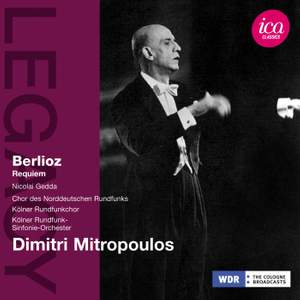
| |  | Berlioz: Grande Messe des Morts, Op. 5 (Requiem)Saal 1, Funkhaus, Cologne, 26 August 1956
The Greek-born Dimitri Mitropoulos (1896–1960) was incredibly gifted – his photographic memory allowed him to conduct without a score in concert and also in rehearsal! After studies in Athens, Brussels and Berlin, he took various posts in Greece. In 1930, Mitropoulos played the solo part in Prokofiev’s Piano Concerto No.3 with the Berlin Philharmonic and conducted the work from the keyboard, becoming the first modern musician to do so. He made his US debut in 1936 and went on to become principal conductor of the Minneapolis Symphony Orchestra (1937–1949) and then music director of the New York Philharmonic (1951–1957), where he was eventually succeeded by Leonard Bernstein. He expanded the repertoire of the NYPO and championed Mahler’s symphonies in particular. Mitropoulos was also a major figure at New York’s Metropolitan Opera House and became its principal conductor in 1954. He died in Milan aged 64 rehearsing Mahler’s Symphony No.3. In the mid-1950s, Mitropoulos frequently visited Cologne to perform with the Kölner Rundfunk-Sinfonie-Orchester, whose broadcasts have been well documented by ICA Classics. Releases include Mitropoulos’s last ever performance: a compelling account of Mahler’s Symphony No.3 (ICAC5021) which was awarded the prestigious Toblacher Komponierhäuschen International Record Prize in 2011. Mitropoulos conducted Berlioz’s massive Requiem with its chorus of over 200 voices and offstage brass at the Salzburg Festival on 15 August 1956. This Cologne performance followed on 26 August 1956. This ICA release is the first official recording using the original WDR master tapes. The sound from the 1956 tapes is incredible by any standards. The tenor soloist in the Sanctus is the young Nicolai Gedda. The performance is contained on one CD running for over 82 minutes. “[a] deeply felt Requiem, still high-voltage despite mono sound.” BBC Music Magazine, September 2012 ***** “There is some slight cause for alarm at the beginning, with a ragged entry from the sopranos. But the choir soon settles down and by the time he reaches the 'Dies irae', Dimitri Mitropoulos has really got into his stride...The hushed ending of the Agnus Dei sets the seal on a remarkable performance.” Gramophone Magazine, November 2012 “our first encounter with the combined Cologne choirs isn’t ideal [but] I must encourage you to persevere because the performance soon settles and the singers make a pretty good job of Berlioz’s demanding writing...Mitropoulos has the measure of this vast score and is able to convey its gaunt majesty, its beauty and its grandeur.” MusicWeb International, January 2013 | | | (also available to download from $10.50) | In stock - usually despatched within 1 working day. |
|
|
| |  | Berlioz: Grande Messe des Morts, Op. 5 (Requiem)
The first in a new series of releases from the world-renowned conductor Paul McCreesh and his Gabrieli Consort. Called Winged Lion (the symbol of Venice and of St Mark, as well as the Gabrieli Consort), the label will release recordings of Renaissance and Baroque repertoire, as well as large-scale 19th-and 20th-century oratorio, including on the near horizon, Howells’ Requiem Recorded in Poland as part of the Wratislava Cantans Festival (of which McCreesh is artistic director) this staggering performance of Berlioz’s ‘Grand Mass for the Dead’ is produced by a force of over 400 performers – drawn from the Gabrieli Consort and Players, the Wroclaw Philharmonic Orchestra and Choir and students from Chetham’s School of Music. Future releases with McCreesh will include Mendelssohn’s Elijah [with Simon Keenlyside] , Haydn’s The Seasons, Britten’s War Requiem and a re-recording of their famed disc ‘A Venetian Coronation’, about which Gramophone had said: “Without doubt, this is one of the finest records of Italian Renaissance polyphony to appear for a long time”. The year also marks the ensemble’s 30th anniversary, and the 400th anniversary of the death of Giovanni Gabrieli whose music, along with that of Andrea Gabrieli, features on the recording. Founded in 1982 by artistic director Paul McCreesh, the Gabrieli Consort & Players are world-renowned interpreters of great choral and instrumental repertoire, spanning from the Renaissance to the present day. Their performances encompass virtuosic a cappella programmes, mould-breaking reconstructions of music for historical events and major works from the oratorio tradition. With Paul McCreesh, the Gabrielis are regular visitors to the world’s most prestigious concert halls and festivals and have built a large and distinguished discography. “as fine an account as I have ever heard...overwhelming in the great apocalyptic tuttis, but at the same time beautifully clear in detail, with a lovely bloom on the individual choral and instrumental lines of this paradoxically intimate work...[McCreesh] has a profound understanding of the score and has inspired his Anglo-Polish forces, above all the superb chorus, to feel it with him and take it to their hearts.” Sunday Times, 2nd October 2011 “McCreesh provides pretty much the enormous forces Berlioz demands...But he recognises that Berlioz sought more than mere noisy grandeur, and the results are fascinating. McCreesh's pace is fairly slow and weighty, but it seldom feels slack. In the reverberant acoustic of Mary Magdalene, Wroclaw, textures remain open....Even those used to the Colin Davis or Charles Munch tradition may find its airy beauties compelling.” BBC Music Magazine, November 2011 ***** “I’d turn to this performance most for its gentler qualities: like the loveliness of the Wroclaw Philharmonic Choir; or the quiet corners of the final sections, when rest eternal beckons and the instruments’ individual colours rise to the fore. Robert Murray, the tenor soloist, wafts down nicely from on high.” The Times, 14th October 2011 *** “an interpretation that is impressive not merely by dint of the music’s more monumental statements or its ample sonorities, but also through the subtlety of expression that Paul McCreesh elicits from the massive forces required to perform it.” The Telegraph, 13th October 2011 ***** “The result is clear-textured and austere, even where the decibel count is extreme in the Dies Irae...McCreesh keeps it all on a tight rein, but the chief glory is the choral singing, superb in its fervour and weight, with the difficult tenor line notably strong and ecstatic.” The Guardian, 13th October 2011 **** “Berlioz's 1837 Grande Messe has rarely sounded so thrilling or transparent...the muted plangency and expressivity of [McCreesh's] female semi-chorus in the "Sanctus" is every bit as impactful as the rolling waves of timpani in the "Tuba Mirum", while the snaking coils of strings have an otherworldly, Gothic flavour.” The Independent on Sunday, 23rd October 2011 “McCreesh has achieved something quite out of the ordinary in this performance...The impact is overwhelming, not merely in the full-throated eruptions...The concept of Berlioz's Requiem Mass may embrace a certain element of grandiosity but, listening to this performance, it is impossible to forget that Berlioz was a supreme orchestrator and a composer with a broad dramatic talent.” Gramophone Magazine, November 2011 “terrific singing and an uncommonly corporate involvement in the ritual of music-making” Classic FM Magazine, December 2011 ***** “well recorded in a suitably reverberant acoustic, it sounds stunning...this is a definitive recording of a staggering piece.” The Arts Desk, 12th November 2011 “A triumph of performance and scholarship” MusicWeb International, May 2012 | | | In stock - usually despatched within 1 working day. |
|
|
| |  | Conductor and Teacher: Marek Janowskia film by Michel Follin
Experience is all, but, Janowski advises Olivier Dejours, firstly be a good musician, be an excellent player, good coach and reach out to others. “Janowski works thoughtfully with Dejours on translating musical ideas into sound through unselfconscious gestures.” BBC Music Magazine, August 2011 **** “Follin's documentary...neither fuels nor fells the famous "maestro mystique" of the conductor's podium. Although much time is devoted to interpretative matters...much of their discussion turns to nuts-and-bolts matter like technique and personnel management” Gramophone Magazine, Awards Issue 2011 | | | In stock - usually despatched within 1 working day. |
|
|
| |  | Berlioz - Grande Messe des morts & Symphonie fantastique
This issue brings together Berlioz’s greatest symphony – the fantastique – and grandest choral work. The former was inspired by his wish to impress the actress, Harriet Smithson, with whom he had become infatuated seeing her as Juliet as well as Hamlet’s Ophelia. He invoked her in all five movements by employing a theme – an “idée fixe” – in this autobiographical work which has become not only well known and extremely popular. The “Grande Messe des Morts” or Requiem requires such enormous forces to make its full effect that performances are necessarily rare events. With the main orchestra and chorus occupying the centre Berlioz employs brass bands to the left, right, behind and even behind the conductor giving the Tuba mirum section in the Dies Irae a spectacular effect on the listener. Parts of the Requiem, however, are handled with extreme delicacy thus when the full forces come together their impact is even more thrilling. André Previn and his London Symphony Orchestra clearly revel in the opportunities offered by both works; the Requiem, with the London Philharmonic Choir, was recorded in the vast space of Walthamstow Town Hall to imitate the vast acoustic space of “Les Invalides” in Paris where it was first performed. | | | In stock - usually despatched within 1 working day. |
|
|
| |  | Berlioz: Grande Messe des Morts, Op. 5 (Requiem)live recording 28th August 1956
| | | In stock - usually despatched within 1 working day. |
|
|
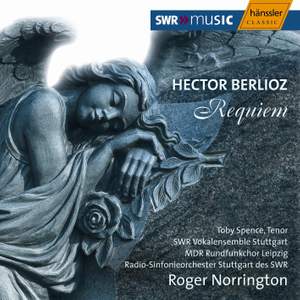
| |  | Berlioz: Grande Messe des Morts, Op. 5 (Requiem)
“Norrington's approach is pensive, sober and funereal-but it's so well paced that the sense of inevitability underlines man's mortality, and the outbursts when they do come are more effective for their comparative restraint...a reminder that the first performance was in church, not on a concert hall stage.” Andrew McGregor, bbc.co.uk, 8th May 2006 “"Truly it was of frightening greatness," wrote Berlioz after the Requiem 's première. The massed timpani of the "Tuba mirum" produced an "indescribable shock". The chief priest wept uncontrollably, while one of the choral singers suffered a nervous breakdown.
Thankfully, there seems to have been no such casualty among the singers in this "live" performance from Stuttgart. The rich, ample acoustics of the Beethovensaal give full value to Berlioz's vast spatial effects, most spectacularly the four brass bands that herald the timpani onslaught in the "Tuba mirum". Yet Norrington's concern for clarity of line and articulation, and the carefully judged balances, mean that we hear far more than usual of Berlioz's brilliant and bizarre orchestral detail.
Norrington's dramatic urgency, allied to choral singing of thrilling body and bite, make the apocalyptic movements duly overwhelming. No less moving is the choir's luminous delicacy in the "Quid sum miser" and "Quaerens me" - music of Cistercian purity and austerity - while Toby Spence brings a calm, rapt beauty to the cruelly high solo in the "Sanctus". A magnificent achievement, to be set alongside Colin Davis's recordings of this awesome work.” The Telegraph | | | (also available to download from $21.00) | In stock - usually despatched within 1 working day. |
|
|
| |  | Berlioz: Grande Messe des Morts, Op. 5 (Requiem)
Paul Groves is the tenor soloist in this performance of this huge choral work. The work was first performed in 1837 with a choir of 210, though Berlioz would have preferred “seven or eight hundred”. “…Berlioz's Requiem… is for the most part a work of almost austere beauty and quiet contemplation, in which (a few truly apocalyptic moments aside) the outsize orchestral forces are deployed more to support sonorous pianissimos than simply to raise the roof. Not that Sylvain Cambreling doesn't relish every uniquely Berliozian effect... Meanwhile, his control of long-term tempo and tension is masterly. But what really makes this version special is the virtuosic contribution of the EuropaChorAkademie, a group of young professional singers drawn from all over Europe... under the inspired direction of Joshard Daus. ...they display a truly breathtaking purity of intonation, rhythmic precision and collective engagement, as resonantly full-toned in the soft a cappella fugato of the 'Quaerens Me' as in the thundering eruptions of the Dies Irae.” BBC Music Magazine, January 2010 ***** | | | (also available to download from $21.00) | Usually despatched in 2 - 3 working days. (Available now to download.) |
|
|
| |  | Berlioz: Grande Messe des Morts, Op. 5 (Requiem)
Digital recording made by Denon. This release is available in Europe only. Booklet essay and sung texts. ‘Haunted by the absence of God’ is how the Berlioz biographer David Cairns described the Grande Messe des morts. Written at a time and in a country where there was no place for God after the Revolution, it is a work of genuine mourning and high drama. In 1837 Berlioz was commissioned by the French Interior Ministry to write something that could be used for major public ceremonies. He had already composed a Messe solenelle in 1824, and he turned to this work for both material and inspiration. The resulting Requiem is one of the largest religious works of all time – and in length compares with Verdi’s Requiem and Britten’s War Requiem. Berlioz, like Bruckner, saw his work scored for massive choral and instrumental forces, as almost architectural in structure. He certainly wanted to fill every possible part of the cathedral or church with sound. This remarkable work looks back as well as forwards – the influence of past masters such as Gossec and Cherubini hovers over the Requiem, but there is also a break with tradition. This is a deeply personal work.It is violent, frightening, and often uncomfortable. Berlioz wrote, ‘The poetry of the Prose des morts so intoxicated and exalted me that nothing presented itself to my mind with any clarity: my head was seething, I felt quite dizzy.’ It is also, for all its grandeur, an austere work. The massive choral and orchestral sections present a forbidding if impressive façade and this is only broken in one section which allows the tenor soloist a brief moment in the spotlight. This austerity no doubt reflects the influence of Cherubini whose C minor Requiem of 1815 has no soloists. | | | Usually despatched in 4 - 5 working days. |
|
|
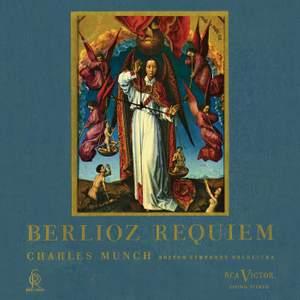
| |  | Berlioz: Grande Messe des Morts, Op. 5 (Requiem)
“Munch's second recording of Berlioz's setting of the Requiem Mass resonates to a vision recognising that the devil is in the quiet detail, and that (paradoxically) intimacy triumphs.” BBC Music Magazine, October 2009 **** | | | Usually despatched in 2 - 3 working days. |
|
|
| |
|