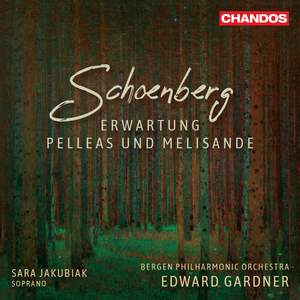
All recordingsPrices shown exclude VAT. (UK tax is not payable for deliveries to United States.) See Terms & Conditions for p&p rates. | |  | Schoenberg: Pelleas und Melisande - Erwartung
“Charbonnet's performance, as recorded here, makes this kaleidoscopic score seem unremittingly hectic...However, if you believe that Erwartung embodies the composer's agonised attempt to exorcise the events of just a year before its composition...the music can never be too raw or shocking in effect.” Gramophone Magazine, October 2012 | | | (also available to download from $10.50) | In stock - usually despatched within 1 working day. |
|
|
| |  | Vladimir Ashkenazy conducts Mahler & Schoenberg
Recording locations: Jesus Christus Kirche, Berlin, Germany, January 1996 (Schoenberg); Konzerthaus Schauspielhaus, Berlin, Germany, June/August 1995 (Mahler) Two gargantuan late-Romantic Austrian works are coupled on this very rare recording by Vladimir Ashkenazy and the Deutsches Sinfonie-Orchester Berlin. The recording had limited release in Germany and this is its first international release. Mahler’s Third Symphony is the longest symphony by any composer to be part of the basic repertoire and, at first, had subtitles attached to each of the movements. But the composer had a distrust for programmatic music and by the time the symphony was published and premiered, these verbal explications had been removed. Mahler and Schoenberg met in 1904 at a rehearsal of Schoenberg’s string sextet Verklärte Nacht. The older composer became a defender of Schoenberg’s work, conducting it when he could. Schoenberg, whose outlook on Mahler’s work was at first unfavourable, was bowled over by the Third Symphony and regarded it as a work of genius. His own Pelleas und Melisande based on Maurice Maeterlinck's play, is a gargantuan symphonic poem and was his first completed orchestral work. The orchestral forces (as with the Mahler Symphony) are huge, and although Schoenberg includes no vocal parts, the orchestra is handled with considerable bravura and includes 64 strings (plus two harps), 17 woodwinds, 18 brass and 8 percussion. | | | In stock - usually despatched within 1 working day. |
|
|
| |  | Schoenberg - Pelleas Und Melisande & Erwartung
Schoenberg’s polyphonic tone poem Pelleas und Melisande is often compared to Debussy’s opera based on the same text by Maurice Maeterlinck. According to the composer, “The first performance, 1905, in Vienna, under my own direction, provoked riots among the audience and even the critics. Reviews were unusually violent and one of the critics suggested putting me in an asylum and keeping music paper out of my reach. Only six years later, under Oscar Fried’s direction, it became a great success, and since that time has not caused the anger of the audience”. The most innovative features of Erwartung, a “monodrama for soprano and large orchestra”, are the continual variation of orchestral textures, and the constantly changing tempi. Not only are the instrumental combinations new, but the instruments themselves are required to produce new sounds. “Anja Silja could hardly be more persuasive in Erwartung, Schoenberg's 1909 monodrama for soprano and large orchestra. Silja is magnificent at conveying the tortured intensity of Schoenberg's writing, and Craft accentuates those obsessive figurations that give the score its claustrophobic intensity.” Gramophone Magazine, November 2008 “The two pieces couldn’t be more stylistically different. The luxuriant Pelleas is a whirlpool of emotions built tightly by Craft and the Philharmonia, balancing the robust core and lightness of this multilayered score with an emphasis on sinister undertow. It’s a similar story with Erwartung, as Craft’s orchestra mimic the emotions of the nervy soprano Anja Silja.” The Times, 23rd August 2008 **** | | | (also available to download from $6.00) | In stock - usually despatched within 1 working day. |
|
|
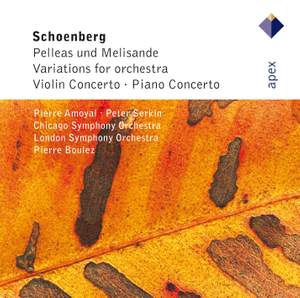
| |  |
“Boulez keeps the music moving, and brings welcome clarity to Pelleas's potentially murky orchestration. The more angular Variations and concertos aren't as comfortable, though both soloists are persuasive.” BBC Music Magazine, July 2007 **** | | | In stock - usually despatched within 1 working day. |
|
|
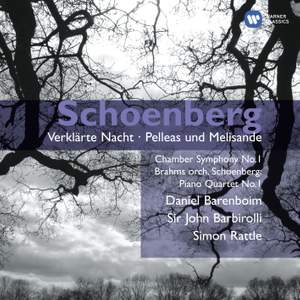
| |  | Schoenberg - Orchestral Works
“Barenboim's youthful passion in Verklärte Nacht is trumped by Barbirolli's ripe reading of Pelleas. Rattle is more clear-eyed, especially in the Brahms orchestration. Collectible non-scary Schoenberg.” BBC Music Magazine, March 2007 **** | | | In stock - usually despatched within 1 working day. |
|
|
| |  | Schoenberg: Verklärte Nacht & Pelleas und Melisande
“This is a very distinguished coupling, superbly played by the BPO – a truly 'legendary' reissue, quite unsurpassed on record. Karajan never approached contemporary music with the innate radicalism and inside knowledge of a composer-conductor like Boulez; yet he can't be accused of distorting reality by casting a pall of late-Romantic opulence and languor over these works. He's understandably most at home in the expansive and often openly tragic atmosphere of Schoenberg's early tone-poems Verklärte Nacht and Pelleas und Melisande. The richly blended playing of the BPO provides the ideal medium for Karajan's seamless projection of structure and expression. He remains especially sensitive to the music's lyricism, to the connections that to his ears override the contrasts. Although Verklärte Nacht has certainly been heard in performances less redolent of 19th-century tradition, as well as less calculated in its recorded acoustic, this remains a powerfully dramatic reading. One man's view, then: but, given the man, a notably fascinating one.” Gramophone Classical Music Guide, 2010 “They have never been presented as ravishingly as by Karajan and the Berlin Philharmonic on this splendidly recorded disc.” Penguin Guide, 2011 edition | | | In stock - usually despatched within 1 working day. |
|
|
| |  | Claudio Abbado conducts Mahler and Schoenberg
Release of the successful DVD on Blu-ray Disc. What makes Abbado’s Mahler performance so remarkable is that their impact is never achieved at the expense of the multiple sensitivities, subtleties and extreme sophistication. Mahler’s Fourth Symphony and Schoenberg’s Pelleas and Melisande are performed by one of the world’s leading youth orchestras: The Gustav Mahler Youth Orchestra. Includes an introduction to Schoenberg’s Pelleas and Melisande by Alberica Archinto and Elli Stern, offering fascinating insights into this unparalleled composition. DVD release comes right in time for the 80th Anniversary Celebrations of Claudio Abbado and will be accompanied by the other EuroArts June releases: Claudio Abbado Special Anniversary Box and the Abbado Beethoven Box. Picture format Blu-ray Disc: 1080i Full HD Sound formats Blu-Ray Disc: PCM Stereo, DTS-HD Master Audio Region code: All (worldwide) Subtitles: English, French, German Booklet notes: English, French, German Runnning time: 113 mins | 
| | | Scheduled for release on 3 June 2013. Order it now and we will deliver it as soon as it is available. |
|
|
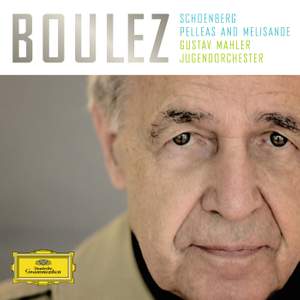
| |  | Schoenberg: Pelleas und Melisande
Pierre Boulez, renowned for championing the most daring music of the 20th century, leads this 2003 Tokyo concert, played in the presence of Japan’s Emperor and Empress. Schoenberg’s Pelleas and Melisande could have received no treatment more royal than Boulez gives it at Suntory Hall with the Gustav Mahler Youth Orchestra The Guardian observed, “For a quarter of a century now Boulez’s performances of all the modernists have set benchmarks . . . he remains unrivalled in the works of the Second Viennese School, and in Schoenberg in particular” “Boulez wonderfully captures the sense of the young Schoenberg's overflowing creativity and the way in which the wealth of his musical ideas can hardly be contained within the orchestral frame, and the playing of the GMJO is suitably exuberant. It makes for a thrilling experience” The Guardian, 22nd March 2012 **** “No composer-conductor is more sensitive than Pierre Boulez to the divergent responses to Wagner's Tristan that can be traced in Debussy's opera and Schoenberg's symphonic poem...Boulez brings out the best aspects of its formal flexibility and textural richness...The rapport between seasoned maestro and youthful players has never been more satisfying.” Gramophone Magazine, May 2012 | | | Usually despatched in 2 - 3 working days. |
|
|
| |  | Schoenberg & Faure: Pelleas & Melisande
Duisburg Philharmonic Orchestra, Jonathan Darlington | | | Usually despatched in 2 - 3 working days. |
|
|
| |  | Christian Thielemann conducts Schoenberg & Wagner
The catalyst for Schoenberg’s early symphonic poem based on Maurice Maeterlinck’s play ‘Pelleas et Melisande’ was provided by Richard Strauss. Strauss had provided encouragement and support for the young composer during his time in Berlin from 1901–3. Schoenberg was unaware that Debussy had recently completed his operatic masterpiece based on the same subject, and was certainly oblivious to the incidental music by Sibelius to the play written at the same time. Indebted to Wagner and indeed Strauss, the composer commented ‘apart from a mere handful of omissions and minor changes to the order of the scenes, I attempted to reproduce every detail in music. The three main characters are reflected by three themes in the manner of Wagnerian leitmotifs’ Completed in 1903, ‘Pelleas und Melisande’ represents the crowning glory of Schoenberg’s early period, and a turning point in his creative life. ‘When I woke up I heard a sound, it grew louder, I could no longer imagine myself in a dream, music was sounding, and what music! After it died away, R came in with the five children and put in to my hands the score of his ‘Symphonic Birthday Greeting’. Cosima Wagner writing in her diary on Christmas day 1870. Although it is a wonderful small scale chamber work, based on themes from the opera Siegfried, it is also a very cleverly construct piece, with effective motivic links which are developed, transformed and dissolved. After he had completed Parsifal, the composer intended to complete a series of one-movement symphonies (he started one of these in 1882) and it may be that the ‘Siegfried Idyll’ was a prototype for these projected works. | | | Usually despatched in 4 - 5 working days. |
|
|
| |
|