All recordingsPrices shown exclude VAT. (UK tax is not payable for deliveries to United States.) See Terms & Conditions for p&p rates. | |  | Mozart - Violin Sonatas Volume 3
Sitkovetsky was born in Azerbaijan, grew up in Moscow where he studied at the Moscow Conservatoire and then emigrated to the US where he studied at the Julliard School. He has performed throughout the world as a soloist and also conducts. He is increasingly involved with contemporary composers and has premiered concerti written for him by Caskin and Meyer. | | | In stock - usually despatched within 1 working day. |
|
|
| |  | Mozart: Violin Sonatas Nos. 17, 18, 20 & 23
This CD marks the beginning of a new small side-line for CAvi of performances on period instruments. There will just be two or three titles per year. Giorgio Tabacco is harpsichord professor at Turin’s Giusseppe Verdi Conservatory. Francesco d’Orazio is a brilliant and versatile violinist who was awarded the Abbiati Prize XXIX of the Italian Music Critics in 2009. | | | Usually despatched in 2 - 3 working days. |
|
|
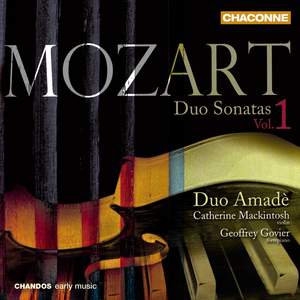
| |  | Mozart: Duo Sonatas Volume 1
Catherine Mackintosh and Geoffrey Govier (Duo Amadè) Mozart’s charming and intimate late violin sonatas KV 301, 302 and 303, composed in Mannheim in 1778 are performed here on period instruments by Duo Amadè (Catherine Mackintosh and Geoffrey Govier) and coupled with two sets of variations based on French popular tunes. Mackintosh and Govier have a love for this repertoire which stretches back to the late 1980s when they first met at the Royal College of Music, London. They formed Duo Amadè in order to perform the charming and intimate works of Mozart for this combination in concert often carried out with readings from his family letters. In 2006 Duo Amadè performed the whole cycle at the Royal College of Music. Violinist Catherine Mackintosh is best known as the former leader of Orchestra of Age of Enlightenment and part of the Purcell Quartet. She is joined by fortepianist Geoffrey Govier. Geoffrey plays a fortepiano after Anton Walter made by Christopher Clare in Cluny while Catherine plays a violin dating from 1703 by Giovanni Grancino. These instruments bring a lightness and freshness of articulation to these delightful works, entirely in keeping with the spirit of enlightenment in which the sonatas were written. It is their aim is to record the complete cycle of mature sonatas. “For Catherine Mackintosh and Geoffrey Govier the "rules" of historically informed performance have become second nature; we get the impression they're playing for sheer enjoyment of the music.” Gramophone Magazine, January 2009 “For Catherine Mackintosh and Geoffrey Govier the 'rules' of historically informed performance have become second nature; we get the impression they're playing for sheer enjoyment of the music. All the distinctive moments are appreciated and given due emphasis but in a spontaneous way, the interpretative points never going beyond what musicians with good rapport might do on the spur of the moment. Yet it's obvious that Govier and Mackintosh are careful, as well as spirited, interpreters. The recorded sound and balance are excellent, and they artfully control their dynamics so that principal and subsidiary lines are clearly distinguished. The concluding Rondo of K302 contains many octave passages shared by piano and violin; here, with precise matching of tone colour, articulation and volume, Govier and Mackintosh turn what might seem like a rare lapse of Mozartian imagination into a delightful colouristic device. In the first movement of this sonata they make the most of the quasi-orchestral writing, with its pulsating crescendi, horn imitations and tremolando effects. Colourful in a different way is the minor section in K301's finale, where the con sordino piano's soft quality perfectly supports the poised violin melody. You may wonder whether to favour Duo Amadève; or the impressive Podger/Cooper team (see aobe). The latter mix into their programmes the juvenile works from the 1760s, but if you are most interested in the great series of works starting with K301, Duo Amadève; may suit you better.” Gramophone Classical Music Guide, 2010 | | | (also available to download from $10.50) | Usually despatched in 2 - 3 working days. (Available now to download.) |
|
|
| |  | Mozart - Violin Sonatas
Annette Unger (violin), Brunhild Webersinke (piano) & Michael Pfaender (cello) | |
|
| |  | Mozart - The Palatine Sonatas
Tobias Koch (harpsichord) & Lisa Marie Landgraf (violin) A wonderful collection of the earliest of Mozart’s sonatas, written and dedicated to the Princess Elector of
Mannheim over 250 years ago. | |
|
| |  | Mozart in Paris
Booklet texts in English & French “Gil and Orli Shaham give warm and ardent performances of these pieces, bringing the music vividly to life.” BBC Music Magazine, August 2007 **** | | | (also available to download from $10.50) | This item is currently out of stock at the UK distributor. You may order it now but please be aware that it may be six weeks or more before it can be despatched. (Available now to download.) |
|
|
| |  | Mozart - Violin SonatasRecorded at the Palais Daun-Kinsky, Vienna, 17-19 December 2005
“The venue, the early 18th-century Palais Daun-Kinsky in Vienna, is opulent in appearance, and opulent in sound as well… the Shahams… have clearly worked out exactly what they want to do with phrasing, rubato and dynamics, and play with complete unanimity. No extras, commentary, or documentary - just Mozart.” BBC Music Magazine, August 2006 **** | | | Usually despatched in 2 - 3 working days. |
|
|
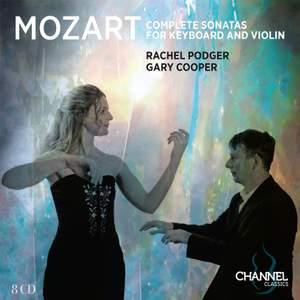
| |  | Mozart - Complete Sonatas for Keyboard & Violin, Volume 2
"The interaction between Rachel Podger and the gifted fortepianist Gary Cooper is no less than
extraordinary. They succeed in cracking a formidable code that leads the listener to understand the
musical connection between single phrases and larger sections within the sonata form Mozart perfected.
(…) (…) Podger and Cooper’s masterly first endeavour captures the heart and the mind of the master."
The Strad “The outstanding work on this second instalment is the big E flat Sonata K481. Cooper and Podger provide a broad performance of its wonderful slow movement that really plumbs its depths, applying ornamentation in a way that Mozart might well have done himself. Cooper and Podger are superb in the G major K301, with an account of the minor-mode siciliano-like episode in its finale that's both expressive and irresistibly lilting.” BBC Music Magazine, November 2005 **** “Gary Cooper and Rachel Podger's projected set of the Mozart duo sonatas (of which this is the second volume) will be more complete than most, including the works he wrote for keyboard with accompanying violin between the ages of seven and 10. Of course these can't be compared to the later sonatas but they're certainly not without interest; and on the present disc the progress between No 2 and No 15 is striking – the latter's Adagio shows an enormous increase in expressive range (further extended by Gary Cooper's extravagant decoration of the repeats) with the violin complementing the melody most effectively. The decision to use the same fortepiano for all the sonatas may not be the most accurate historical way of presenting them but, as Cooper points out, it does help the listener to hear them as belonging to a single line of development. Both artists show an impressive command of the rhetorical 18th-century approach to phrasing and expression, giving a very lively air to the music-making – there are no flat, routine moments. The theatrical manner of No 18's first movement inspires a wonderfully bright, colourful performance, and the contrasts inherent in the two-speed opening movement of No 20 are brilliantly realised. Some may find the continually active style of playing a step too far, and there were places, in the first movement of No 33, for example, where a calmer, less eventful approach might have been welcome. But the great Adagio of this sonata has a beautiful sense of line and, throughout, the marriage of expertise and stylistic awareness results in truly treasurable performances.” Gramophone Classical Music Guide, 2010 “Both artists show an impressive command of the rhetorical 18th-century approach to phrasing and expression, giving a very likely air to the music-making - there are no flat, routine moments.” Gramophone Magazine, February 2006 | | | Usually despatched in 4 - 5 working days. |
|
|
| |  | Mozart - Sonatas for Piano & Violin Volume 1
Mozart: | Violin Sonata No. 18 in G major, K301 Violin Sonata No. 19 in E flat major, K302 Violin Sonata No. 20 in C major, K303 Violin Sonata No. 21 in E minor, K304 Violin Sonata No. 22 in A major, K305 Violin Sonata No. 17 in C major, K296 Violin Sonata No. 23 in D major, K306 Violin Sonata No. 24 in F major, K376 Violin Sonata No. 25 in F major, K377 Violin Sonata No. 26 in B flat major, K378 |
David Breitman (piano), Jean-François Rivest (violin) | | | Usually despatched in 2 - 3 working days. |
|
|
| |  | Mozart - The Great Violin Sonatas, Vol.1
Mozart: | Violin Sonata No. 17 in C major, K296 Violin Sonata No. 18 in G major, K301 Violin Sonata No. 19 in E flat major, K302 Violin Sonata No. 20 in C major, K303 Violin Sonata No. 21 in E minor, K304 Violin Sonata No. 22 in A major, K305 Violin Sonata No. 23 in D major, K306 Violin Sonata No. 24 in F major, K376 Violin Sonata No. 25 in F major, K377 Variations (12) in G major on 'La Bergère Célimène, K374a (K359) |
| | | (Sorry, download not available in your country) | Usually despatched in 8 - 10 working days. |
|
|
| |
|