Prices shown exclude VAT. (UK tax is not payable for deliveries to United States.) See Terms & Conditions for p&p rates. | |  | Beethoven: Piano Sonatas Nos. 1-32 (Complete)
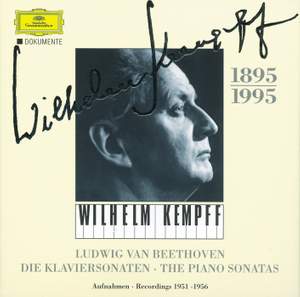
Regis presents classic recordings of the complete Beethoven sonatas at an exceptional price. Wilhelm Kempff’s mono set is often regarded as superior to his later stereo set and appears here, newly transferred and organised sequentially, in a beautifully packaged 9-CD wallet box. | | | This item is currently out of stock at the UK distributor. You may order it now but please be aware that it may be six weeks or more before it can be despatched. |
|
|
| |  | Beethoven: Piano Sonatas Nos. 1-32 (Complete)
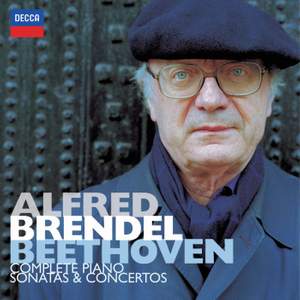
For many collectors in the 1960s, the budget priced Vox Turnabout LPs of the Beethoven Sonatas and Concertos were a revelation, and introduced an amazing young talent to the public. Alfred Brendel was born in 1931 in Wiesenberg, and won the Concorso Busoni in 1949. He studied with Edwin Fischer, Paul Baumgartner and Edward Steuermann. The Vox Beethoven recordings won the Grand Prix du Disque in 1965, and were praised by critics world-wide. These early recordings illustrate clearly all the characteristics that would become a hallmark of Brendel’s playing. A refusal to fall back on ‘flashy’ bravura, and the intellectual rigour he brings to the Beethoven sonatas marked him out even in these early recordings as one of the very great pianists of the 20th century. Brendel retired from the musical scene in 2009 at the height of his powers, leaving a recorded legacy without parallel in the music of Beethoven, Mozart and Schubert. ‘They are lively, direct, forceful and stylish; and nowhere do they find Brendel wanting in brilliance or facility. He certainly sounds as if he enjoys playing the piano.’ Gramophone June 1964 ‘This is a strikingly polished performance of the “Hammerklavier” Sonata’ Gramophone April 1962 ‘Principally it is the earlier sonatas which are included here, and these benefit very much from Brendel's strong attack. But the slow movements, too, seem more fully satisfying now than they did in the last box: those of the C major and E flat Sonatas, particularly, take their rightful place as forerunners of Beethoven's adagio style to come. Again Brendel is generous with repeats’ Gramophone March 1965 ‘The sonatas in this present box are most beautifully played. Particularly, perhaps, the quicker and more forthright movements; here there is a splendid rhythmic firmness, helped along by strong accents and by an effective habit of spreading an occasional chord for extra stress (this must have been clone in Beethoven's time, you would think, with harpsichord techniques still in the air). The rhythmic control is especially rewarding in contrapuntal sections of the music, where Brendel's left hand projects the whole music firmly forward’ Gramophone February 1965 | | | Usually despatched in 4 - 5 working days. |
|
|
| | .jpg) | Beethoven: Piano Sonatas Nos. 1-32 (Complete)
Beethoven has always been a part of the concert repertoire of exclusive Chandos artist Louis Lortie, and it rose again to the top of his agenda as he prepared to complete his recorded cycle of the composer’s sonatas earlier this year. Sonatas Nos 22, 23, 24, 25, 27, 30, 31 and 32, newly recorded, will be released for the first time as part of a box set of the entire canon, which will be available at the bargain price of 9 CDs for the price of 3. This box set of the complete piano sonatas is a must for all lovers of Beethoven and great piano playing. The compositions are bold and beautiful, challenging, witty and fresh. They seem to encompass all aspects of human sensibility and aspiration, and the superb playing of Louis Lortie takes the music to another level. His recording of the composer’s ‘Eroica’ Variations, which won an Edison Award, was described by Gramophone in glowing terms: ‘His account… is spacious and magisterial, virile yet sensitive, and the wide range of dynamic nuance and keyboard colour is there to illumine Beethoven’s textures and not highlight the artist’s pianism. He succeeds in communicating the power of Beethoven’s imagination: the part-writing in the fugue emerges with a masterly clarity, and is beautifully weighted and balanced.’ Highlights among the new recordings are that of the sublime Sonata No. 30, composed in 1820 – 22, which displays all the characteristics of Beethoven’s last creative phase: rich harmonic structures, a fascination with intricate counterpoint, and a strict adherence to classical and baroque forms. Also worthy of a separate mention is Sonata No. 22, a veritable study in contrasts. Its two complementary themes – a gracious, dignified ‘feminine’ theme resembling a minuet, and a stamping, assertive, ‘masculine’ theme – gradually influence one another in the course of the movement until they become thoroughly integrated and combined in the final passages. “Lortie seems less interested in metaphysical profundity than in textural stylishness; spending enough time with this set to grasp Lortie's aims and insights is nevertheless genuinely rewarding” BBC Music Magazine, Christmas 2010 **** “Time and again a faultless pianistic sheen and mastery are allied to the finest musical perception. Here, surely, is vital and living proof that you can maintain an individual and distinctive voice while remaining scrupulously true to the composer...Nothing is forced or rushed, everything is subtly nuanced and phrased beneath an outwardly urbane surface...These are performances to treasure and revisit.” Gramophone Magazine, January 2011 | | | (also available to download from $38.50) | Usually despatched in 2 - 3 working days. (Available now to download.) |
|
|
| |  | Friedrich Gulda plays Beethoven (1953-7)
The appearance of a new, complete recording by Friedrich Gulda of the Beethoven sonatas, made before his two previously known cycles, can be regarded as a sensation. If a pianist makes three recordings within 20 years of the most important cycle for his instrument then it would be regarded, even by today’s standards, as extraordinary. But to have done it in the 1950s and ’60s was a unique achievement - the business of capturing it as a sound recording in the early 1950s was still something brave and new in every way. Schnabel’s recording from the 1930s had the ill luck of being made at the ‘wrong’ time, when the world was busy with greater problems; the same was more or less true of the first recording that Wilhelm Kempff began, but did not complete, during the War. To be sure, the history of sound recording has meant that constant technical advancements (LP, stereo and digital techniques) have been the prime reason for artists to make lavish, new complete recordings of the same works. All the same, Gulda’s second complete recording, for Decca in London, hitherto believed to be his first, still counts among the most audacious early recording projects of the sonatas in the post-war years. The recording that preceded it, which Orfeo have been authorised to publish here, was made for Austrian Radio. Gulda went to the Viennese studios to make it at the turn of 1953/4, at a time when the city was still under the control of the Russian occupying power. This young pianist, born in Vienna on 16 May 1930, had begun his international career in spectacular fashion by winning the Geneva Competition in 1946. He performed Beethoven’s sonatas in the autumn of 1953 in several Austrian cities. He was so ‘played in’ that it seems to have been a mere matter of routine for him to record up to six big sonatas in the space of just two days in the studio. This was an incredible achievement that is in no way diminished by the minimal glitches to be found here. If anything, these inaccuracies enhance the spontaneity and vibrancy of Gulda’s performance, which even at this early stage of his career was distinguished by a headstrong personality and exceptional abilities. His choice of tempi is fearless and stringent, while his high degree of precision is fostered by an economical use of the pedal and a rejection of any arbitrary accelerandi or ritardandi (as for example in the Hammerklavier Sonata). It is such aspects of his playing in particular that reveal a de-Romanticisation of Beethoven. This was a process to which Gulda’s interpretations contributed, yet which detracted not a whit from the master’s greatness. On the contrary: it is precisely the simplicity and the clarity of Gulda’s Beethoven interpretations – despite their occasional stylised moments – that make evident the humility and modesty of the pianist in the face of the supreme genius of the composer. The Sonatas are here complemented by the Six Bagatelles Op. 126, the Diabelli Variations Op. 120 and the Eroica Variations Op. 35. | | | Usually despatched in 3 - 4 working days. |
|
|
| |  | Beethoven: Piano Sonatas Nos. 1-32 (Complete)
The critically acclaimed recording by Gerhard Oppitz of the 32 Beethoven Piano Sonatas (previously only available separately) is now available as a boxed set. Piano News wrote: "Oppitz approaches the opening of the ”Waldstein” Sonata at exactly the correct speed and with the correct colouring: precise but not detached, passionate but always transparent……” | | | (also available to download from $79.25) | Usually despatched in 2 - 3 working days. (Available now to download.) |
|
|
| |  | Beethoven - Complete Piano Sonatas
| | | Usually despatched in 8 - 10 working days. |
|
|
| |  | Beethoven: Piano Sonatas Nos. 1-32 (Complete)
3600 hours of rehearsal and 3 years in the making. The complete piano sonatas of Beethoven, performed on the highly acclaimed and revolutionary Australian Stuart Piano by Gerard Willems, winner of the recently-awarded inaugural Queen Elizabeth II Australian Musical Scholarship. “I have no hesitation in recommending this box of discs as an important event in the process by which our musical life and enterprises grow and diversifies.” Sydney Morning Herald | | | Usually despatched in 2 - 3 working days. |
|
|
| |  | Beethoven: Piano Sonatas Nos. 1-32 (Complete)
On the wake of the box-set featuring some live and studio recordings of Dino Ciani (CDS 413/1-6), which has met with great success, Dynamic releases another publication dedicated to the artistry of this fine pianist, who died tragically and prematurely almost thirty years ago. This new set of nine CDs holds the entire cycle of Beethoven’s thirty-two piano sonatas which Ciani performed at the Unione Musicale in Turin in eight concerts, from 4th October to 29th November 1970, which were recorded but never published before. Listening to these recordings from over thirty years ago we clearly perceive the wealth, complexity and, in many ways, the novelty of Dino Ciani’s approach as a performer. With impressively profound introspection, Dino Ciani follows the extraordinary journey that leads him from opus 2 on to opus 111. It is perhaps in the last Sonatas that Ciani gives of his best. In a sort of ecstasy of sound, he exalts and savours the cantabile element in these compositions. Then he abandons himself unguardedly as he unleashes a musical force that seems to create itself out of nothing and to find its rules and justification in itself alone. Extraordinary are also Ciani’s encores: the Finale of the Hammerklavier Sonata, with dizzying counterpoint passages, and the entire Moonlight Sonata, opus 27 n. 2. The enclosed booklet contains unpublished photos. | | | (also available to download from $38.50) | Usually despatched in 2 - 3 working days. (Available now to download.) |
|
|
| |  | Beethoven: Piano Sonatas Nos. 1-32 (Complete)
| | | This item is currently out of stock at the UK distributor. You may order it now but please be aware that it may be six weeks or more before it can be despatched. |
|
|
| |  | Beethoven: Piano Sonatas Nos. 1-32 (Complete)
| | | In stock - usually despatched within 1 working day. |
|
|
| |
|