All recordingsPrices shown exclude VAT. (UK tax is not payable for deliveries to United States.) See Terms & Conditions for p&p rates. | |  | Debussy - Complete Piano Works Volume 4
Debussy: | Études pour piano (12) (complete) |
Pascal Rogé has established a reputation as the world’s foremost interpreter of the French piano repertoire. His recordings of the music of Erik Satie are unsurpassed after years in the catalogue, and his series for ONYX continues with a 4th volume featuring the 12 Études, among the composer’s masterpieces. Gramophone said of Rogé’s recording of the Preludes: ‘this disc of the complete Debussy Preludes has all his improvisatory warmth and charm, qualities that can take you to the very heart of the composer’s evanescent world’. “Rogé has little time for the common perception of Debussy as an "impressionist" composer, all pastel shades and dewy outlines. His playing is bold, muscular when it needs to be, and above all concerned at all times with formal and textural clarity...he is a sure guide to the musical worlds the Études inhabit, and to the moments when they transcend their technical function” The Guardian, 30th September 2010 *** “As with the other discs in this complete Debussy survey, Rogé draws some lovely sounds from the piano” BBC Music Magazine, December 2010 ** “Rogé brings to every piece a refined sensibility, his pacing, colouring and voicing beautifully judged.” Sunday Times, 31st October 2010 **** “this release is packed with remarkable insights that will entrance connoisseurs of the Études and win them many new admirers.” Graham Rogers, bbc.co.uk, 2nd November 2010 | | | In stock - usually despatched within 1 working day. |
|
|
| |  | Debussy - Complete Works for Solo Piano Volume 4
“Bavouzet commands all the shading, nuance and timbral sensitivity one expects in Debussy, together with virtuoso flair and characterful spontaneity.’ (Gramophone), “…there is a balance of clarity and lyricism that immediately distinguish the pianist’s work.” (International Piano) are just a couple of reviews from the previous three volumes of this highly praised recording project. This appraisal of Jean-Efflam Bavouzet, an exclusive Chandos artist, affirms his position as one of the greatest Debussy interpreters. ‘We have a lot to learn from Debussy,’ writes Bavouzet. ‘Through the sophisticated sounds he seeks to create and the simplicity of his textures by which he builds, in just a few phrases and harmonies, a whole world of poetry, but also through writing which always reveals a highly contrapuntal way of thinking, Debussy compels us to listen to his music in a very private, intense and nearly religious manner.’ Here Bavouzet completes his cycles with works at the extreme of his pianistic style; Études Books 1 & 2 and Images Books 1 & 2. Étude retrouvée completes the recording. The Images were the product of Debussy the art-lover and derive from his early reading Baudelaire. The Études, on the other hand, look inwards at the properties and possibilities of the musical substance itself. They contain some of Debussy’s most demanding piano writing – five of the twelve were never recorded commercially until after 1950. But, despite their difficulty a playful spirit is very much in evidence. This series is a deeply personal project for Bavouzet who has been involved in all aspects of the recording process. “Jean-Efflam Bavouzet's flexible virtuosity and innate grasp of Debussy's style and sound world yields ravishing, freshly minted interpretations of the Images and Etudes that proudly rank with (and sometimes surpass) the catalogue's reference versions.” Gramophone Magazine, December 2008 “Anyone who doubts Bavouzet's abilities should sample the playful romp through the third of the Images, the quasi-Etude 'Mouvement', or his beautifully atmospheric 'Et la lune descend sur le temple qui fut'.” BBC Music Magazine, November 2008 **** “Jean-Efflam Bavouzet's flexible virtuosity and innate grasp of Debussy's style and sound world yields ravishing, freshly minted interpretations of the Images and Etudes that proudly rank with (and sometimes surpass) the catalogue's reference versions. The Images gain welcome nourishment from Bavouzet's portfolio of ravishing colour shadings and articulations, while easily absorbing such pianistic liberties as playing one hand before the other, à la Michelangeli. His headlong, impulsive 'Hommage à Rameau' contrasts with similarly nuanced yet more austere readings. In 'Poissons d'or', he sneaks a few piranhas into the fishbowl as he modifies Debussy's aussi léger que possible directive with volatile dynamic hairpins and witty accents. 'Et la lune descend sur le temple qui fût' also rivets your attention via his seductive legato and three-dimensional textures. Bavouzet's Chandos Etudes remake may well be the best yet. As you follow the intelligently contoured left-hand counterlines of 'Pour les tierces' you almost don't notice the fluency and easy evenness of Bavouzet's right-hand double notes. On the other hand, in 'Pour les huit doigts' and 'Pour les degrés chromatiques' he favours melodic inflection and linear motion over Aimard's and Uchida's smoother, scintillating surfaces. The difficult leaps of 'Pour les accords' have rarely sounded less like technical feats and more like music, and 'Pour les arpèges composés' rivals Horowitz's 1965 reading for harmonic pointing and sexiness. Bavouzet precedes this étude with a full-bodied, emotionally generous performance of its recently rediscovered earlier version, Etuderetrouvée. This attractively engineered release will reveal more and more details to savour with each rehearing – guaranteed! If you haven't yet ordered it, what are you waiting for?” Gramophone Classical Music Guide, 2010 “Debussy playing does not come any better than this” Penguin Guide, 2011 edition | | | (also available to download from $10.50) | In stock - usually despatched within 1 working day. |
|
|
| |  | Debussy: Piano Music Volume 4
This well-filled disc also includes a rarely heard 13th étude, the Étude retrouvée discovered only in 1977. Another late work is Six Épigraphes antiques. These short pieces originated as musical renderings of six poems from Pierre Louÿ’s collection Chansons de Bilitis, purportedly translations of ancient Greek texts by a Greek courtesan. Originally written for two pianos, the Épigraphes were later arranged for a single player by the composer himself. The remaining pieces on the disc come from opposite ends of Debussy’s career. Intermède is the piano version of a movement from his Piano Trio No. 1 from 1880, while Les Soirs illumines from 1917 is Debussy’s last completed work, written as a token of gratitude to his coal merchant, a Monsieur Tronquin, for having provided the household with precious fuel during the wartime winters. “All Ogawa's performances are scrupulously worked, considered and clarified.” Gramophone Magazine, September 2008 | | | (also available to download from $10.50) | In stock - usually despatched within 1 working day. |
|
|
| |  | Debussy: Études pour piano (12) (complete)
“Her playing carries blazing conviction at every turn, and its sheer virtuosity is breathtaking ... Vivid communication is helped by a fairly forward, resonant recording, which captures every nuance without detriment to overall perspective ... supreme in every instance, and in pretty well every department, be it refinement of sonority, accent, timing, characterization or sheer dexterity.” Gramophone Magazine | | | In stock - usually despatched within 1 working day. |
|
|
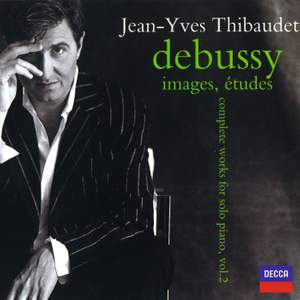
| |  | Complete Solo Piano Music, Vol.2
“Jean-Yves Thibaudet's Debussy cycle is a cornucopia of delights. The 12 Etudes could hardly be presented more personally or vivaciously. Nos 6 and 7 are marvels of bright-eyed irony and humour, while Nos 8 and 9 contrast a haunting alternation of lassitude and hyperactivity with razor-sharp cascades of repeated notes. His timing in the central lento, molto rubato of No 12 is memorably acute; throughout, you're aware of a pianist with a penchant for spare pedalling and a refined brilliance, far remote from, say, Gieseking's celebrated, opalescent magic. He takes a brisk hand to the Children's Corner suite (allegro rather than allegretto in 'Serenade for the Doll', hardly modérément animé in 'The Snow is Dancing') but even here his spruce technique and vitality are never less than enlivening. In the Suitebergamasque he dances the 'Menuet' with an unusual sense of its underlying grace and gravity, and his 'Clair de lune' is exceptionally silvery and transparent. Both books of Images are given with a rare sense of epiphany or illumination, of flashing fins and sunlight in 'Poissons d'or' and of a timeless sense of archaism in 'Hommage à Rameau'. Decca's presentation and sound are, respectively, lavish and natural. If you want to hear Debussy new-minted, with air-spun and scintillating textures, Thibaudet is your man.” Gramophone Classical Music Guide, 2010 | | | In stock - usually despatched within 1 working day. |
|
|
| |  |
Also available as part of the Debussy - The Piano Works box set, ALC4002. | | | In stock - usually despatched within 1 working day. |
|
|
| |  | Debussy: Complete Piano Works, Vol. 5
| 
| |
|
| |  | Debussy: 12 Études
Mariangela Vacatello (piano) The Debussy-year 2012 brought a wealth of reissues on the market, but surprisingly few new recordings. Reason the more to welcome this new recording of a generous selection of Debussy piano works, centred around the substantial “12 Etudes”.These works, written in the later stage of Debussy’s creative life, form the apotheosis of his style. Far from any evocative “impressionistic” Tonmalerei or picturesque atmosphere painting they are Debussy’s answer to the Etudes of Chopin, purely abstract creations of melody, harmony and rhythm. Fiercely uncompromising and difficult, they form the summit of Debussy’s piano oeuvre, and one of the highest challenges to any performing pianist. The young Italian pianist Mariangela Vacatello likes challenges, as was convincingly proven by her excellent recording of the Liszt Transcendental Studies (Brilliant Classics): “…poetic and playful, her technique knows no limits..a remarkable artist..” (Piano News) and a “5 Star” review in the German magazine Fono Forum. Liner notes in English and Italian. The exciting young Italian pianist Mariangela Vacatello is a Liszt specialist, renowned for her passionate performances and technical ability. She has given concerts at prestigious venues across the USA and Europe, and she has won many awards. These include second prize at the Franz Liszt International Piano Competition in 1999, and the Internet Audience Award at the 2009 Van Cliburn International Piano Competition. ‘A very exciting player’ Musical Opinion, 2008. Vacatello’s previous disc of the Transcendental Studies on Brilliant Classics won golden opinions; now she turns to a no less challenging but somewhat more elliptical aesthetic with the late piano music of Debussy. The 12 Etudes move from ironic instruction to fiendish complexity; part satire, part evocation of a lost world. Complementing the Etudes are the more immediately assimilable sets of Estampes and early Arabesques as well as the delightful glitter of L’Isle Joyeuse. | | | Usually despatched in 4 - 5 working days. |
|
|
| |  | Hommage à Debussy: Works for Piano Vol. 4
| |
|
| |  | Le Tombeau De Debussy
To kick off Fuga Libera’s Debussy year, Jan Michiels has conceived a superb and generous programme to honour the "ultima verba" for piano which Debussy composed during the First World War, and the most significant fragments of the collective tribute rendered to him by some of the masters he had influenced in La Revue musicale of 1920. Apposing his own signature to the cd booklet, Jan Michiels invites us to listen to his wonderful Erard grand piano. His selection does full justice to the quality of these works which, though less popular than the Préludes and some of the composer’s earlier works, lack nothing in terms of inspiration and insight into the future. The interpolation in the Études – rendered here in full – of the pages by Dukas, Bartók, Roussel, de Falla and Stravinski and the scattered pages signed "Claude Debussy, French composer" between 1914 and 1917, are here particularly compelling: what better tribute could we give this composer on the dawn of the 150th anniversary of his birth? | | | (also available to download from $10.50) | Usually despatched in 4 - 5 working days. (Available now to download.) |
|
|
| |
|