All recordingsPrices shown exclude VAT. (UK tax is not payable for deliveries to United States.) See Terms & Conditions for p&p rates. | |  | Henri Bonamy plays Mussorgsky & Debussy
Henri Bonamy has been a prize winner in numerous international piano competitions and has established himself on today’s concert platform. He has performed throughout Europe with major orchestras and is regularly invited to international festivals. | | | (also available to download from $10.50) | In stock - usually despatched within 1 working day. |
|
|
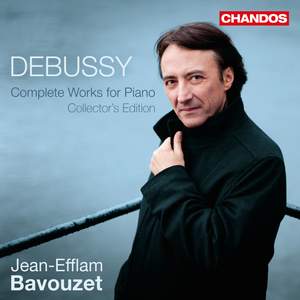
| |  | Debussy - Complete Works for Solo Piano Volume 4
“Bavouzet commands all the shading, nuance and timbral sensitivity one expects in Debussy, together with virtuoso flair and characterful spontaneity.’ (Gramophone), “…there is a balance of clarity and lyricism that immediately distinguish the pianist’s work.” (International Piano) are just a couple of reviews from the previous three volumes of this highly praised recording project. This appraisal of Jean-Efflam Bavouzet, an exclusive Chandos artist, affirms his position as one of the greatest Debussy interpreters. ‘We have a lot to learn from Debussy,’ writes Bavouzet. ‘Through the sophisticated sounds he seeks to create and the simplicity of his textures by which he builds, in just a few phrases and harmonies, a whole world of poetry, but also through writing which always reveals a highly contrapuntal way of thinking, Debussy compels us to listen to his music in a very private, intense and nearly religious manner.’ Here Bavouzet completes his cycles with works at the extreme of his pianistic style; Études Books 1 & 2 and Images Books 1 & 2. Étude retrouvée completes the recording. The Images were the product of Debussy the art-lover and derive from his early reading Baudelaire. The Études, on the other hand, look inwards at the properties and possibilities of the musical substance itself. They contain some of Debussy’s most demanding piano writing – five of the twelve were never recorded commercially until after 1950. But, despite their difficulty a playful spirit is very much in evidence. This series is a deeply personal project for Bavouzet who has been involved in all aspects of the recording process. “Jean-Efflam Bavouzet's flexible virtuosity and innate grasp of Debussy's style and sound world yields ravishing, freshly minted interpretations of the Images and Etudes that proudly rank with (and sometimes surpass) the catalogue's reference versions.” Gramophone Magazine, December 2008 “Anyone who doubts Bavouzet's abilities should sample the playful romp through the third of the Images, the quasi-Etude 'Mouvement', or his beautifully atmospheric 'Et la lune descend sur le temple qui fut'.” BBC Music Magazine, November 2008 **** “Jean-Efflam Bavouzet's flexible virtuosity and innate grasp of Debussy's style and sound world yields ravishing, freshly minted interpretations of the Images and Etudes that proudly rank with (and sometimes surpass) the catalogue's reference versions. The Images gain welcome nourishment from Bavouzet's portfolio of ravishing colour shadings and articulations, while easily absorbing such pianistic liberties as playing one hand before the other, à la Michelangeli. His headlong, impulsive 'Hommage à Rameau' contrasts with similarly nuanced yet more austere readings. In 'Poissons d'or', he sneaks a few piranhas into the fishbowl as he modifies Debussy's aussi léger que possible directive with volatile dynamic hairpins and witty accents. 'Et la lune descend sur le temple qui fût' also rivets your attention via his seductive legato and three-dimensional textures. Bavouzet's Chandos Etudes remake may well be the best yet. As you follow the intelligently contoured left-hand counterlines of 'Pour les tierces' you almost don't notice the fluency and easy evenness of Bavouzet's right-hand double notes. On the other hand, in 'Pour les huit doigts' and 'Pour les degrés chromatiques' he favours melodic inflection and linear motion over Aimard's and Uchida's smoother, scintillating surfaces. The difficult leaps of 'Pour les accords' have rarely sounded less like technical feats and more like music, and 'Pour les arpèges composés' rivals Horowitz's 1965 reading for harmonic pointing and sexiness. Bavouzet precedes this étude with a full-bodied, emotionally generous performance of its recently rediscovered earlier version, Etuderetrouvée. This attractively engineered release will reveal more and more details to savour with each rehearing – guaranteed! If you haven't yet ordered it, what are you waiting for?” Gramophone Classical Music Guide, 2010 “Debussy playing does not come any better than this” Penguin Guide, 2011 edition | | | (also available to download from $10.50) | In stock - usually despatched within 1 working day. |
|
|
| |  | Debussy - Complete Piano Works Volume 3
“Where Bavouzet breaks out into blazing Mediterranean sunlight, Rogé is happy to withdraw into shadow-land. Time and again his playing suggests emotion recollected in tranquillity rather than turmoil;… "Poissons d'or" is a marvellous distillation of indolence and flashing disruption.” Gramophone Magazine, July 2008 | | | In stock - usually despatched within 1 working day. |
|
|
| |  | Debussy - Images
“Simon Trpceski turns to Debussy's withdrawn poetry and fantasy with an ease and delicacy that suggest, once more, a wholly exceptional artist. He is, perhaps above all, harmonically aware, with every change of colour and sonority subtly underpinned, making you doubly aware of Debussy's chiaroscuro, his infinite play of light and shade. The First Arabesque could hardly be more charming or insinuating, the Second thrown off with all the requisite perkiness and vivacity. In Children's Corner Trpceski's 'Dr Gradus' is truly modérément and a far cry from a once fashionable virtuoso rush as well as much received French wisdom. His 'Golliwogg' is superbly cantankerous and up-front, though with plenty of sly winks and nudges when required, and in extreme contrast, in 'Et la lune descend sur le temple qui fut' (Images, Bk 2) you will hear an ideally balanced chording and a tonal translucency inseparable from great Debussy-playing. The end, too (pianissimo and lointain) is memorably evocative. True, there is a momentary loss of focus at the end of 'Poissons d'or' where the final shift of emphasis is blurred, but such tiny lapses are like spots on the sun. Trpceski's way with 'Clair de lune' makes you long to hear him in the complete Suite bergamasque.” Gramophone Classical Music Guide, 2010 “Following his fire-eating Chopin recital, Simon Trpceski retreats into Debussy's more withdrawn poetry and fantasy with an ease and delicacy that suggest, once more, a wholly exceptional artist.” Gramophone Magazine, March 2008 “[Of Images Book II] He [Simon Trpceski] turned ordinary notes into gently shimmering cascades of colour, finally building up to the rollicking, occasionally jazzy ‘Poissons d’or.’ His playing was so perfect that it took an effort to remember to breathe while listening” The Toronto Star | | | In stock - usually despatched within 1 working day. |
|
|
| |  |
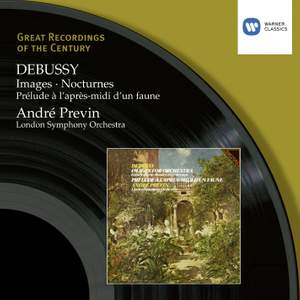
The Images and the Prélude à l’après-midi d’un faune were EMI’s first ever digital recording; they were taped in No.1 Studio, Abbey Road, in July 1979. (The Nocturnes date from 1983.) | | | In stock - usually despatched within 1 working day. |
|
|
| |  | Debussy - Complete Piano Works Volume 2
| | | In stock - usually despatched within 1 working day. |
|
|
| |  |
“Michelangeli focuses and clarifies with every miraculous stroke of the keys, etching these miniatures in pristine colours, his meticulous technique bathing each scene in brilliant sunshine.” BBC Music Magazine, June 2005 ***** | | | In stock - usually despatched within 1 working day. |
|
|
| |  | Complete Solo Piano Music, Vol.2
“Jean-Yves Thibaudet's Debussy cycle is a cornucopia of delights. The 12 Etudes could hardly be presented more personally or vivaciously. Nos 6 and 7 are marvels of bright-eyed irony and humour, while Nos 8 and 9 contrast a haunting alternation of lassitude and hyperactivity with razor-sharp cascades of repeated notes. His timing in the central lento, molto rubato of No 12 is memorably acute; throughout, you're aware of a pianist with a penchant for spare pedalling and a refined brilliance, far remote from, say, Gieseking's celebrated, opalescent magic. He takes a brisk hand to the Children's Corner suite (allegro rather than allegretto in 'Serenade for the Doll', hardly modérément animé in 'The Snow is Dancing') but even here his spruce technique and vitality are never less than enlivening. In the Suitebergamasque he dances the 'Menuet' with an unusual sense of its underlying grace and gravity, and his 'Clair de lune' is exceptionally silvery and transparent. Both books of Images are given with a rare sense of epiphany or illumination, of flashing fins and sunlight in 'Poissons d'or' and of a timeless sense of archaism in 'Hommage à Rameau'. Decca's presentation and sound are, respectively, lavish and natural. If you want to hear Debussy new-minted, with air-spun and scintillating textures, Thibaudet is your man.” Gramophone Classical Music Guide, 2010 | | | In stock - usually despatched within 1 working day. |
|
|
| |  | Debussy: Works for Piano
| | | In stock - usually despatched within 1 working day. |
|
|
| |  | Paris Tsenikoglou plays Debussy & Chopin
Paris Tsenikoglou (piano) Greek pianist Paris Tsenikoglou won first prize at the Athens International Piano Competition in 2001 at the young age of 12 years old, having given his first public recital at the age of 11 performing Bach’s Goldberg variations amongst other works. | 
| | | (also available to download from $10.50) | Usually despatched in 2 - 3 working days. (Available now to download.) |
|
|
| |
|