Beethoven: String Quartet No. 11 in F minor Op. 95 'Serioso'

This page lists all recordings of String Quartet No. 11 in F minor Op. 95 'Serioso', by Ludwig van Beethoven (1770-1827) on CD, SACD, DVD & download (MP3 & FLAC). Generally, more recent releases are listed first, but with priority given to those that are in stock.

Recommendations

Chamber Choice
March 2005
First Choice
January 2009
Historic Choice
January 2009
100 Greatest RecordingsEditor's Choice
January 2009

All recordings

Prices shown exclude VAT. (UK tax is not payable for deliveries to United States.)
See Terms & Conditions for p&p rates.

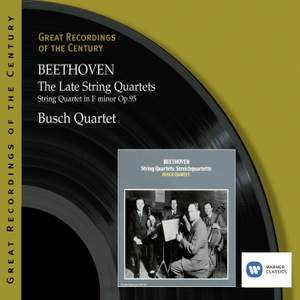
Beethoven: String Quartets Nos. 7-11

Beethoven: String Quartets Nos. 7-11


Beethoven:

String Quartet No. 7 in F major, Op. 59 No. 1 'Rasumovsky No. 1'

String Quartet No. 8 in E minor, Op. 59 No. 2 'Rasumovsky No. 2'

String Quartet No. 9 in C major, Op. 59 No. 3 'Rasumovsky No. 3'

String Quartet No. 10 in E flat major, Op. 74 'Harp'

String Quartet No. 11 in F minor Op. 95 'Serioso'


Released or re-released in last 6 months

DG Duo - 4791432

(CD - 2 discs)

$15.00

(Sorry, download not available in your country)

In stock - usually despatched within 1 working day.

Chiaroscuro Quartet play Beethoven & Mozart

Chiaroscuro Quartet play Beethoven & Mozart


Beethoven:

String Quartet No. 11 in F minor Op. 95 'Serioso'

Mozart:

Adagio & Fugue in C minor for Strings, K546

String Quartet No. 16 in E flat, K428


Chiaroscuro Quartet

In September 2011 the Chiaroscuro Quartet released its debut CD of music by Mozart and Schubert to critical acclaim. The disc was awarded a ‘Choc de l’Année’ by the French music magazine Classica and was highly praised by Télérama and the Strad magazine. It was chosen as 'Chamber Choice' in the December 2011 issue of BBC Music Magazine which described the playing as “period-instrument playing of consummate virtuosity”.

Future engagements for the Quartet include a return to Aix-en-Provence followed by a series of concerts throughout Sweden. They will return to the UK for a series of concerts broadcast on BBC Radio 3, their Edinburgh Festival debut and appearances at venues across London.

Formed in 2005, the Chiaroscuro Quartet performs music of the Classical era on period instruments informed by a historical approach. Recent UK concert highlights include appearances at Wigmore Hall in London, York Early Music Centre, The Sage Gateshead (recorded for BBC Radio 3) and a residency in Aldeburgh.

Released or re-released in last 6 months

Aparté - AP051

(CD)

$18.00

In stock - usually despatched within 1 working day.

Beethoven: String Quartets Nos. 11 & 15

Beethoven: String Quartets Nos. 11 & 15


Beethoven:

String Quartet No. 11 in F minor Op. 95 'Serioso'

String Quartet No. 15 in A minor, Op. 132


Beethoven’s genius as a composer for the string quartet is patent in every one of quartets he wrote, but the two works coupled here, so different in character and temperament, perfectly exemplify his huge expressive range. He once declared that F minor was a ‘barbarous’ key, and its associations in his work are oppressive. The String Quartet No.11 in F minor was composed in 1810, but the score was not published until 1816 (which accounts for its misleadingly high opus number). Beethoven himself gave it the subtitle Quartetto serioso, as if to stress its powerful, dramatic atmosphere, its terse, laconic themes, its tense minor-key mood, only relieved in the last unexpected opera buffa scurryings of the finale’s coda.

A furious opening theme, like a brandished fist, sets its angry stamp on the whole first movement. It is immediately answered by a wide-leaping phrase in dotted rhythm, with a side-slip into the distant ‘Neapolitan’ key of G flat. Themes and motifs succeed each other in an almost improvisatory manner. A gentler melody, in the remote key of D flat, rises on the viola and tries to extricate itself from the wrathful mood, but the furious motif continually asserts its authority – sometimes in more insinuating guise in the middle voices or in the cello, sometimes with overwhelming force as in the movement’s final bars.

The poignant Allegretto ma non troppo, which serves the quartet for a ‘slow movement’, has a more familiar formal shape. Nominally in D major, it begins with a descending cello figure that introduces a serene instrumental cantilena, followed in its turn by a restlessly chromatic fugato. The D major song returns, but there are intense reminders of the fugato before the movement ends with an air of expectancy on a diminished seventh chord. The ensuing scherzo returns us to F minor with a vengeance. This rugged, obstreperous music is built from obsessive dotted rhythms. The trio, which appears twice (with another side-slip into G flat and then to the slow-movement key of D), is smoother – like a chorale, decorated by the figuration of the first violin – but does not relieve the tension in any way.

The finale begins with a slow, disconsolate introduction, marked by wide intervals and at first seeming to promise release from the prevailing tensions. But it swiftly gives way to a nervy Allegretto agitato whose song-like theme is drawn into a whirlwind of rhythmic activity. Here again there are copious ‘Neapolitan’ inflections to G flat. After the movement has apparently run its course a few sombre, quiet bars lead into an utterly unexpected coda: a gay and witty Allegro in F major that seems a display of comic-operatic good humour.

Op. 95 is often regarded as closing Beethoven’s ‘middle period’ in composition, and it would be thirteen years before he returned to the string quartet genre. The ‘late quartets’ which he composed in 1823-6 are generally considered among his most important and personal works. Shortly after he began writing the String Quartet No.15 in A minor in 1825 he suffered a sudden serious illness: an intestinal inflammation. He completed the work while recuperating in the Viennese suburb of Baden, as is shown by his designation of the slow movement as a convalescent’s ‘song of thanksgiving’.

Beethoven’s sketchbooks of the time show an obsession with the four uppermost notes of the minor scale: these give rise to the work’s four-note opening figure, which in various forms constitutes the first movement’s mysterious introduction. In the fretful Allegro that it leads into the tension never really relaxes. The ensuing Allegro ma non tanto is a minuet with a double theme, perhaps in homage to the corresponding movement in Mozart’s A major Quartet, K464, a work Beethoven much admired.

The centrepiece of the quartet is the Adagio, which Beethoven himself entitled a ‘Sacred Song of thanksgiving from one who is recovered, to the Godhead; in the Lydian Mode’. It is a huge, very slow set of double variations, whose first element is an austere, archaic chorale, each line of which is separated by short contrapuntal passages. The second theme is a solemn dance which Beethoven marked ‘feeling new strength’ (neue Kraft fühlend) and whose wide leaps, florid decoration and rhythmic pulse all suggest the physical obverse to the hymn’s spiritual demeanour. There are two variations of the chorale, enclosing one variation of the dance, to create a very broad movement that closes in an empyrean nirvana.

By an act of almost perverse contrast the fourth movement is a march, not military or funereal but workaday, almost municipal in its rugged dotted rhythms and mellifluous second strain. It is, however, very short; and by a second incongruous contrast it flows into a very dramatic, very operatic recitative for the first violin against tremolando chords. The pace quickens to a swooping Presto that touches off the finale, a restless sonata-rondo whose main theme has the character of a celestial but somewhat melancholic waltz. Towards the end one of the subsidiary episodes refers back to the four-note figure with which the work opened, and the tonality finally brightens into A major, although to the end the music retains a tinge of melancholy.

Virgin Premium - 0293152

(CD)

$11.25

In stock - usually despatched within 1 working day.

Mendelssohn: Octet in E flat major, Op. 20, etc.

Beethoven:

String Quartet No. 11 in F minor Op. 95 'Serioso'

Orchestral Version

Wiener Philharmoniker, Christoph von Dohnanyi

Mendelssohn:

Octet in E flat major, Op. 20

Orchestral Version

Strings of the Israel Philharmonic Orchestra, Zubin Mehta


Australian Eloquence - 4800813

(CD)

$10.25

In stock - usually despatched within 1 working day.

Beethoven - String Quartets Nos. 10 & 11

Beethoven - String Quartets Nos. 10 & 11


Beethoven:

String Quartet No. 10 in E flat major, Op. 74 'Harp'

String Quartet No. 11 in F minor Op. 95 'Serioso'


The Tokyo String Quartet continues its complete Beethoven cycle with this third volume. Both the graceful Op. 74, nicknamed 'Harp' for its use of pizzicato, and Op.95, with its quest for the essential, testify to the new maturity achieved by the composer around 1810. The Tokyo String Quartet has captivated audiences and critics alike since it was founded more than 30 years ago. Regarded as one of the supreme chamber ensembles of the world, the Tokyo Quartet has collaborated with a remarkable array of artists and composers, built a comprehensive catalogue of critically acclaimed recordings and established a distinguished teaching record. Performing well over a hundred concerts worldwide each season, the Tokyo String Quartet has a devoted international following that includes not only the major capitals of the world but also reaches all four corners, from Australia to Estonia to Scandinavia and the Far East.

“Op 74 is an underrated masterpiece… Robert Simpson's… description of the introductory poco adagio as lit from within by a quiet, human warmth, find an echo in the Tokyo String Quartet's interpretation of the work. Their own consummate beauty of thought and expression is heard as the sotto voco opening... ...listeners are sure to respond to this artistry as readily as they would to the crystalline clarity of SACD sound.” Gramophone Magazine, March 2009

“Although perfection is usually unattainable, I can’t recall any other performances of these two works that are so suggestive of the word… if I were restricted to owning only one account of each of these works, I’d opt for this release.” Mortimer H Frank, International Record Review, January 2009

Super Audio CD

Format:

Hybrid Multi-channel

Harmonia Mundi - HMU807460

(SACD)

$17.50

In stock - usually despatched within 1 working day.

Beethoven - Complete String Quartets Volume 2

Beethoven - Complete String Quartets Volume 2


Beethoven:

String Quartet No. 12 in E flat major, Op. 127

String Quartet No. 7 in F major, Op. 59 No. 1 'Rasumovsky No. 1'

String Quartet No. 2 in G major, Op. 18 No. 2

String Quartet No. 11 in F minor Op. 95 'Serioso'

String Quartet No. 15 in A minor, Op. 132


Recorded live Konzerthaus Vienna 1989

“In terms of sheer quartet-playing these players are difficult to fault: ensemble is flawless, intonation perfect, and their mastery unimpeachable. The video presentation is totally free from affectation: the vision is straightforward and never draws attention to itself.” Penguin Guide, 2011 edition

DVD Video

Region: 0

Format: NTSC

EMI - 3385869

(DVD Video - 2 discs)

$19.75

In stock - usually despatched within 1 working day.

Beethoven: String Quartet No.  7 in F major, Op. 59 No. 1 'Rasumovsky No. 1', etc.

Beethoven:

String Quartet No. 7 in F major, Op. 59 No. 1 'Rasumovsky No. 1'

String Quartet No. 11 in F minor Op. 95 'Serioso'


Virgin Beethoven/Artemis Quartet - 5457382

(CD)

$15.50

In stock - usually despatched within 1 working day.

Beethoven: Complete String Quartets Volume 1

Beethoven: Complete String Quartets Volume 1


Beethoven:

String Quartet No. 6 in B flat major, Op. 18 No. 6

String Quartet No. 11 in F minor Op. 95 'Serioso'

String Quartet No. 16 in F major, Op. 135


Quartetto di Cremona

During the past ten years the Quartetto di Cremona has matured into a string quartet of international renown, combining the Italian culture of string playing with an awareness of historical performance practice.

Having for many years performed at the great international halls, it is often regarded as the successor to the famous Quartetto Italiano. The musical style of the Quartetto di Cremona is marked by a fruitful tension between Italian and

German-Austrian influences: Following their academic studies the players continued their training with Piero Farulli of the Quartetto Italiano. He strongly favoured intuitive playing and a fervent, emotional, romantic and 'Italian' approach to music. Afterwards the musicians pursued their studies with Hatto Beyerle of the Alban Berg Quartet who represents a clear, classical, 'Austro-German' style, focusing on faithfulness to the original, form and structure as a basis for musical interpretation and inspiration. Both teachers have left a lasting impression on the quartet and significantly influenced its musical style. The players naturally unite both poles, combining boisterous enthusiasm with a distinct sense for musical architecture, cultivating the fusion of structure and xpression, external shape and internal passion.

With the three works contained in Volume 1, the Quartetto di Cremona covers the most important periods of Beethoven’s quartet oeuvre. The final of the six Op. 18 Quartets features a mysteriously programmatic dimension in its last

movement, “La Malinconia”, whereas Op. 95 from Beethoven’s middle period is both highly compact yet dramatically gripping. The disc closes with Beethoven’s final Quartet, Op. 135, completed in Vienna one year before his death: it differs from his less easily approachable late works in taking on a conciliatory stance.

“on the evidence of the first release in this series, the Quartetto di Cremona look set to bring much to this new project … It is the individual voices of these players that are so beautiful as well as the way that they interact so naturally. Listening to the CD layer, they are extremely well recorded with every instrument well balanced in a wide soundstage. I look forward immensely to the next instalment of this cycle.” The Classical Reviewer, 24th March 2013

Released or re-released in last 6 months

Super Audio CD

Format:

Hybrid Multi-channel

Audite - AUDITE92680

(SACD)

$17.00

(also available to download from $10.50)

Usually despatched in 3 - 4 working days. (Available now to download.)

Beethoven: String Quartet No. 11 & Kreutzer Sonata No. 9

Beethoven: String Quartet No. 11 & Kreutzer Sonata No. 9

arr. for solo violin and string orchestra


Beethoven:

String Quartet No. 11 in F minor Op. 95 'Serioso'

arr. for solo violin and string orchestra

Violin Sonata No. 9 in A major, Op. 47 ‘Kreutzer'

arr. for solo violin and string orchestra


Antje Weithaas (violin)

Camerata Berlin

This new recording offers two particularly good examples of ‘orchestrations’ of smaller works: Beethoven’s String Quartet in F Minor op. 95 and the ’Kreutzer' Violin Sonata No. 9 in A Major. These are two prime examples of the extent to which our view of a masterpiece can be transformed and expanded through arrangement.

Violinist Antje Weithaas has created a new orchestral version of the work in collaboration with the Bern Camerata’s double bassist Steuri, both performing here.

“In this skillful arrangement for string orchestra… Beethoven’s ‘Serioso’ Quartet sounds completely at home, so much so that one is left hankering to hear the rest of the cycle played like this.” The Strad

Avi Music - AVI8553226

(CD)

$17.00

Usually despatched in 2 - 3 working days.

The Mahler Album

The Mahler Album


Beethoven:

String Quartet No. 11 in F minor Op. 95 'Serioso'

arr. for string orchestra, G. Mahler

Mahler:

Symphony No. 5 in C sharp minor - Adagietto

Symphony No. 10 in F sharp major - Adagio

arr. for string orchestra, H. Stadlmair


Amsterdam Sinfonietta, Candida Thompson

“A quartet for string orchestra! That sounds strange to you. I already know all the objections that will be raised: ruination of intimacy, of individuality. But that is an error. What I intend is only an ideal representation of the quartet. Chamber music is primarily written for the living room. It is really enjoyed only by the performers. The four ladies and gentlemen who sit at their music stands are also the audience towards which this music turns. If chamber music is transferred to the concert hall, this intimacy is already lost. But even more is lost. In a large space the four voices are lost and do not speak to the listener with the power that the composer wanted to give them. I give them this power by strengthening the voices. I unravel the expansion that is dormant in the voices and give the sounds wings.” Thus Mahler in an open letter in the Viennese newspaper Die Wage in January 1899. (from: liner notes by Willem de Bordes)

“Nice performances, stunning recording.” BBC Music Magazine, December 2011 ****

Super Audio CD

Format:

Hybrid Multi-channel

25% off Channel Classics

Channel - CCSSA31511

(SACD)

Normally: $16.75

Special: $12.56

Usually despatched in 4 - 5 working days.

Page: 

 1   2   3   4   5   6   7 

 Next >>

Copyright © 2002-13 Presto Classical Limited, all rights reserved.