All recordingsPrices shown exclude VAT. (UK tax is not payable for deliveries to United States.) See Terms & Conditions for p&p rates. | |  | Beethoven: String Quartets, Op. 18 (Volume 1)
The Sacconi Quartet presents a new recording of three of Beethoven’s masterful early string quartets. The Opus 18 quartets (Nos 1, 4 and 6) appear on the third release on the Quartet’s own label, Sacconi Records. The disc is released upon the recent completion of the Sacconi Quartets’ two year Beethoven Cycle, performed in the UK at both the Canterbury Festival and Music at St Peter’s, Wallingford. This set of six works, published as Opus 18 in 1801, were Beethoven’s first attempt at writing for the string quartet. Beginning these early masterpieces, the 28 year old Beethoven was already known for his virtuosic improvisations and remarkable musicianship. In these quartets he not only demonstrates his skill and mastery of the medium as developed by Haydn and Mozart, but also explores new musical territory, anticipating later developments in his compositional style. The F major quartet (Op.18 No.1) is a masterpiece in brilliance and vitality, with a slow movement that contains some of the most sensitive and tragic writing of his earlier works. In Op.18 No.4 in C minor, Beethoven moves towards a more concerto-like format and the first violin dominates in this vibrant and atmospheric piece. The final quartet of the set, Op.18 No.6 in B flat major is a work of extreme contrasts, and the slow introduction to the last movement, La Malinconia, is a celebrated passage of profound originality. The Sacconi Quartet is one of the UK's leading string quartets. Since its formation at the Royal College of Music in 2001, it has established a secure and substantial reputation. The Quartet is recognised for its unanimous and compelling ensemble, performing with style and commitment and consistently communicating with a fresh and imaginative approach. Its four founder members demonstrate a shared passion for string quartet repertoire, infectiously reaching out to audiences with their energy and enthusiasm. Over the past decade they have enjoyed a highly successful international career, performing regularly throughout Europe, at London’s major venues, in recordings and radio broadcasts. | | | In stock - usually despatched within 1 working day. |
|
|
| |  | Beethoven: String Quartets Op. 18, No. 1 & Op. 127Beethoven/Artemis Quartet Volume 6
For the Artemis Quartet, Beethoven remains “the most modern, provocative, experimental and boldest composer of all”. The Artemis’ devotion to Beethoven’s towering quartets brings two seasons of concerts around Europe and the US and, in 2011, the release of the complete cycle on Virgin Classics. The sixth release in the Artemis Quartet’s complete Beethoven cycle comes as the Berlin-based ensemble devotes its international performing schedule to this cornerstone of the repertoire. “This group finds a balance between projecting musical structure and conveying immediacy,” wrote the New York Times in March 2010. “The players cultivate unity of thought and intention but not conformity of sound and style ... the Beethoven performances the Artemis offered were remarkably cogent and organic. The Quartet in E flat (Op. 127), the first of the five late works, is my favourite of the Beethoven quartets, partly because it is so blithely strange. Artemis captured that quality in an engrossing performance. For example, in the middle of the pensive slow movement the music breaks out into something reminiscent of a sentimental German beer-hall tune complete with an oompah dance riff, qualities impishly conveyed here. The seemingly breezy theme of the finale has astonishing twists embedded in its phrases and harmonies, vividly realized by Artemis”. “...there's an astringent, dramatic quality to the playing, which is most effective in the "String Quartet No 12 in E flat major", making light work of the change in the second movement from lachrymose introversion to something akin to a jaunty dance, and back into bleakness again two minutes later” The Independent, 8th October 2010 *** “they negotiate the tricky changes of tempo in the first movement of Op. 127 with great fluidity, provide an expressive yet poised view of the slow movement, and invest the Scherzo with suitably rustic verve and rhythmic dynamism” BBC Music Magazine, December 2010 *** “They are integrated yet, individual, four musicians each outstanding but not standing out as such. The internal balance of the Artemis Quartet reflects their equilibrium...what's also communicated [is] the uncompromising honesty and probity of these musicians.” Gramophone Magazine, December 2010 “The group's take on the String Quartet No. 12 resists smoothing over its uncomfortable, disconcerting juxtapositions of material...The Artemis's thoughtful, assertive interpretations plug us into Beethoven's radical core. They cast Beethoven as an instinctive modernist.” Classic FM Magazine, February 2011 ***** | | | In stock - usually despatched within 1 working day. |
|
|
| |  |
The Smithson String Quartet | | | In stock - usually despatched within 1 working day. |
|
|
| |  |
2 CDs for 1 “Enjoyable as other digital recordings of Beethoven's first quartets by (for example) the Takács and Lindsay Quartets are, this new Tokyo set just about pips all rivals to the post. The reason is primarily one of balance, not only within the group itself but also in terms of overall musical judgement – whether relating to tempo, dynamics or emphases, or simply the way the players combine a sense of classical style with an appreciation of Beethoven's startling originality. Even as early as No 1's pensive opening, you notice how skilfully rests are being gauged, contrasts in colour and inflection, too: the way the clipped first motif leads into its sweetly imploring extension a couple of bars later. The Scherzo's skipping gait, incisive but lightly dispatched, is another source of pleasure, and so is the seemingly effortless swirl of the closing Allegro. The old quartet cliché about 'leaning together' is here a principal attribute. At times it could be just one person playing. The qualifying ma non tanto of the C minor's opening Allegro is pointedly observed: dramatic impact is sustained while composure is maintained. The crispness of the Andante scherzoso and the cannily calculated crescendi at the start of the finale is oustanding. Few ensembles have characterised the A major's cantering first idea as happily as the Tokyos do here, while the ethereal and texturally variegated middle movements anticipate the very different world of Beethoven's 'late' quartets. Beautifully blended recordings, too: if you're after a top-ranking digital set of Op 18, you couldn't do better.” Gramophone Classical Music Guide, 2010 “…this new Tokyo set just about pips all rivals to the post. The reason is primarily one of balance, not only within the group itself but also in terms of overall musical judgement - whether relating to tempo, dynamics or emphases, or simply the way the players combine a sense of classical style with an appreciation of Beethoven's startling originality.” Gramophone Magazine, February 2008 “this release makes one look forward to the Tokyo's completion of what is, so far, a formidable traversal.” International Record Review “The Tokyo Quartet here produce a sumptuous, beautifully blended sonority and perform with outstanding music insight, unanimity and polish.” The Strad, February 2008 | | | In stock - usually despatched within 1 working day. |
|
|
| |  | Beethoven - Complete String Quartets Volume 1
Recorded live Konzerthaus Vienna 1989 “In terms of sheer quartet-playing these players are difficult to fault: ensemble is flawless, intonation perfect, and their mastery unimpeachable. The video presentation is totally free from affectation: the vision is straightforward and never draws attention to itself.” Penguin Guide, 2011 edition | | | In stock - usually despatched within 1 working day. |
|
|
| |  | Beethoven - The Early String Quartets
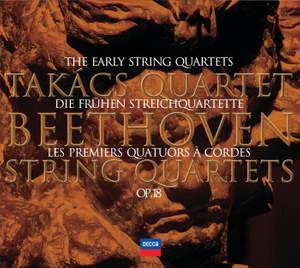
“Robert Simpson disagreed with writers who believed that Beethoven's backward glances to Haydn and Mozart in his Op 18 set were so obvious as to distract attention from his own individuality. The Takács disagree, too. They concede the tradition, but those glances are far from obvious. From the beginning this is Beethoven through and through. The opening bars of Op 18 No 1 are soft yet terse. The answering calls are conciliatory, but the suspense is palpable. And, in a trenchant Allegro con brio, every sforzando is used to raise the tension, especially in the development. There are no concessions to surface beauty, and the message isn't subdued. The Takács are particular about dynamics. The fortissimo chord near the finish of the slow movement is startling, and the build up from pianissimo is as impressive as the drop back to the end. The Adagio, though directed to be both impassioned and tender, tends to be fervent, while fine inflections to the line ensure that the fairly swift tempo doesn't appear hurried. Conversely, the Adagioma non troppo of No 6 is compassionately slow, but continuously mobile: these musicians don't overlay textures with fatty tissue. Despite wide separation, ensemble is always close-knit. Just how close may be appreciated in the Scherzos, which are tight and cohesive. That of No 4 has, in addition, precise give and take between the contrapuntal lines. The Takács play them in a way that leads the ear on without ignoring the expressive demands of the unusual marking Andantescherzoso quasi Allegretto.” Gramophone Classical Music Guide, 2010 | | | In stock - usually despatched within 1 working day. |
|
|
| |  | Delian Quartett play Beethoven
After Crescendo reported in detail about the ‘shooting stars, Delian Quartett’ in 2008, the magazine Ensemble and a number of other specialist publications have also acknowledged the extraordinary development of the group resulting in several features and promotion. | 
| | | (also available to download from $10.50) | Usually despatched in 2 - 3 working days. (Available now to download.) |
|
|
| |  | Classical: Afflatus Quartet
Afflatus Quartet: Roman Novotny (flute), Jana Brozkova (oboe), Vojtech Nydl (clarinet) & Ondrej Roskovec (bassoon) Four members of the internationally renowned Afflatus (Wind) Quintet from the Czech Republic perform arrangements by Bok, Vester, and Muclinger of chamber music by Beethoven and Mozart on a new hybrid SACD. Afflatus Quartet derives from Afflatus (Wind) Quintet, the winner of one of the most prestigious chamber music competitions in the world, the International Music Competition of the ARD Munich 1997. With Radek Baborak, the world famous horn player and Afflatus member taking a "vacation" from the ensemble, the four remaining members, each of which is an active soloist throughout Europe and especially in Czech Republic, have produced an album that features classical repertoire by Beethoven and Mozart in arrangements for wind quartet. The disc includes versions of Beethoven’s String Quartet No.1 by Bok, and Adagio and Allegro, Wo0.33 by Vester, alongside those of Mozart’s Fantasie in F minor, K608, Andante in F major, K.616, and Adagio and Allegro in F minor, K.594 by Munclinger. | | | Usually despatched in 4 - 5 working days. |
|
|
| |  | Beethoven: The Early String QuartetsIn Concert at the Library of Congress 1943-1962
The release of this two-disc set completes the Budapest String Quartet's historic Beethoven string quartet cycle, recorded at the Library of Congress's Coolidge Auditorium. Both the middle and late Quartets from this cycle (BRIDGE9099A/C and BRIDGE9072A/C) have frequently been cited as among the finest recordings ever made of Beethoven's singular masterpieces. The present recordings of Beethoven's six Op. 18 quartets were selected from performances given during the Budapest's 22-year long residency at the Library. In addition to the six quartets, a short track drawn from a Budapest String Quartet rehearsal (1944) is included on disc two. “It’s been well worth the wait for these performances. Restoration has done what it can for the boxy originals, but the energy and drive of the playing will make up for that.” MusicWeb International, March 2012 | | | Usually despatched in 2 - 3 working days. |
|
|
| |  |
| | | Usually despatched in 8 - 10 working days. |
|
|
| |
|