All recordingsPrices shown exclude VAT. (UK tax is not payable for deliveries to United States.) See Terms & Conditions for p&p rates. | |  | Debussy: 16 Préludes
Debussy: | Préludes - Book 1: No. 1, Danseuses de Delphes Préludes - Book 2: No. 3, La Puerta del Vino Préludes - Book 1: No. 6, Des pas sur le neige Préludes - Book 1: No. 11, La Danse de Puck Préludes - Book 1: No. 9, La serenade interrompue Préludes - Book 1: No. 3, Le vent dans la plaine Préludes - Book 2: No. 5, Bruyères Préludes - Book 2: No. 6, General Lavine - eccentric Préludes - Book 2: No. 10, Canope Préludes - Book 1: No. 7, Ce qu’a vu le vent de l’ouest Préludes - Book 1: No. 8, La fille aux cheveux de lin Préludes - Book 1: No. 12, Minstrels Préludes - Book 1: No. 10, La cathédrale engloutie Préludes - Book 2: No. 8, Ondine Préludes - Book 2: No. 7, La terrasse des audiences au clair de lune Préludes - Book 2: No. 12, Feux d’artifice |
Debussy's twenty-four Preludes, like Chopin's, are surprisingly self-sufficient. Divided into two books, published in 1910 and 1913, the Preludes are an intimate record of Debussy's inner and imaginative life. Their titles were after-thoughts rather than direct inspirations, largely because Debussy's delicate and complex response to natural phenomena or human idiosyncrasy could hardly be contained or expressed by a simple caption or heading. The Cuban-American pianist Jorge Bolet isn't readily associated with the music of Debussy, but his selection of sixteen of the composer's Preludes yield performances of refinement and fluidity. Lines are clearly delineated and the myriad of impressions within a single piece are nothing short of kaleidoscopic. | | | In stock - usually despatched within 1 working day. |
|
|
| |  | Debussy: 16 Préludes
Debussy: | Préludes - Book 1: No. 1, Danseuses de Delphes Préludes - Book 1: No. 3, Le vent dans la plaine Préludes - Book 1: No. 6, Des pas sur le neige Préludes - Book 1: No. 7, Ce qu’a vu le vent de l’ouest Préludes - Book 1: No. 8, La fille aux cheveux de lin Préludes - Book 1: No. 9, La serenade interrompue Préludes - Book 1: No. 11, La Danse de Puck Préludes - Book 1: No. 10, La cathédrale engloutie Préludes - Book 1: No. 12, Minstrels Préludes - Book 2: No. 3, La Puerta del Vino Préludes - Book 2: No. 5, Bruyères Préludes - Book 2: No. 6, General Lavine - eccentric Préludes - Book 2: No. 7, La terrasse des audiences au clair de lune Préludes - Book 2: No. 8, Ondine Préludes - Book 2: No. 10, Canope Préludes - Book 2: No. 12, Feux d’artifice |
Jorge Bolet made this superbly languid and delicate recording of 16 Préludes by Debussy less than two years before his untimely death in 1990 at the age of 75. The Cuban-born pianist's reputation was largely founded on his mercurial, blockbusting performances and recordings of Rachmaninov and Liszt, but this disc shows a true pianist’s lightness of touch, as well as some superbly sensitive engineering and technical preparation of his beloved Baldwin SD-10 instrument, chosen by Bolet in preference to the far more popular Steinways. Bolet's own personal fastidiousness – he always recorded in a jacket and tie – is reflected, and in perhaps unexpected and certainly fascinating ways, in this personal selection from the two books of twelve Préludes, and the ordering of them. He may have been a reluctant, and and indeed until the last couple of decades of his life, infrequent visitor to the studio – he once remarked that he would rather give hundreds of concerts than make one recording – but this wariness does not translate itself into metronomical stiffness but rather reflect a refined version of the spontaneity that manifested itself more naturally in his concert playing. ‘Bolet’s performances, with their inimitable beauty of line and shimmering sonority (very much the product of an unobtrusive but subtle virtuoso pedal technique), their poetic freedom within a basic pulse, were like some serene and final distillation of all he had learnt and known, the massive and legendary virtuosity of earlier days directed into an everincreasing concern with more durable musical truths.’ Gramophone, 1991 “He basically alternates tranquil and lively, but slow and dreamy pieces such as Des pas sur la neige or La Fille aux cheveux de lin seem to loom largest — dreamy not meaning ethereal, but a spaciousness and weightiness of sonority new to Debussy, and of which Bolet is the suavest exponent.” Sunday Times, 7th November 2010 *** “Bolet's deep and velvety touch brings out a more profound mysticism in Debussy's multifaceted visions.” BBC Music Magazine, February 2011 *** | | | Usually despatched in 2 - 3 working days. |
|
|
| |  | Debussy/Matthews - Preludes
Debussy: | Jeux - Poème dansé Préludes - Book 1: No. 1, Danseuses de Delphes Préludes - Book 1: No. 9, La serenade interrompue Préludes - Book 1: No. 6, Des pas sur le neige Préludes - Book 2: No. 4, Les fées sont d’exquises danseuses Préludes - Book 1: No. 2, Voiles Préludes - Book 2: No. 9, Hommage á S.Pickwick Esq. Préludes - Book 2: No. 7, La terrasse des audiences au clair de lune Préludes - Book 2: No. 5, Bruyères Préludes - Book 2: No. 8, Ondine Préludes - Book 1: No. 5, Les collines d'Anacapri Préludes - Book 2: No. 12, Feux d’artifice Préludes - Book 1: No. 10, La cathédrale engloutie | Matthews, C: | Postlude: Monsieur Croche |
(Debussy preludes arranged for orchestra by Colin Matthews)
"Matthews has been heralded for the success with which he has taken the inspiration of the piano masterpieces and skillfully created orchestral works of great variety, beauty and drama. “…these pieces are more than orchestrations, they are recreations achieved by entering into the mind and thought of the original composer. Beautiful performances.” Sunday Telegraph 2007 “Matthews's exquisite treatment of this supremely pianistic music goes far beyond mere orchestration. While some of his arrangements are relatively straightforward - Danseuses de Delphes, which opens the first book and with which this sequence also opens, for instance, is a relatively strict translation of the original into orchestral terms - pieces such as Bruyères and Feux d'Artifice are virtually recomposed, though they never trespass beyond Debussy's own musical world. The whole set is a remarkable achievement, and Elder and his orchestra play these pieces with great care and sensitivity. Yet by comparison their account of Jeux seems rather lumbering, applying colour with a broad brush to what should be needle-point detail. The disc remains a treat, though.” The Guardian, 20th February 2009 **** “…Jeux… has an underlying eroticism. The diaphanous atmospheric detail from the strings and subtle wind colouring in Debussy's poème dansé require great delicacy of feeling and sensuous caressing from the violins in the movements of restrained ecstasy, which are exquisitely realised here. The transparent acoustic of the Bridgewater Hall and the balancing skill of producer Andrew Keener add to the allure of this miraculous score, with the violent climax superbly graduated and the closing pages returning spontaneously to the opening mood. Altogether this is a fascinating and rewarding disc...” Gramophone Magazine, June 2009 “Matthews’s creative finesse is remarkable: the pieces aren’t simply dressed in orchestral clothes, rather sensitively re-imagined for an expanded palette of refined colours by a gifted contemporary composer.” The Times, 17th July 2010 **** “The diaphonous atmospheric detail from the strings and subtle wind colouring in Jeux, Debussy's poème dansé, require great delicacy of feeling and sensuous caressing from the violins in the moments of restrained ecstasy, which are exquisitely realised here. The transparent acoustic of the Bridgewater Hall and the balancing skill of producer Andrew Keener add to the allure of this miraculous score, with the violent climax superbly graduated and the closing pages returning spontaneously to the opening mood. The programme is completed by 12 more of Colin Matthews's highly imaginative orchestrations of Debussy's piano Préludes, and these, to my ears, have even more distinction than the first group, which came in harness with Mark Elder's compelling Hallé account of La mer (see above). The shimmering textures Matthews creates from the 'Danseuses de Delphes', 'Des pas sur la neige' and 'Les fées sont d'exquises' are even more translucently exotic, balanced by the luxuriance of 'Bruyères'. If not quite matching Stokowski's famous over-the-top transcription, 'La cathédrale engloutie' produces a splendidly expansive, watery spectacle, tolling bell included, which is sonorously moving. However, 'S Pickwick Esq', with its side drum and mock-solemn national anthem snippet on the brass, feels rather too heavily pompous, not witty enough, and 'Feux d'artifice', too, is a bit of a damp squib – it sounds much more effective in its barer piano original. Moreover, Colin Matthews's own Monsieur Croche makes an exuberantly brilliant postlude, even if its helter-skelter progress obviously includes very few crochets. Altogether this is a fascinating and rewarding disc and is well worth aquiring to make a pair, alongside its illustrious companion.” Gramophone Classical Music Guide, 2010 | | | Usually despatched in 4 - 5 working days. |
|
|
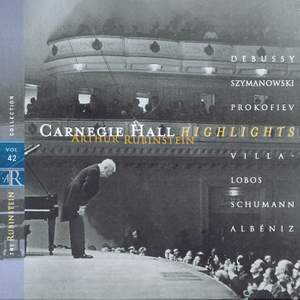
| |  | Artur RubinsteinLive, Moscow, Great Hall Moscow Conservatory, 1st October, 1964
Chopin: | Polonaise No. 5 in F sharp minor, Op. 44 Impromptu No. 3 in G flat major, Op. 51 Nocturne No. 8 in D flat major, Op. 27 No. 2 Piano Sonata No. 2 in B flat minor, Op. 35 'Marche funèbre' Barcarolle in F sharp major, Op. 60 Étude Op. 25 No. 1 in A flat major 'Aeolian Harp' Étude Op. 25 No. 5 in E minor Étude Op. 10 No. 4 in C sharp minor Étude Op. 10 No. 5 in G flat major 'Black Key' Waltz No. 3 in A minor 'Grande Valse Brillante', Op. 34 No. 2 Polonaise No. 6 in A flat major, Op. 53 'Héroïque' | Debussy: | Préludes - Book 2: No. 8, Ondine | Schumann: | Fantasiestücke, Op. 12 No. 1 'Des Abends' | Villa-Lobos: | O Polichinelo (from Prole do Bebê, book 1) |
Artur Rubinstein's charismatic personality and unique ability to connect with an audience made each of his concert appearances an event. Surprisingly, the vast majority of his recorded output - whether on record or film - was made in the recording studio.This rare film, preserved in the vaults of the Russian State television archives for nearly 50 years, shows Rubinstein at his prime playing in the Great Hall of the Moscow Conservatory.This historic concert both testifies to Rubinstein's freer and risk-taking approach when in front of an audience and allows us to share the electric atmosphere of his live appearances. BONUS: 1928 footage accompanying a silent film “From the archives of Russian state television, this astonishing film captures the great Rubinstein holding his Moscow audience spellbound.” BBC Music Magazine, May 2009 ***** “Considering his celebrity, longevity and huge studio recording legacy, there is very little film of Rubinstein in concert. Indeed, this is the only full solo recital I can recall and as such is immensely valuable… fine as are most of his studio recordings, Rubinstein played with a greater freedom and daring when in front of an audience. The playing, of course, is heart-warming... Everything seems so inevitable and right, whether in the caressing phrases of the Barcarolle or the bravura of the A flat Polonaise, the inevitable trademark conclusion to any Rubinstein recital.” Gramophone Magazine, May 2009 “Considering his celebrity, longevity and huge studio recording legacy, there is very little film of Rubinstein in concert. Indeed, this is the only full solo recital one can recall and as such is immensely valuable, not least because the printed programme is devoted entirely to the composer with whom he was most closely associated and because, fine as are most of his studio recordings, Rubinstein played with a greater freedom and daring when in front of an audience. The film of the occasion, preserved in the vaults of the Russian State television archives for nearly 50 years, provides a vivid reminder of this great artist's idiosyncrasies – the dignified, immobile posture, the expressionless face and the little tug at his lapels before the start of each item. The playing, of course, is heart-warming, the kind that can absorb the odd fluff, though the memory lapse in the Scherzo of the Sonata is disconcerting (he has to make an unwritten repeat before ad libbing his way into the Trio). Everything seems so inevitable and right, whether in the caressing phrases of the Barcarolle or the bravura of the A flat Polonaise, the inevitable trademark conclusion to any Rubinstein recital. Aficionados will relish his only known performance of the Aeolian Harp Study, Op 25 No 1. (The bonuses are two short – 1'45” – silent films of excerpts from two études shot in slow motion in Canada in 1928.)” Gramophone Classical Music Guide, 2010 | | | Usually despatched in 2 - 3 working days. |
|
|
| |  | From Mozart To Messiaen
Bartók: | Perpetuum mobile (Mikrokosmos No. 135) | Beethoven: | Piano Sonata No. 24 in F sharp major, Op. 78 | Brahms: | Intermezzo in E flat major, Op. 117 No. 1 | Debussy: | Préludes - Book 1: No. 10, La cathédrale engloutie Préludes - Book 2: No. 8, Ondine Préludes - Book 1: No. 2, Voiles Préludes - Book 2: No. 6, General Lavine - eccentric Préludes - Book 2: No. 4, Les fées sont d’exquises danseuses Préludes - Book 2: No. 7, La terrasse des audiences au clair de lune Préludes - Book 1: No. 3, Le vent dans la plaine Préludes - Book 1: No. 7, Ce qu’a vu le vent de l’ouest Reflets dans l'eau (No. 1 from Images pour piano - Book 1) Préludes - Book 1: No. 5, Les collines d'Anacapri Clair de Lune (from Suite Bergamasque) | Liszt: | Un Sospiro from 3 Concert Studies, S144 No. 3 | Messiaen: | Visions de l'Amen for 2 pianos with John Ranck (piano) | Mozart: | Rondo in D major, K485 | Schubert: | Impromptu in B flat major, D935 No. 3 | Schumann: | Fantasiestücke, Op. 12 No. 1 'Des Abends' Aufschwung, Op. 12, No. 2 |
| | | Usually despatched in 4 - 5 working days. |
|
|
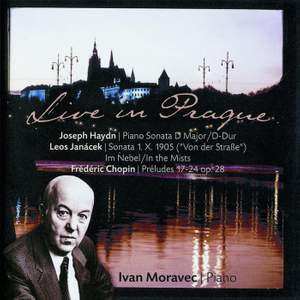
| |  | Ivan Moravec, Live In Prague
Prague Spring 2000 Recital Ivan Moravec is simply one of the great pianists alive today. His reputation rests on superlative performances and recordings of a repertoire in which he really is supreme: Debussy, Chopin, Brahms, and Mozart. This latest recording of Moravec features a finely balanced program including works of his countryman, Leos Janácek. No music-lover will want to be without this recording, destined to become a classic. | |
|
| |  | Piano Recital: Amir Tebenikhin
“He is a strong, assured pianist with virtuoso fingers and resonant, unforced sound. His playing is very natural: no fancy tricks, no technical splurges. He just lets the music unfold in a free, natural manner...If he comes your way, catch him.” American Record Guide | | | (also available to download from $6.00) | Usually despatched in 2 - 3 working days. (Available now to download.) |
|
|
| |  | Reflections in the Water
| | | (also available to download from $21.50) | Usually despatched in 2 - 3 working days. (Available now to download.) |
|
|
| |  | Water Music of the Impressionists
“Rosenberger provides the cascading musical flow that effectively brings the music flooding into your listening area.” American Record Guide “Defines the state of the art in piano recordings.” CD Review | | | (also available to download from $10.75) | Usually despatched in 2 - 3 working days. (Available now to download.) |
|
|
| |  | Jorge Bolet: The Last Romantic
Albéniz: | Tango (No. 2 from Espana, Op. 165) | Chopin: | Ballades Nos. 1-4 Preludes (24), Op. 28 Nocturne No. 7 in C sharp minor, Op. 27 No. 1 Nocturne No. 15 in F minor, Op. 55 No. 1 Nocturne No. 8 in D flat major, Op. 27 No. 2 Nocturne No. 18 in E major, Op. 62 No. 2 Nocturne No. 5 in F sharp major, Op. 15 No. 2 Waltz No. 6 in D flat major, Op. 64 No. 1 'Minute Waltz' Waltz No. 14 in E minor, Op. post., KKIVa:15, B 56 Nocturne No. 2 in E flat major, Op. 9 No. 2 Étude Op. 25 No. 1 in A flat major 'Aeolian Harp' Étude Op. 25 No. 2 in F minor Étude Op. 25 No. 11 in A minor 'Winter Wind' Barcarolle in F sharp major, Op. 60 Fantasia in F minor, Op. 49 | Debussy: | Préludes - Book 1: No. 1, Danseuses de Delphes Préludes - Book 2: No. 3, La Puerta del Vino Préludes - Book 1: No. 6, Des pas sur le neige Préludes - Book 1: No. 11, La Danse de Puck Préludes - Book 1: No. 9, La serenade interrompue Préludes - Book 1: No. 3, Le vent dans la plaine Préludes - Book 2: No. 5, Bruyères Préludes - Book 2: No. 6, General Lavine - eccentric Préludes - Book 2: No. 10, Canope Préludes - Book 1: No. 7, Ce qu’a vu le vent de l’ouest Préludes - Book 1: No. 8, La fille aux cheveux de lin Préludes - Book 1: No. 12, Minstrels Préludes - Book 1: No. 10, La cathédrale engloutie Préludes - Book 2: No. 8, Ondine Préludes - Book 2: No. 7, La terrasse des audiences au clair de lune Préludes - Book 2: No. 12, Feux d’artifice Préludes - Book 1: No. 8, La fille aux cheveux de lin | Franck, C: | Prélude, Choral et Fugue, M21 | Godowsky: | Studies on the Chopin Etudes: excerpts Elegy for the left hand alone Ständchen (after Richard Strauss) Adagietto from L'Arlesienne (after Bizet) | Liszt: | Réminiscences de Norma, S394 | Mendelssohn: | Prelude & Fugue for piano in E minor, Op. 35 No. 1 Rondo capriccioso in E major, Op. 14 Song without Words, Op. 19b No. 3 in A major 'Hunting Song' | Moszkowski: | En Automne, Op. 36 No. 4 La Jongleuse, Op. 52 No. 4 | Rachmaninov: | Variations on a Theme of Chopin, Op. 22 Prelude Op. 3 No. 2 in C sharp minor Prelude Op. 32 No. 7 in F major Prelude Op. 32 No. 12 in G sharp minor Prelude Op. 23 No. 5 in G minor Prelude Op. 23 No. 10 in G flat major Melodie on a theme in D major by Rachmaninov Liebesfreud (after Kreisler) Liebesleid (after Kreisler) | Schlözer: | Etude in A flat major, Op. 1 No. 2 | Schubert: | Piano Sonata No. 20 in A major, D959 Piano Sonata No. 14 in A minor, D784 Rosamunde: excerpts | Schumann: | Carnaval, Op. 9 Fantasie in C major, Op. 17 |
| 
| | Decca - 4807363 (CD - 9 discs) Normally: $53.75 Special: $39.00 |
| | In stock - usually despatched within 1 working day. |
|
|
| |
|