Strauss, R: Liebesszene (from Feuersnot)

This page lists all recordings of Liebesszene (from Feuersnot), by Richard Strauss (1864-1949) on CD, SACD & download (MP3 & FLAC). Generally, more recent releases are listed first, but with priority given to those that are in stock.

Prices shown exclude VAT. (UK tax is not payable for deliveries to United States.)
See Terms & Conditions for p&p rates.

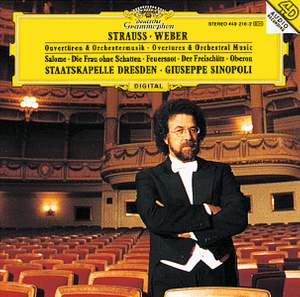
Strauss, R: Don Quixote, Op. 35, etc.

Strauss, R:

Don Quixote, Op. 35

Till Eulenspiegels lustige Streiche, Op. 28

Der Rosenkavalier: Waltzes

Metamorphosen

Sextet from Capriccio, Op. 85

Die Frau ohne Schatten, Symphonische Phantasie

Liebesszene (from Feuersnot)

Salome: Dance of the Seven Veils


Klaas Boon (viola), Tibor de Machula (cello), Theo Olof (violin)

Royal Concertgebouw Orchestra, Staatskapelle Dresden, Stuttgarter Kammerorchester, Bernard Haitink, Eugen Jochum, Karl Munchinger, Gieuseppe Sinopoli

Beginning with two rascally characters - the deluded Don Quixote and the prankster Till Eulenspiegel, this set includes remarkable recordings from the catalogues of Philips and Deutsche Grammophon, with some recordings appearing on CD internationally for the first time - Haitink's "Don Quixote", Jochum's blazing "Till Eulenspiegel" and shimmering Rosenkavalier Waltzes (both sets) and Munchinger's recording of the sextet from Capriccio. Sinopoli's "Metamorphosen", previously coupled with Bruckner's Eighth symphony and long unavailable, finds its rightful place in this Strauss collection. In addition to the Rosenkavalier and Capriccio moments, we have other orchestral music from Strauss's operas, all conducted by Sinopoli and concluding with one of the most exciting and thrillingly-recorded versions of the Dance of the Seven Veils.

Australian Eloquence - 4800478

(CD - 2 discs)

$14.25

In stock - usually despatched within 1 working day.

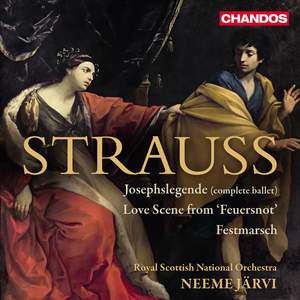
R. Strauss: Josephslegende

R. Strauss: Josephslegende


Strauss, R:

Josephs Legende

Liebesszene (from Feuersnot)

Festmarsch


Josephslegende by Richard Strauss is based on the Biblical tale of the adventures of Joseph in Egypt after he has been sold into slavery by his brothers. Strauss started the work in June 1912. However, in a letter of 11 September, he confided that ‘Joseph isn’t progressing as quickly as I expected. The chaste Joseph himself isn’t at all up my street, and if a thing bores me I find it difficult to set it to music. This God-seeker Joseph – he’s going to be a hell of an effort!’ Quite characteristic for Strauss, he showed far more interest in the sexual elements of the story, in which Potiphar’s wife attempts to seduce Joseph and ends up committing suicide. The ballet was premiered at the Paris Opéra in May 1914, where it was presented as part of a triple bill alongside danced interpretations of Rimsky-Korsakov’s Sheherazade and Schumann’s Papillons.

Strauss’s opera Feuersnot (Trial by Fire) has been interpreted as a parody of Richard Wagner’s idea of ‘redemption through love’. The opera takes place during the Midsummer Festival, where lovers swear their fidelity by leaping through the flames of a bonfire. In the story, the main character, Kunrad, is attracted to Diemut, a young girl who rejects his advances, with dire consequences. In retaliation, he persuades a sorcerer to extinguish all the fires in the town, stating that the only way to restore them is via ‘the body of a virgin in heat’. The opera concludes with the Love Scene, recorded here, in which Diemut sacrifices her virginity to Kunrad in order to release the spell on the fires. At the time of its premiere in 1901, the strong sexual theme was quite disturbing to its audiences.

Also on this disc is the Festmarsch, Op. 1, his first published orchestral work, which Strauss wrote at the tender age of twelve. Five years later he approached the publisher Breitkopf & Härtel who initially refused to take it on. Only when the work’s dedicatee, Strauss’s uncle Georg Pschorr, indicated that he would pay for the printing costs himself did they relent. Strauss’s father launched the piece at a concert given by his amateur orchestra, Wilde Gung’l, in March 1881.

The works are performed by the Royal Scottish National Orchestra under Neeme Järvi, who in 2012 celebrated his thirty-year recording career with Chandos Records.

Released or re-released in last 6 months

Super Audio CD

Format:

Hybrid Multi-channel

Chandos - CHSA5120

(SACD)

Normally: $16.75

Special: $15.00

Scheduled for release on 3 June 2013. Order it now and we will deliver it as soon as it is available.

The Welte Mignon Mystery Volume 3

The Welte Mignon Mystery Volume 3

Richard Strauss today playing his 1906 interpretations


Strauss, R:

Salome: Dance of the Seven Veils

Salome: fragments

Ein Heldenleben, Op. 40: Love Scene

Stimmungsbilder Op. 9: Nos. 1-4

Cäcilie, Op. 27 No. 2

Heimliche Aufforderung, Op. 27 No. 3

Liebesszene (from Feuersnot)


Richard Strauss (piano)

Modern recordings from piano rolls recorded in 1906

Tacet - The Welte Mignon Mystery - TACET137

(CD)

$17.00

Usually despatched in 2 - 3 working days.

Strauss & Wagner: Orchestral Works

Strauss & Wagner: Orchestral Works


Strauss, R:

Don Juan, Op. 20

Liebesszene (from Feuersnot)

Wagner:

Siegfried: Waldweben

Götterdämmerung: Siegfried's Rhine Journey

Siegfried Idyll


Wiener Philharmoniker, Orchestre du Théâtre National de l’Opéra de Paris, André Cluytens

Testament - SBT1255

(CD)

$15.50

Usually despatched in 4 - 5 working days.

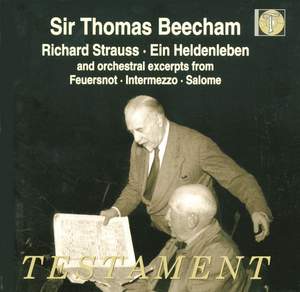
Strauss, R: Ein Heldenleben, Op. 40, etc.

Strauss, R:

Ein Heldenleben, Op. 40

Liebesszene (from Feuersnot)

Träumerei am Kamin (from Intermezzo)

Salome: Dance of the Seven Veils


Testament - SBT1147

(CD)

$15.50

Usually despatched in 4 - 5 working days.

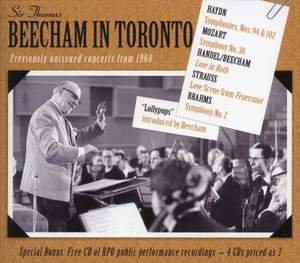
Beecham in Toronto

Beecham in Toronto


Brahms:

Symphony No. 2 in D major, Op. 73

Recorded live in Toronto on 7th April, 1960

CBC Symphony Orchestra

Delius:

North Country Sketches

Recorded live on 4th November 1959

Royal Philharmonic Orchestra

Handel:

Love in Bath (suite on Handel arias by Sir Thomas Beecham)

Recorded live in Toronto on 3rd April, 1960

CBC Symphony Orchestra

Haydn:

Symphony No. 102 in B flat major

Recorded live in Toronto on 3rd April, 1960

CBC Symphony Orchestra

Symphony No. 94 in G Major 'Surprise'

Recorded live in Toronto on 7th April, 1960

CBC Symphony Orchestra

Lalo:

Symphony in G minor

Recorded live on 25th October 1959

Royal Philharmonic Orchestra

Massenet:

La Vierge: Le Dernier Sommeil de la vierge (Légende sacrée)

Recorded live on 5th April, 1960

Toronto Symphony Orchestra

Mozart:

Symphony No. 38 in D major, K504 'Prague'

Recorded live in Toronto on 3rd April, 1960

CBC Symphony Orchestra

Symphony No. 35 in D major, K385 'Haffner'

Recorded live on 25th December 1958

Royal Philharmonic Orchestra

Rossini:

La gazza ladra Overture

Recorded live on 5th April, 1960

Toronto Symphony Orchestra

Saint-Saëns:

Le Rouet d'Omphale, Op. 31

Recorded live on 5th April, 1960

Toronto Symphony Orchestra

Sibelius:

Karelia Suite, Op. 11: Alla marcia

Recorded live on 5th April, 1960

Toronto Symphony Orchestra

Strauss, R:

Liebesszene (from Feuersnot)

Recorded live in Toronto on 7th April, 1960

CBC Symphony Orchestra

Suppe:

Ein Morgen, ein Mittag, ein Abend in Wien Overture

Recorded live on 5th April, 1960

Toronto Symphony Orchestra

Wagner:

Die Meistersinger von Nürnberg: Overture

Recorded live on 4th November 1959

Royal Philharmonic Orchestra


This 4CD set includes three Beecham concerts from Toronto in 1960, which have never been released before. The works include Haydn Symphonies Nos. 94 and 102, Mozart Symphony No. 38 and Brahms’s Symphony No.2. Some “Lollipops” are introduced by Beecham himself and there are interviews with Leon Goossens and Neville Cardus.

The bonus CD is Beecham conducting the RPO.

“the performances still pulsate with the old energy. At times, he makes the CBC Symphony play like a Beecham orchestra in its élan and phrasing.” Sunday Times, 30th October 2011

20% off Music & Arts

Music & Arts - MACD1255

(CD - 4 discs)

Normally: $38.25

Special: $30.60

(also available to download from $28.00)

Usually despatched in 2 - 3 working days. (Available now to download.)

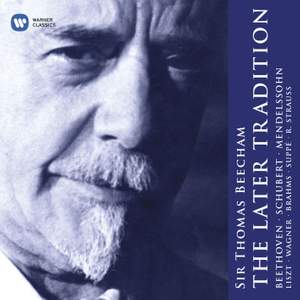
Sir Thomas Beecham: The Later Tradition

Sir Thomas Beecham: The Later Tradition


Beethoven:

Symphony No. 2 in D major, Op. 36

Symphony No. 7 in A major, Op. 92

Mass in C major, Op. 86

Jennifer Vyvyan (soprano), Monica Sinclair (contralto), Richard Lewis (tenor), Marian Nowakowski (bass)

Beecham Choral Society

Incidental music to The Ruins of Athens

Brahms:

Academic Festival Overture, Op. 80

Schicksalslied, Op. 54

Symphony No. 2 in D major, Op. 73

Liszt:

A Faust Symphony, S108

Alexander Young (tenor)

Orpheus, symphonic poem No. 4, S98

Psalm 13

Walter Midgley (tenor)

Mendelssohn:

A Midsummer Night's Dream Overture, Op. 21

The Fair Melusine Overture, Op. 32

Schubert:

Symphony No. 3 in D major, D200

Symphony No. 5 in B flat major, D485

Symphony No. 6 in C major, D589

Strauss, R:

Don Quixote, Op. 35

Paul Tortelier (cello), Leonard Rubens (viola), Oscar Lampe (violin)

Le Bourgeois Gentilhomme, Op. 60

Ein Heldenleben, Op. 40

Steven Staryk (violin)

Liebesszene (from Feuersnot)

Salome: Dance of the Seven Veils

Intermezzo, Op. 72: Entr'acte in A flat

Suppe:

Dichter und Bauer Overture

John Kennedy (cello)

Wagner:

Die Meistersinger von Nürnberg: Overture


There can be few, if any, musicians who have singlehandedly done so much in the establishment of resources for musical performance than Sir Thomas Beecham.

During WWI he conducted and supported financially both the Hallé and London Symphony Orchestras and the Royal Philharmonic Society. In 1915 he formed the Beecham Opera Company which trained many young British singers in this field. Eight years later this became the British National Opera Company and was absorbed into Covent Garden in 1932 when Beecham returned to be its Musical Director.

To quote David Cairns “We are nationally and individually a more musically aware people because of him and what he gave us”. A forceful statement, true, but whose life could ever challenge it?

Dissatisfied by conditions and practices, notably the supply of deputies for rehearsals, prevalent in British orchestras, he formed the London Philharmonic Orchestra that same year. Beecham was now able to be at the fulcrum of all developments in music in Britain. WWII put an end to this halcyon period. With Covent Garden shut he travelled, primarily in America, and did not return to Britain until 1944. The London Philharmonic had now become a self-governing body so Beecham, then aged 67, launched the Royal Philharmonic Orchestra. This was the orchestra with which he committed to disc so many classic recordings with which EMI Classics marks the 50th anniversary of his passing.

It is true that Beecham had particular favourites in composers – Haydn, Mozart, Schubert, Berlioz, Bizet and Puccini spring immediately to mind; also his love for Handel – even though his performances were always BIG-scale! He was an early champion of Richard Strauss and became a most effective exponent of Sibelius. His name will always be inextricably linked with that of Delius whose music Beecham seemed to know better even than the composer and it is appropriate that they are buried not far apart in the graveyard at St. Peter’s Parish Church, Limpsfield, Surrey.

He was knighted in 1916, the year he succeeded to his father’s baronetcy, and made a Companion of Honour in 1957.This affable, brilliant, usually charming, ever-communicative, quick-witted – even, at times, to the point of cruelty, dedicated conductor was also the most gifted executive musician England has ever produced.

He was fortunate that his grandfather, a chemist, had created the highly successful pharmaceutical manufacturing business which bore his name. His father, who had started in the company whilst still a teenager, was also fond of music so he was prepared to fund his son’s enthusiastic appetite to attend operas and concerts both here and abroad.

Born on 29th April 1879 in St. Helens, he attended public school at Rossall where his talent at the piano became a legend (the only boy ever to have been allowed a grand piano in his study!). From there he briefly attended Oxford (Wadham) but the composition classes, with Charles Wood in London and Moszkowski in Paris, were funded privately. As a conductor he was purely self-taught.

He formed an orchestra in his home town and deputised for Richter at a Hallé concert when his father was mayor. His career path was clear: he would use his financial resources to support the art which he enjoyed with the aim of bringing it to as many as possible.

At the age of 30 he launched the Beecham Symphony Orchestra, all young and carefully chosen. They would tour, play for opera and ballet and give concerts of adventurous music. London duly welcomed him for a season of intensive opera performances and over the next three years introduced many new ones to British audiences, including by Strauss, Delius and the Russians. He also brought Diaghilev’s Ballets Russes starring Nijinsky and Karsavina to the British stage.

“The finesse of the detail, the fierce attack, individual flair, corporate precision, blazing warmth: the sum total is playing of tangible personality and, often, ineffable beauty...Listen to the Royal Philharmonic principals dancing through Strauss’s Bourgeois Gentilhomme...you’ll go weak at the knees.” The Times, 18th February 2011 *****

EMI Sir Thomas Beecham Edition - 9186112

(CD - 8 discs)

$30.25

In stock - usually despatched within 1 working day.

Copyright © 2002-13 Presto Classical Limited, all rights reserved.