All recordingsPrices shown exclude VAT. (UK tax is not payable for deliveries to United States.) See Terms & Conditions for p&p rates. | |  | Debussy & Mahler: Mélodies de jeunesse
Julie Fuchs (soprano) & Alphonse Cemin (piano) Julie Fuchs, the 26-year-old soprano from Avignon, has just won a Victoire de la Musique Classique in the 'Lyrical Revelation of the Year' category, after being hailed a Classical Revelation by the perfomers’ rights society, ADAMI and carrying off the Gabriel Dessurget prize at the 2011 Aix-en-Provence Festival. Today, roles such as Susanna in 'Figaro' or Urgande in 'Amadis de Gaule' correspond perfectly to the quality of her voice, as did the title role in 'Acis et Galatée' which she took in July 2011 for the Aix-en-Provence Festival. Over the coming decade, that voice and that stage presence will see her moving towards weightier roles, with the title role of La Traviata beckoning. She’s at the start of a big career: one to watch. “Fuchs’ bright soprano radiates character and sensitivity. An enchanting disc.” Financial Times, 16th March 2013 **** | 
| | | In stock - usually despatched within 1 working day. |
|
|
| |  | Mahler & Zemlinsky: Songs
Alma Mahler was greatly admired by many gentlemen of intellectual circles during the late nineteenth-century. This disc portrays songs set by Alma Mahler, Alexander Zemlinsky and Gustav Mahler. Ruth Ziesak easily portrays the joy and sorrow in each of these lieder, skillfully accompanied by Gerold Huber. “Ziesak is an impressive Lieder performer giving highly convincing interpretations that demonstrate her clear bright tones and enviable tuning. The sensitive work from Gerold Huber adds to the desirability of the release” MusicWeb International, 13th June 2013 | 
| | | (also available to download from $11.00) | In stock - usually despatched within 1 working day. |
|
|
| |  | Des Knaben Wunderhorn
Wolfgang Holzmair is one of the great word-painters of our time and one of the foremost interpreters of Mahler’s songs. He is embarking on an international tour of this repertoire, which has been a central part of his career, to mark his 60th birthday. His interpretation of this music draws upon many years of experience and brings a deep insight to these wonderful songs. Mahler composed his settings of poems by Clemens Brentano and Achim von Arnim in 1892. The piano-writing is remarkable for its almost orchestral complexity and imitation of orchestral effects. Mahler would eventually score 12 of the 'Wunderhorn' songs for orchestra. The poems’ appeal to Mahler is easy to understand: nature, yearning, love, farewells, night, death, spectral goings-on, boisterous youth, high spirits and wry, crisp humour all combined with the agitated imagination and personality of the composer to produce some of the greatest songs by any composer. They also formed the fertile ground from which several of the symphonies grew. “this is a unique sequence, showing that most of the earliest settings which sit alongside the more familiar numbers, usually linked by theme, are just as finely-wrought and no less typical of Mahler's most haunting preoccupations.” BBC Music Magazine, Christmas 2012 **** “His word-painting is superb, replacing sheer vocal firepower wityh more Lieder-friendly qualities of agility , precision and nuance. Poetic narrative is everywhere apparent...Holzmair seems to make the case for Mahler inheriting the Lieder mantle from Schumann...for nearly 80 minutes you can listen to Mahler's melodies and barely recall that they exist in an orchestral version” Gramophone Magazine, December 2012 | | | In stock - usually despatched within 1 working day. |
|
|
| |  | Berio: Orchestral realisations of Schubert, Brahms & Mahler
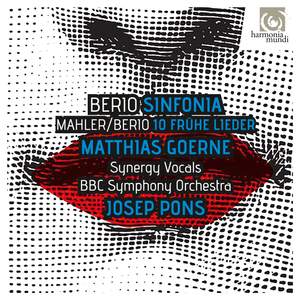
Berio had an abiding fascination with reconciling the past and the present, which can be seen in his orchestral realisations of works by Mahler and Brahms, and most notably, in Rendering (1990), his typically creative completion of unfinished symphonic sketches by Schubert. In Rendering, Berio – in his own words – sets himself the target of ‘following those modern restoration criteria that aim at reviving the old colours without, however, trying to disguise the damage that time has caused, often leaving inevitable empty patches in the composition’. In the ‘restoration’, Schubert’s sketches have been beautifully orchestrated in period style, and the ‘empty patches’ have been filled with music composed by Berio himself, in his own voice – thereby successfully combining the musical worlds of the early nineteenth and late twentieth centuries into one convincing whole. The Clarinet Sonata by Brahms embodies the composer’s taut and concentrated compositional style. In transcribing the work, Berio felt that, when experienced in the less intimate surroundings of today’s concert halls, the extreme compression of Brahms’s late chamber music style was in need of some additional support, and his version, recorded here, includes a fourteen-bar orchestral introduction to the first movement, leading into Brahms’s own, much shorter opening phrase, as well as five additional bars at the beginning of the second movement. Berio completed his orchestration of six early songs by Gustav Mahler in 1987, and conducted the first performance with the Toscanini Orchestra on 7 December that year, with Thomas Hampson the baritone soloist. The six songs in this orchestrated set are ‘Hans und Grete’, ‘Phantasie’, ‘Scheiden und Meiden’, ‘Erinnerung’, ‘Frühlingsmorgen’, and ‘Ich ging mit Lust durch einen grünen Wald’. The Bergen Philharmonic Orchestra is conducted by Edward Gardner, with Roderick Williams the baritone soloist in the songs by Mahler and Michael Collins the soloist in Brahms’s Clarinet Sonata. “Gardner shapes it all beautifully, and his soloists – Michael Collins in the Sonata, baritone Roderick Williams in the songs – are suave and refined.” The Guardian, 2nd February 2012 **** “In a joyfully discombobulating programme, Luciano Berio's mischief-making orchestration of Mahler's "Six Early Songs" uses the Mahlerian paintbox in an almost anti-Mahlerian, jaunty fashion...Gardner conducts with élan, highlighting the clean attack of the Bergen strings.” The Independent, 12th February 2012 **** “Gardner's phrasing of the central movement [is] a cousin to Brian Newbould's completion, and thus Rendering's periodic, unpredictable descent into twilit oblivion becomes all the more touching...Leaving balance issues to the engineers, Roderick Williams takes a relaxed, confiding approach, never less than suave even against the galloping rhythms of 'Scheiden und Meiden'.” Gramophone Magazine, May 2012 “[Berio's] versions of the Mahler songs are straightforward and affectionately sung by Roderick Williams...Berio himself looms larger in Rendering...The sound of the celesta, alien to Schubert, signals these departures into a dream world, which Gardner captures atmospherically. His assured sense of style in Schubert's material is compelling.” BBC Music Magazine, May 2012 **** | | | (also available to download from $11.00) | In stock - usually despatched within 1 working day. |
|
|
| |  | Mahler - UrlichtLieder
“One of my recordings of the year” Michael Kennedy, Sunday Telegraph “astonishing sophistication” BBC Music Magazine ***** | | | In stock - usually despatched within 1 working day. |
|
|
| |  | Mahler - Songs
“This disc shows Stephan Genz entering his fourth decade with all the light suppleness and ardour of his youthful recordings, but now with darker colours and firmer bass ballast folding into his baritone. His intuitive musical partnership with Roger Vignoles is as sentient and perceptive as ever; and together they uncover the dark, sensual mysteries of the late-Romantic response to the natural world” BBC Music Magazine “Stephan Genz's voice and style place him above his many noted contemporaries. His mellifluous baritone recalls that of a young Thomas Hampson, but his understanding of the Lieder genre is even more penetrating, as this Mahler recital reveals. Each song is shaped as a whole yet with subtleties of phrase and word-painting that seem inevitable in every respect, especially as the chosen tempi always seem the right ones. Performing and listening to these songs with piano is inevitably a more intimate experience than when they are heard in their orchestral garb. The pair's rapport is evident throughout. Memorable are the the poise and stillness of 'Ich atmet' einen Linden duft' from the Rückert-Lieder, the eloquent sadness of 'Nicht Wiedersehen' and the restrained sorrow of the whole of Kindertotenlieder. Not a hint of sentimentality, such a danger in Mahler, spoils the experience of the composer's deeply felt emotions. Hyperion's recording, beautifully balanced, catches the true quality of Genz's voice and the refinement of Vignoles's playing. This disc is an experience not to be missed by any lover of Mahler and/or of Lieder.” Gramophone Classical Music Guide, 2010 | | | In stock - usually despatched within 1 working day. |
|
|
| |  | Mahler - Songs of My Youth
“The performance are radiant and deeply understanding from both singer and pianist, well caught in atmospheric recording. A heart-warming record.” Penguin Guide, 2010 **** | | | In stock - usually despatched within 1 working day. |
|
|
| |  | Clytus Gottwald: Alma Mahler & Gustav MahlerTranscriptions for a Capella Choir
At the turn of the 19th to the 20th century the interest of the composers for a cappella choir music seemed to be weakening; Mahler and Debussy wrote for choir, then promptly included them into orchestral works. The a capella music of the 1920s was influenced by the polyphonic tradition of the 16th century. In the 1960s Ligeti opened up new perspectives with his piece for choir Lux aeterna. Gottwald’s transcriptions refer to Ligeti’s work giving us ultimately better understanding of the contemporary choir music. “Eminently suited to this repertoire the SWR Vokalensemble Stuttgart display consistent unison producing a sound that often feels blissful. Meticulous preparation combined with subtlety of dynamic shading and unerring accuracy make for highly satisfying listening.” MusicWeb International, 24th May 2013 | 
| | | (also available to download from $11.00) | Usually despatched in 2 - 3 working days. (Available now to download.) |
|
|
| |  | Mahler: Lieder
Bo Skovus is considered to be one of the top Lieder interpreters of his generation. This Danish baritone is a star of the Vienna State Opera. He performs with the leading opera houses and orchestras in Europe, America and Japan. “Skovhus is an experienced practitioner of the art of Lieder recital and is renowned for taking risks with his interpretations. He has plenty of voice when he so chooses, even if a certain throatiness is creeping in these days...
Vladar’s pianism... is a real tour de force: rich in tone, subtle in dynamics and wonderfully vivid” MusicWeb International, August 2012 | | | Usually despatched in 2 - 3 working days. |
|
|
| |  | Fischer-Dieskau 85th Birthday Edition: Mahler LiederBerlin Philharmonie, 1971 (live)
These releases from the archives of the RIAS and the Sender Freies Berlin document the unequalled quantitative and qualitative spectrum which baritone Fischer-Dieskau acquired during the five decades of his career. They offer a fascinating insight into the breadth of his repertoire as well as his artistic approach, with which he maintained a careful balance of development and continuity until the end. These recordings – spanning Beethoven’s sacred songs Op. 48 of 1806, through Schumann, Brahms, Mahler and Reger, to Heinrich Sutermeister’s expressive psalm setting of 1948 – demonstrate the essential Fischer-Dieskau. Not only do they document the artistic partnership with pianists such as Hertha Klust, Daniel Barenboim, Cord Garben, Aribert Reimann and Tamás Vásáry, but also the delightful collaboration with the organist Ulrich Bremsteller. Furthermore, Dietrich Fischer-Dieskau can be heard together with his wife and musical partner, Julia Varady. This is a documentary edition both in the sense of a historic and an artistic legacy: it reveals the riches of lieder from the last two centuries which Fischer-Dieskau, in his role of musical chronicler, made accessible for the present age; and it is an impressive record of an incomparable interpretational art, according to which word and music were always treated and realised as a unit. | | | Usually despatched in 3 - 4 working days. |
|
|
| |
|