Prices shown exclude VAT. (UK tax is not payable for deliveries to United States.) See Terms & Conditions for p&p rates. | |  |
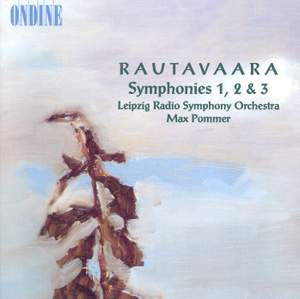
It has been said that the heroic Third Symphony, written after his student years in 1961, almost sounds like
Bruckner. Rautavaara's own notes in the CD booklet declare that "the four movements breathe in a solemn,
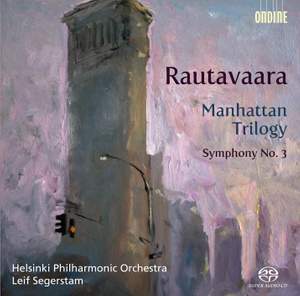
Brucknerian swelling - akin to the rhythm of the land and the sea." “The music is full of voluptuous, organic melody, rich textures and a subtle yet surging development. Segerstam's performance shows sensitivity, a seamless evolution and lush sound.” BBC Music Magazine, March 2008 **** “Rautavaara studied at the Juilliard School in 1955-56 and Manhattan Trilogy (2004) was commissioned to celebrate its centennial. In recalling his youthful sojourn in the Big Apple, the composer deployed the full panoply of his late orchestral manner in a hugely engaging triptych describing his 'hopeful Daydreams', 'sudden Nightmares of doubt' and 'slowly breaking Dawn of the personality'. Where Segerstam's vivid interpretation, allied to Ondine's sumptuous recording, glows through its 20 minutes, Inkinen provides a beautifully focused reading, nearly two min- utes swifter, with every detail brought out to telling effect. Not the most gripping of Rautavaara's recent orchestral essays Manhattan Trilogy is nonetheless accomplished. What connects it to the Third Symphony (1959-61) is the treatment of the past. The symphony – one of the finest of the post-war period, serially organised within a vibrant tonal framework – recreates the idiom of Bruckner from a late-1950s sensibility and, ironically, remains the more progressive. Rautavaara's most recent symphony, the Eighth (1999), was memorably recorded by Segerstam (Ondine). Inkinen once again produces a refined interpretation with crystal-clear detail although Segerstam achieved more grandeur in the peroration. Choice here really will depend on couplings (the Harp Concerto on Ondine). The revision of the Sixth Symphony's finale as a – presumably – stand-alone concert piece shorn of its part for synthesiser works well enough, though it is no substitute for the whole work, for which turn to Max Pommer's bracing account (also with the Helsinki Philharmonic) for Ondine. In context, though, the Naxos programme works most effectively and is a nearperfect introduction to Rautavaara's late manner. Both discs are highly recommendable; at its price, the Naxos is hard to beat but Ondine has the Third. Buy both!” Gramophone Classical Music Guide, 2010 | | | (also available to download from $10.50) | In stock - usually despatched within 1 working day. |
|
|
| |  |
| | | (also available to download from $10.50) | Usually despatched in 2 - 3 working days. (Available now to download.) |
|
|
| |  | Rautavaara: Cantus Arcticus
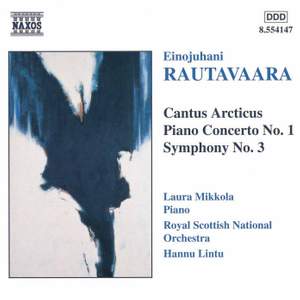
“a masterpiece that blows away the oft-expressed contention that there's no great music in traditional forms being written today” Classics Today “No other new music stands to benefit more from extensive exposure, not so much because of its quality (which is beyond question), as because of an almost tangible connection with nature, than that by Rautavaara. One constantly senses the joy of a man alone with the elements: awe-struck, contented, inspired. Bird-song comes from all directions, literally in the ' Concerto for birds and orchestra' or Cantusarcticus, which sets taped bird-song against a rustic orchestral backdrop. The tape blends well with the music and is very atmospheric. The young Finnish conductor Hannu Lintu directs a fine performance. The First Piano Concerto and Third Symphony (out of seven) receive good performances, most notably the Brucknerian Symphony, an impressive and often dramatic work that begins and ends in the key of D minor. The orchestration incorporates four Wagner tubas, though some of the finest material is also the quietest. The slow movement is sullen but haunting, the Scherzo occasionally suggestive of Nielsen or Martinu and the finale brings the parallels with Bruckner fully within earshot. The First Piano Concerto has a brilliance and immediacy that should please orchestral adventurers and piano aficionados. The solo writing employs clusters and much filigree fingerwork, but it's the noble, chorale-like second movement that leaves the strongest impression. Laura Mikkola gives a good performance. Naxos gives a full sound picture and overall, this is an excellent CD, concisely annotated by the composer.” Gramophone Classical Music Guide, 2010 | | | (also available to download from $6.00) | Usually despatched in 2 - 3 working days. (Available now to download.) |
|
|
| |  | Rautavaara - The 8 SymphoniesDigital recordings, previously released
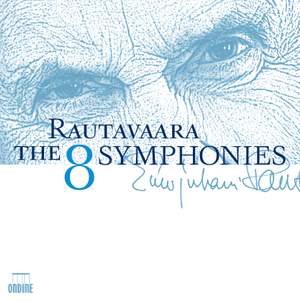
Digibox with 'LIMITED EDITION' sticker, 4 CDs, 16p booklet + 16p extra insert (Rautavaara back catalogue) Einojuhani Rautavaara may well be the most popular symphonist alive today. On the occasion of his 80th anniversary, Ondine pays homage to its longtime ‘house composer’ by releasing the first-ever edition of the complete eight symphonies, in a special box set. Written between 1955 and 1999, the eight symphonies form a central pillar in Rautavaara's extensive artistic output and showcase the many stylistic periods in his fruitful career.They are hauntingly accessible to the listener and have proven wide audience appeal; the Seventh Symphony, ‘Angel of Light' (1994), became a best-seller and spurred Rautavaara to considerable international fame (including a Grammy nomination), leading The Philadelphia Orchestra to commission the Eighth Symphony, 'The Journey' (1999), for their centenary celebrations. These recordings have all been released by Ondine to international popular and critical acclaim, and were all produced in close collaboration with the composer. Elegant packaging, with the use of metallic colour, underlines the exclusivity of this limited edition, in combination with an attractive price. | | | (also available to download from $24.00) | In stock - usually despatched within 1 working day. |
|
|
| |
|