Prices shown exclude VAT. (UK tax is not payable for deliveries to United States.) See Terms & Conditions for p&p rates. | |  | Bizet: Orchestral Works
| | | In stock - usually despatched within 1 working day. |
|
|
| |  | Bizet - Suites
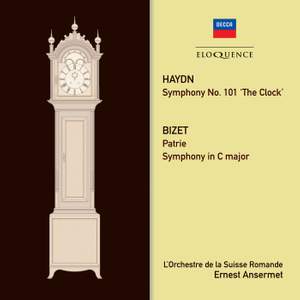
Bizet's Carmen was misunderstood at its premiere in 1875. The Opera-Comique was a place where respectable families could be entertained, and where virginal daughters could be introduced to blameless sons with marriage in mind. No one expected to see uncouth gypsies, dirty smugglers and vulgar cigarette girls on its stage, let alone unvarnished human passions and murder, as Bizet so vividly portrayed them in Carmen! This 2CD set brings together Ansermet's complete Bizet stereo recordings for Decca, are good-natured and piquant without being showy for showiness's sake. The 'rural' element of so much of the music in the Bizet suites is emphasised and in L'Arlesienne, Ansermet ensures that the Provence sun and starlight shine clearly through the music's textures. Likewise, his approached to the early Symphony is summery and there is an unpressured willingness to give the symphony space in which to breathe. Nothing is forced, and melodies are allowed to come into happy bloom. Joaquin Turina was born in Seville, the city in which most of Carmen is set, so he could hardly avoid composing 'Spanish music'. Turina's Danzas fantasticas are more abstract and less stereotypical than some of the other Spanish repertory Ansermet recorded, but they require no less of a visceral response. Ansermet's languid, sensual, intoxicating, and sometimes even sinister reading of this score, brilliantly captured by Decca's engineering team, remains a standard by which other recordings should be judged. | | | In stock - usually despatched within 1 working day. |
|
|
| |  | Bizet: Orchestral Works
| | | Usually despatched in 2 - 3 working days. |
|
|
| |  | Bizet: Symphony in C Major, Patrie Overture
| |
|
| |  | André Cluytens
| | | Usually despatched in 4 - 5 working days. |
|
|
| |  | Bizet: Complete Orchestral Music
Although many listeners will have been introduced to Georges Bizet (1838–1875) through his wellloved operas – notably The Pearl Fishers and Carmen – this fantastic volume celebrates his orchestral music, sometimes overlooked but entirely worthy of attention. The collection surveys his complete body of orchestral works, taking in symphonies, suites, preludes and overtures. Fans of the dramatic compositions will not be disappointed: a large portion of the three-disc set is devoted to music inspired by or written for the stage. Two suites from Carmen are a highlight, with movements that bring to life the opera’s most magical moments, from Spanish dances to the famous Toréador song and Habañera. An orchestral suite based on the mature opera La Jolie Fille de Perth is also included, as are the two L’Arlésienne Suites of evocative, colourful incidental music to a play by Alphonse Daudet. Bizet’s two main contributions to large-scale symphonic music are also featured: although the composer was never entirely satisfied with Roma symphony, the early Symphony in C is undoubtedly one of his masterpieces, charming and ebullient in style. Some less well-known but equally impressive works round off this collection, which is rich in opportunities for listeners to discover the different sides of Bizet’s colourful music. Enrique Bátiz, leading two internationally renowned orchestras, delivers thrilling performances, making this an indispensable and comprehensive volume. | | | In stock - usually despatched within 1 working day. |
|
|
| |  | Bizet - Orchestral Works
| | | In stock - usually despatched within 1 working day. |
|
|
| |  | Sir Thomas Beecham conducts French Music
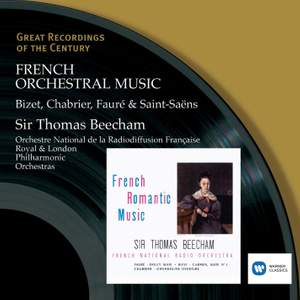
Berlioz: | Symphonie fantastique, Op. 14 Le Corsaire Overture, Op. 21 Marche troyenne (from Les Troyens) Chasse royale et Orage (from Les Troyens) Le carnaval romain Overture, Op. 9 King Lear Overture, Op. 4 La Damnation de Faust, Op. 24: Ballet des Sylphes La Damnation de Faust, Op. 24: Menuet des Follets | Bizet: | Symphony in C L'Arlesienne Suites 1 & 2 Carmen: Prelude to Act I Carmen: Entr'actes Patrie Overture, Op. 19 Roma: Carnaval | Chabrier: | Gwendoline Overture Joyeuse Marche España | Debussy: | Prélude à l'après-midi d'un faune L'Enfant prodigue: Cortege et Air de danse | Delibes: | Le Roi s'amuse: Incidental Music | Fauré: | Dolly Suite, Op. 56 Pavane, Op. 50 | Franck, C: | Symphony in D minor | Gounod: | Faust - Ballet Music Roméo et Juliette: Le Sommeil de Juliette | Gretry: | Ballet Suite Zémire et Azor | Lalo: | Symphony in G minor | Massenet: | Cendrillon Valse La Vierge: Le Dernier Sommeil de la vierge (Légende sacrée) | Saint-Saëns: | Danse des Prêtresses de Dagon (from Samson et Dalila) Bacchanale from Samson et Dalila Le Rouet d'Omphale, Op. 31 | Vidal, P-A: | Zino-zina: gavotte |
There can be few, if any, musicians who have singlehandedly done so much in the establishment of resources for musical performance than Sir Thomas Beecham. During WWI he conducted and supported financially both the Hallé and London Symphony Orchestras and the Royal Philharmonic Society. In 1915 he formed the Beecham Opera Company which trained many young British singers in this field. Eight years later this became the British National Opera Company and was absorbed into Covent Garden in 1932 when Beecham returned to be its Musical Director. To quote David Cairns “We are nationally and individually a more musically aware people because of him and what he gave us”. A forceful statement, true, but whose life could ever challenge it? Dissatisfied by conditions and practices, notably the supply of deputies for rehearsals, prevalent in British orchestras, he formed the London Philharmonic Orchestra that same year. Beecham was now able to be at the fulcrum of all developments in music in Britain. WWII put an end to this halcyon period. With Covent Garden shut he travelled, primarily in America, and did not return to Britain until 1944. The London Philharmonic had now become a self-governing body so Beecham, then aged 67, launched the Royal Philharmonic Orchestra. This was the orchestra with which he committed to disc so many classic recordings with which EMI Classics marks the 50th anniversary of his passing. It is true that Beecham had particular favourites in composers – Haydn, Mozart, Schubert, Berlioz, Bizet and Puccini spring immediately to mind; also his love for Handel – even though his performances were always BIG-scale! He was an early champion of Richard Strauss and became a most effective exponent of Sibelius. His name will always be inextricably linked with that of Delius whose music Beecham seemed to know better even than the composer and it is appropriate that they are buried not far apart in the graveyard at St. Peter’s Parish Church, Limpsfield, Surrey. He was knighted in 1916, the year he succeeded to his father’s baronetcy, and made a Companion of Honour in 1957.This affable, brilliant, usually charming, ever-communicative, quick-witted – even, at times, to the point of cruelty, dedicated conductor was also the most gifted executive musician England has ever produced. He was fortunate that his grandfather, a chemist, had created the highly successful pharmaceutical manufacturing business which bore his name. His father, who had started in the company whilst still a teenager, was also fond of music so he was prepared to fund his son’s enthusiastic appetite to attend operas and concerts both here and abroad. Born on 29th April 1879 in St. Helens, he attended public school at Rossall where his talent at the piano became a legend (the only boy ever to have been allowed a grand piano in his study!). From there he briefly attended Oxford (Wadham) but the composition classes, with Charles Wood in London and Moszkowski in Paris, were funded privately. As a conductor he was purely self-taught. He formed an orchestra in his home town and deputised for Richter at a Hallé concert when his father was mayor. His career path was clear: he would use his financial resources to support the art which he enjoyed with the aim of bringing it to as many as possible. At the age of 30 he launched the Beecham Symphony Orchestra, all young and carefully chosen. They would tour, play for opera and ballet and give concerts of adventurous music. London duly welcomed him for a season of intensive opera performances and over the next three years introduced many new ones to British audiences, including by Strauss, Delius and the Russians. He also brought Diaghilev’s Ballets Russes starring Nijinsky and Karsavina to the British stage. “The French accent he found for the RPO in Bizet's L'Arlesienne Suites is still deliciously colourful 55 years on. This is the box to explore first if you're a fan of Beecham's lollipops...no wonder he was awarded the Légion d'honneur for services to French music.” Gramophone Magazine, July 2011 **** “The finesse of the detail, the fierce attack, individual flair, corporate precision, blazing warmth: the sum total is playing of tangible personality and, often, ineffable beauty...Listen to...the strings’ silken tenderness in Grétry’s Zémire et Azor...Then there’s the fizz of Beecham’s Berlioz.” The Times, 18th February 2011 ***** | | | In stock - usually despatched within 1 working day. |
|
|
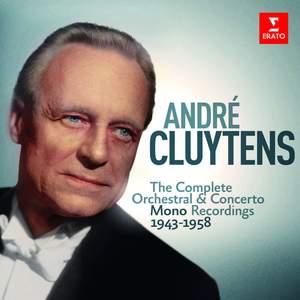
| |  | Andre Cluytens - A French Collection
Berlioz: | Symphonie fantastique, Op. 14 Roméo et Juliette, Op. 17 (excerpts) | Bizet: | L'Arlesienne Suites 1 & 2 Patrie Overture, Op. 19 Symphony in C La jolie fille de Perth suite | Debussy: | La Boite A Joujoux (orch. André Caplet) Children's Corner (orch. André Caplet) | Fauré: | Requiem, Op. 48 | Franck, C: | Symphonic Variations for piano & orchestra, M46 Aldo Ciccolini (piano) Symphony in D minor | Indy: | Symphony on a French Mountain Song Op. 25 | Ravel: | Le Tombeau de Couperin Valses nobles et sentimentales Alborada del gracioso (orchestral version) Daphnis et Chloé - Suite No. 1 Daphnis et Chloé - Suite No. 2 Menuet antique Une barque sur l'océan (orchestral version) | Roussel: | Symphony No. 4 in A major, Op. 53 Le Festin de l'Araignée, Op. 17 - fragments symphonique Symphony No. 3 in G minor, Op. 42 Bacchus et Ariane, Op. 43 - Suite No. 2 Sinfonietta for string orchestra, Op. 52 | Saint-Saëns: | Symphony No. 3 in C minor, Op. 78 'Organ Symphony' |
Orchestre National de la Radiodiffusion Francaise & Conservatoire Concerts Society Orchestra, Andre Cluytens recorded 1953-1966 | | | Usually despatched in 4 - 5 working days. |
|
|
| |  | Alexander Gauk Edition Volume 1
Arensky: | March, in memory of Suvorov Characteristic Pieces (24), Op. 36: In the Fields Waltz in F major, from: 6 Children’s Pieces Op. 34 | Beethoven: | Coriolan Overture, Op. 62 | Bizet: | Patrie Overture, Op. 19 | Casella: | Italia, Op. 11 | Dukas: | The Sorcerer's Apprentice | Enescu: | Romanian Rhapsody in A major, Op. 11 No. 1 | Glazunov: | Spring, Op. 34 Waltz in D major Op. 42 No. 3 | Glinka: | Premiere Polka in B Flat Major Kamarinskaya Memory of Friendship Patriotic Song | Ivanov-Radkevich: | Russian Overture | Khachaturian: | Spartacus Suite Symphony No.1 in E minor | Liszt: | A Faust Symphony, S108 | Mendelssohn: | Ruy Blas Overture, Op. 95 | Miaskovsky: | Symphony No. 17 in G sharp minor, Op. 41 | Milhaud: | Suite Provençale | Prokofiev: | Flourish, Mighty Land Op. 114 Russian Overture, Op. 72 | Rachmaninov: | Three Russian Songs, Op. 41 Evegeny Kibkalo (baritone) | Rimsky Korsakov: | The Song of Oleg, The Wise Dmitri Tarkhov (tenor), Konstantin Polyaev (bass) | Shostakovich: | Symphony No. 5 in D minor, Op. 47 Symphony No. 11 in G minor, Op. 103 'The year 1905' | Tchaikovsky: | The Seasons, Op. 37b (omitting May & August) Hamlet: Overture & Incidental Music |
USSR State Radio & TV Symphony Orchestra & Chorus, Alexander Gauk This set presents a great opportunity to become more familiar with the charismatic Russian conductor, Alexander Gauk. He was also a composer but is probably better known for his orchestral arrangements, notably of Tchaikovsky’s ‘The Seasons’, included in this set. Gauk also reconstructed the score of Rachmaninoff’s first piano concerto from the parts in 1945, thus enabling further performances after its disastrous première in 1897. He had a preference for Russian music which is shown here, eight out of the ten CDs being devoted exclusively to Russian composers. Many of the most prominent Russian conductors of the twentieth century were once pupils of Alexander Gauk, for example, Evgeny Mravinsky and Evgeny Sveltanov. Gauk, who died in 1963, was one of those talented Russian musicians who rarely had the opportunity to experience the western lifestyle yet his fame did reach beyond his mother country. Apart from featuring some of today’s better known symphonies by Shostakovich (Nos. 5 and 11) and the aforementioned ‘The Seasons’, the Gauk Edition comprises seldom performed works by Arensky, Balakirev (Islamey), Myaskovsky (Symphony No. 17) and Glinka and Rimsky-Korsakov. | | | In stock - usually despatched within 1 working day. |
|
|
| |
|