All recordingsPrices shown exclude VAT. (UK tax is not payable for deliveries to United States.) See Terms & Conditions for p&p rates. | |  | Mozart: Opera Arias
| | | (Sorry, download not available in your country) | Usually despatched in 2 - 3 working days. |
|
|
| |  | Elisabeth Schwarzkopf sings Mozart, Schubert and Strauss
| | | Usually despatched in 4 - 5 working days. |
|
|
| |  | Mozart: Opera Arias
| | | Usually despatched in 4 - 5 working days. |
|
|
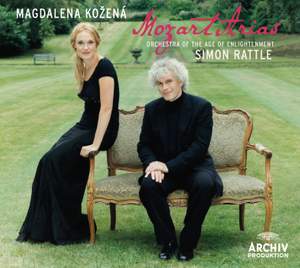
| |  | Mozart - Arias
Mozart: | Giunse alfin il momento... Deh, vieni, non tardar… (from Le nozze di Figaro) Voi che sapete (from Le nozze di Figaro) Ch'io mi scordi di te?... Non temer, amato bene, K505 In uomini, in soldati (from Così fan tutte) Ei parte...Per pietà (from Così fan tutte) E amore un ladroncello (from Così fan tutte) Non più di fiori (from La clemenza di Tito) Quando avran fine omai ... Padre, germani, addio! (from Idomeneo) Vado, ma dove? oh Dei!, K583 Non so più cosa son, cosa faccio (from Le nozze di Figaro) Alma grande e nobil core K578 Giunse alfin il momento - Al desio di chi t'adora K492/577 |
“'Singing Mozart is second nature to her,' enthuses Rattle of Magdalena KoOená. 'Each woman on each track is a completely distinct personality.' Promotional hype? Well, in hyper-Beckmesserish mode you could say her legato in 'Per pietà' is not quite seamless, the tempo for 'Deh vieni' a touch too jaunty. But this is barrel-scraping. If anyone has recorded a lovelier Mozart recital in recent years, we've yet to hear it. In her early thirties, KoOená is now consummate mistress of her art. Her liquid high mezzo, with its easy upward extension, combines warmth with the bloom and freshness of youth, while her coloratura, on display in 'Al desio di chi t'adora', is as brilliant and expressive as Bartoli's, yet without the Italian diva's intrusive aspirates. Beyond this, Rattle's claim is hard to refute. Cherubino (whose 'Voi che sapete' is sung in an embellished version published in 1810) and Dorabella (a blithe, flighty 'È amore un ladroncino') are the only roles here in KoOená's stage repertoire. But she 'lives' each of these wide-ranging characters intensely, from the remorseful Vitellia in La clemenza di Tito (sorrow etched into the texture of her voice) via the tenderness and anguish of Ilia in Idomeneo to a delightfully sly, knowing Despina. The vivid, tangy accompaniments from Rattle and the OAE go well beyond mere good style, with a classy basset-horn obbligato from Anthony Pay in the Vitellia aria. Fortepianist Jos van Immerseel is an equally sympathetic partner in an impassioned yet intimate performance of Ch'iomi scordi di te.” Gramophone Classical Music Guide, 2010 | | | Usually despatched in 8 - 10 working days. |
|
|
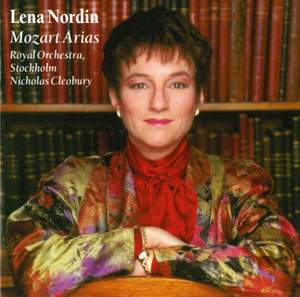
| |  | Lena Nordin: Mozart Arias
Mozart: | Soffre il mio cor con pace (from Mitridate, Re di Ponto, K87) Lungi da te, mio bene (from Mitridate, Rè di Ponto, KV87) Barbaro, oh Dio, mi vedi (from Il re pastore) L'amerò, sarò costante (from Il re pastore) Martern aller Arten (from Die Entführung aus dem Serail) Non so più cosa son, cosa faccio (from Le nozze di Figaro) Porgi amor (from Le nozze di Figaro) Voi che sapete (from Le nozze di Figaro) Deh vieni, non tardar (from Le nozze di Figaro) Come scoglio (from Così fan tutte) E amore un ladroncello (from Così fan tutte) |
| |
|
| |  | Mozart: Arias
Mozart: | Non so più cosa son, cosa faccio (from Le nozze di Figaro) Voi che sapete (from Le nozze di Figaro) Chi sà, chi sà qual sia, K582 E amore un ladroncello (from Così fan tutte) Alma grande e nobil core K578 Vedrai, carino (from Don Giovanni) Giunse alfin il momento... Deh, vieni, non tardar… (from Le nozze di Figaro) Parto, parto, ma tu ben mio (from La Clemenza di Tito) Ecco il punto...Non più di fiori vaghe catene (from La clemenza di Tito) Deh, per questo istante solo (from La Clemenza di Tito) Ch'io mi scordi di te?... Non temer, amato bene, K505 |
“Mozart wrote some of his most appealing music for the mezzo-soprano voice with the roles of Cherubino and Susanna in Le nozze di Figaro, Dorabella in Così fan tutte and Zerlina in DonGiovanni each boasting at least one memorable aria. Alongside these this disc includes a handful of concert arias including Ch'io mi scordi di te? which was written for the farewell performance of the great mezzo Nancy Storace with Mozart playing the concertante piano role. Here with as innate an interpreter of Mozart's piano writing as András Schiff and a voice so remarkably selfassured as Cecilia Bartoli's the electricity of that first, historic performance seems almost to be recreated. And, here as elsewhere, György Fischer directs the splendid Vienna Chamber Orchestra with disarming sensitivity while the recording is wonderfully warm and vibrant. Cecilia Bartoli boasts a voice of extraordinary charm and unassuming virtuosity: her vocal characterisations would be the envy of the finest actresses and her intuitive singing is in itself a sheer delight. But she also brings to these arias a conviction and understanding of the subtleties of the language which only a native Italian could. Listen to the subtle nuances of 'Voi che sapete', the depth of understanding behind Dorabella's seemingly frivolous 'E'amore un ladroncello'; these aren't mere performances, but interpretations which cut to the very soul of the music. No Mozart lover should be without this CD.” Gramophone Classical Music Guide, 2010 | | | (Sorry, download not available in your country) | Usually despatched in 8 - 10 working days. |
|
|
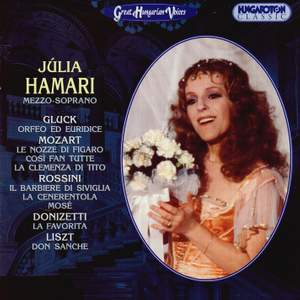
| |  | Great Hungarian Voices: Júlia HamariWorks by Gluck, Mozart, Rossini, Donizetti, Liszt
Júlia Hamari (mezzo), with Ildikó Komlósi (mezzo-soprano), János B. Nagy (tenor), Ferenc Begányi (bass) Hungarian State Orchestra, Hungarian State Opera Orchestra, Ervin Lukács, Tamás Pál, Lamberto Gardelli | | | Usually despatched in 4 - 5 working days. |
|
|
| |  | The Art of Christa LudwigChrista Ludwig 80th Birthday Tribute
Bach, J S: | St John Passion, BWV245: Es ist vollbracht Recorded: 1961, Berlin-Grünewald, Grünewaldkirche Berliner Symphoniker, Karl Forster St Matthew Passion, BWV244: Erbarme dich Recorded: 3-4 January, 14-15 April, 10-12 May, 21, 25-26 November, 28 December 1961, Kingsway Hall, London Philharmonia Orchestra, Otto Klemperer | Bellini: | Sgombra è la sacra selva from Norma Recorded: 5-12 September 1960, Teatro all Scala, Milan Orchestra del Teatro alla Scala di Milano, Tullio Serafin | Bizet: | L'amour est un oiseau rebelle 'Habanera' (from Carmen) sung in German Berliner Symphoniker, Horst Stein | Brahms: | Sapphische Ode, Op. 94 No. 4 Recorded: 11, 13, 14, 17 & 20 November, 1957, Abbey Road Studios, London Gerald Moore (piano) Liebestreu, Op. 3 No. 1 Recorded: 11, 13, 14, 17 & 20 November, 1957, Abbey Road Studios, London Gerald Moore (piano) Der Schmied Op. 19/4 Recorded: 11, 13, 14, 17 & 20 November, 1957, Abbey Road Studios, London Gerald Moore (piano) Die Mainacht, Op. 43 No. 2 Recorded: 11, 13, 14, 17 & 20 November, 1957, Abbey Road Studios, London Gerald Moore (piano) Dein blaues Auge, (No. 8 from Acht Lieder und Gesänge, Op. 59) Recorded: 31 March – 3 April 1969, Abbey Road Studios, London Geoffrey Parsons (piano) Von ewiger Liebe, Op. 43 No. 1 Recorded: 31 March – 3 April 1969, Abbey Road Studios, London Geoffrey Parsons (piano) Das Mädchen spricht, Op. 107 No. 3 Recorded: 31 March – 3 April 1969, Abbey Road Studios, London Geoffrey Parsons (piano) Heimweh, Op. 63 No. 8 Recorded: 31 March – 3 April 1969, Abbey Road Studios, London Geoffrey Parsons (piano) Wie Melodien zieht es mir, Op. 105 No. 1 Recorded: 31 March – 3 April 1969, Abbey Road Studios, London Geoffrey Parsons (piano) Mädchenlied, Op. 107 No. 5 Recorded: 31 March – 3 April 1969, Abbey Road Studios, London Geoffrey Parsons (piano) Vergebliches Ständchen, Op. 84 No. 4 Recorded: 31 March – 3 April 1969, Abbey Road Studios, London Geoffrey Parsons (piano) Der Tod, das ist die kühle Nacht, Op. 96 No. 1 Recorded: 31 March – 3 April 1969, Abbey Road Studios, London Geoffrey Parsons (piano) Auf dem See (No. 2 from Acht Lieder und Gesänge, Op. 59) Recorded: 31 March – 3 April 1969, Abbey Road Studios, London Geoffrey Parsons (piano) Feldeinsamkeit, Op. 86 No. 2 Recorded: 31 March – 3 April 1969, Abbey Road Studios, London Geoffrey Parsons (piano) In stiller Nacht (No. 42 from Deutsche Volkslieder, WoO 33) Recorded: 31 March – 3 April 1969, Abbey Road Studios, London Geoffrey Parsons (piano) Schwesterlein, WoO posth. 37 No. 1 Recorded: 31 March – 3 April 1969, Abbey Road Studios, London Geoffrey Parsons (piano) Immer leiser wird mein Schlummer, Op. 105 No. 2 Recorded: 31 March – 3 April 1969, Abbey Road Studios, London Geoffrey Parsons (piano) Ständchen, Op. 106 No. 1 Recorded: 31 March – 3 April 1969, Abbey Road Studios, London Geoffrey Parsons (piano) Two songs for contralto with viola obbligato, Op. 91 Recorded: November 1965 & March 1966, Abbey Road Studios, London Geoffrey Parsons (piano) & Herbert Downes (viola) Alto Rhapsody, Op. 53 Recorded: March 1962, Kingsway Hall, London Philharmonia Chorus & Orchestra, Otto Klemperer | Handel: | Es blaut die Nacht (Julius Caesar) Recorded: 19 March, 1962, Berlin-Grünewald, Grünewaldkirche Berliner Symphoniker, Horst Stein | Mahler: | Der Abschied (Das Lied von der Erde) Recorded: 19-22 February, 1964, Kingsway Hall, London & 7-8 November 1966, Abbey Road Studos, London Philharmonia Orchestra & New Philharmonia Orchestra, Otto Klemperer Ich ging mit Lust (Lieder und Gesänge aus der Jugendzeit) Hans und Grete (Lieder und Gesänge aus der Jugendzeit) Frühlingsmorgen (Lieder und Gesänge aus der Jugendzeit) Wo die schönen Trompeten blasen (Des Knaben Wunderhorn) Der Schildwache Nachtlied (Des Knaben Wunderhorn) Um schlimme Kinder artig zu machen (Lieder und Gesänge aus der Jugendzeit) Ich atmet' einen linden Duft (Rückert-Lieder) Liebst Du um Schönheit (Rückert-Lieder) Um Mitternacht (Rückert-Lieder) Das irdische Leben (Des Knaben Wunderhorn) Wer hat dies' Liedlein Erdacht? (Des Knaben Wunderhorn) Lob des hohen Verstandes (Des Knaben Wunderhorn) Ich bin der Welt abhanden gekommen (Rückert-Lieder) Rheinlegendchen (Des Knaben Wunderhorn) Des Antonius von Padua Fischpredigt (Des Knaben Wunderhorn) Recorded: 3-5 May, 1957, Abbey Road Studios, London Gerald Moore (piano) | Mozart: | In quali eccessi ... Mi tradì quell'alma ingrate (from Don Giovanni) Recorded: June/July 1966, Abbey Road Studios, London New Philharmonia Orchestra, Otto Klemperer E amore un ladroncello (from Così fan tutte) Recorded: September 1962, Kingsway Hall,, London Philharmonia Orchestra, Karl Böhm | Rachmaninov: | Sing not, O lovely one (Ne poi, krasavitsa, pri mne), Op. 4 No. 4 Recorded: November 1965 & March 1966, Abbey Road Studios, London Geoffrey Parsons (piano) Oh, my field, Op. 4 No. 5 Recorded: November 1965 & March 1966, Abbey Road Studios, London Geoffrey Parsons (piano) | Ravel: | Trois chansons madécasses Recorded: November 1965 & March 1966, Abbey Road Studios, London Geoffrey Parsons (piano) | Reger: | Der Brief, Op. 76, No. 8 Recorded: 29 November & 1 December, 1965, Bürgerbräu, Munich Gerald Moore (piano) Volkslied aus Franken – Waldeinsamkeit, Op. 76, No. 3 Recorded: 29 November & 1 December, 1965, Bürgerbräu, Munich Gerald Moore (piano) | Rossini: | La regata veneziana Recorded: 29 November & 1 December, 1965, Munich Bürgerbräu Gerald Moore (piano) | Saint-Saëns: | Une flûte invisible Recorded: November 1965 & March 1966, Abbey Road Studios, London Geoffrey Parsons (piano) | Schubert: | Die Allmacht, D852 Recorded: 11, 13, 14, 17 & 20 November, 1957, Abbey Road Studios, London Gerald Moore (piano) Fischerweise, D881 (Schlechta) Recorded: 11, 13, 14, 17 & 20 November, 1957, Abbey Road Studios, London Gerald Moore (piano) An die Musik D547 Recorded: 28-30 November, 1961, Abbey Road Studios, London Geoffrey Parsons (piano) Der Musensohn, D764 (Goethe) Recorded: 28-30 November, 1961, Abbey Road Studios, London Geoffrey Parsons (piano) Ganymed, D544 (Goethe) Recorded: 28-30 November, 1961, Abbey Road Studios, London Geoffrey Parsons (piano) Auf dem Wasser zu singen, D774 Recorded: 28-30 November, 1961, Abbey Road Studios, London Geoffrey Parsons (piano) Ave Maria, D839 Recorded: 28-30 November, 1961, Abbey Road Studios, London Geoffrey Parsons (piano) Die Forelle, D550 Recorded: 28-30 November, 1961, Abbey Road Studios, London Geoffrey Parsons (piano) Gretchen am Spinnrade, D118 Recorded: 28-30 November, 1961, Abbey Road Studios, London Geoffrey Parsons (piano) Frühlingsglaube, D686 Recorded: 28-30 November, 1961, Abbey Road Studios, London Geoffrey Parsons (piano) Der Tod und das Mädchen, D531 Recorded: 28-30 November, 1961, Abbey Road Studios, London Geoffrey Parsons (piano) Lachen und Weinen, D777 Recorded: 28-30 November, 1961, Abbey Road Studios, London Geoffrey Parsons (piano) Litanei auf das Fest Allerseelen, D343 Recorded: 28-30 November, 1961, Abbey Road Studios, London Geoffrey Parsons (piano) Erlkönig, D328 Recorded: 28-30 November, 1961, Abbey Road Studios, London Geoffrey Parsons (piano) Der Hirt auf dem Felsen, D965 (Von Chezy / Muller) Recorded: 8 November, 1965, Abbey Road Studios, London Geoffrey Parsons (piano) | Schumann: | Frauenliebe und -leben, Op. 42 Recorded: 3, 4, 6 May & 25 June, 1959, Abbey Road Studios, London Gerald Moore (piano) | Strauss, R: | Die Nacht, Op. 10 No. 3 Recorded: 11, 13, 14, 17 & 20 November, 1957, Abbey Road Studios, London Gerald Moore (piano) Allerseelen, Op. 10 No. 8 Recorded: 11, 13, 14, 17 & 20 November, 1957, Abbey Road Studios, London Gerald Moore (piano) Schlechtes Wetter, Op. 69 No. 5 Recorded: 29 November & 1 December, 1965, Bürgerbräu, Munich Gerald Moore (piano) Der Rosenkavalier, Act 3 – conclusion Recorded: 10-15 & 17-22 December 1956, Kingsway Hall,, London Teresa Stich-Randall, Elisabeth Schwarzkopf, Eberhard Wächter Philharmonia Orchestra, Herbert von Karajan | Verdi: | Quid sum miser (from Requiem) Recorded: 16-21, 23-27 September 1963 & 7 April 1964, Kingsway Hall, London Philharmonia Chorus & Orchestra, Carlo Maria Giulini Liber scriptus (from Requiem) Recordare (from Requiem) | Wagner: | Wesendonck-Lieder (5) orch. Mottl Philharmonia Orchestra, Otto Klemperer Mild und leise 'Isolde's Liebestod' (from Tristan und Isolde) Recorded: 21-23 March 1962, Kingsway Hall, London Philharmonia Orchestra, Otto Klemperer | Wolf, H: | Gesang Weylas (No. 46 from Mörike-Lieder) Recorded: 11, 13, 14, 17 & 20 November, 1957, Abbey Road Studios, London Gerald Moore (piano) Auf einer Wanderung (No. 15 from Mörike-Lieder) Recorded: 11, 13, 14, 17 & 20 November, 1957, Abbey Road Studios, London Gerald Moore (piano) |
“Her voice took naturally to the microphone, so this four-disc set is another source of infinite musical pleasure to be snapped up quickly before it disappears.” Penguin Guide, 2011 edition | | | In stock - usually despatched within 1 working day. |
|
|
| |
|