All recordingsPrices shown exclude VAT. (UK tax is not payable for deliveries to United States.) See Terms & Conditions for p&p rates. | |  |
“Frauenliebe Baker's 'heroine' is knowing, so that the early rapture seems tainted by hindsight. But the voice is sovereign; awesome in its control, majestic in its command.” BBC Music Magazine, January 2006 **** “carefully remastered and sounding remarkably real and vivid...her range of expression runs the whole gamut...A performance that should be in every collection.” Penguin Guide, 2010 edition *** | | | In stock - usually despatched within 1 working day. |
|
|
| |  | Brahms: Lieder
Brahms: | Bei dir sind meine Gedanken (No. 2 from Sieben Lieder, Op. 95) Wie Melodien zieht es mir, Op. 105 No. 1 Sapphische Ode, Op. 94 No. 4 Feldeinsamkeit, Op. 86 No. 2 Nachtigall, Op. 97 No. 1 Verzagen, Op. 72 No. 4 Alte Liebe, Op. 72 No. 1 An die Nachtigall, Op. 46 No. 4 (Text: L.C.H. Hölty) Das Mädchen spricht, Op. 107 No. 3 Dein blaues Auge, (No. 8 from Acht Lieder und Gesänge, Op. 59) Geheimnis, Op. 71 No. 3 Ständchen, Op. 106 No. 1 Von ewiger Liebe, Op. 43 No. 1 Der Tod, das ist die kühle Nacht, Op. 96 No. 1 Auf dem Kirchhofe, Op. 105 No. 4 Die Mainacht, Op. 43 No. 2 Anklänge, Op. 7 No. 3 Spanisches Lied, Op. 6 No. 1 Mädchenlied (No. 6 from Sieben Lieder, Op. 95) Am Sonntag Morgen Op. 49 No. 1 Liebestreu, Op. 3 No. 1 Vergebliches Ständchen, Op. 84 No. 4 Das Mädchen (No. 1 from Sieben Lieder, Op. 95) Therese, Op. 86 No. 1 Mädchenlied, Op. 107 No. 5 Der Jäger (No. 4 from Sieben Lieder, Op. 95) Der Schmied Op. 19/4 Der Gang Zum Liebchen, Op. 31 No. 3 Sonntag, Op. 47 No. 3 Mädchenlied, Op. 85 No. 3 Wiegenlied, Op. 49 No. 4 (Lullaby) |
| 
| | | Scheduled for release on 3 June 2013. Order it now and we will deliver it as soon as it is available. |
|
|
| |  | Renate & Daniel Behle: Generation
Beethoven: | An die ferne Geliebte (To the distant beloved), Op. 98 | Brahms: | Von ewiger Liebe, Op. 43 No. 1 Die Mainacht, Op. 43 No. 2 Liebesglut, Op. 47, No. 2 Sonntag, Op. 47 No. 3 Unbewegte laue Luft (No. 8 from Acht Lieder und Gesänge, Op. 57) Feldeinsamkeit, Op. 86 No. 2 Versunken, Op. 86 No. 5 Wie Melodien zieht es mir, Op. 105 No. 1 Ballade, Op. 10 No. 1 ‘Edward' | Liszt: | Über allen Gipfeln ist Ruh (Wandrers Nachtlied II), S.306 Es muss ein Wunderbares sein, S. 314 | Mendelssohn: | Hexenlied, Op. 8 No. 8 | Schumann: | Belsazar, Op. 57 | Wagner: | Träume (No. 5 from Wesendonck-Lieder) Im Treibhaus (No. 3 from Wesendonck-Lieder) Der Engel (No. 1 from Wesendonck-Lieder) | Wolf, H: | Mignon I 'Heiß mich nicht reden' (No. 5 from Goethe-Lieder) Mignon II 'Nur wer die Sehnsucht kennt' (No. 6 from Goethe-Lieder) Mignon III 'So lasst mich scheinen' (No. 7 from Goethe-Lieder) Mignon IV 'Kennst du das Land' (No. 9 from Goethe-Lieder) |
For this new recording on Capriccio mother and son unite. For more than fifteen years Renate Behle has been one of the world’s most outstanding interpreters of dramatic roles. With her “warm, sumptuous, full voice” whose “sound is etched in one’s memory” (Financial Times), she has thrilled audiences and critics alike on nearly every major opera stage in the world. Here she performs a recital of works by Mendelssohn, Schumann, Beethoven and Brahms amongst others, with her son Daniel, a tenor in great demand on the major opera and concert stages of the world. | | | (also available to download from $10.50) | Usually despatched in 2 - 3 working days. (Available now to download.) |
|
|
| |  | Brigitte Fassbaender sings Lieder by Johannes Brahms
Brahms: | Liebestreu, Op. 3 No. 1 Meine Lieder Op. 106 No. 4 An eine Äolsharfe, Op. 19 No. 5 Auf dem Kirchhofe, Op. 105 No. 4 Über die Heide Op. 86 No. 4 Im Garten, Op. 70 No. 1 Verzagen, Op. 72 No. 4 Es hing der Reif, Op. 106 No. 3 Regenlied (No. 3 from Acht Lieder und Gesänge, Op. 59) O kühler Wald, Op. 72 No. 3 Wehe, so willst du mich wieder, Op. 32 No. 5 Two songs for contralto with viola obbligato, Op. 91 with Thomas Riebl (viola) Mädchenlied, Op. 107 No. 5 Die Mainacht, Op. 43 No. 2 Ständchen, Op. 106 No. 1 In stiller Nacht (No. 42 from Deutsche Volkslieder, WoO 33) Von ewiger Liebe, Op. 43 No. 1 |
This highly regarded recording of a collection of lieder by Brahms was first released in 1982 and features one of the outstanding singers of her generation, the German mezzo-soprano Brigitte Fassbaender. The pianist is Irwin Gage, and they are joined on two of the songs by the viola player Thomas Riebl. Brigitte Fassbaender’s international career took off when she appeared as Octavian in Der Rosenkavalier at the Royal Opera House, Covent Garden in 1971. Since then she has appeared in all of the major opera houses around the world in roles such as as Clairon in Capriccio, the Composer in Ariadne auf Naxos, Fricka in Die Walküre, Carmen in Carmen, Orlovsky in Die Fledermaus, Amneris in Aïda, Maddalena in Rigoletto, Eboli in Don Carlos, and Klytemnestra in Elektra. Brigitte Fassbaender has also been successful as a lieder singer. In 1987, she won a Gramophone Award for her Deutsche Gramophon disc of songs by Franz Liszt and Richard Strauss. Johannes Brahms was a prolific composer of Lieder and wrote around 200 during his lifetime. The first collection appeared in 1853, when Brahms had just turned 20, and the last was published in 1896, just a few months before his death. | | | (also available to download from $10.50) | Usually despatched in 4 - 5 working days. (Available now to download.) |
|
|
| |  | Hermann Prey: Liederabend 1963
Brahms: | Dein blaues Auge, (No. 8 from Acht Lieder und Gesänge, Op. 59) Wie Melodien zieht es mir, Op. 105 No. 1 Die Mainacht, Op. 43 No. 2 | Cornelius: | Vater unser, der Du bist im Himmel (No. 1 from Vater unser, Op. 2) Zu uns komme Dein Reich (No. 3 from Vater unser) Fuhre uns nicht in Versuchung (No. 8 from Vater unser, Op. 2) Erlose uns vom Ubel (No. 9 from Vater unser) | Fortner: | Gesänge (4) nach Hölderlin | Pfitzner: | Im Herbst Op. 9 No. 3 In Danzig, Op. 22 No. 1 Der Kuhne, Op. 9 No. 4 Der Gärtner (Eichendorff) | Strauss, R: | Morgen, Op. 27 No. 4 Befreit, Op. 39 No. 4 |
This is a wonderfully balanced recital, combining familiar repertoire with works from lesser known composers; all beautifully interpreted by Prey in his prime. Every performance by Prey deserves attention from the serious vocal collector. | | | (also available to download from $10.50) | Usually despatched in 2 - 3 working days. (Available now to download.) |
|
|
| |  | Jussi Björling - In Song
Arthur: | Today | Bizet: | Je crois entendre encore (from Les Pêcheurs de Perles) | Brahms: | Die Mainacht, Op. 43 No. 2 | Curtis, E: | Torna a Surriento | Geehl: | For You Alone | Grieg: | En svane (No. 2 from Seks Digte af Henrik Ibsen, Op. 25) Seks Sange, Op. 48 No. 6 'Ein Traum' | Kalman: | Das Veilchen vom Montmartre | Körling: | Vita rosor | Leoncavallo: | Mattinata - 'L'aurora di bianco vestita' | Liszt: | Es muss ein Wunderbares sein, S. 314 | Rachmaninov: | Lilacs, Op. 21 No. 5 | Schubert: | Die Forelle, D550 Die Allmacht, D852 Ständchen 'Leise flehen meine Lieder', D957 No. 4 Wandrers Nachtlied II 'Über allen Gipfeln ist Ruh', D768 Die böse Farbe (No. 17 from Die schöne Müllerin, D795) | Sibelius: | Svarta rosor, Op. 36 No. 1 (Ernst Josephson) | Sjögren: | I drömmen du är mig nära | Strauss, R: | Ständchen, Op. 17 No. 2 Morgen, Op. 27 No. 4 | Tosti: | Ideale | trad.: | Ack Värmeland du sköna (Ah Värmland, Thou Fairest) arr. Randel Allt Under Himmelens Fäste | Wolf, H: | Verborgenheit (No. 12 from Mörike-Lieder) |
Historic Masters Ltd. Is delighted to be associated with, and to have contributed to, this CD release of little known material by one of the truly great tenors of the twentieth century. In the course of our researches we have discovered original metal parts for three recordings by Jussi Björling which were not released by EMI at the time they were made. All three have now been issued as part of our Historic Masters series and we are delighted to be able to make copies available for transfer to this CD. The tenor solo from Bizet’s Les Pêcheurs de perles was recorded in April 1947. Given that it is Björling’s only studio version of this aria, it seems surprising that it remained unissued until November 1977, late in the LP era. Only then was it included in an EMI boxed set entitled The Art of Jussi Björling. The other two items, the songs Mattinata and For you alone, rank amongst our most sensational discoveries in the EMI archive. These were the very first recordings made by Björling as an adult on 4 September 1929. Piano accompanied, they were almost certainly intended as tests to determine Björling’s suitability for a recording contract. Listening to these first recordings, there can be no surprise that Björling clearly passed this examination with flying colours. Three months later he was in the studio for what was in effect the launching of his hugely successful recording career with HMV and Victor. In the first few months of that career Björling repeated both songs – this time with full orchestral accompaniment. Perhaps this explains why the original tests were forgotten and, indeed, were marked in March 1930 as ‘destroyed’. In 1952, RCA, using the recently developed tape technology, decided to record a selection of the songs that Björling performed at his recitals. It is unlikely that all of these pieces would have been given at one time, but they were certainly included in his programmes over the years and give a very representative selection of the range of his repertoire. Apart from German Lieder, he always liked to sing some Swedish pieces, as well as works by the Finnish composer Sibelius, who complimented him on his interpretations of his songs, particularly those written to Swedish words. This recording from 1952 remained on the catalogue for many years as an LP in the USA, but it was less widely available in Europe and can now be heard here for the first time in a CD transfer from the original master tape. It finds Björling in particularly glorious voice. Extract from the booklet | | | Usually despatched in 4 - 5 working days. |
|
|
| |  | Brahms - Cello Sonatas Nos. 1 & 2
Anthony Leroy (cello) & Sandra Moubarak (piano) “The performances are exceptional. Anthony Leroy and Sandra Moubarak have a real understanding of Brahm's unusually long phrases. In the great sweeping melody of the opening of the E minor Sonata they begin pensively and are not afraid to use considerable freedom of tempo change at the peak of the exposition before returning to this inwardness. The Adagio, another very long and varied melody, is beautifully phrased...” Gramophone Magazine, August 2007 “Brahms's cello sonatas tackle head on the real problem of balancing the cello's potentially gruff lowest register and singing high tones with the orchestra, but he does not make matters easy for himself. Some of the piano textures are very thick and there are places in this recording where the problems are barely solved: the start of the F major Second Sonata and the finale of the E minor No 1 are cases in point. He is at least considerate enough to refine the piano textures when he risks asking the cello to play the flowing theme of this finale with the tricky slurred pizzicato, and this comes off excellently here. The performances are exceptional. Anthony Leroy and Sandra Moubarak have a real understanding of Brahms's unusually long phrases. In the great sweeping melody of the opening of the E minor Sonata they begin pensively and are not afraid to use considerable freedom of tempo change at the peak of the exposition before returning to this inwardness. The Adagio, another very long and varied melody, is beautifully phrased, as is the middle section of the third movement, its marking dolce espressivo constrasting with the general Allegro passionato. The E minor Sonata's Minuet has a delightful lilt, and they go with a will at the difficult final fugue. There are also charming performances of the two songs included as fill-ups.” Gramophone Classical Music Guide, 2010 | | | Usually despatched in 4 - 5 working days. |
|
|
| |  | Lieder
Berg: | Im Zimmer Liebesode Die Nachtigall Sommertage | Brahms: | Geheimnis, Op. 71 No. 3 Ständchen, Op. 106 No. 1 Sonntag, Op. 47 No. 3 Mädchenlied, Op. 107 No. 5 Wiegenlied, Op. 49 No. 4 (Lullaby) Die Mainacht, Op. 43 No. 2 Salamander, Op. 107 No. 2 Von ewiger Liebe, Op. 43 No. 1 Meine Liebe ist grün, Op. 63 No. 5 O kühler Wald, Op. 72 No. 3 Heimweh, Op. 63 No. 8 Auf dem Kirchhofe, Op. 105 No. 4 Wie rafft' ich mich auf Op. 32,1 (v.Platen) | Eisler: | Die Sünde Vater und Mutter Der Tod |
Ines Moraleda (mezzo soprano) & Barbara Holzl (piano) | | | Usually despatched in 2 - 3 working days. |
|
|
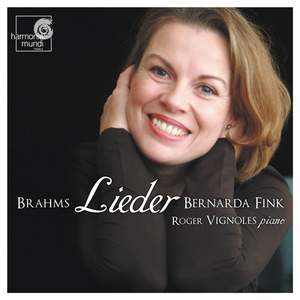
| |  | Brahms - Lieder
Brahms: | Bei dir sind meine Gedanken (No. 2 from Sieben Lieder, Op. 95) Wie Melodien zieht es mir, Op. 105 No. 1 Sapphische Ode, Op. 94 No. 4 Feldeinsamkeit, Op. 86 No. 2 Nachtigall, Op. 97 No. 1 Verzagen, Op. 72 No. 4 Alte Liebe, Op. 72 No. 1 An die Nachtigall, Op. 46 No. 4 (Text: L.C.H. Hölty) Das Mädchen spricht, Op. 107 No. 3 Dein blaues Auge, (No. 8 from Acht Lieder und Gesänge, Op. 59) Geheimnis, Op. 71 No. 3 Ständchen, Op. 106 No. 1 Von ewiger Liebe, Op. 43 No. 1 Der Tod, das ist die kühle Nacht, Op. 96 No. 1 Auf dem Kirchhofe, Op. 105 No. 4 Die Mainacht, Op. 43 No. 2 Anklänge, Op. 7 No. 3 Spanisches Lied, Op. 6 No. 1 Mädchenlied (No. 6 from Sieben Lieder, Op. 95) Am Sonntag Morgen Op. 49 No. 1 Liebestreu, Op. 3 No. 1 Vergebliches Ständchen, Op. 84 No. 4 Das Mädchen (No. 1 from Sieben Lieder, Op. 95) Therese, Op. 86 No. 1 Mädchenlied, Op. 107 No. 5 Der Jäger (No. 4 from Sieben Lieder, Op. 95) Der Schmied Op. 19/4 Der Gang Zum Liebchen, Op. 31 No. 3 Sonntag, Op. 47 No. 3 Mädchenlied, Op. 85 No. 3 Wiegenlied, Op. 49 No. 4 (Lullaby) |
"Brahms was capable - as were all his great predecessors - of writing a melody that was his own property, right down to the smallest inflection, and yet sounded like a folksong. Or, to put it another way, a melody that was a real, genuine folksong - and yet was by Brahms." Wilhelm Furtwängler, 1931 “From Roger Vignoles's first light-filled notes in 'Bei mir sind meine Gedanken', with Bernada Fink's smiling, wide-eyed voice, these performers make it sound as though the ink is still wet on Brahms's manuscripts. The real skill of Fink and Vignoles is to capture that fusion of physical and emotional movement within a song - and to recreate it with real spontaneity.” BBC Music Magazine, March 2007 **** “'Bei dir sind meine Gedanken', one of Brahms's happiest songs, makes an inviting aperitif. Buoyed by the evanescent shimmer of Roger Vignoles's accompaniment, Bernarda Fink is all confiding eagerness, phrasing deftly and gracefully and showing a natural feeling for Brahmsian rubato. One would expect Fink's warm, luminous mezzo, flecked by darker, deeper tints, to be near ideal for, say, the nostalgia of 'Alte Liebe' or the many songs of elegiac loss and heartbreak, all touchingly done here. But having thought of her as an essentially 'serious' singer, dignified, eloquent, the vivacity and 'face' she brings to 'Bei dir sind meine Gedanken' and other lighter songs is sheer delight. 'Ständchen', here more sunlit than moonlit, is charmingly characterised, with an affectionate caress on the dreaming girl's 'Vergiss nicht mein'. Fink is playfully coquettish without archness in the delicious 'Spanisches Lied', and sings 'Vergebliches Ständchen' with an outgoing boldness and witty touches of timing – and the tender lingering on the penultimate 'Mein Knab' suggests that the boy's luck may soon be about to change. Other singers have brought a more intense yearning to 'Die Mainacht' and found greater mystery amid the slumberous balm of 'Feldeinsamkeit'. But Fink's flowing performances, sensitively shaped and inflected, are never less than satisfying. It is good to be reminded, too, that, for all its melancholy, 'Die Mainacht' is also a song of spring, suffused by warm major-key harmonies, with a hint of excited anticipation at the line 'Wann, o lächelndes Bild'. On the face of it, Fink's lyric mezzo would seem to be on the light side for 'Von ewiger Liebe'. But with Vignoles imaginatively 'orchestrating' the keyboard part, she gives a finely graded, deeply moving performance, vividly contrasting the contained passion of the boy's words with the girl's gentle candour. The glowing climactic avowal of eternal love is truly overwhelming, setting the seal on a Brahms recital of rare distinction.” Gramophone Classical Music Guide, 2010 “For all the tragic, premature loss last year of Lorraine Hunt Lieberson, Argentinian Bernarda Fink is just one of a golden generation of mezzos vying for the mantle of Janet Baker. One of the most versatile, as at ease in Baroque repertoire as in music from Handel and Mozart to Schumann, Fink's rich, warm voice boasts the perfect blend of colour and clarity for this selection of 31 songs from the almost 200 Brahms wrote. Her musical intelligence combines with the sensitivity of Roger Vignoles to capture the folk-song spirit behind their urbane polish.” The Observer | | | Usually despatched in 3 - 4 working days. |
|
|
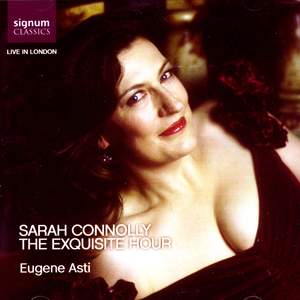
| |  | The Exquisite Hour
Brahms: | Ständchen, Op. 106 No. 1 Da unten im Tale (No. 6 from Deutsche Volkslieder, WoO 33) Nachtwandler, Op. 86 No. 3 Feldeinsamkeit, Op. 86 No. 2 Alte Liebe, Op. 72 No. 1 Die Mainacht, Op. 43 No. 2 Von ewiger Liebe, Op. 43 No. 1 | Britten: | Tit for Tat | Hahn, R: | À Chloris L'Enamourée Trois jours de vendange L'heure exquise Quand je fus pris au pavillon | Haydn: | Arianna a Naxos, cantata, Hob.XXVIb/2 | Ireland: | Her song | Korngold: | Glückwunsch Alt-Spanisch Sterbelied Gefasster adschied | Weill, K: | Lost in the stars Speak low |
“a hugely impressive disc, testifying to the versatility and range of a singer who has already drawn comparisons with Janet Baker” The Guardian “A national treasure” Evening Standard “Connolly's lovely singing reaches to the sensuous core” The Telegraph “Almost seven years ago we went to the Wigmore Hall expecting to hear a well known soprano only to find that she had been replaced by a less well-known mezzo. Sarah Connolly had already appeared with the English National Opera in major roles such as Handel's Xerxes and Donizetti's Mary Stuart. Disappointment at missing the scheduled artist vanished with the completion of the substitute's first phrases. Delight took its place and increased steadily throughout the recital. It was a clear, fresh and powerful voice, used with intelligent assurance, and by the final groups (Duparc and Falla) she had established with the audience the rapport of a much more experienced artist. What was true at the Wigmore holds for this concert at St John's, Smith Square, where her success with the audience is again unmistakable and fully merited. Again, her choice of programme contributes to the success: a judicious mixture of the familiar and out-of-the-way, and well suited to voice and style. The Brahms group is particularly satisfying, with Die Mainacht broadly phrased, Nachtwandler imaginatively hushed and Von ewigerLiebe warmly felt. The Hahn songs are equally (if contrastingly) delightful, the two pastiche pieces, A Chloris and Quand je fus pris au pavillon charmingly in period. Weill's Speak Low and Ireland's Her Song are winning encore pieces. That leaves Haydn's Arianna a Naxos, the long and demanding concert aria which opens the programme. Here we find a substantial achievement and a limitation. The style is admirably clean and the emotional range well probed, but the whole remains a little impersonal and one is driven to comparisons. Janet Baker brings warmer humanity and a more memorable timbre while Cecilia Bartoli is more vivid – hear her intense 'Tradita io sono' for instance, or the pale 'Già più non reggo' or the furious final 'Barbaro ed infedel'. That comparison does, however, throw into a very favourable light Eugene Asti's accompaniment: where András Schiff (for Bartoli) is over– assertive, Asti is sensitive and keeps proportion. And indeed he does so throughout: a constant pleasure and a major contribution to the recital's undoubted success.” Gramophone Classical Music Guide, 2010 “Connolly woos her audience with the calling-card for any and every mezzo: Haydn's dramatic cantata, Arianna a Naxos. And every second of its nervous and emotional life - its hopes, fears and final despair - are uncovered in Connolly's superbly observant voice and imagination.” BBC Music Magazine, March 2006 ***** “…a clear, fresh and powerful voice, used with intelligent assurance… The Brahms group is particularly satisfying, with Die Mainacht broadly phrased, Nachtwandler imaginatively hushed and Von ewiger Liebe warmly felt. The Hahn songs are equally… delightful, the two pastiche pieces, A Chloris and Quand je fus pris au pavillon charmingly in period. ...Weill's Speak Low and Ireland's Her Song are winning encore pieces.” Gramophone Magazine, May 2006 | | | Usually despatched in 3 - 4 working days. |
|
|
| |
|