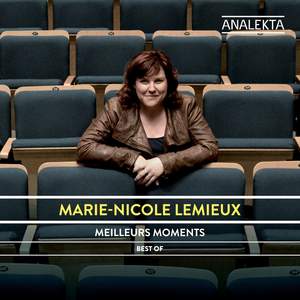
All recordingsPrices shown exclude VAT. (UK tax is not payable for deliveries to United States.) See Terms & Conditions for p&p rates. | |  | Best of Marie-Nicole Lemieux
Brahms: | Abschied (No. 3 from Neun Gesänge, Op. 69) Vom Strande (No. 6 from Neun Gesänge, Op. 69) Salome (No. 8 from Neun Gesänge, Op. 69) Feldeinsamkeit, Op. 86 No. 2 Nachtwandler, Op. 86 No. 3 Versunken, Op. 86 No. 5 Ich wandte mich und sahe an Op. 121 No. 2 Two songs for contralto with viola obbligato, Op. 91 | Handel: | Mi palpita il cor - cantata HWV132: Se un di m'adora la mia crudele Irene, idolo mio, HWV 120b Lungi da me pensier tiranno, HWV 125b - cantata per alto e continuo | Scarlatti, D: | Salve Regina | Vivaldi: | Stabat Mater, RV621 |
| 
| | | In stock - usually despatched within 1 working day. |
|
|
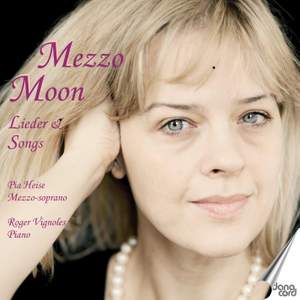
| |  | Mezzo MoonLieder & Songs
Brahms: | Nachtwandler, Op. 86 No. 3 | Mozart: | Abendempfindung an Laura, K523 | Nielsen: | Sænk kun dit Hoved, du Blomst, Op. 21 (FS 42), Book 2 No. 1 | Reger: | Schlichte Weisen, Op. 76 (selection) Des Kindes Gebet, Op. 76 No. 22 | Respighi: | Notte, P. 97 No. 1 | Schubert: | Litanei auf das Fest Allerseelen, D343 Nacht und Träume, D827 Ständchen 'Leise flehen meine Lieder', D957 No. 4 Wiegenlied, D498 | Schumann: | Mondnacht (No. 5 from Liederkreis, Op. 39) Du bist wie eine Blume, Op. 25 No. 24 | Strauss, R: | Die Nacht, Op. 10 No. 3 Morgen, Op. 27 No. 4 | Wagner: | Der Engel (No. 1 from Wesendonck-Lieder) Träume (No. 5 from Wesendonck-Lieder) | Weyse: | Natten er så stille from Prinsesse Isabella | Zemlinsky: | Süße, süße Sommernacht |
Pia Heise - a rare talent nurtured by world leading accompanist, Roger Vignoles, has her first CD released featuring a beautiful selection of music which has a theme of the night running through it. “Heise has an attractive voice and sings with appealing candour. Roger Vignoles is an attentive, vastly experienced accompanist. Yet it is hard to suppress the feeling that this debut recital is premature...In both [Danish] songs she sings with a confidence and a mezzo glow in the tone that can seem inhibited in the familiar German songs...As yet her characterisation is cautious, generalised, with no illumination of individual words and phrases.” Gramophone Magazine, Awards Issue 2012 | | | (also available to download from $10.50) | Usually despatched in 4 - 5 working days. (Available now to download.) |
|
|
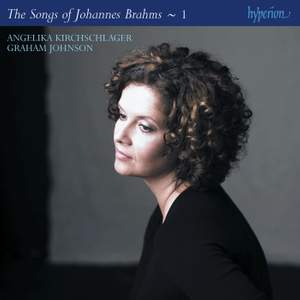
| |  | Brahms: The Complete Songs Volume 1 (Angelika Kirchschlager)
Brahms: | Von ewiger Liebe, Op. 43 No. 1 Lieder (7), Op. 48 O komme, holde Sommernacht, Op. 58 No. 4 Dämmrung senkte sich von oben (No. 1 from Acht Lieder und Gesänge, Op. 59) Auf dem See (No. 2 from Acht Lieder und Gesänge, Op. 59) Meine Liebe ist grün, Op. 63 No. 5 Wenn um den Hollunder, Op. 63 No. 6 Scheiden und Meiden, Op. 19, No 2 In der Ferne, Op. 19, No. 3 Salome (No. 8 from Neun Gesänge, Op. 69) Abendregen, Op. 70 No. 4 Therese, Op. 86 No. 1 Feldeinsamkeit, Op. 86 No. 2 Nachtwandler, Op. 86 No. 3 Über die Heide Op. 86 No. 4 Versunken, Op. 86 No. 5 Bei dir sind meine Gedanken (No. 2 from Sieben Lieder, Op. 95) Beim Abschied (No. 3 from Sieben Lieder, Op. 95) Der Jäger (No. 4 from Sieben Lieder, Op. 95) Da unten im Tale (No. 6 from Deutsche Volkslieder, WoO 33) Soll sich der Mond nicht heller scheinen (No. 35 from Deutsche Volkslieder, WoO 33) Feinsliebchen, du sollst mir nicht barfuß gehen (No. 12 from Deutsche Volkslieder, WoO 33) Och Moder, ich well en Ding han! (No. 33 from Deutsche Volkslieder, WoO. 33) |
Graham Johnson’s complete Schubert and Schumann songs series for Hyperion are landmarks in the history of recorded music. Now this indefatigable performer and scholar turns to the songs and vocal works of Brahms. Each disc of this Hyperion edition takes a journey through Brahms’s career. The songs are not quite presented in chronological order but they do appear here in the order that the songs were presented to the world. Each recital represents a different journey through the repertoire (and thus through Brahms’s life). In a number of these Hyperion recitals an opus number will be presented in its entirety (in the case of this disc, Op 48). The folksongs of 1894 will be shared between all the singers in the series. Hyperion is delighted to present the celebrated mezzo-soprano Angelika Kirchschlager in this first volume of the series. She enjoys an international career as one of today’s most important singers, dividing her time between recitals and opera in Europe, North America and the Far East. “This selection keeps springing pleasant surprises. Kirchschlager’s articulation can be veiled, but she always sings with feeling, and Graham Johnson expertly judges the quirky piano accompaniments. His notes, as usual, are awesomely detailed.” The Times, 29th May 2010 **** “Kirchschlager’s charm shines through in the lighter, more folkish songs of Op 48 and more high-spirited inspirations such as the enchanting O komme, holde Sommernacht and Bei dir sind meine Gedanken.” The Telegraph, 13th June 2010 ** “Graham Johnson, once again, is both mastermind and pianist, and, as ever, his accompanying notes and essays are as witty and richly allusive as his playing...This recital is beautifully shaped.” BBC Music Magazine, July 2010 **** “Angelika Kirchschlager sings with purity of tone, evenly produced and unfailingly accurate in intonation...Graham Johnson's notes...complementary to his playing, are enlightening as ever and in a way which only he knows how to be.” Gramophone Magazine, August 2010 “Johnson's arrangement of this recital and his exceptional accompanying skills, together with Kirchschlager's voice and approach, almost always so appropriate to Brahms, make this a highly desirable disc.” International Record Review, July/August 2010 | | | Usually despatched in 2 - 3 working days. |
|
|
| |  | Fischer-Dieskau 85th Birthday Edition: Brahms LiederBerlin Philharmonie, 1972 (live)
Brahms: | Nachtwandler, Op. 86 No. 3 Wehe, so willst du mich wieder, Op. 32 No. 5 Abenddämmerung, Op. 49 No. 5 Meerfahrt, Op. 96 No. 4 Wie rafft' ich mich auf Op. 32,1 (v.Platen) Geheimnis, Op. 71 No. 3 Wir wandelten, wir zwei zusammen Op. 96/2 Botschaft, Op. 47 No. 1 Lindes Rauschen in den Wipfeln, Op. 3, No. 6 Regenlied (No. 3 from Acht Lieder und Gesänge, Op. 59) Ständchen, Op. 106 No. 1 Wie bist du, meine Königin Op. 32 No. 9 Fruhlingslied, Op. 85, No. 5 Unüberwindlich, Op. 72 No. 5 Sonntag, Op. 47 No. 3 Der Gang zum Liebchen, No. 1, Op. 48 Wehe, so willst du mich wieder, Op. 32 No. 5 Feldeinsamkeit, Op. 86 No. 2 |
These releases from the archives of the RIAS and the Sender Freies Berlin document the unequalled quantitative and qualitative spectrum which baritone Fischer-Dieskau acquired during the five decades of his career. They offer a fascinating insight into the breadth of his repertoire as well as his artistic approach, with which he maintained a careful balance of development and continuity until the end. These recordings – spanning Beethoven’s sacred songs Op. 48 of 1806, through Schumann, Brahms, Mahler and Reger, to Heinrich Sutermeister’s expressive psalm setting of 1948 – demonstrate the essential Fischer-Dieskau. Not only do they document the artistic partnership with pianists such as Hertha Klust, Daniel Barenboim, Cord Garben, Aribert Reimann and Tamás Vásáry, but also the delightful collaboration with the organist Ulrich Bremsteller. Furthermore, Dietrich Fischer-Dieskau can be heard together with his wife and musical partner, Julia Varady. This is a documentary edition both in the sense of a historic and an artistic legacy: it reveals the riches of lieder from the last two centuries which Fischer-Dieskau, in his role of musical chronicler, made accessible for the present age; and it is an impressive record of an incomparable interpretational art, according to which word and music were always treated and realised as a unit. | | | Usually despatched in 3 - 4 working days. |
|
|
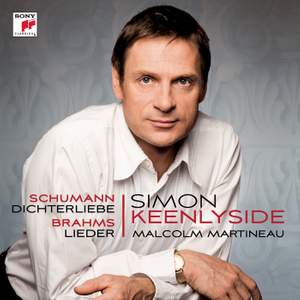
| |  | Schumann - Dichterliebe
Brahms: | Nachtigallen schwingen, Op. 6 No. 6 Lerchengesang Op. 70 No. 2 Nicht mehr zu dir zu gehen, Op. 32 No. 2 Über die Heide Op. 86 No. 4 Wie rafft' ich mich auf Op. 32,1 (v.Platen) Auf dem Kirchhofe, Op. 105 No. 4 Von ewiger Liebe, Op. 43 No. 1 O kühler Wald, Op. 72 No. 3 Es schauen die Blumen, Op. 96 No. 3 Feldeinsamkeit, Op. 86 No. 2 Nachtwandler, Op. 86 No. 3 Verzagen, Op. 72 No. 4 An eine Äolsharfe, Op. 19 No. 5 Nachtigall, Op. 97 No. 1 Abenddämmerung, Op. 49 No. 5 An die Nachtigall, Op. 46 No. 4 (Text: L.C.H. Hölty) | Schumann: | Dichterliebe, Op. 48 |
“Here is a singer-actor who has it all…” The Sunday Times “In a league of his own…” The Sunday Telegraph “The king of barnstorming performances…” The Independent Sony Music Entertainment UK is pleased to present the first of three albums by British baritone Simon Keenlyside, who has recently signed a new exclusive recording contract with the Sony UK company. The first recording under this exciting new agreement features Schumann’s Dichterliebe, Op.48, and a selection of Lieder by Brahms, sensitively accompanied by pianist Malcolm Martineau. Simon Keenlyside was born in London and studied zoology at Cambridge before attending the Royal Northern College of Music for vocal studies. One of the world’s most sought-after and charismatic singers, he has appeared at many of the world’s major opera houses and concert halls, and is noted for his versatility and highly charged performances. Highlights of his career so far include his acclaimed performance of Billy Budd at the ENO, Prospero in the world premiere of Thomas Ades' The Tempest, at the Royal Opera House, Covent Garden; Count Almaviva in Milan and Vienna under Muti; Don Giovanni in Ferrara under Abbado and Pelleas in San Francisco, Geneva and Paris. Simon Keenlyside won the 2006 Olivier Award for outstanding achievement in Opera for his performance of Billy Budd at ENO and Winston in the world premiere of 1984 at the Royal Opera House, Covent Garden, and in 2007 he won a Gramophone Award for Tales Of Opera, his album of operatic arias recorded for Sony Music in Germany. “Throughout, the baritone combines a detailed approach with an overview, demonstrating an exceptional ability to seek out the meaning of both text and music, holding them together in one single image. …a great Lieder singer at the peak of his powers. He is well served by his accompanist, who deploys a huge range of tone and colour with an equally firm artistic intent.” BBC Music Magazine, November 2009 ***** | | | Usually despatched in 3 - 4 working days. |
|
|
| |  | Dietrich Fischer-Dieskau sings Die Schone Magelone
Live recording: The Cologne Broadcasts, 1952. | | | Usually despatched in 3 - 4 working days. |
|
|
| |  | Janet BakerBrahms - Lieder
Brahms: | Heimweh, Op. 63 No. 8 O kühler Wald, Op. 72 No. 3 Geheimnis, Op. 71 No. 3 Wir wandelten, wir zwei zusammen Op. 96/2 Meerfahrt, Op. 96 No. 4 Ständchen, Op. 106 No. 1 Ein Wanderer, Op. 106 No. 5 Regenlied (No. 3 from Acht Lieder und Gesänge, Op. 59) Das Mädchen spricht, Op. 107 No. 3 Mädchenlied, Op. 107 No. 5 Mondnacht, WoO 21 Auf dem Kirchhofe, Op. 105 No. 4 Feldeinsamkeit, Op. 86 No. 2 Vergebliches Ständchen, Op. 84 No. 4 An die Nachtigall, Op. 46 No. 4 (Text: L.C.H. Hölty) Meine Liebe ist grün, Op. 63 No. 5 Herbstgefühl, Op. 48 No. 7 Abendregen, Op. 70 No. 4 Verzagen, Op. 72 No. 4 Nachtwandler, Op. 86 No. 3 Komm bald, Op. 97 No. 5 (Groth) Der Tod, das ist die kühle Nacht, Op. 96 No. 1 Von ewiger Liebe, Op. 43 No. 1 |
Recorded: BBC Studios, London, 16 September 1960 / 4 January 1968 / 7 February 1961 “Listening to these Brahms songs culled from BBC broadcasts one realises just why Dame Janet's reputation continues to remain so high and why so many of her successors don't quite match her standards. To every song here, familiar or unfamiliar, she brings her special ability of making it her own and reaching to its heart. It's an almost uncanny gift, and not one easy to explain, but it makes every song in this programme momentous. Wondrous is the sustained half-voice with which she invests Nachtwandler with its intimate, sad feeling. Then there's the outpouring of joy that is Meine Liebe ist grün to which she brings the most lustrous tone and an outgoing manner, and finally the gentle sense of fun, never overdone, which she brings to the very familiar VergeblichesStändchen. If Brahms had written no other songs than Feldeinsamkeit, Der Tod, das ist die kühle Nacht and Von ewiger Liebe, he would surely be hailed as a great Lieder composer. Baker obviously understands their astonishing high quality. The first is sung, as it should be, with a kind of inner wonder, each amazing line given its full due. In the second, a Liebestod avant la lettre, she sings with the proper impassioned feeling, while the last, a happier statement of eternal love, is sung with the rugged conviction that always showed the singer at her very best. Lush and Hamburger, especially the latter, are fully cognisant of what to do with Brahms's intricate writing for the piano. The sound is admirable, catching early Baker in full flow.” Gramophone Classical Music Guide, 2010 “This is an important disc and one that will give great pleasure since it contains so much fine and deeply committed singing. It’s certainly a mandatory purchase for all admirers of Brahms’s lieder or of Dame Janet Baker.” MusicWeb International “what singing: what a voice, what beauty of line, variety of colour, incisive diction and unforced mastery of the whole difficult art of Lieder…the disc is a feast.” The Times | | | (also available to download from $10.50) | Usually despatched in 2 - 3 working days. (Available now to download.) |
|
|
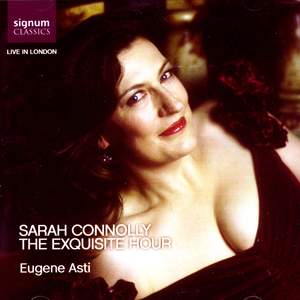
| |  | The Exquisite Hour
Brahms: | Ständchen, Op. 106 No. 1 Da unten im Tale (No. 6 from Deutsche Volkslieder, WoO 33) Nachtwandler, Op. 86 No. 3 Feldeinsamkeit, Op. 86 No. 2 Alte Liebe, Op. 72 No. 1 Die Mainacht, Op. 43 No. 2 Von ewiger Liebe, Op. 43 No. 1 | Britten: | Tit for Tat | Hahn, R: | À Chloris L'Enamourée Trois jours de vendange L'heure exquise Quand je fus pris au pavillon | Haydn: | Arianna a Naxos, cantata, Hob.XXVIb/2 | Ireland: | Her song | Korngold: | Glückwunsch Alt-Spanisch Sterbelied Gefasster adschied | Weill, K: | Lost in the stars Speak low |
“a hugely impressive disc, testifying to the versatility and range of a singer who has already drawn comparisons with Janet Baker” The Guardian “A national treasure” Evening Standard “Connolly's lovely singing reaches to the sensuous core” The Telegraph “Almost seven years ago we went to the Wigmore Hall expecting to hear a well known soprano only to find that she had been replaced by a less well-known mezzo. Sarah Connolly had already appeared with the English National Opera in major roles such as Handel's Xerxes and Donizetti's Mary Stuart. Disappointment at missing the scheduled artist vanished with the completion of the substitute's first phrases. Delight took its place and increased steadily throughout the recital. It was a clear, fresh and powerful voice, used with intelligent assurance, and by the final groups (Duparc and Falla) she had established with the audience the rapport of a much more experienced artist. What was true at the Wigmore holds for this concert at St John's, Smith Square, where her success with the audience is again unmistakable and fully merited. Again, her choice of programme contributes to the success: a judicious mixture of the familiar and out-of-the-way, and well suited to voice and style. The Brahms group is particularly satisfying, with Die Mainacht broadly phrased, Nachtwandler imaginatively hushed and Von ewigerLiebe warmly felt. The Hahn songs are equally (if contrastingly) delightful, the two pastiche pieces, A Chloris and Quand je fus pris au pavillon charmingly in period. Weill's Speak Low and Ireland's Her Song are winning encore pieces. That leaves Haydn's Arianna a Naxos, the long and demanding concert aria which opens the programme. Here we find a substantial achievement and a limitation. The style is admirably clean and the emotional range well probed, but the whole remains a little impersonal and one is driven to comparisons. Janet Baker brings warmer humanity and a more memorable timbre while Cecilia Bartoli is more vivid – hear her intense 'Tradita io sono' for instance, or the pale 'Già più non reggo' or the furious final 'Barbaro ed infedel'. That comparison does, however, throw into a very favourable light Eugene Asti's accompaniment: where András Schiff (for Bartoli) is over– assertive, Asti is sensitive and keeps proportion. And indeed he does so throughout: a constant pleasure and a major contribution to the recital's undoubted success.” Gramophone Classical Music Guide, 2010 “Connolly woos her audience with the calling-card for any and every mezzo: Haydn's dramatic cantata, Arianna a Naxos. And every second of its nervous and emotional life - its hopes, fears and final despair - are uncovered in Connolly's superbly observant voice and imagination.” BBC Music Magazine, March 2006 ***** “…a clear, fresh and powerful voice, used with intelligent assurance… The Brahms group is particularly satisfying, with Die Mainacht broadly phrased, Nachtwandler imaginatively hushed and Von ewiger Liebe warmly felt. The Hahn songs are equally… delightful, the two pastiche pieces, A Chloris and Quand je fus pris au pavillon charmingly in period. ...Weill's Speak Low and Ireland's Her Song are winning encore pieces.” Gramophone Magazine, May 2006 | | | Usually despatched in 3 - 4 working days. |
|
|
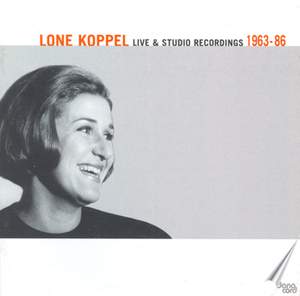
| |  | Lone Koppel: Live & Studio Recordings 1963-86Many arias sung in Danish
Beethoven: | Abscheulicher! Wo eilst du hin? (from Fidelio) | Bellini: | O rendetemi la speme...Qui la voce sua soave...Vien, diletto (from I Puritani) | Brahms: | Nachtwandler, Op. 86 No. 3 Es träumte mir (No. 3 from Acht Lieder und Gesänge, Op. 57) Ständchen, Op. 106 No. 1 Mädchenlied, Op. 85 No. 3 Mädchenlied, Op. 107 No. 5 | Giordano, U: | La mamma morta (from Andrea Chénier) | Puccini: | Mario! Mario! Mario! ...Son qui! ... Mia gelosa! (from Tosca) Vissi d'arte (from Tosca) Sola, perduta, abbandonata (from Manon Lescaut) Quando me'n vo (from La Bohème) In quelle trine morbide (from Manon Lescaut) | Schubert: | Rosamunde, D797: Romance 'Der Vollmond Strahlt auf Bergeshöh'n' Nacht und Träume, D827 Im Frühling, D882 Nur wer die Sehnsucht kennt, D877/4 Lachen und Weinen, D777 Die Sterne, D939 (Leitner) | Shostakovich: | Jeg ved en sø i skoven langt,
langt herfra - Katerina Izmailova | Strauss, R: | Was willst du, fremder Mensch? (from Elektra) Es gibt ein Reich (from Ariadne auf Naxos) Ah! Du wolltest mich nicht deinen Mund küssen lassen (from Salome) from Salome Ständchen, Op. 17 No. 2 Die Nacht, Op. 10 No. 3 Schlechtes Wetter, Op. 69 No. 5 | Verdi: | Tu che la vanità (from Don Carlo) D'amor sull'ali rosee (from Il Trovatore) | Wolf, H: | Erstes Liebeslied eines Mädchens (No. 42 from Mörike-Lieder) An eine Æolsharfe (No. 11 from Mörike-Lieder) Er ist's (No. 6 from Mörike-Lieder) |
| | | (also available to download from $21.00) | Usually despatched in 4 - 5 working days. (Available now to download.) |
|
|
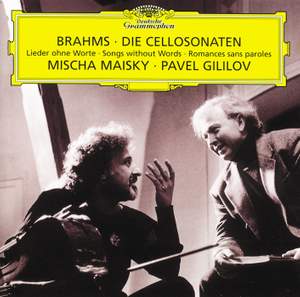
| |  | Brahms - Cello Sonatas
| | | Usually despatched in 8 - 10 working days. |
|
|
| |
|