All recordingsPrices shown exclude VAT. (UK tax is not payable for deliveries to United States.) See Terms & Conditions for p&p rates. | |  | Brahms: String Quartet No. 3
On Thursday, November 1st, 2012, after performing the entire corpus of Beethoven's String Quartets at the Pays de Fayence String Quartet Festival in the South of France, the Ysaÿe Quartet announced that it was bringing its 30-year career to an end in January 2014. The 14 months ahead are to be devoted a major series of concerts, with a special emphasis on the music of Beethoven. Founded in 1984 by a group of students at the Paris Conservatoire, the Quartet took its name from Eugène Ysaÿe (1858-1931), a violinist, chamber musician and composer whose influence is still felt today. From the start and more especially after winning First Prize at the prestigious Evian String Quartet Competition in 1988, the Ysaÿe Quartet has stood at the pinnacle of the international chamber music scene, on a par with such legendary formations as the LaSalle and Amadeus Quartets that provided an inspiration for its work. It has brought an open-minded, committed and unfussy approach, characteristic of great playing, to a wide range of repertoires, from Haydn, Mozart and Beethoven to contemporary composers, who have often written specially for it, such as Boucourechliev, Dusapin, Tanguy, Krawczyk, Escaich, Fraisse or Cerha. At the same time, teaching commitments have long been a central part of the Quartet's activities. In 1993, Miguel da Silva persuaded his colleagues to join him in setting up a specific String Quartet course at the Paris National Conservatoire (now the Paris Regional Conservatoire). This was a national first. Ysaÿe's students, both French (Psophos, Ebène, Modigliani, Voce, Hermès, Girard, Zaïde and Varèse) and international (Aviv of Israel, Incanto of Switzerland, Difference of Latvia) have won major awards around the world. Today, alongside alto player and founder member, Miguel da Silva, Ysaÿe consists of violinists Guillaume Sutre and Luc-Marie Aguera and cello player Yovan Markovitch. The Ysaÿe Quartet's recordings have won innumerable French and international awards. “A warmly played coupling of two Viennese classics” The Strad, March 2013 “Quatuor Ysaÿe have always had personality in spades. Their own particular brand of French elegance (which occsaionally borders on an engaging purist dourness, depending on how far they have strayed from the native repertoire at which they excel so highly) is unmistakable” Gramophone Magazine, April 2013 “the Quatuor Ysaÿe is an ardent, highly trained ensemble with a slightly febrile edge to its style that some listeners may feel override the more mellow moments of Brahms's least stressful String Quartet...the augmented Ysaÿe Quartet sound more in their element in the expansive paragraphs and ecstatic climaxes of Verklärte Nacht.” BBC Music Magazine, May 2013 **** | 
| | | In stock - usually despatched within 1 working day. |
|
|
| |  | Borodin Quartet play Schubert & BrahmsCité de la Musique, Paris, 16 January 2010
Described as ‘the quartet world’s most senior ensemble’, the Borodin Quartet is one of the great quartets of our time. The quartet celebrated its 65th anniversary with a sold-out concert at the Wigmore Hall, in London, a week before this live recording from the Cité de la Musique. Following the performance the Financial Times wrote that ‘today’s Borodin Quartet has lost nothing of its old authority’. The Telegraph named this anniversary concert at the Wigmore Hall as their best chamber moment of 2010, stating that the quartet ‘proved that decades of experience really count’. The Sunday Telegraph wrote ‘the Borodin Quartet plays with uncommonly rich, even tone and consoling warmth. For sheer musical presence, it has few equals.’ The quartet has stayed true to its roots, retaining its unique sound and style of playing over the years. The quartet’s recording of the Brahms quartets on Warners is described in the Penguin Guide as ‘Marvellously sophisticated playing.’ This is the first DVD release of this material. 1DVD Sound format: LPCM stereo Picture format: 4:3 Running time: 95’ Subtitles: n/a Menu languages: English Booklet languages: E/F/G Region code: 0 Territory Restrictions: None | | | In stock - usually despatched within 1 working day. |
|
|
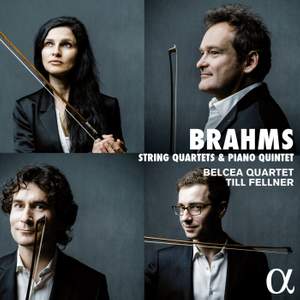
| | Brahms: String Quartets & Piano Quintet
| | | In stock - usually despatched within 1 working day. |
|
|
| |  | Brahms: Complete String Quartets & Clarinet Quintet
Brahms’ standing among the world’s greatest classical composers is confirmed by his inclusion, together with Bach and Beethoven, in the ‘Three Bs’ triumvirate. A leading figure of the Romantic period who excelled in almost every form, he was particularly renowned for his contributions to chamber music; this release details four such examples, all expertly performed by the Juilliard Quartet. As with the symphony, Brahms was very conscious of the tradition that lay behind the genre of the string quartet, and it is said that he spent the better part of a decade working on Op.51. While No.1 is known for its gritty intensity – brilliantly captured in this recording – No.2, which looks back to Beethoven’s Op.18 through its first movement’s impeccable sonata-allegro form, was written along altogether more lyrical lines. The work presents an engaging follow-up to the experimental Third Quartet in Bb major and is wonderfully complemented by the ensuing Clarinet Quintet Op.115. Here a spirit of mellow reflection comes to the fore, providing a perfect ending to a delightful collection. The Juilliard String Quartet is one of the longest establishd chamber ensembles, renowned for the interpretative clarity of a range of repertoire from Beethoven to Elliott Carter, and their account of these works – some of Brahms’ most famous – has been described as ‘the stuff of charismatic greatness’. Featuring exemplary playing from clarinettist Neidich, this compilation brims with colour and expression. Recorded in the 1990s. Last year the Juilliard Quartet received a Grammy Award for Lifetime Achievement. | | | Usually despatched in 2 - 3 working days. |
|
|
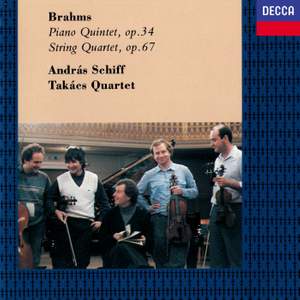
| |  | Brahms - String Quartets Nos. 1 & 3
New recordings by the Takács Quartet on Hyperion have become important landmarks in the musical calendar. This second disc of Brahms string quartets looks set to repeat all the commercial and critical success of their first. It took twenty years for the famously self-critical Brahms to release his Op 51 string quartets for publication. Despite frequent requests, they were held back until they had reached his requisite standard of perfection. It is clear that Brahms’s struggle with the string quartet medium eventually led him to find an intensely personal language for it, with an unmistakable originality of melody and texture. Op 51 No 1 is both suffused with great musical richness and organically unified, with each idea growing with unerring logic out of the last in a process of continual development, and the main subject of each movement clearly arising out of the same germ. Having hesitated so long over his first two string quartets, Brahms managed to produce their successor, Op 67, without any protracted birth-pangs, and the fact that the new work was dedicated to a well-known physician prompted him to elaborate on the medical analogy. ‘I am’, he told Theodor Wilhelm Engelmann (the husband of the pianist Emma Brandes, and himself a keen amateur cellist) ‘publishing a string quartet, and may need a doctor for it (as with the first ones). This quartet rather resembles your wife—very dainty, but brilliant! … It’s no longer a question of a forceps delivery; but of simply standing by. There’s no cello solo in it, but such a tender viola solo that you may want to change your instrument for its sake!’ “Muscular, austere, tautly argued performances from a close-knit group.” Gramophone Magazine, December 2008 “Their approach is alert, texturally clear and passionate … these are admriable performances which I recommend to any prospective buyer … this new Takács reading weighs in at the top end of the many available versions” BBC Music Magazine “The Takács chart the music’s undulating emotions with a compelling assuredness … playing of radiant warmth and phrasal sensitivity. Andrew Keener and Simon Eadon work wonders in capturing a warm yet articulate ambience for these physically imposing and richly detailed scores. Strongly recommended” International Record Review “Viola to the fore in the third movement, Agitato, of No 3; and Geraldine Walther, firm-toned and assertive, rises to the occasion as the only un-muted instrumentalist here. Agitation isn't consistently maintained though because the Takács Quartet tend to ease the tension in places. Yet there is no slack in the other movements. This close-knit group unanimously stretch or tighten the rhythm, achieving evenly matched dynamics such as the sotto voce sequences in the opening Vivace, the hushed dolce e grazioso in the recapitulation of the Andante and the stilled peace of the G flat sixth variation in the finale. Walther is well in the picture in this movement too whereas elsewhere she appears occasionally to lose focus. Not so in No 1. Her place on the right of the ensemble is firmly assured here. The work is 'commonly held to be representative of Brahms's austerity and asceticism' (Edwin Evans), and these epithets are apposite for the Takács, spare of style and tone. The players' control over the first movement doesn't preclude a range of rubato that serves to sharpen the musical argument. Nor does it preclude a linear drive that knits the six themes of the last movement into a coherent whole, while they do not let up on the melancholy of the middle movements, the third particularly dark. The recording is tonally credible but is widely separated.” Gramophone Classical Music Guide, 2010 “Viola to the fore in the third movement, Agitato, of No 3; and Geraldine Walther, firm-toned and assertive, rises to the occasion as the only un-muted instrumentalist here. Agitation isn't consistently maintained though because the Takács Quartet tend to ease the tension in places. Yet there is no slack in the other movements. This close-knit group unanimously stretch or tighten the rhythm, achieving evenly matched dynamics such as the sotto voce sequences in the opening Vivace, the hushed dolce e grazioso in the recapitulation of the Andante and the stilled peace of the G flat sixth variation in the finale. Walther is well in the picture in this movement too whereas elsewhere she appears occasionally to lose focus. Not so in No 1. Her place on the right of the ensemble is firmly assured here. The work is 'commonly held to be representative of Brahms's austerity and asceticism' (Edwin Evans), and these epithets are apposite for the Takács, spare of style and tone. The players' control over the first movement doesn't preclude a range of rubato that serves to sharpen the musical argument. Nor does it preclude a linear drive that knits the six themes of the last movement into a coherent whole, while they do not let up on the melancholy of the middle movements, the third particularly dark. The recording is tonally credible but is widely separated.” Gramophone Classical Music Guide, 2010 | | | Usually despatched in 2 - 3 working days. |
|
|
| |  | Brahms - String Quartets Nos. 1-3The Auryn Series Vol. XVI
Brahms laboured long and hard over the composition of his string quartets but the effort paid off in abundance with resulting masterpieces of the chamber music repertoire. The Auryn Quartet were formed in 1981.They have an exclusive contract with TACET and have recorded music by Beethoven, Haydn and Britten, receiving many awards and international critical acclaim. | | | Usually despatched in 2 - 3 working days. |
|
|
| |  |
| | | Usually despatched in 3 - 4 working days. |
|
|
| |  | Brahms: Complete String Quartets
“When you have an intelligent, technically almost superhuman ensemble like the Emerson Quartet, playing with obvious feeling for the music, reservations about quartet-style fly out of the window.” BBC Music Magazine “Technical finesse has always been a given with this group, and as ever their playing has a sureness and ease that leaves most ensembles behind. Their reading of the ebullient Third Quartet is particularly fine, with the leader imbuing the ravishing second-movement melody with teasing little portamenti. And in the finale, lyricism is combined with an infectious élan.” Gramophone Magazine, September 2007 BBC Music Magazine
Chamber Choice - June 2007 |
| | | Usually despatched in 2 - 3 working days. |
|
|
| |  |
| | | Usually despatched in 3 - 4 working days. |
|
|
| |  | Brahms - String Quartets Nos. 1-3 (complete)
The reviewer of the opus 51 Quartets in Gramophone in September 1990 commented: “… in the tonal mellowness and bloom of the recording itself, not to mention their own intuitively musical phrasing, their intimate interplay and subtleties of balance, this disc somehow manages to bring home Brahms’s true richness as a quartet composer …”. | | | Usually despatched in 2 - 3 working days. |
|
|
| |
|