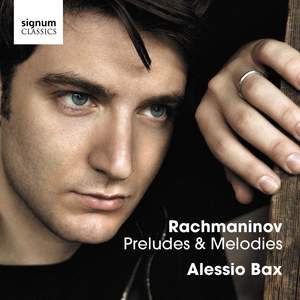
Prices shown exclude VAT. (UK tax is not payable for deliveries to United States.) See Terms & Conditions for p&p rates. | |  | Rachmaninov: Preludes & Melodies
In his second solo recital disc for Signum, this release demonstrates Alessio Bax’s dazzling skill and flair in performance and interpretation – this time with Rachmaninov’s piano works. The programme is centered around the Preludes Op.23, but takes in a broad selection of his other studies, etudes, melodies and transcriptions. Bax describes the programme as being a collection of ‘Visions and Landscapes’. “He writes in the sleeve notes of a long-held desire to record Rachmaninov and [in the Vocalise] you feel he totally understands the composer's unique harmonic world. It's worth acquiring the CD for this track alone.” The Observer, 31st July 2011 “[Bax] has technique to burn but also has the unteachable ability to tug at the heart strings...In the transcriptions, Bax pays particular attention to the intricate weaving of separate voices, and is truly affecting in his own arrangement of Vocalise. This is one of the most intelligent and engrossing Rachmaninov recitals of recent years.” Classic FM Magazine, September 2011 ***** “With this intricate and enterprising recital, the wondrously gifted Alessio Bax fulfils, in his own words, a long-cherished dream...he finds all of the composer's dark-hued melancholy, playing with an impeccable sense of vocal line and with an intense and stylish rubato...if his Op. 23 Preludes lack the classic quality of, say, Lympany or Osborne, his vividness and personality weaven their own intoxicationg spell.” Gramophone Magazine, Awards Issue 2011 | | | Usually despatched in 3 - 4 working days. |
|
|
| |  |
| | | Usually despatched in 2 - 3 working days. |
|
|
| |  | Rachmaninov: Variations on a Theme of Chopin
“The Variations are striking for Biret's sheer capability; not just an impressively robust technical facility, but a vivid and involving reading to match. ...the recorded piano sound is wide and open throughout...the disc represents a rare combination of Rachmaninov's smaller works, and a thoroughly recommendable Chopin Variations” International Record Review, March 2000 | | | Usually despatched in 2 - 3 working days. |
|
|
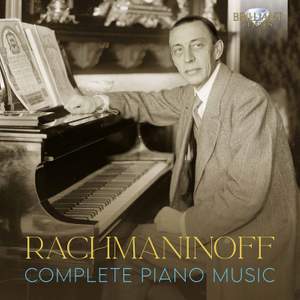
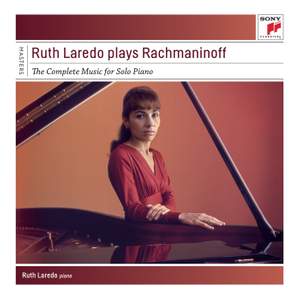
| |  | Rachmaninov - The Complete Solo Piano Music
Rachmaninov: | Morceaux de Fantaisie, Op. 3 Preludes Op. 23 Nos. 1-10 (complete) Morceaux de Salon, Op. 10 Moments Musicaux, Op. 16 Piano Sonata No. 2 in B flat minor, Op. 36 Morceau de fantaisie in G minor (1890) Song without words Piano Piece in D minor Fughetta in F (1899) Fragments Oriental Sketch (1917) Three Nocturnes Four Pieces (?1888) Preludes Op. 32 Nos. 1-13 (complete) Prelude in F major Prelude in D minor Op. post. (1917) Études-Tableaux, Op. 33 Etudes-Tableaux, Op. 39 Piano Sonata No. 1 in D minor, Op. 28 Piano Sonata No. 2 in B flat minor, Op. 36 Variations on a theme of Chopin, Op. 22 Variations on a theme of Corelli, Op. 42 Melodie in E Major, Op. 3 No. 3 |
'A significant testimony to Howard Shelley's artistry. Pianistically impeccable, he understands what Rachmaninov was about' (Gramophone) “This Hyperion set is a significant testament to Howard Shelley's artistry. Pianistically impeccable, he understands what Rachmaninov was about. The original piano works span 45 years of the composer's life. The earliest pieces here, the Nocturnes, strangely owe allegiance neither to Field nor Chopin, but are very much in the mid- to late 19th-century Russian salon style. The Third, in C minor, has nothing whatever to do with its title. Nicely written too, but still uncharacteristic, are four pieces from 1888, which amply demonstrate that from his early teens the composer had something individual to say. The Mélodie in E major is memorable for its hypnotic use of piano tone. Hyperion's recording quality can be heard at its very best here; there's real bloom and colour. Written shortly after his First Piano Concerto in the early 1890s, the Morceaux de fantaisie, Op 3 bring us to familiar Rachmaninov. The ubiquitous Prelude in C sharp minor is the second number but Shelley tries to do too much with it; he's more effective in the Sérénade with its Spanish overtones. In the E flat minor Moment musical, Op-16 one feels that he's able to master Rachmaninov's swirling accompaniments idiomatically. In Variation No 15 of the Variations on a Theme of Chopin he succeeds in bringing the notes to life, getting his fingers around the fleet scherzando writing. The first set of Preludes is mainstream repertoire. In the warmly expressive D-major Prelude he lends the piece a strong Brahmsian feel and it emerges as very well focused. He transforms the C minor into a restless mood picture. The First Sonata is often dismissed as being unwieldy but Shelley gives it a symphonic stature and allows it to be seen in conjunction more with the composer's orchestral writing. Shortly after the Third Concerto Rachmaninov wrote the Op 32 Preludes. Shelley conjures up an exquisite moonlit scene for the G major, but he's not as impressive in the B minor. However, with him it's always the music that dictates the course of the interpretation. In the two sets of Etudes-tableaux he excels, as he does too in the Second Sonata. He draws together the disparate elements of the finale with terrific mastery and is the equal of the 'Horowitz clones' for technique. In the Corelli Variations he's not quite in tune with the scope of the work but is outstanding in the transcriptions, if a little straight-faced. The recorded sound is never less than serviceable and is sometimes excellent.” Gramophone Classical Music Guide, 2010 | | | Usually despatched in 2 - 3 working days. |
|
|
| |
|