Prices shown exclude VAT. (UK tax is not payable for deliveries to United States.) See Terms & Conditions for p&p rates. | |  | Cecus: Alexander Agricola and his contemporariesRecorded in Duisburg (Belgium) in February 2010
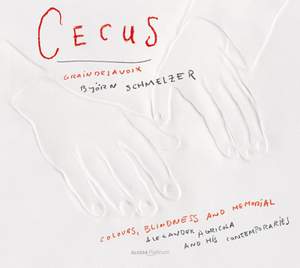
To complete a triptych of recordings presenting an alternative view of performance practice from across a century of Franco-Flemish polyphony, Björn Schmelzer and Graindelavoix now turn their attention to music by Alexander Agricola and his contemporaries in Cecus. Following on from their two earlier albums, Joye and La Magdalene, Cecus concerns itself with music associated with blind players (notably two fiddlers from Bruges) and memory and commemoration (laments on the deaths of Agricola and Johannes Ockeghem) coming from the chapel of Philippe le Beau and Juana of Castile. Alexander Agricola’s own musical world – and especially Cecus non judicat de coloribus [The Blind Do Not Distinguish Colours] – crosses the border between theory and practice, between flamboyant experience and rational construction and constantly evokes blindness in relation to memory and written or improvised music, but also in connection with those songs of mourning. Graindelavoix’s new CD for Glossa promises polyphony in sharply-articulated, richly-coloured performances, provided with athletic vocal gestures by Schmelzer and his Antwerp-based ensemble of musicians from Spain, Estonia, the UK, France and Belgium. “[The Agricola is] the first recording of a piece that looks slight on the page but is moving enough in performance...it's good of Graindelavoix to tackle some fo the famous pieces of the time (Nymphes des bois and Absalon fili mi, whoever wrote it) along with some obscure ones.” Gramophone Magazine, February 2011 | | | (also available to download from $10.50) | Usually despatched in 3 - 4 working days. (Available now to download.) |
|
|
| |  | Dulcis MelancholiaA Musical Biography of Marguerite d'Autriche
Margaret was the daughter of the emperor Maximilian I of Austria and Mary of Burgundy. Music was played daily in her court and she played several instruments. She left a legacy of two songbooks and a book of Basses dances, all preserved in the former Burgundian library, now part of the Belgian Royal Library in Brussels. 500 years on, we can catch an echo of the joys and sorrows in her life. | | | Usually despatched in 2 - 3 working days. |
|
|
| |  | What is our life?Renaissance Laments and Elegies
Cambridge Taverner Choir, Owen Rees Recorded March 1995 at Charterhouse Chapel, Surrey | | | Usually despatched in 2 - 3 working days. |
|
|
| |  | Pierre de la Rue: Portrait musicalMesses, motets, chansons & Magnificat
Pierre de la Rue was one of the most prolific composers of his generation and is thought to have been born in Tournai, a city ruled by France in the fifteenth century and now the main town of the current Belgian province of Hainaut. Little is known about his musical employment but in 1492, he was employed in the chapel of Maximilian, the future Holy Roman Emperor. “For my money, Capilla Flamenca is currently among the top two or three ensembels for early Renaissance polyphony...La Rue is a 'slow burner', and in performances of this quality the music's subtlties will more readily disclose themselves to the attentive listener.” Gramophone Magazine, April 2012 | | | Usually despatched in 2 - 3 working days. |
|
|
| |
|