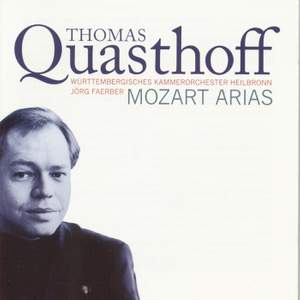
All recordingsPrices shown exclude VAT. (UK tax is not payable for deliveries to United States.) See Terms & Conditions for p&p rates. | |  | Mozart Arias
| | | In stock - usually despatched within 1 working day. |
|
|
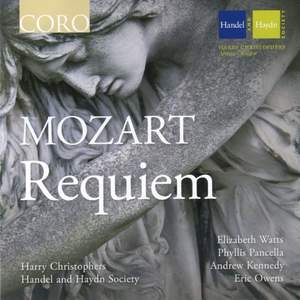
| |  | Mozart: Requiem
Following the success of the Mozart Mass in C minor last year, CORO is delighted to announce the release of its second recording with Harry Christophers and the Handel and Haydn Society. Celebrated soloists Elizabeth Watts, Phyllis Pancella, Andrew Kennedy and Eric Owens joined Harry and the Society to record Mozart’s Requiem live at Boston’s Symphony Hall earlier this year. Mozart’s final moments are reflected through this masterpiece of drama, intensity and depth. The mysterious circumstances surrounding the Requiem’s commission (delivered by a ‘messenger in black’ who refused to reveal the identity of the person who had sent him), and the fact it was left incomplete by a dying Mozart, have ensured a continued fascination with the work. Completed by Mozart’s colleague Süssmayr in 1792, the Requiem is one of Mozart’s most popular and enduring works and one of the most enigmatic pieces of music ever composed. The CD will also feature Mozart’s Ave verum corpus and the first recording on period instruments of his concert aria Per questa bella mano for bass voice and solo double bass obligato—a piece famous for its fiendishly difficult double bass part, performed superbly on this recording by Robert Nairn. “[Owens's] instrument sounds magisterial as it rolls along, matching well with the three remaining soloists. Elizabeth Watts is a luminous soprano. Phyllis Pancella can rely on the almost contralto-like qualities of her mezzo. Andrew Kennedy's strong tenor makes a direct human appeal. The choir, too, is well blended and nicely balanced, negotiating the fast passages with impressive neatness. Orchestral playing is both vivid and disciplined” BBC Music Magazine, December 2011 **** “a tangible excitement and momentum from one movement to the next makes this interpretation far more exciting than many studio recordings...And what a Dies irae this is. Breathless, barely contained, with brisk and extreme changes of dynamics always grabbing you by the hand and dragging you onwards; it is totally compelling...It's the most consistently engaging and propulsive recording of the Requiem I've heard.” Classic FM Magazine, November 2011 ***** “The recording grants welcome clarity to the orchestration, with colle parti trombones particularly audible. Tempi are generally brisk...the performance of [Per questa bella mano] is all one could wish for.” Gramophone Magazine, January 2012 | | | Usually despatched in 2 - 3 working days. |
|
|
| |  | Mozart: Arias
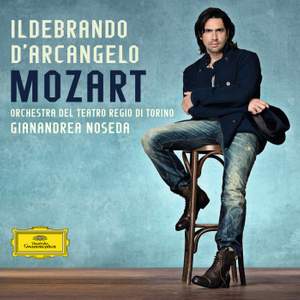
From the outset of his career, bass-baritone Ildebrando D’Arcangelo has been the pre-eminent Mozart man in his Fach. For his all-Italian Mozart album under Gianandrea Noseda, he delivers numbers famous and rare that brim with vocal distinction and interpretive panache. D’Arcangelo’s awesome Don Giovanni (“Champagne Aria”) and uproarious Leporello (“Catalogue Aria”) establish his wide emotional range. Excerpts of his much anticipated Guglielmo in Così fan tutte, which goes public in Paris in 2011 (followed by Vienna and L.A.), and his notable Figaro highlight other facets of D’Arcangelo’s command as a Mozartian. With its unusually prominent writing for the double bass, the concert aria, “Per questa bella mano”, is a composition out of the ordinary; it shows that in addition to being a master of character creation, D’Arcangelo is a master of pure singing. “Ildebrando D’Arcangelo is a complete knock-out as Leporello − charming, funny, sexy. What a difference a native Italian speaker makes in the role”, says The Independent “Ildebrando d’Arcangelo, mellow and secure in tone, forcefully brings the characters and drama alive.” The Telegraph, 17th June 2011 **** “The velvety patina and fierce core strength of the Italian bass-baritone is on show here in a patterning of both popular operatic and rarer concert arias...He shifts from the expression of astonishment to regret, from pride to shame within Leporello's 'Catalogue' aria” BBC Music Magazine, August 2011 *** “D'Arcangelo's savour of text, crucial in Mozart's recitatives, is second to none in this repertoire today...All non-Italian aspirants to Figaro, Leporello and Giovanni should listen to this disc to hear exemplary diction and communication of the text: D'Arcangelo lives the roles precisely because he understands what he is singing and is able to project its meaning so vividly.” International Record Review, July/August 2011 “The sonorous bass-baritone of Ildebrando d'Arcangelo, with its oaken middle register and ringing top notes, is certainly an impressive instrument.” Gramophone Magazine, September 2011 “D'Arcangelo is a rising operatic star with a rich, dark, burnished bass-baritone voice, a flawless technique and an unusually wide vocal range: skills particularly evident in the demanding concert arias. There's plenty of characterisation, too - smooth and seductive in Don Giovanni's 'Deh, vieni alla finestra', knowing in the 'Catalogue' aria - his Leporello is no bumbling servant, but a sly, rather dangerous man who resents his status.” Classic FM Magazine, September 2011 **** | | | Usually despatched in 2 - 3 working days. |
|
|
| |  | JC Bach & Mozart: Concert Arias
Bach, J C: | Ebben si vada...lo ti lascio: Ebben si vada Sventurata, in van mi legno first recording Sentimi, non partir...Al mio bene - Recitativo: Sentimi, non partir | Mozart: | Ah, lo previdi... Ah, l'invola agl'occhi miei, K272 Per questa bella mano, concert aria, K 612 Ch'io mi scordi di te?... Non temer, amato bene, K505 Non più, tutto ascoltai - Non temer, amato bene, K490 |
Hjordis Thebault, Hiroko Kouda (sopranos) & Gustav Belacek (bass) Solamente Naturali, Didier Talpain For the first time complete on CD: substantial, large-scale concert arias, in which a solo instrument plays a counterpart against the voice, a kind of Sinfonia Concertante with an instrument and voice as soloists. Mozart had great respect for the Johann Christian Bach (the youngest son of J.S.) and even in his youth copies and arranged works of him.The influence therefore is obvious. Beautiful period-instrument performance by the Solamente Naturali, Didier Talpain, who already made more and highly acclaimed recordings for Brilliant: Hummel: Mathilde and C.P.E. Bach Hamburg Symphonies. The origin of the dialogue between a solo voice and several obbligati instruments dates from the early baroque period (1600), and probably emerged from the hum drum setting of the market square where a singer would perform to the accompaniment of a few wind instruments. More refined relations of this musical form soon could be found in sacred and operatic works. This CD contains the complete obbligato arias by master and pupil – J.C Bach and Mozart.Therefore we can hear examples of the pre classical (1750-75) and the classical period (1775-1820). There is one undisputed masterpiece here - Mozart’s Ch’io mi scordi di te? K505 for soprano and piano.The aria is an expression of personal sadness. Nancy Storace, the first Susanna in Figaro, had left Mozart and returned to London. This is no operatic love affair gone wrong, but a real life one. Mozart himself is represented by the piano, Nancy by the stunning soprano role. Mozart’s friend and teacher J.C. Bach has a world premiere recording on this CD. His aria Sventura in van mi lagno of 1773 is an impressive virtuoso work for high soprano with two obbligato horns. One the players J.C Bach wrote for was none other than Giovanni Punto, hence the extremely challenging nature of the horn part for a natural horn. | | | Usually despatched in 4 - 5 working days. |
|
|
| |  | Mozart: Concert Arias for Baritone and Orchestra & Overtures
Mozart: | Così fan tutte, K588: Overture Rivolgete a lui lo sguardo (from Così fan tutte) Le nozze di Figaro, K492: Overture Vedro mentr'io sospiro (from Le nozze di Figaro) Don Giovanni, K527: Overture Alcandro, lo confesso - Non so d'onde viene, K294 Mentre ti lascio, K513 Un bacio di mano, K541 Die Zauberflöte, K620: Overture Per questa bella mano, concert aria, K 612 Così dunque tradisci … Aspri rimorsi atroci, K432 Io ti lascio, oh cara, addio, KAnh. 245 |
Klaus Mertens (bass baritone) Capella Weilburgensis, Doris Hagel The nine large-scale Concert Arias for Baritone and Orchestra by Wolfgang Amadeus Mozart date for the most part from the composer’s last creative period. | | | (also available to download from $10.50) | Usually despatched in 2 - 3 working days. (Available now to download.) |
|
|
| |  | Cesare Siepi
The song recital given by Cesare Siepi brings back memories of the legendary production of Don Giovanni staged during the Mozart bicentenary celebrations of 1956. Both as Don Giovanni himself and in his recital programme that same summer, Siepi delighted audiences with his warm bass voice. It was in fact not so much a song recital in the strict sense of the term but more of a highly personal encounter with a great singer who was a declared favourite with the Salzburg Festival's audiences. It is also a prime example of the great evenings of singing with which the Festival was to regale its ecstatic audiences from 1956 onwards. Siepi's programme was chosen to showcase his beautiful voice and cultivated singing but also his artistic versatility. Live Recording 1956. | | | Usually despatched in 3 - 4 working days. |
|
|
| |  | George London 1953
George London (baritone) Orchester des Bayerischen Rundfunks, Hermann Weigert | | | Usually despatched in 2 - 3 working days. |
|
|
| |
|